Your Memory Is Not a Gift You Were Born With—It Is a Skill You Build: Lessons from Moonwalking with Einstein
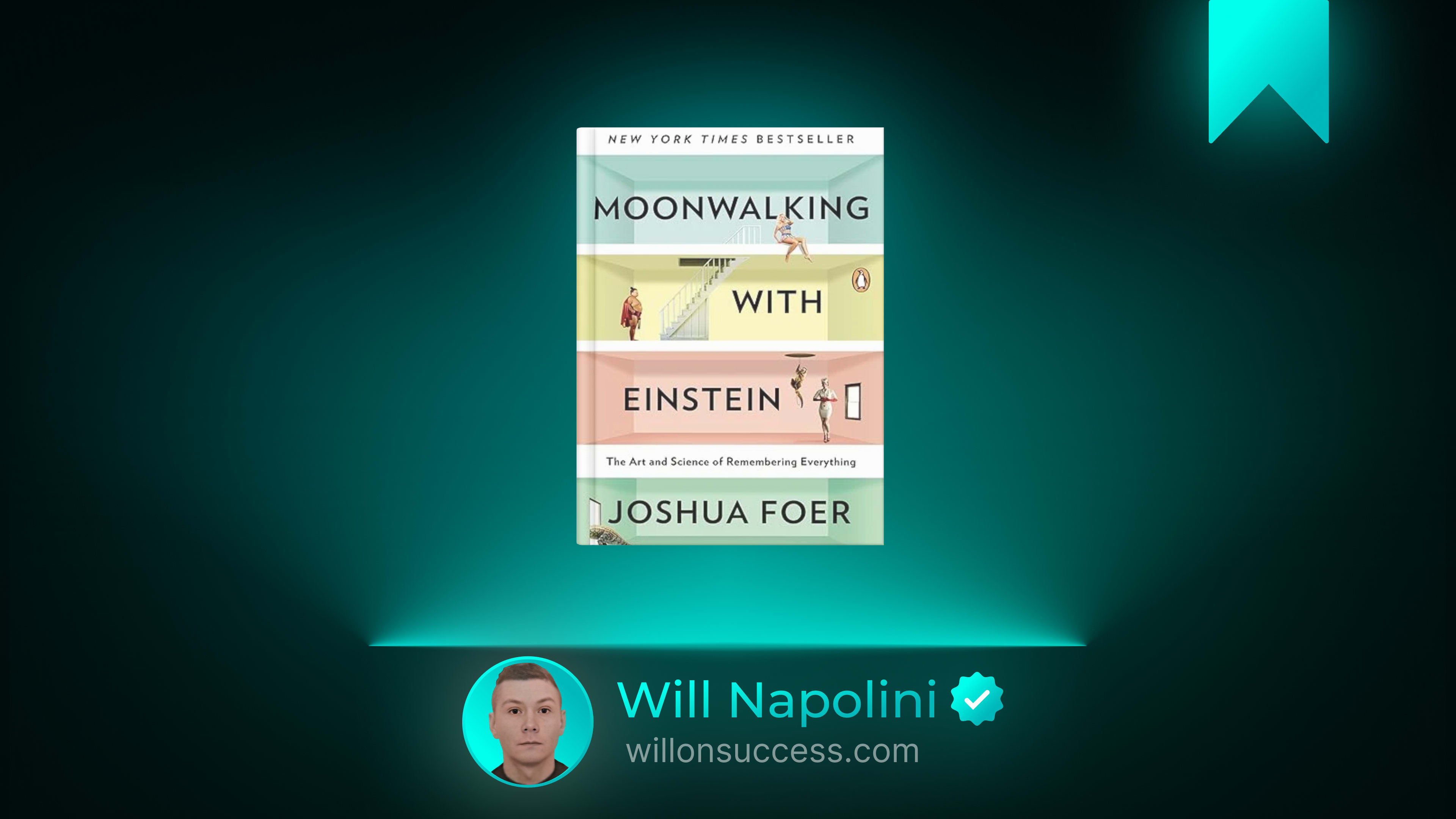
You have probably said it a hundred times. Maybe today. “I have a terrible memory.” You say it the way you might say “I have brown eyes”—as though it were a fixed trait, a genetic hand you were dealt, a ceiling you cannot raise.
I used to believe that too. I believed that some people were simply born with a steel trap between their ears, and the rest of us were stuck with a sieve. That the distance between forgetting a name at a dinner party and reciting the order of a shuffled deck of cards was the distance between two different species of human being.
Then I read Joshua Foer’s Moonwalking with Einstein, and the entire architecture of that belief collapsed.
What if the reason you forget names, lose your keys, and walk into rooms with no idea why you are there has almost nothing to do with the brain you were born with—and almost everything to do with the way you have never been taught to use it?
The Big Idea
Moonwalking with Einstein is, on its surface, the story of a journalist who stumbled into the world of competitive memory and ended up winning the USA Memory Championship. But underneath that story is a radical and deeply hopeful argument:
Extraordinary memory is not a talent. It is a technique.
The people who memorize thousands of digits of pi, or the order of fifty-two shuffled playing cards in under two minutes, do not have structurally different brains from yours. Foer makes this point repeatedly throughout the book. Brain scans of memory athletes show no unusual anatomy. What they have is a method—a set of ancient, trainable strategies that transform abstract, forgettable information into vivid, spatial, unforgettable images.
And because it is a method, it can be learned. Not by geniuses. Not by savants. By anyone willing to practice deliberately for a sustained period of time.
This matters because it changes what you believe is possible for yourself. If memory is a gift, you either have it or you do not, and there is nothing to be done. But if memory is a skill—like playing the piano, like building a cabinet, like learning to swim—then the only question is whether you are willing to practice.
The Journalist Who Became the Champion
The story begins in a gymnasium. Foer, a young science journalist, is covering the USA Memory Championship for a magazine assignment. He expects to find a collection of eccentrics—people with photographic memories or autistic savant abilities. What he finds instead is a group of ordinary-looking people who have trained themselves to perform extraordinary feats using techniques that date back over two thousand years.
One of the competitors, a British memory athlete named Ed Cooke, takes Foer aside and makes a claim that will change the journalist’s life. He tells Foer that anyone can learn to do what these competitors do. That memory is not fixed. That with the right training, Foer himself could compete.
Foer is skeptical. But he is also curious. So he makes a decision that most of us would never make: he commits. For one full year, he trains his memory using the same methods the champions use. He works with Cooke as his coach. He practices daily. He studies the history of mnemonics, interviews neuroscientists, visits amnesia patients, and immerses himself in the strange, dedicated subculture of memory athletes.
And then, one year later, he returns to that same gymnasium. Not as a journalist. As a competitor. And he wins.
I want you to sit with that for a moment. One year. From covering the event to winning it. Not because his brain changed. Because his technique changed. Because he moved from passively receiving information to actively encoding it.
The Memory Palace: A Two-Thousand-Year-Old Secret
The central technique in the book—and the one that has dominated memory training since ancient Greece—is called the Memory Palace, or the Method of Loci.
The idea is beautifully simple. Human beings are terrible at remembering abstract information—numbers, names, lists, playing cards. But we are extraordinarily good at remembering spaces. You can probably walk through your childhood home in your mind right now and recall where every piece of furniture sat. You can remember the layout of your first apartment, the route to your elementary school, the position of the stove in a kitchen you haven’t entered in twenty years.
The Memory Palace exploits this asymmetry. You take a familiar location—your home, your walk to work, the rooms of a building you know well—and you mentally place vivid, bizarre, exaggerated images along a path through that space. When you need to recall the information, you simply “walk” through the palace in your mind and observe the images you left there.
Foer gives a clear example. Suppose you need to remember a grocery list. Instead of repeating “eggs, milk, bread” over and over, you imagine cracking a giant egg on your front porch, pouring a river of milk down your hallway, and watching a loaf of bread sit on your couch wearing sunglasses. The more absurd, the more sensory, the more emotionally charged the image, the more firmly it sticks.
This is not a modern hack. Foer traces the technique back to Simonides of Ceos, a Greek poet who, according to tradition, discovered the principle around the fifth century BCE. For centuries afterward, the art of memory was considered essential training for orators, statesmen, and scholars. Cicero practiced it. Medieval monks used it to memorize entire sermons. It was considered a cornerstone of education.
Then something shifted. The printing press arrived. Books became cheap. Then came notebooks, then photographs, then computers, then smartphones. We no longer needed to carry information inside our heads because we could carry it outside them. The art of memory faded from education. It became a curiosity, a party trick, a competition for enthusiasts.
Foer does not argue that we should abandon external memory. But he does ask a question worth sitting with: In outsourcing our memory to devices, what have we lost? And what might we regain by rebuilding even a small part of that internal capacity?
The Baker/baker Paradox: Why Some Things Stick and Others Vanish
One of the most illuminating concepts in the book is what Foer calls the Baker/baker paradox.
If I tell you a man’s name is Baker, you will likely forget it by tomorrow. But if I tell you a man is a baker—his profession—you will remember that detail far more easily.
Why? Because the word “baker” as a name is isolated. It has no hooks. It floats in your mind unattached to anything else. But the profession “baker” comes wrapped in a web of associations: the smell of bread, the image of an apron, the warmth of an oven, the early morning hours. Your brain has dozens of connection points to grab onto.
This is the principle of elaborative encoding. Information becomes memorable when it is woven into a rich web of associations, images, and meanings. The more connections you build around a piece of information, the harder it becomes to lose.
Foer shows how memory athletes apply this principle systematically. They never try to memorize raw data. They transform it. A number becomes an image. An image becomes a character. A character performs an action in a specific location. Every piece of information is translated into something vivid, spatial, and interconnected.
What I took from this is not just a memory trick. It is a principle about how learning works at every level. You do not remember what you passively encounter. You remember what you actively engage with, reshape, and connect to what you already know.
The OK Plateau: Where Most People Stop Growing
There is a concept in the book that I think about more than any other. Foer calls it the OK Plateau.
When you learn a new skill—driving, typing, playing a song on the guitar—you improve rapidly at first. Then, after a relatively short period, you reach a level of performance that is “OK.” Good enough. Functional. And once you arrive there, you stop improving. You go on autopilot. You drive the same route for twenty years and never become a better driver. You type at the same speed for a decade and never get faster.
This is the OK Plateau. And Foer argues that most of us live on it for most skills in most areas of our lives. We reach “good enough” and then we coast.
Memory athletes do something different. They never let themselves coast. They use what researchers call deliberate practice: they constantly push slightly beyond their current ability, identify specific weaknesses, and design targeted exercises to address them. They do not just repeat what they already know. They stretch toward what they cannot yet do.
This is the difference between practice and mere repetition. Repetition maintains. Deliberate practice develops. And the moment you stop pushing past your comfort zone, growth stops.
I have seen this pattern in every area of life. The writer who writes the same safe article for ten years. The professional who performs the same tasks without seeking new challenges. The person who reads the same genre, eats the same meals, has the same conversations. They are not failing. They are simply comfortable. And comfort, sustained long enough, becomes a ceiling.
Memory and Identity: What We Lose When We Stop Remembering
Foer does not limit the book to technique. In the later chapters, he moves into deeper philosophical territory. He visits patients with severe amnesia—people who cannot form new memories, who live trapped in an eternal present. He reflects on what it means to be a person without a past.
The conclusion he reaches is one I find both sobering and clarifying: we are, in a very real sense, the sum of our memories. Your identity is not a fixed object sitting somewhere in your brain. It is a narrative you construct from the experiences you retain, the lessons you carry, the people you remember loving.
When we stop exercising our memory—when we let every device, every note-taking app, every search engine do the remembering for us—we are not just losing convenience. We are thinning the material from which we build our sense of self. We become people who experience a great deal but retain very little. People who live many days but remember few of them.
This is not an argument against technology. It is an argument for intentionality. For deciding what deserves to live inside you rather than on a server.
Why This Matters on an Ordinary Tuesday
You are not training to memorize a deck of cards. I want to be clear about that. The value of this book is not that you will become a memory athlete.
The value is what changes in your daily life when you understand that memory is trainable.
At work, you stop being the person who says “let me write that down” for every single detail. You begin to hold more context in your mind, to see connections between ideas, to speak in meetings without shuffling through notes. You become more present because you are no longer anxious about forgetting.
In relationships, you remember the stories people tell you. You recall the name of a colleague’s child, the book a friend mentioned three months ago, the worry your partner voiced last week. And that remembering is a form of love. It says: you mattered enough for me to hold onto.
In learning, you stop rereading textbooks passively and start actively encoding. You build associations. You create images. You test yourself instead of merely reviewing. You learn faster, retain longer, and build knowledge that compounds rather than evaporates.
In aging, you give yourself a tool. The fear of cognitive decline is real. But a trained, actively used memory is not the same as a passive one. The principle is simple: what you exercise, you strengthen. What you neglect, you lose.
Practical Application
You do not need a year. You do not need a coach. You can begin today with the simplest version of the technique Foer describes.
Build Your First Memory Palace
Choose a location you know intimately. Your home. Your walk to work. The rooms of your childhood house. Select five specific spots along a path through that location: the front door, the kitchen counter, the bathroom mirror, the bedroom window, the back porch. These are your five “stations.”
Now take five items you need to remember today—errands, talking points for a meeting, ingredients for a recipe. Transform each one into a vivid, absurd, sensory image. Place each image at one of your stations. Make them move. Make them ridiculous. Make them impossible to ignore.
Then, at the end of the day, walk through your palace mentally and see what is waiting for you at each station. You will be surprised how clearly they appear.
Push Past Your Own OK Plateau
Choose one skill you have let settle into “good enough.” Writing. Public speaking. A language. A physical discipline. Identify one specific weakness within that skill. Design a ten-minute exercise that targets only that weakness. Do it every day for two weeks. Do not aim for comfort. Aim for the edge of your ability.
Practice One Act of Elaborative Encoding Daily
The next time you meet someone new, do not just hear their name. Build a hook. If her name is Rivera, imagine a river flowing over her shoulder. If his name is Stone, picture him balancing a smooth grey stone on his palm. Ten seconds of active encoding is worth more than a hundred passive repetitions.
Ask What Deserves to Live Inside You
At the end of each day, choose one moment—a conversation, an observation, a small insight—and deliberately commit it to memory. Replay it. Add sensory detail. Give it a location in your mental landscape. You are not just remembering. You are choosing what your future self gets to carry.
Who Should Read This Book
If you have ever said “I’m just not good at remembering things,” this book will challenge that belief at its foundation. It is especially valuable for students, teachers, lifelong learners, and anyone who feels that information passes through them without sticking.
It will also appeal to anyone interested in the science of expertise—how ordinary people develop extraordinary abilities through structured practice. Foer writes with the curiosity of a journalist and the rigor of someone who has done the research. The book is part memoir, part science writing, part history. It moves quickly and reads easily.
That said, if you are looking for a dense neuroscience textbook or a step-by-step memory course with hundreds of drills, this is not that book. It is a narrative exploration. It introduces the principles and demonstrates them through Foer’s own journey. You will need to supply the practice yourself. And if you are someone who already uses mnemonic systems regularly, you may find the techniques familiar. The book’s deeper value, in that case, lies in its philosophical reflections on what memory means for identity and attention in a distracted age.
One Small Step
Here is what I want you to do before you close this page.
Think of one thing you need to remember tomorrow. A task. A name. An idea for a project. One thing.
Now close your eyes. Picture the front door of your home. See the color of the paint. Feel the texture of the handle. Now take that piece of information and turn it into a single vivid image. Make it strange. Make it funny. Make it impossible. Place that image squarely in the center of your front door, as though it has been waiting there for you all along.
Open your eyes.
Tomorrow, when you walk to that door—physically or in your mind—you will see it waiting. And you will know, in your body, that your memory was never broken. It was simply untrained.
You start with one image. You build one room. You walk the path again tomorrow. And the day after that, the room becomes a hallway, and the hallway becomes a house, and the house becomes a palace. You build it slowly. You build it with intention. And what you build, you will not forget.