The Time You Are Trying to Save Is the Time You Are Losing: Lessons from Michael Ende’s Momo
Look at your calendar. Look at the endless list of tasks you have convinced yourself you must finish before you can finally “relax.”
We treat time like money. We deposit it, we budget it, we try to save it. But I want to ask you a question that has quietly changed the way I live: What if the very act of trying to save time is the reason you feel like you never have enough of it?
There is a dangerous assumption hiding inside the way most of us think about productivity. We believe that efficiency will eventually buy us freedom. We tell ourselves that if we just work fast enough today, we will have time for what matters tomorrow.
Michael Ende, the brilliant German author behind The Neverending Story, addressed this illusion decades before smartphones and burnout became cultural epidemics. In his 1973 novel Momo, he presents a central thesis that feels more urgent today than ever: Time is not a resource you can hoard in a bank. Time is the very fabric of your life. When you try to save it by cutting out the “unproductive” moments—daydreaming, lingering, listening, playing—you do not accumulate more time. You simply kill the time you had.
The Story of the Time Thieves
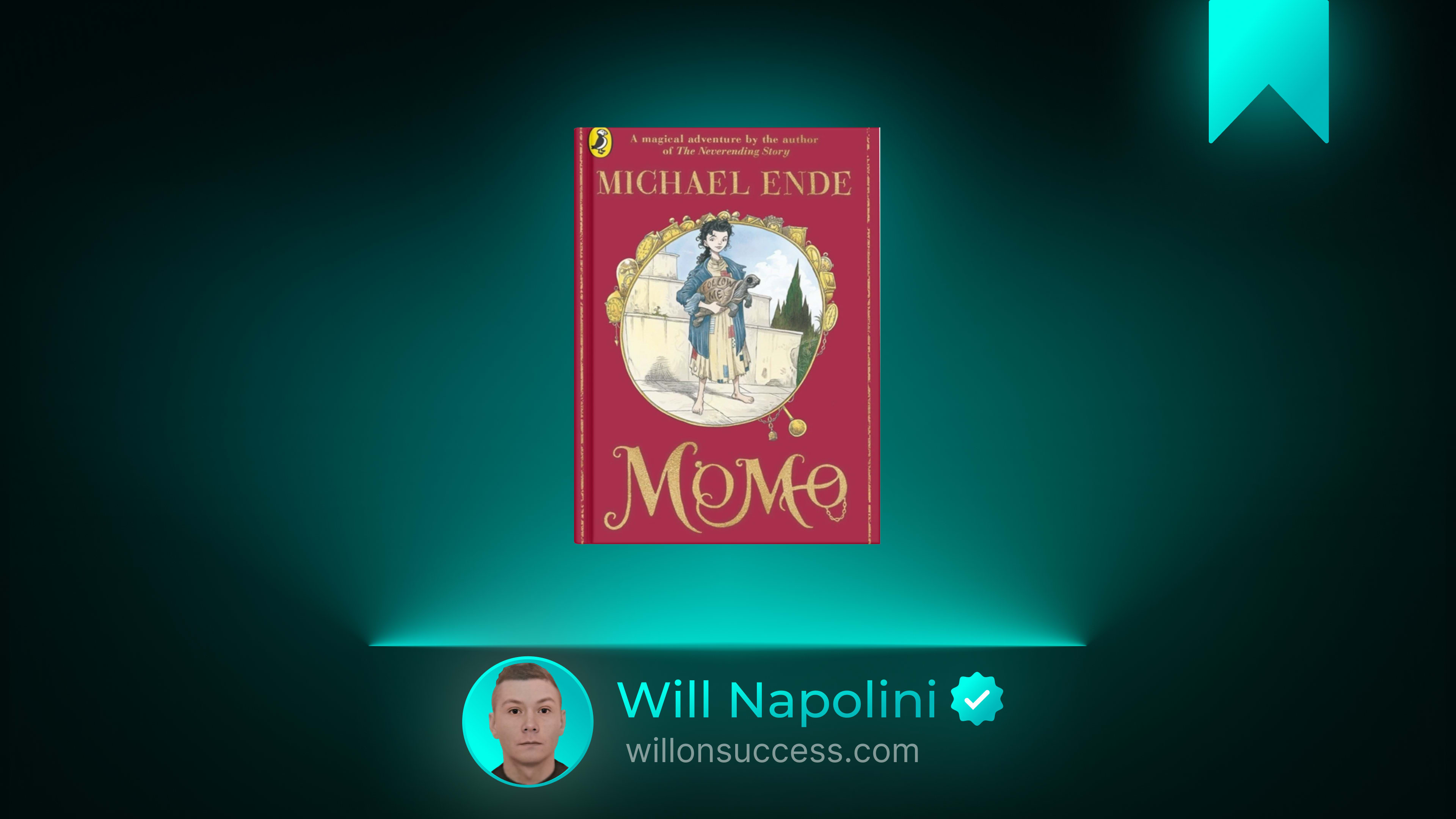
Momo is disguised as a children’s fantasy, but it operates as a profound philosophical fable for adults. The story follows a poor, disheveled orphan girl named Momo who takes up residence in the ruins of an ancient amphitheater on the outskirts of a bustling city.
Momo possesses no magical powers in the traditional sense. Her gift is much simpler and far more rare: she knows how to listen. When people come to her with their worries, their arguments, or their confusion, she simply sits with them. She does not offer quick fixes. She does not check her watch. By simply being fully present, she helps people find their own clarity, resolve their conflicts, and remember who they are.
But the peace of the city is threatened by the arrival of the “Grey Men.” They are smooth-talking representatives of the Time Savings Bank. They approach busy citizens with a seductive pitch: calculate all the time you waste on sleeping, chatting, or enjoying a slow cup of coffee, and deposit it into a savings account. In return, you will earn interest in the form of more time later.
The citizens take the bait. They stop visiting friends. They rush through meals. They eliminate leisure. But as they “save” more time, a strange sickness spreads. People become anxious, irritable, and exhausted. They are always rushing, yet they never arrive. The children, with no adults to play with them, are given expensive, soulless toys that teach them to be efficient rather than imaginative.
Momo sees what the adults cannot. The Grey Men are not saving time; they are stealing it.
To fight them, she is guided by a mysterious sage named Professor Secundus Minutus Hora and his remarkable tortoise, Cassiopeia. Cassiopeia has a unique gift: she can see exactly half an hour into the future. Professor Hora takes Momo to the realm where time is born and reveals the truth. Time is kept in the form of “hour-lilies”—stunning, radiant flowers that bloom in the presence of a lived moment. The Grey Men survive only by freezing these flowers and smoking their dried petals. They cannot create time; they can only consume it.
The Illusion of Saved Time
We live in a culture that equates time with currency. We “spend” it, “waste” it, and “invest” it. But Ende understood that time is closer to a heartbeat than a bank account.
Here is what I would tell you if we were sitting across the table: You cannot save a Tuesday to spend on a Saturday. When you rush through a conversation with your child so you can get back to work, you are not saving that twenty minutes for later. That twenty minutes is gone. It has been turned into a dried petal in a corporate ledger.
The moments we try to bypass in the name of efficiency are often the very moments that make the journey worth taking. When you view your life purely through the lens of efficiency, you begin to view the people around you as obstacles to your productivity. The colleague who asks a question becomes an interruption. The spouse who wants to talk becomes a delay. You become a Grey Man, smoking the dried petals of your own stolen hours, rushing toward a future that never actually arrives.
Deep Listening Is the Ultimate Act of Respect
Momo changed her community not by doing more, but by being fully there.
Today, listening has become a rare commodity. When someone speaks to us, we are usually formulating our reply, checking a notification, or mentally calculating what we need to do next. We offer them the fragmented leftovers of our attention.
But true listening requires a sacrifice of your own internal clock. It requires you to step out of your timeline and enter theirs. When you give someone your undivided attention, you are giving them the most valuable thing you possess: your lived time. You are telling them, without words, that they matter more than your schedule.
That kind of presence builds trust, heals relationships, and fosters deep connection. It is the opposite of hustle. It is an act of profound respect.
The Wisdom of the Next Half Hour
When we look at the entirety of our lives—the career we want to build, the debt we want to pay off, the person we want to become—we often freeze. The mountain is too high. The timeline is too long.
Cassiopeia the tortoise offers a brilliant antidote to modern overwhelm. She cannot see the end of the journey. She can only see thirty minutes ahead.
I have found this to be one of the most practical mental models for navigating difficult seasons. When you are exhausted, do not look at the next ten years. Do not even look at the next month. Just ask yourself: What is the right thing to do in the next thirty minutes?
Maybe it is drinking a glass of water. Maybe it is sending one difficult email. Maybe it is stepping outside to breathe the air. You do not need to solve your entire life today. You only need to navigate the next half hour with integrity and presence. Small steps, taken consistently, will eventually carry you across the continent.
The Grey Men Live Inside Your Head
The most chilling aspect of Ende’s story is that the Grey Men do not use force. They use persuasion. They convince the citizens to police themselves.
You do not need a Time Savings Bank to rob you of your life. You have built one inside your own mind. It is the inner voice that tells you reading a novel is a waste of time. It is the guilt you feel when you sit on a park bench doing absolutely nothing. It is the belief that your worth is directly tied to your output.
The Grey Men represent the relentless drive of modern optimization. They promise that if you just eliminate the “friction” of being human, you will finally be successful. But a life without friction, without pause, and without idle wonder is not a life optimized. It is a life hollowed out.
Why This Matters Now
Look at how we treat our weekends. We often treat them as recovery periods so we can be productive again on Monday, or we pack them with “optimizing” activities. We track our sleep, our steps, and our screen time. We have turned rest into another metric to be managed.
When you view your life purely through the lens of transactions, you begin to ask, “What is the return on investment of this friendship?” or “Is this hobby advancing my career?” This transactional mindset erodes the very foundation of human connection. Momo reminds us that the most valuable things in life—a shared laugh, a quiet walk, a deep conversation—yield absolutely no measurable return on investment. And that is exactly why they are priceless.
When you shift your perspective, everything changes. You realize that the goal of your life is not to reach the end of your to-do list. The goal is to inhabit the hours you have been given.
Practical Application
How do you fight the Grey Men in a world that demands your constant availability? You do not fight them by working harder. You fight them by reclaiming your unproductive moments.
Audit Your “Time Savings” Accounts Look at the areas of your life where you are rushing just to get them over with. Are you speed-reading to your kids? Are you eating lunch at your desk while typing? Choose one of these activities and deliberately slow it down. Do it simply for the sake of doing it.
Practice Momo Listening The next time a friend, partner, or colleague comes to you with a problem, do not offer a solution. Do not look at your phone. Just listen. Let them finish their sentences. Let the silence sit. Watch how the dynamic changes when you stop trying to “fix” them and simply hold space for them.
Schedule “Unscheduled” Time Block out thirty minutes on your calendar this week. Label it “Nothing.” During that time, do not consume content, do not plan, and do not work. Just sit, walk, or stare out a window. Let your mind wander. This is not wasted time; this is where your deepest insights are born.
Who Should Read This Book
Momo is technically categorized as children’s literature, but that is its greatest Trojan horse.
If you are someone who feels chronically behind, who measures your days in checkboxes, and who feels a quiet, persistent exhaustion that sleep cannot cure, this book is for you. It is a balm for the over-optimized soul.
However, if you are looking for a step-by-step productivity system, a morning routine template, or a guide to scaling a business, you will be disappointed. This book offers no hacks. It offers a mirror. It asks you to examine the fundamental philosophy behind your actions, rather than just tweaking the actions themselves.
One Small Step
I want you to take one action today that the Grey Men would hate.
Find a task you normally rush through—making your morning coffee, walking to your car, washing the dishes. Tomorrow, do it half as fast as you usually do. Pay attention to the water, the sound, the temperature, the movement. Do not think about what comes next.
You will quickly realize that you are not losing time. You are finally arriving in it.
We spend so much of our lives trying to build a future where we will finally have the time to live. But the future is just an idea. The only place you can actually breathe, love, and build a meaningful character is right now, in the messy, un-optimizable present.
Stop trying to save your life for later. The time you are looking for is the time you are currently standing in.