Seeing With the Heart: What The Little Prince Teaches Us About a Meaningful Life
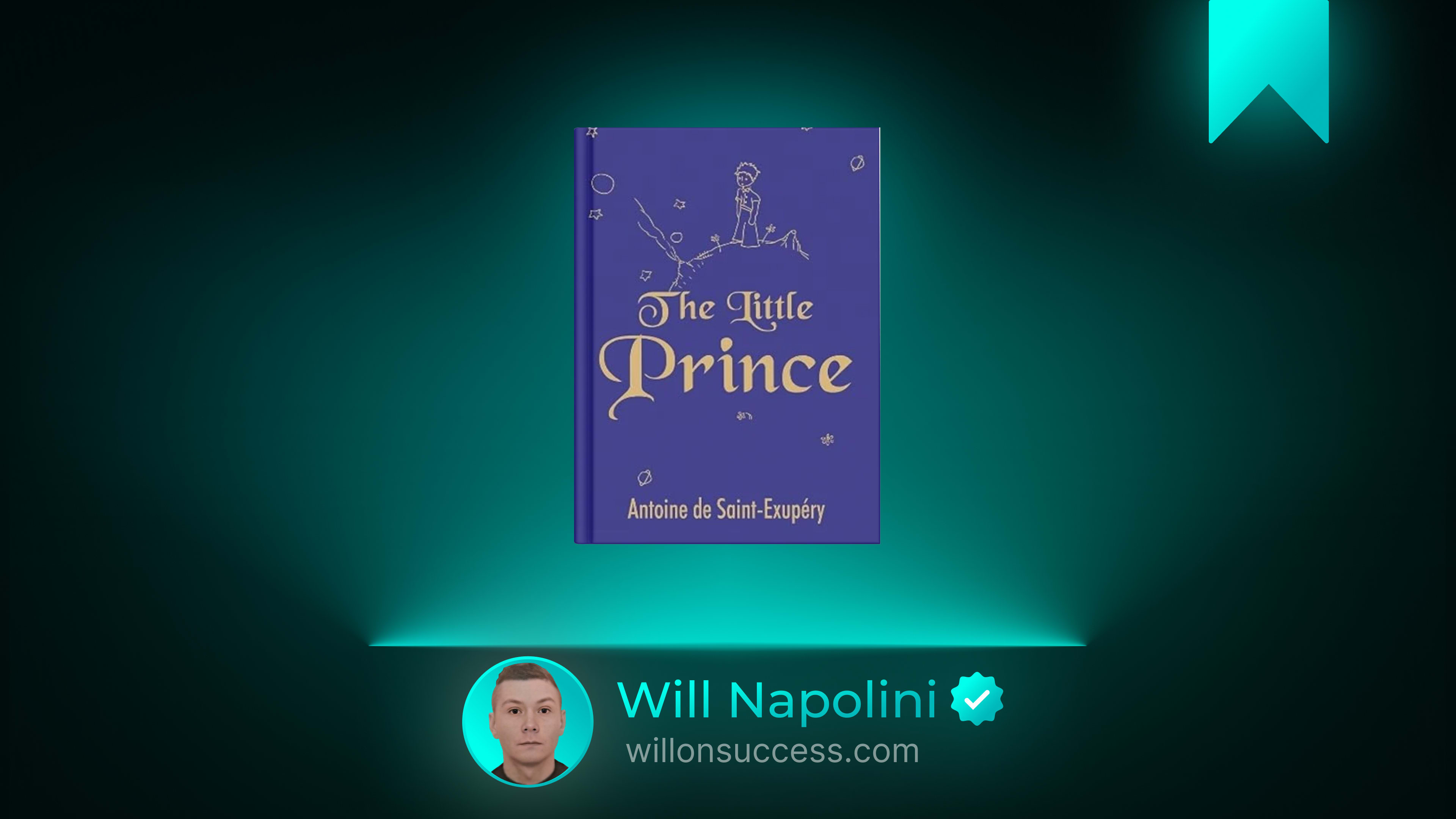
I want to ask you to look at a drawing.
Imagine a simple, somewhat lumpy brown shape on a piece of paper. If I showed it to you, you might glance at it and say, “That is a hat.”
But it is not a hat. It is a boa constrictor digesting an elephant.
When Antoine de Saint-Exupéry showed this drawing to the grown-ups in his life, they all saw a hat. They told him to put away his drawings and focus on geography, grammar, and arithmetic. And so, the child who drew the elephant gave up his art to become a pilot, learning to fly airplanes and navigate by the stars.
I start here because I suspect you know exactly what it feels like to look at a hat when you should be seeing an elephant.
You may be optimizing every hour of your day, tracking every metric, checking off every task on your list, and still lying awake at night wondering why your life feels so strangely empty. You are doing everything the grown-ups told you to do. You are focusing on matters of consequence. But somewhere along the way, the color drained out of the world.
If I could sit across the table from you right now, I would not ask you about your five-year plan. I would ask you when you last looked at the stars and felt anything at all.
The Big Idea
At its core, The Little Prince is not a children’s book. It is a profound, quietly radical manifesto about how to live a meaningful life in a world obsessed with the superficial. Published in 1943 by a French aviator who understood both the beauty of the sky and the fragility of human life, the book centers on a single, devastating truth:
What is essential is invisible to the eye.
We lose our way when we trade deep connection and inner wonder for superficial metrics. We convince ourselves that if we can just measure something—our income, our followers, our productivity—we can control it. But the things that actually give life its weight and its warmth cannot be counted. They can only be felt.
This book is a mirror. It asks you to examine what you are spending your life chasing, and whether you are neglecting the quiet, invisible roots that actually sustain you.
The Story
The narrator of the story is an aviator who crashes his plane in the middle of the Sahara Desert. He is a thousand miles from civilization, with only eight days of drinking water left. He is facing death.
But on the first morning, he is woken by a small, extraordinary voice asking: “If you please—draw me a sheep.”
This is the Little Prince, a boy who hails from a tiny asteroid known as B-612. The Prince has left his home because he is confused by a beautiful, vain, and demanding rose that he loves but does not yet know how to understand. He travels across the universe, visiting neighboring asteroids, each inhabited by a single adult.
He meets a king who commands nothing but the stars. He meets a vain man who only wants to be admired. He meets a drunkard who drinks to forget the shame of drinking. He meets a businessman who counts stars so he can “own” them.
Disillusioned by the narrow, hollow lives of these grown-ups, the Prince finally arrives on Earth. There, he meets a fox, who teaches him the secret of life, and a pilot, who learns how to see again before his water runs out.
It is a story about a journey outward across the universe, which is really a journey inward to the heart.
The Trap of the Grown-Up Mindset
Let’s talk about the businessman.
When the Little Prince arrives on the fourth planet, he meets a man who is so busy he doesn’t even look up when the Prince arrives. The man is counting stars. “Five hundred and one million, six hundred twenty-two thousand, seven hundred thirty-one,” he mutters.
The Prince asks what he is doing. The man explains that he is counting the stars so he can own them. He writes the number on a piece of paper, locks it in a drawer, and goes back to counting. He does not admire the stars. He does not study them. He does not let them make him feel small or connected to the universe. He merely wants to possess the number of them.
I have seen this happen more times than I can count. I have sat with brilliant, hardworking people who have spent their entire lives counting stars.
They count their billable hours. They count their net worth. They count the square footage of their homes and the number of people who validate them online. They lock these numbers in a mental drawer and call it success.
But here is the truth about the grown-up mindset: it confuses measurement with meaning.
You can own a million things and still starve for a single moment of genuine connection. When you reduce your life to a spreadsheet, you strip it of its soul. The businessman thought he was being practical, but he was actually wasting his life on a desert rock, missing the very beauty of the sky above him.
If you are exhausted, it might be because you are trying to digest numbers instead of experiencing the elephant. You are managing your life instead of living it.
The Discipline of Pulling the Baobabs
Before the Prince left his tiny home planet, he had a morning routine. It was not glamorous, and it was not optional. He had to carefully tend to his soil to pull up the shoots of the baobab trees.
Baobabs are massive trees with roots that can dig into the core of a planet. If a baobab is allowed to grow, its roots will eventually tear a small asteroid like B-612 entirely apart. But when they are young, they look exactly like harmless little rosebushes or radishes.
The Prince explains that it is a question of discipline. When you finish your morning toilet, you must carefully tend to the toilet of the planet. You must pull the baobabs the moment you recognize them.
“It is very tedious work,” the Prince admits, “but very easy.”
This is one of the most practical principles of personal development I have ever encountered. The things that destroy our lives rarely happen overnight. They do not arrive as sudden catastrophes. They arrive as tiny, harmless shoots that we ignore because we are too busy or too tired to deal with them.
The unaddressed resentment in your marriage. The slight compromise in your integrity at work. The extra glass of wine you use to numb the stress. The fifteen minutes of scrolling you do to avoid a difficult conversation.
These are your baobabs.
You may think they are small. You may think they don’t matter. But if you leave them unattended, their roots will quietly wrap around the foundation of your life, and one day, they will tear your world apart.
Growth requires the unglamorous, daily discipline of pulling the weeds. You cannot wait until the baobab is a towering crisis to deal with it. You must protect your inner world every single morning. Small actions, repeated consistently, are what keep your planet intact.
The Secret of the Fox: Creating Meaning Through Connection
When the Prince arrives on Earth, he is heartbroken. He had believed his rose was entirely unique in the universe. But he stumbles upon a garden containing five thousand roses, all identical to his own. He throws himself into the grass and weeps. He feels that his treasure is ordinary, and therefore, his life is meaningless.
Then, he meets the fox.
The fox begs the Prince to “tame” him. The Prince doesn’t understand the word. The fox explains: “It means to establish ties.”
The fox explains that right now, they are just a little boy and a fox to each other, entirely interchangeable with a hundred thousand other boys and foxes. But if the Prince tames him, they will need each other. To the fox, the Prince will be unique in all the world.
The fox gives the Prince instructions. He must sit in the grass, a little closer each day, without saying a word. “Words are the source of misunderstandings,” the fox says. He must come at the same time every day, so the fox’s heart can begin to beat faster in anticipation.
This is the mechanism of meaning. Meaning is not something you find hiding under a rock. Meaning is something you forge through the patient, deliberate investment of your time.
We live in an era where we want everything instantly. We want the deep friendship without the long, quiet afternoons. We want the thriving marriage without the difficult, unglamorous conversations. We want the mastery of a craft without the thousand hours of lonely practice.
But the fox teaches us that the value of a thing is entirely dependent on the time we have spent on it.
When you finally tame the fox, something magical happens to your perception. The fox tells the Prince that he will not eat wheat bread, so wheat fields mean nothing to him. But the Prince has hair the color of gold. Once the Prince has tamed him, the golden wheat fields will remind the fox of the Prince, and the wind blowing through the wheat will sound like music.
This is what love and deep commitment do to you. They alter your landscape. They make the ordinary world shimmer with hidden significance. You do not find meaning in the world; you weave it through the time you willingly give away.
The Uniqueness of the Rose
Armed with the fox’s secret, the Prince returns to the garden of five thousand roses. He looks at them and realizes they are beautiful, but they are empty.
He tells them: “You are beautiful, but you are empty. No one could die for you. To be sure, an ordinary passerby would think that my rose looked just like you. But in herself alone she is more important than all the hundreds of you other roses: because it is she that I have watered; because it is she that I have put under the glass globe; because it is she that I have sheltered behind the screen; because it is for her that I have killed the caterpillars… because she is my rose.”
Here is the great illusion of our modern lives: the belief that there is a perfect partner, a perfect career, or a perfect life out there waiting to be discovered. We treat our commitments like consumer goods. If the rose loses a few petals, if she becomes difficult or demanding, we assume we made the wrong choice. We think we should trade her in for a newer model.
But the Prince’s realization flips the script entirely. His rose was not intrinsically the most important flower in the universe. She became the most important flower in the universe because of what he did for her.
Character and meaning are built through responsibility. “You become responsible, forever, for what you have tamed,” the fox tells him.
When you commit to a person, a project, or a community, you are making a vow to water them, to protect them from the harsh winds, and to listen to their complaints—even when they are vain or difficult. It is your investment that creates the value. The grass is not greener on the other side. The grass is greener where you water it.
Why It Matters
Why does a story about a boy, a fox, and a flower matter to you today?
Because you are likely living in a desert.
The Sahara Desert in the book is a metaphor for the spiritual landscape of the modern adult. It is vast, it is lonely, and it is easy to die of thirst without realizing it. You can be surrounded by people, connected to millions through a screen, and still be wandering in a desert of your own making.
We have built a world that is incredibly efficient at counting stars and incredibly poor at taming foxes. We have optimized our logistics, but we have forgotten our rituals. We have cured many diseases, but we are suffering from an epidemic of loneliness and quiet despair.
When the pilot and the Prince are finally dying of thirst in the desert, they set out to find a well. The pilot is exhausted, carrying the heavy, sleeping child. As dawn breaks, the pilot looks at the moonlit sand and realizes why he loves the desert so much.
“What makes the desert beautiful,” the Prince whispers, “is that somewhere it hides a well.”
What makes your life beautiful is not the visible accumulation of your achievements. It is the hidden well. It is the deep, unseen reserves of love, purpose, and connection that you have cultivated in the quiet moments. When the crises come—and they will come—you cannot drink your bank account. You cannot find comfort in your job title. You can only draw water from the well you have spent years digging in the private chambers of your heart.
Practical Application
Understanding this philosophy is beautiful, but understanding without action changes nothing. How do you bring the wisdom of B-612 to an ordinary Tuesday?
1. Audit Your Stars
Take ten minutes this week to look at how you measure your life. What numbers are you obsessing over? Are they serving your soul, or are they just keeping you busy? Choose one metric you normally track—perhaps your daily step count, your social media engagement, or your revenue—and deliberately ignore it for three days. Replace that tracking time with a walk outside where you do nothing but look at the sky.
2. Pull One Baobab
Identify one small, negative habit or unresolved issue that you have been ignoring. It might be a difficult email you need to send, a small apology you owe a friend, or a cluttered drawer that causes you daily stress. Do not wait for motivation. Address it tomorrow morning before you open your phone. Pull the weed while it is small.
3. Tame Someone
Choose one person in your life—a partner, a child, a friend, or a colleague. Commit to spending twenty minutes with them this week without any agenda. Put your phone in another room. Do not try to solve their problems, optimize their schedule, or teach them a lesson. Just sit in the grass with them. Listen. Let the time do its work.
Who Should Read This Book
If you are feeling burnt out by the relentless optimization of modern life, this book will feel like a cool drink of water. It is essential reading for parents who want to remember how to speak to their children, for leaders who want to lead with humanity, and for anyone who suspects they have been looking at hats for far too long.
However, if you are looking for a rigid, step-by-step framework to double your income in thirty days, you will be disappointed. This book does not offer hacks. It offers a mirror. It requires a willingness to be vulnerable, to admit that you might have been wrong about what matters, and to accept the risk that comes with loving things that can be lost. As the fox warns, “You run the risk of weeping a little, if you let yourself be tamed.” But it is a risk worth taking.
One Small Step
You do not need to overhaul your entire life today. You just need to change how you see the world in front of you.
Tonight, before you go to sleep, look at someone you love, or think of a project you deeply care about. Remind yourself of the time you have invested in them. Look past the surface, past the flaws, past the visible reality. Remind yourself: What is essential is invisible to the eye.
Then, do one small, unmeasurable thing just for them.
We spend so much of our lives trying to become important to the world, forgetting that the world only becomes important to us through the quiet ties we forge in the dark. You are not a machine built for output. You are a gardener, tending to a fragile, beautiful planet.
Protect your soil. Water your rose. Look up at the stars and listen to them laugh.
The journey back to yourself is not a matter of traveling farther; it is simply a matter of finally opening your eyes.