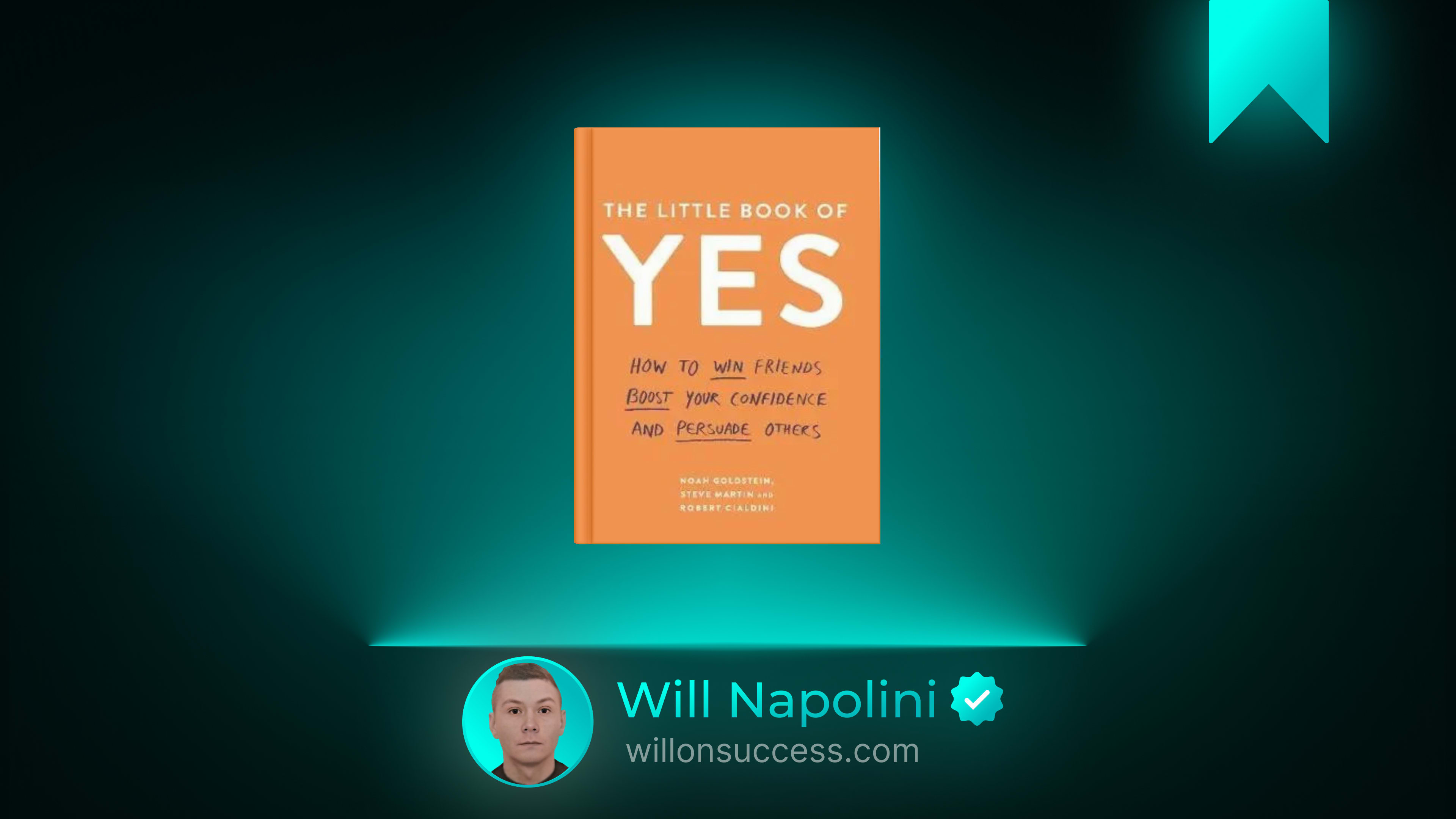
The Little Book of Yes by Goldstein, Martin, and Cialdini: The Quiet Science of Persuasion
Have you ever presented a brilliant idea in a meeting, only to watch it die in polite silence? Have you ever asked for a favor you knew was entirely reasonable, only to be met with a vague “let me think about it” that eventually turned into a “no”?
We tend to assume that getting a “yes” requires a certain kind of personality. We think we need to be louder, more charismatic, or more aggressive. For a long time, the prevailing wisdom suggested that influence was a mystical gift reserved for the extroverted few. If you did not naturally possess it, you were told to simply work harder, argue louder, or push your way through.
What I have learned through years of studying human behavior, and what the science of behavioral psychology confirms, is profoundly encouraging. Persuasion is rarely a battle of logic or a contest of willpower. It is a dance with human nature. And like any dance, there are steps. If you know the steps, the movement feels natural. If you do not, you end up stepping on toes and wondering why the music stopped.
The Big Idea: Context Over Charisma
In their concise and powerful book, The Little Book of Yes, Noah Goldstein, Steve Martin, and Robert Cialdini dismantle the myth that influence requires a magnetic personality. The authors, building on decades of behavioral science and Cialdini’s foundational research on influence, argue something that changes everything about how we approach our daily interactions: persuasion is not about changing people. It is about changing the context in which you ask them to change.
The book distills years of research into 21 short, highly actionable essays outlining specific, scientifically proven strategies to increase the chances that someone will agree to your request. The central thesis rests on a fundamental truth about the human brain: we are not purely rational calculators. We are busy, tired, and constantly bombarded with decisions. To survive the sheer volume of daily choices, our brains rely on mental shortcuts, or heuristics.
If you understand these shortcuts, you can align your requests with the natural flow of human psychology, rather than swimming upstream against it. You do not need to change your personality to become more persuasive. You only need to change the context.
The Story: The Power of a Single Word
To understand how deeply our brains rely on these shortcuts, let me take you back to a classic experiment that perfectly illustrates the architecture of agreement. In the 1970s, a Harvard psychologist named Ellen Langer sent her research assistants to cut in front of innocent people waiting in line at a library photocopier.
In the first scenario, the assistant simply asked, “Excuse me, I have five pages. May I use the Xerox machine?” Without any reason provided, about 60 percent of people let the researcher skip the line.
In the second scenario, the assistant added a genuine reason: “May I use the Xerox machine because I’m in a rush?” Compliance predictably jumped to 94 percent. Being in a rush is a valid justification, and people responded to it.
But here is where the magic of human psychology reveals itself. In the third variation, the assistant said, “May I use the Xerox machine because I have to make copies?”
This is not a reason at all. It is a tautology. Everyone in line has to make copies; it is the only reason anyone waits for a photocopier. Yet, compliance still skyrocketed to 93 percent.
Why does an empty reason perform almost as well as a real one? Because the human brain is wired to respond to the structure of justification. The word “because” acts as a psychological trigger. It signals that a reason is coming, and our brains, eager to conserve energy, often accept the structure of the request without scrutinizing the substance. People do not resist requests; they resist the friction of the unknown. When you provide a “because,” you remove the friction.
The Major Principles of Agreement
Goldstein, Martin, and Cialdini outline several core principles that govern how we say yes. Here are the most vital ones, translated from the laboratory into the reality of your daily life.
The Architecture of Justification
As the copy machine study demonstrates, the human mind craves a framework. We are deeply uncomfortable with arbitrary demands. When you ask someone to do something—whether it is asking a colleague to adopt a new software, asking your teenager to clean the garage, or asking a client to sign a contract—you are asking them to expend energy.
If you do not provide an architectural support for that request, their brain instinctively pushes back to conserve resources.
This is not about manipulation; it is about respect. Providing a reason shows that you respect the other person’s autonomy enough to explain why their time or effort is required. Even if the reason is simple, the structure signals that you are not acting arbitrarily. You are inviting them into your logic.
The Gravity of the Group
Imagine you are staying in a hotel. You see a card on the towel rack asking you to reuse your towels to help save the environment. You might read it, nod, and still toss the towel on the floor. But what if the card said, “75 percent of guests who stayed in this specific room reused their towels”?
This is the power of social proof, and more specifically, the power of proximity. We look to others to guide our behavior, especially when we are uncertain. But we do not look to just anyone. We look to people who are most like us, or who have navigated our exact situation.
When the researchers tested this in actual hotels, they found that referencing the behavior of guests who had stayed in that exact room dramatically increased towel reuse compared to a generic environmental plea. The closer the reference group is to the person you are persuading, the heavier the gravitational pull toward a “yes.” We orbit the behavior of our peers.
The Asymmetry of Generosity
There is a reason why restaurants that bring you a small mint with the check tend to get higher tips. It is the principle of reciprocity. We are biologically and socially wired to repay debts. But the authors show that the way you give matters just as much as what you give.
In a famous study of restaurant tipping, waiters who brought a single mint with the bill saw tips increase by about 3 percent. When they brought two mints, tips went up by roughly 14 percent. But when the waiter brought one mint, turned to walk away, paused, turned back, and said, “For you nice folks, here’s an extra mint,” tips increased by a staggering 23 percent.
What changed? The monetary value of the candy was negligible. What changed was the perception of personalization and intentionality. The gift felt custom-made for the recipient in that specific moment. A generic favor creates a generic obligation. A thoughtful, highly personalized act of generosity creates a profound desire to say “yes” in return.
The Magnetism of Identity
People are deeply motivated to act in ways that are consistent with how they view themselves, and how they believe their “group” views them. Cialdini refers to this as the principle of unity. We say yes to people we feel a shared identity with.
If you want to persuade someone, look for the shared “we” before you push your “I.” When you frame a request as an expression of a shared identity, saying “no” feels like a betrayal of the self. Saying “yes” becomes an act of loyalty to the group you both belong to. You are no longer two separate entities negotiating a transaction; you are members of the same tribe solving a shared problem.
Why This Matters in a Noisy World
You might be wondering if using these psychological triggers crosses the line into manipulation. It is a fair question, and one that anyone seeking to influence others must wrestle with honestly.
The difference between manipulation and persuasion lies entirely in intent and transparency. Manipulation uses these psychological triggers to trick people into doing something that harms them and benefits you. Persuasion uses these triggers to help people overcome their natural inertia so they can make a choice that is genuinely good for them, for you, and for the relationship.
We live in an era of profound noise. Your colleagues are drowning in emails. Your children are distracted by screens. Your clients are fatigued by endless pitches. If you rely solely on raw logic, your best ideas will die in the inbox. Understanding the science of “yes” is not about learning how to trick people; it is about learning how to clear the path so your best ideas can actually reach them.
It is about respecting human nature enough to speak its language. When you understand the hidden currents of human decision-making, you stop fighting the river and start navigating it.
Practical Application: Moving from Theory to Tuesday
How do we move this from the pages of a book to the reality of an ordinary Tuesday? Here is how you can apply these principles immediately.
1. Audit Your Requests for the “Because” Look at the last three emails you sent asking for something. Did you just state what you needed, or did you provide the architecture of justification? Rewrite your next request to include a clear, honest “because.” Even if the reason is simple, the structure signals respect. Instead of: “Can you send me the Q3 report by Friday?” Try: “Could you send me the Q3 report by Friday because I need to finalize the board presentation over the weekend?”
2. Personalize Your Reciprocity Think about a colleague or a client you need to build goodwill with. Do not send them a generic gift card or a mass-produced holiday basket. Find out what they are struggling with or what they love, and offer a small, highly specific piece of help. If you read an article that perfectly addresses a problem they mentioned last week, forward it with a note: “Saw this and immediately thought of your challenge with the new supply chain software. Page 4 has a workaround you might like.” The asymmetry of a small, personalized gift yields massive returns in loyalty and cooperation.
3. Curate Your Social Proof The next time you are leading a meeting and trying to get buy-in for a new initiative, stop using abstract, industry-wide statistics. Find one person in the room, or in a closely related department, who has already successfully adopted the behavior. Let them tell the story. Instead of: “Industry leaders are moving to a four-day work week.” Try: “The accounting team down the hall—the people who share our exact daily struggles with end-of-month reporting—switched to a compressed schedule last month and actually reduced errors by 10 percent.” Let the gravity of the peer group do the heavy lifting for you.
4. Anchor the Shared Identity Before you enter a negotiation or a difficult conversation, write down three things you and the other person share. Are you both parents? Are you both engineers who hate seeing good code go to waste? Are you both committed to the long-term survival of the company? Open the conversation by explicitly naming that shared identity. “We both want to make sure this product launches without burning out the development team…” Once the “we” is established, the friction of the negotiation drops significantly.
Who Should Read This Book
The Little Book of Yes is essential reading for anyone whose success depends on moving other people to action. If you are a leader trying to drive change, a salesperson trying to close ethical deals, a parent trying to get your kids to cooperate, or a freelancer trying to win clients, this book will change how you communicate. It is short, punchy, and immediately applicable. It is designed for the trenches of daily human interaction.
It may be less useful if you are looking for deep, philosophical treatises on ethics, or if you are a data scientist looking for complex statistical models of consumer behavior. This is a field guide, not a textbook. Furthermore, if you are looking for aggressive, high-pressure sales tactics, you will not find them here. The authors are committed to ethical influence, not coercion.
One Small Step
I want you to try something very specific today.
Think of one small request you need to make. It could be asking your partner to handle dinner, asking a colleague to review a document, or asking a friend to grab coffee.
When you make the request, consciously use the word “because,” followed by a genuine reason.
“Would you mind picking up dinner tonight because I have a hard stop at six and won’t have time to cook?” “Could you review this one-page brief because I want to make sure the tone is right before I send it to the client?”
Watch what happens. Notice how the resistance drops. Notice how the interaction shifts from a demand to a collaboration.
Persuasion is not about forcing a locked door open. It is about realizing the door was never locked; you just needed to turn the handle the right way. The power of “yes” is already inside the people around you. Your only job is to create the conditions that allow it to step into the light.
Start small. Use the word. Provide the context. And watch the doors begin to open.