To Sell Is Human: Why You're Already a Salesperson (And How to Get Better at It)
Have you ever caught yourself saying, “I could never sell anything”? Maybe you said it while negotiating a salary, asking a friend to help you move, or trying to convince your team to adopt a new process. You said it because the word sell carries a particular weight in our culture. It smells like pressure. Like manipulation. Like someone in a too-tight suit asking you to act now before the deal disappears.
I used to believe that, too. I thought selling was something other people did—loud, aggressive people who thrived on closing deals while I quietly did my work and hoped someone would notice.
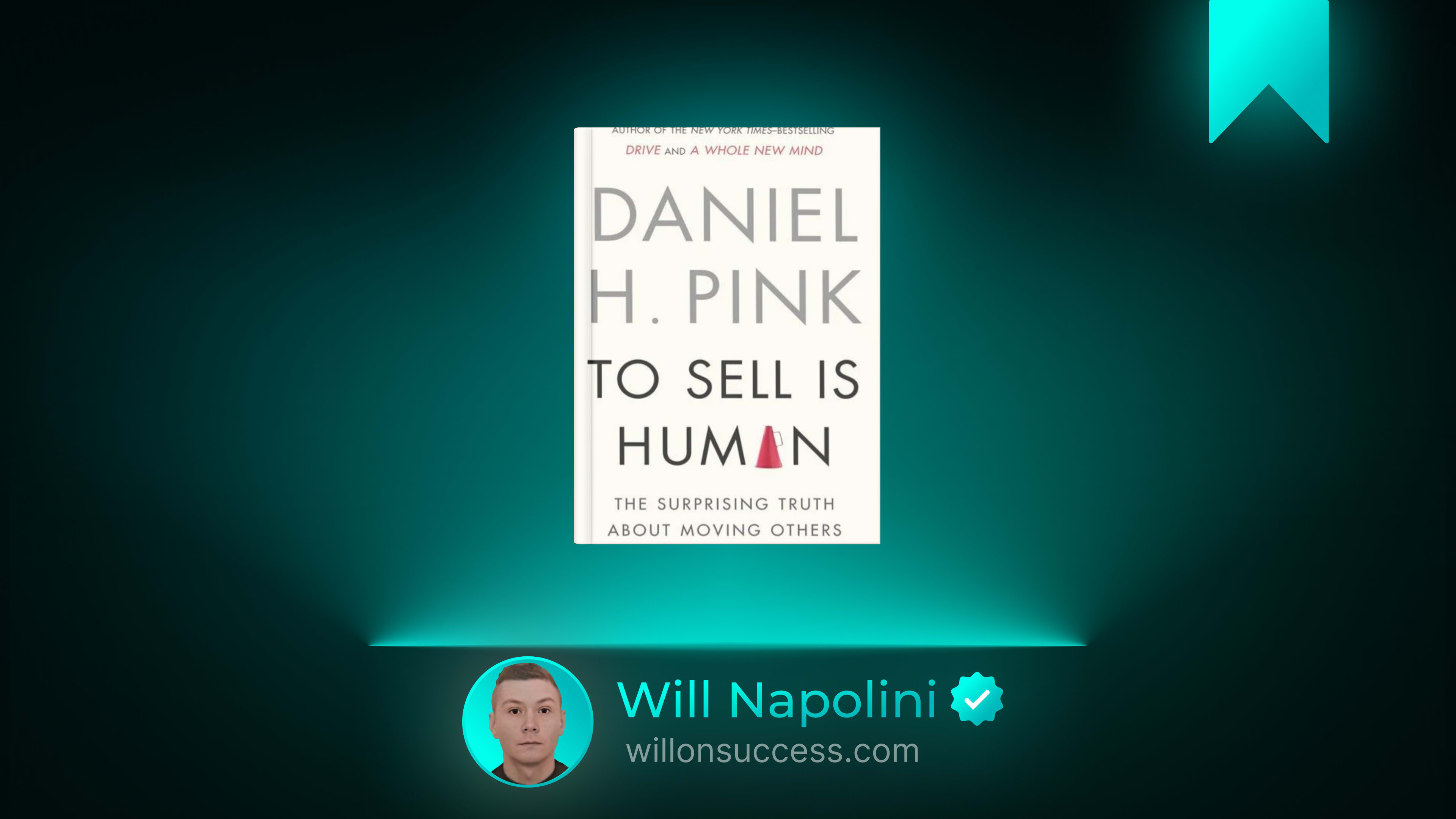
Then I read Daniel Pink’s To Sell Is Human, and something shifted in how I understood nearly every conversation I’d been having for years.
Because here is what Pink makes undeniably clear: you are already selling. You have been selling for a long time. You just never called it that.
The Big Idea: Selling Is Moving Others, and You Do It Every Day
Pink’s central argument is deceptively simple. Roughly one in nine workers in the United States holds a traditional sales job. But the remaining eight? They spend a startling amount of their workweek—around forty percent of it—engaging in what Pink calls non-sales selling. Persuading a colleague to support your project. Convincing a client that your approach is the right one. Getting your teenager to consider a different path. Pitching an idea in a meeting where everyone is checking their phone.
Selling, in Pink’s redefinition, is not about pushing a product onto someone who doesn’t want it. Selling is moving others. It is the act of shifting someone’s perspective, behavior, or decision in a direction that serves both parties.
That redefinition changes everything. Because once you accept that persuasion is woven into the fabric of ordinary work and ordinary relationships, you can stop pretending you don’t need the skill. And you can start developing it honestly, without feeling like you’re compromising your character.
I think that matters more than most people realize. So many capable professionals hold themselves back—not because they lack ideas, but because they cannot move those ideas into other people’s minds. They build something good and then wait to be discovered. And the waiting quietly becomes a career.
The Old Rules Broke: Why “Always Be Closing” No Longer Works
Pink spends meaningful time explaining why the old model of selling has collapsed. For most of the twentieth century, sellers held an enormous advantage: information asymmetry. The car dealer knew the invoice price. The insurance agent understood the policy details. The buyer walked in blind and had to trust.
That era is over. You can compare prices on your phone while standing in a store. You can read reviews, watch demonstrations, and research a service provider’s reputation before ever speaking to a human being. The buyer often walks into the conversation knowing as much as the seller—or more.
Pink frames this as a shift from caveat emptor (let the buyer beware) to caveat venditor (let the seller beware). The power has migrated. And with it, the entire skill set of persuasion must change.
You cannot bullsh your way through a conversation anymore. You cannot rely on scripts and pressure tactics when the person across from you has already done their homework. What works now is different. It is quieter. It is more human.
And that, frankly, is good news for anyone who ever felt uncomfortable with the aggressive stereotype of selling.
The New ABCs: Attunement, Buoyancy, Clarity
Pink replaces the old sales mantra—Always Be Closing—with three principles that actually fit the world we live in now.
Attunement is the ability to step outside your own perspective and genuinely see the situation from the other person’s vantage point. Not performative empathy. Not nodding while you wait for your turn to talk. Actual curiosity about what the other person needs, fears, and values. Pink points to research suggesting that the ability to take another’s perspective is more effective in persuasion than sheer charisma or dominance.
I have watched this play out in rooms where someone is pitching an idea. The person who talks the loudest rarely wins. The person who asks the sharpest question—the one who demonstrates they actually understand the problem from the listener’s side—almost always does.
Buoyancy is the capacity to stay afloat in an ocean of rejection. Pink draws on research around explanatory style—how you explain setbacks to yourself. The person who hears “no” and thinks, “This is permanent, it’s personal, and it’s pervasive,” will sink. The person who treats rejection as temporary, specific, and survivable will keep going. Buoyancy is not toxic positivity. It is the quiet refusal to let one closed door convince you that every door is locked.
Clarity is perhaps the most underrated of the three. In a world drowning in information, the person who can identify the right problem—not just solve an obvious one—becomes extraordinarily valuable. Pink calls this the shift from problem-solving to problem-finding. You are no longer paid merely to answer questions. You are paid to notice which questions matter.
Think about what that means for your Tuesday afternoon. The colleague who walks into a meeting and says, “Here’s the solution” competes with a hundred other voices. The colleague who says, “Wait—I think we’re solving the wrong problem, and here’s what I noticed” changes the direction of the room.
The Pitch Is Not Dead—It Just Grew Up
One of the most practical sections of the book is Pink’s reinvention of the elevator pitch. The old model—thirty seconds of rehearsed monologue designed to overwhelm someone into saying yes—does not survive in a world where attention is scarce and skepticism is high.
Pink outlines several successors. A few worth remembering:
The Question Pitch works because questions invite the listener into the conversation rather than talking at them. Instead of declaring your value, you pose a question that makes the other person lean forward. “What would it look like if your team spent two fewer hours a week on status meetings?” That question does more work than three sentences of self-description.
The Pixar Pitch borrows the narrative structure of a simple story: Once upon a time… Every day… One day… Because of that… Until finally… It works because humans are wired for narrative. We remember stories. We forget bullet points.
The One-Word Pitch forces you to distill your idea into a single concept. If you cannot name it in one word, you may not understand it yet.
What I appreciate about these frameworks is that they are not tricks. They are invitations to think more carefully about what you are actually trying to say and why the other person should care. They replace performance with precision.
Serving Before Selling: The Ethical Core
Here is the part of the book that I think separates it from every other persuasion guide on the shelf. Pink insists—repeatedly, firmly—that effective selling in the modern world must be rooted in service. He uses the term upserving: the principle that the person you are moving should end up better off than before the interaction.
This is not naivety. Pink is not suggesting you become a doormat or that every negotiation is a charity. He is saying something more structural: in a world of transparency and reputation, the seller who serves builds something durable. The seller who manipulates builds a sandcastle at high tide.
I have seen this principle play out in careers, in friendships, in small business relationships. The person who says, “Honestly, I don’t think I’m the right fit for this—let me point you toward someone who is,” earns more long-term trust than the person who takes the money and delivers mediocre work.
Your reputation is a slow construction. Every interaction is a brick. You can build with stone or with straw, but the building takes the same amount of time either way. Choose stone.
Why This Matters on an Ordinary Thursday
Let me bring this down from principle to practice, because that is where ideas either live or die.
You are in a performance review and need to articulate your value. That is selling. You are emailing a potential client and need them to open the attachment. That is selling. You are asking your partner to consider a different approach to a household decision. That is selling. You are trying to get a friend to take their health seriously. That is selling.
If you approach all of these with the old energy—pressure, performance, manipulation—you will feel gross and get poor results. If you approach them with attunement, buoyancy, and clarity, you will feel more like yourself and move people more effectively.
The shift is not from “I can’t sell” to “I will now sell aggressively.” The shift is from denial to skill. From pretending persuasion isn’t part of your life to practicing it with intention and integrity.
What to Actually Do With This
I want to give you something you can use before the day is out. Not a vague aspiration. A specific move.
One experiment for this week: The next time you need to persuade someone—a colleague, a client, a family member—resist the urge to open with your argument. Instead, open with a question that reveals what they care about in this situation. “What would make this work for you?” “What’s your biggest concern about this?” Then listen. Actually listen. Then shape your response around what you heard.
This is attunement in practice. It takes five extra seconds. It changes the entire temperature of the conversation.
One journal question: Think of the last three times you tried to convince someone of something and failed. For each one, ask yourself: Was I solving the problem I thought existed, or the problem they actually had? Write down what you notice.
One habit to build: Before any important conversation this month—meeting, negotiation, request—write one sentence that completes this thought: “The person across from me needs to feel _____ before they can hear what I’m saying.” Then make sure your first words address that need.
Who Should Read This Book
If you are a professional who feels uncomfortable with self-promotion, this book will reframe the entire concept for you. If you are a freelancer, entrepreneur, teacher, manager, or anyone whose work depends on getting other people to say yes to something, Pink gives you a practical vocabulary and a set of tools that respect both your dignity and the other person’s intelligence.
If you are already a seasoned salesperson with decades of closing experience, some of the foundational material may feel familiar. But even then, the sections on problem-finding, buoyancy research, and the new pitch structures offer useful refinements.
The book is not a step-by-step sales manual. It is a persuasive argument (fittingly) that persuasion is a human skill worth developing, wrapped in research, stories, and practical frameworks. Read it as a mindset upgrade more than a tactics handbook, and it will serve you well.
One Small Step Before You Close This Page
Here is what I would ask you to do today. Not tomorrow. Today.
Think of one conversation you have been avoiding because it requires you to persuade someone. A request you have been putting off. An idea you have been sitting on because you are afraid of the “selling” part.
Write down, in two sentences, what you want and why it matters to the other person. Not to you. To them.
Then send the email. Make the call. Ask the question.
You do not need to be a closer. You do not need to be charismatic or loud or aggressive. You need to be clear, curious, and willing to serve the conversation rather than dominate it.
That is enough. That has always been enough.
You were never bad at selling. You were just taught a version of it that was never really yours. The real version—the human version—is the one where you listen first, serve honestly, and trust that clarity is more persuasive than volume.
Go make the call. The person on the other side is waiting to be moved. And you are more ready than you think.