The Pivot Year by Brianna Wiest: How 365 Small Shifts Can Rebuild Your Entire Direction
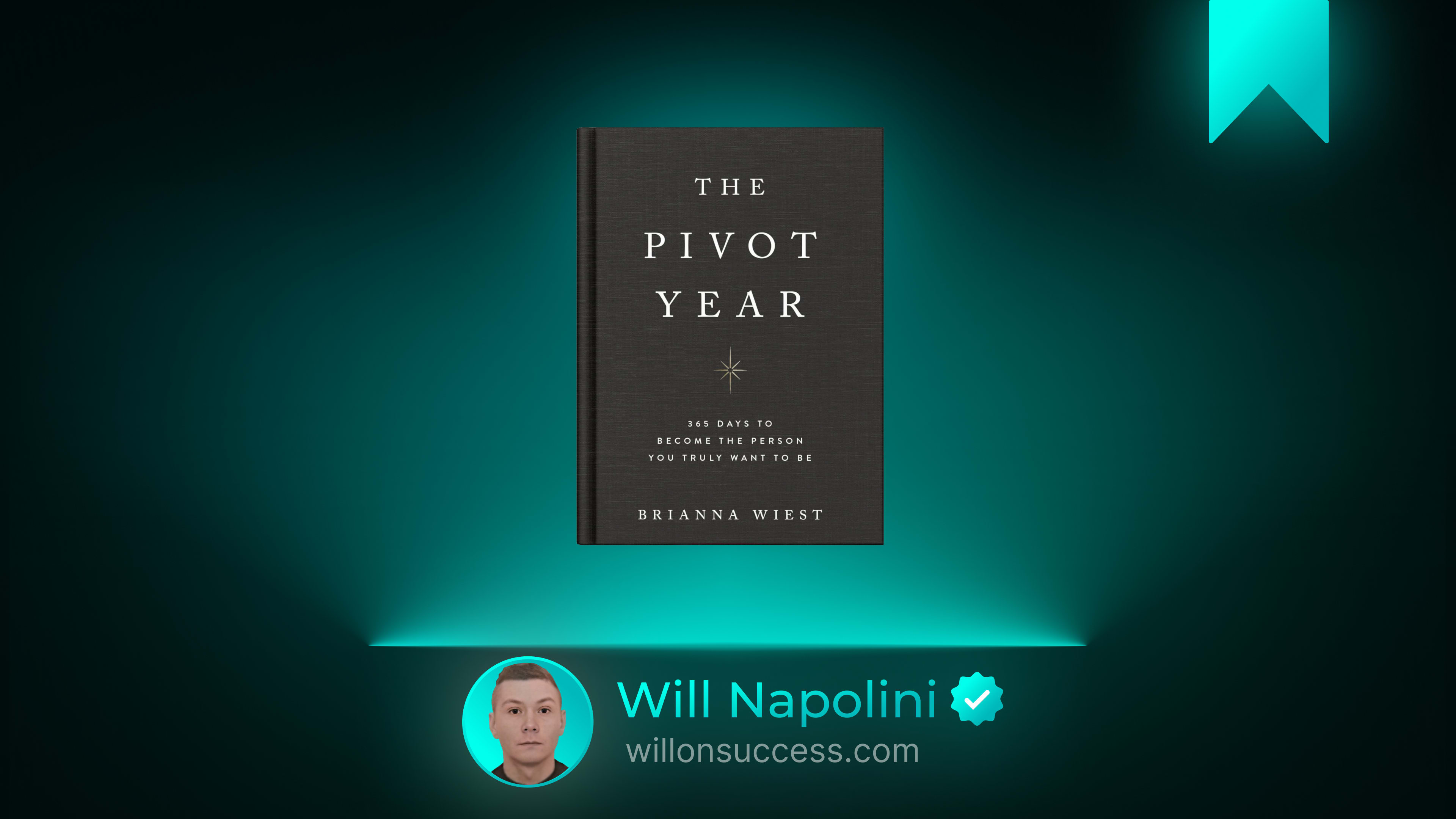
You do not wake up one morning and become a different person. You wake up and make a small choice that, repeated, becomes a direction. And a direction, held long enough, becomes a life.
That is the quiet engine at the heart of Brianna Wiest’s The Pivot Year. Not a thunderclap. Not a single heroic decision. Three hundred and sixty-five small, honest reckonings with yourself, stacked one on top of another, until the person looking back in the mirror is someone you barely recognize from where you started.
If you have been waiting for permission to change your life, or waiting for the right moment, or waiting until you feel ready—this book is, in many ways, an argument that the waiting itself is the problem.
What a “Pivot Year” Actually Means
The word “pivot” has been worn thin by startup culture. It usually means: something failed, so we try something else. Wiest uses it differently, and more personally.
A pivot year, as she frames it, is not about one dramatic career switch or one bold relocation. It is a year in which you stop reinforcing the life you built around old assumptions, old fears, and other people’s expectations, and begin—slowly, imperfectly—constructing something aligned with who you actually are now.
The book is structured as 365 short daily reflections. Each one is only a few paragraphs long. You could read one with your morning coffee. You could read one before bed when the house is quiet and your defenses are lower. The structure itself is part of the teaching: transformation is not a seminar. It is a daily practice of noticing, questioning, and choosing again.
What I appreciate about this approach is its honesty about scale. You do not overhaul your identity in a weekend workshop. You shift it the way a river shifts a canyon—by showing up in the same place, day after day, with just enough pressure to move a grain of sand.
The Life You’re Building May Not Look Like the One You Imagined
One of the most recurring and, I think, most liberating ideas in the book is this: the life that is genuinely yours may look nothing like the blueprint you drew when you were twenty-two, or the one your parents sketched for you, or the one you absorbed from the culture around you.
Wiest returns often to the discomfort of realizing that what you thought you wanted was never really yours. The career you pursued because it sounded impressive. The relationship timeline you followed because everyone else seemed to be following it. The version of success you chased because it was visible, measurable, easy to explain at dinner parties.
Recognizing this is painful. I will not pretend otherwise. There is a particular grief in admitting that you spent years climbing a ladder you never actually wanted to be on. Wiest does not rush past that grief. She sits inside it. She asks you to sit inside it too.
But here is where the book earns its hope: once you see the borrowed blueprint clearly, you can set it down. And once you set it down, you can ask the question that actually matters. Not “What should my life look like?” but “What does my life want to look like, now that I am the one holding the pen?”
That distinction—between should and want, between the inherited plan and the authentic one—runs through nearly every reflection in the book. It is deceptively simple. And it is, for many people, the hardest honest question they will ever answer.
You Cannot Outrun What You Refuse to Feel
A second thread woven throughout the year is the role of unprocessed emotion in keeping us stuck.
Wiest suggests, gently but persistently, that much of what we call “being stuck” is actually avoidance wearing a productive disguise. We stay busy so we do not have to sit with the sadness. We keep optimizing our routines so we do not have to ask whether the routine is pointed in the right direction. We scroll, we plan, we reorganize—anything to avoid the quiet, uncomfortable conversation with ourselves that growth actually requires.
The book does not ask you to become a therapist. It asks something smaller and, in some ways, harder: to stop treating your difficult emotions as interruptions to your life and start treating them as information about your life.
Anger might be telling you a boundary has been crossed. Sadness might be telling you something mattered more than you allowed yourself to admit. Anxiety might be telling you that the path you are on is not the path you need.
You do not have to fix the feeling in the moment. You just have to stop pretending it is not there.
That small act of acknowledgment—I see you, I feel this, I am not going to numb it away tonight—is, according to the logic of this book, where most real pivots begin. Not in the grand decision. In the quiet admission.
Identity Is a Habit, Not a Destiny
Perhaps the most practically useful idea in The Pivot Year is the treatment of identity as something you build through repetition rather than something you discover fully formed.
We tend to talk about “finding ourselves” as though the authentic self is buried under layers of experience, waiting to be excavated intact. Wiest pushes back on that. She suggests, instead, that you are always in the process of becoming. Every small choice—what you pay attention to, what you tolerate, what you practice, what you say yes to and what you finally say no to—is a vote for the person you are constructing.
This reframing matters because it removes the pressure of needing to “figure it all out” before you begin. You do not need a complete vision. You need a direction. You need one honest choice today, and then another tomorrow.
Think of it like building a stone wall. You do not lay the entire wall in one afternoon. You set one stone. You check that it is level. You set another. Step back. Adjust. Set another. For a long time, it looks like nothing more than a low, uneven line of rocks in a field. And then one morning you look up, and there is a wall. Solid. Real. Yours.
Your pivot year works the same way. You will not feel transformed in February. You might not feel it in June. But the daily practice of choosing alignment over autopilot compounds in ways you cannot predict from the inside.
Letting Go Is Not a Single Event
If there is one idea I would want you to carry out of this book and into your ordinary Tuesday, it is this: letting go is not a decision you make once. It is a decision you make every time the old pattern reaches for you.
You let go of the relationship, and then three months later you find yourself composing a text you will never send. You let go of the career identity, and then someone at a gathering asks what you do, and the old answer rises in your throat before you can stop it. You let go of the need to be perfect, and then you catch yourself apologizing for taking up space.
That is not failure. That is the process. Wiest treats this repetition with patience rather than judgment. The letting go is not the dramatic bonfire where you burn the old life. It is the quiet, repeated act of not picking the old thing back up. Again. And again. And again. Until one day you realize you simply forgot to reach for it.
The Daily Structure Is the Point
I want to say something practical about how this book is built, because the structure is not incidental.
Three hundred and sixty-five entries. One per day. Each one short enough to read in three or four minutes. This is not an accident. Wiest is modeling the very principle the book teaches: that transformation happens in small, manageable, repeated encounters with yourself.
You are not being asked to overhaul your worldview in a single sitting. You are being asked to sit with one idea before breakfast and see if it changes how you move through the next twelve hours.
If you read this book the way you would read a novel—binging fifty entries in an afternoon, highlighting furiously, feeling inspired, and then shelving it—you will miss most of its value. The book wants to be lived slowly. One reflection. One day. One small reckoning.
Let it be a practice, not a project.
Where This Meets Your Actual Life
You might be reading this and thinking, That sounds lovely, but I have a mortgage and a manager and three kids and a commute. Fair.
The pivot year is not a retreat to a mountaintop. It happens inside the Tuesday. Inside the meeting where you say the honest thing instead of the safe thing. Inside the evening where you close your laptop and actually ask your partner how their day was, instead of scrolling beside them in silence. Inside the morning where you choose the walk instead of the extra thirty minutes of sleep, not because you are punishing yourself, but because you are keeping a small promise to yourself.
It happens in the budget conversation where you finally admit the spending is filling a hole that money cannot fill. It happens in the Sunday afternoon when you sit with a blank page and write down what you actually want the next five years to look like, not what would impress anyone, but what would make you feel, quietly and without performance, like your life belongs to you.
The pivot is not always dramatic. Sometimes it is just the first honest sentence you have written to yourself in a long time.
Who Should Read This Book, and Who Might Not
The Pivot Year will speak most directly to you if you are in a season of quiet dissatisfaction. Not crisis, necessarily. Not collapse. Just the slow, nagging sense that the life you are living was designed for a version of you that no longer exists. You are functioning. You are responsible. But something essential feels misaligned, and you cannot quite name it.
It will also serve you well if you are recovering from a period where you lost your footing—a loss, a failure, a long stretch of living for someone else’s approval—and you need a gentle, structured way to begin rebuilding without pretending the ground didn’t shift.
It is a book for people who want reflection without rigidity. Guidance without a guru. Permission without pressure.
Who might find it less useful? If you are looking for a step-by-step tactical system—specific productivity frameworks, financial strategies, career blueprints—this is not that book. Wiest is working at the level of orientation, not optimization. She is helping you face the right direction. The specific steps of walking it are yours to design.
And if you are in acute crisis, in the middle of something raw and unprocessed, some of the reflections may land too quickly. There is no harm in setting the book down and returning to it when you have more ground under your feet. The entries will still be here. They are not going anywhere.
One Practice to Start Tonight
I do not want to leave you with a vague sense of inspiration that evaporates by morning. So here is something small and specific.
Tonight, before you go to sleep, take three minutes. You can use a notebook, a notes app, the back of an envelope. Write down one answer to this question:
What is one thing I am currently doing, tolerating, or maintaining not because I want to, but because I am afraid of what would happen if I stopped?
You do not have to solve it. You do not have to quit your job tonight or end the conversation or delete the app. You just have to name the thing. Clearly. In your own handwriting or your own words.
That act of naming is the first stone in the wall. It is the pivot before the pivot. It is the moment you stop pretending the misalignment is not there.
And tomorrow, if you can, read one entry of the book. Just one. Let it sit with you during your commute or your lunch break. See if it shifts the angle of your thinking by even two degrees.
You start small. You stay honest. You let the year do its slow, steady work.
The direction you choose tonight, in three quiet minutes with a pen, may not look like much. But every canyon was once just water, showing up in the same place, refusing to stop.
Your pivot year does not need to be loud. It just needs to be yours. And it can begin before you turn out the light.