The Pillars of the Earth by Ken Follett: What Building a Cathedral Teaches Us About Building a Life
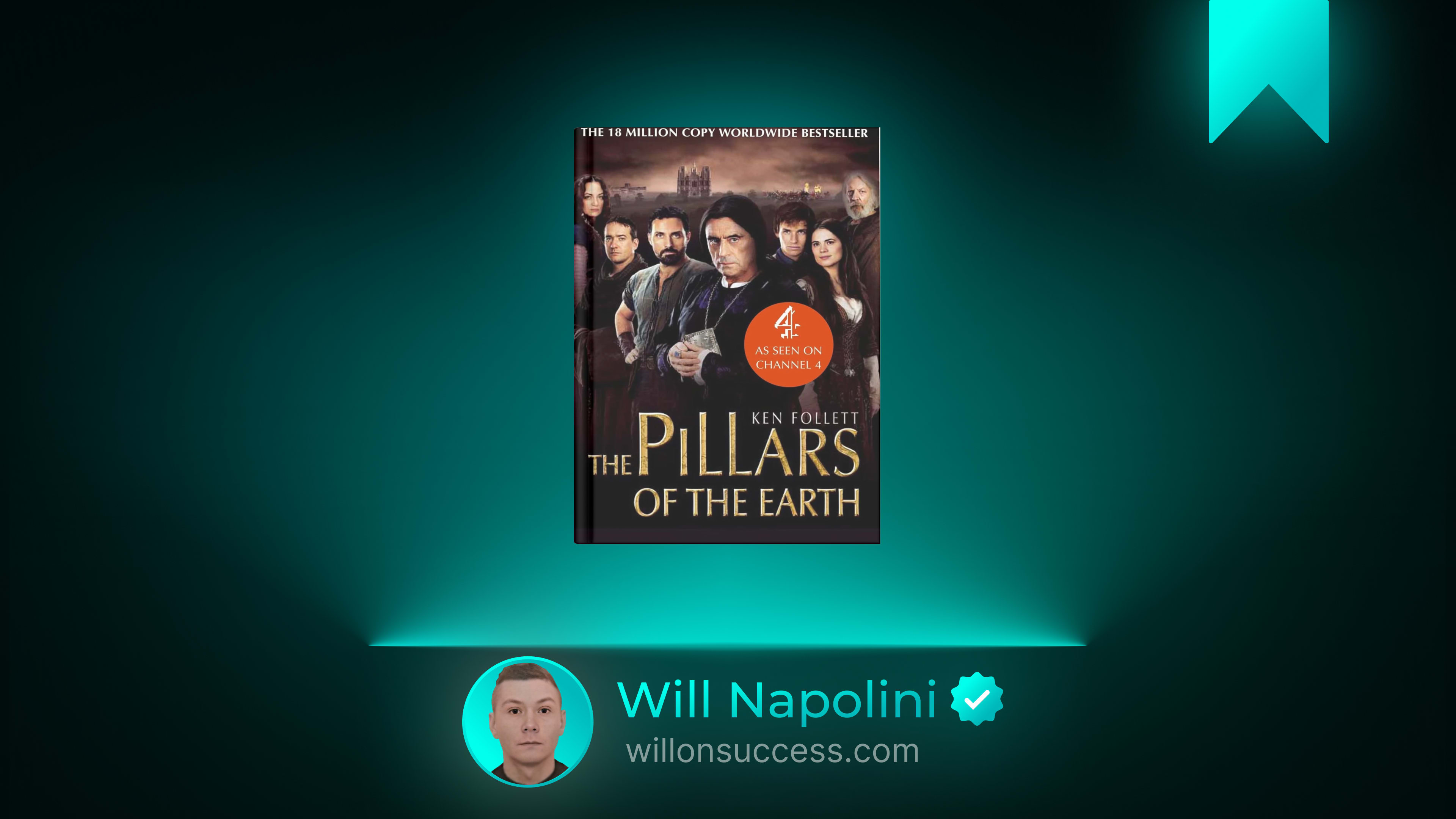
There is a question I keep returning to, one that Ken Follett’s massive novel The Pillars of the Earth answers better than almost any self-help book I have encountered:
What does it actually take to build something that matters?
Not a weekend project. Not a five-year plan. Something that demands decades of your life, survives your failures, outlasts your energy, and may not even be finished in your lifetime.
Follett wrote a thousand-page historical epic about the construction of a cathedral in 12th-century England. On the surface, it is a novel about stone and mortar, kings and bishops, love and betrayal. But underneath all of that, it is one of the most honest portraits I have ever read of what it costs a person to commit to a vision and then keep showing up—year after year, setback after setback—when every reasonable person would have walked away.
If you have ever started something important and felt the slow, grinding weight of time pressing against your patience, this book will speak to you in a language you did not know you needed to hear.
The Cathedral Is Not the Point. The Building Is the Point.
The novel is set during a period English historians call The Anarchy, roughly 1135 to 1154, when civil war tore the country apart and lawlessness became ordinary. Into this chaos, Follett places a small fictional town called Kingsbridge, where a monk named Prior Philip dreams of building a cathedral worthy of God and worthy of the people who will worship inside it.
But the cathedral is not merely a building. It is a decision made by dozens of people, each of whom must sacrifice something to see it rise.
Tom Builder, a master mason, loses everything—his livelihood, his wife, his stability—yet carries in his mind the image of a cathedral he has never drawn on paper. He walks the English countryside in winter, starving, searching for work, because the vision will not let him stop.
Jack, a boy raised in the forest with no formal education, discovers that he can look at stone and understand its hidden geometry. His gift is real, but it means nothing until someone gives him a place to practice it, fail at it, and slowly master it.
Aliena, the daughter of a disgraced nobleman, is stripped of her name, her wealth, and her safety. What follows is not a triumphant recovery montage. It is years of wool trading, of swallowing pride, of rebuilding an identity one small transaction at a time.
And Prior Philip must navigate corrupt bishops, a murderous nobleman named William Hamleigh, political betrayals, and the constant temptation to compromise his principles for the sake of progress.
What binds all of these lives together is not plot convenience. It is the cathedral. The slow, imperfect, often interrupted act of building something none of them may live to see completed.
And that, I think, is the book’s deepest lesson for any of us.
Vision Without a Next Step Is Just a Daydream
Tom Builder carries the image of his cathedral in his mind for years before he ever lays a foundation. The vision sustains him. It gives direction to his wandering. But Follett is careful to show us something important: the vision alone does not build anything.
Tom must find a patron. He must adapt his design to the stone available, the money available, the labor available. He must teach apprentices, negotiate with a prior, revise his plans when a wall cracks or a funding source disappears.
I have seen this pattern in my own life and in the lives of people I care about. Someone holds a beautiful idea—a business, a book, a relationship they want to repair, a skill they want to master—and they hold it so tightly, so reverently, that they never begin the messy, imperfect, unglamorous first step.
Follett’s novel insists, gently but firmly, that vision must descend into action. The cathedral exists first as a thought. But it becomes real only when someone picks up a chisel and strikes stone, knowing the first cut will not be perfect.
Your vision matters. But it matters as a direction, not as a destination you can admire from a safe distance. The question is never “Do I have the right vision?” The question is “What is the next honest, imperfect step?”
Great Work Requires People You Did Not Choose
One of the things that strikes me most about this novel is how little of the cathedral is built by any single hero. Prior Philip provides leadership and moral authority. Tom provides architectural knowledge. Jack provides genius with form and structure. Aliena provides financial support through her wool business. Hundreds of unnamed laborers haul stone and mix mortar.
No one builds this alone. And not everyone involved is pleasant, aligned, or even particularly likable.
Philip must work with people who disagree with him. He must accept help from sources that make him uncomfortable. He must lead a community that includes the lazy, the proud, the frightened, and the ambitious, and somehow keep them moving in the same direction.
This is, I believe, one of the hardest truths about any meaningful endeavor. You will not build your life’s work surrounded only by people who inspire you. You will build it alongside people who frustrate you, who work at a different pace, who see the project differently. And the work will ask you to find a way forward together anyway.
The cathedral does not rise because everyone agrees. It rises because enough people, imperfect and often in conflict, keep showing up to do their part.
The Villain Is Not Ambition. The Villain Is Destruction for Its Own Sake.
William Hamleigh is the novel’s antagonist, and Follett does not make him a cartoon. William is driven by wounded pride, by a desire to dominate, by the belief that power means the ability to take what you want from others. He burns. He threatens. He destroys what others have built, not because he wants to build something better, but because he cannot bear that others have built something he cannot control.
I mention William because I think his spirit lives in smaller forms in all of our lives. Not as a medieval nobleman with a sword, but as the voice that says: Why bother? Tear it down. Start over. It is not good enough. You are not good enough. None of this will matter.
The contrast Follett draws is stark. On one side, people who build slowly, imperfectly, over decades. On the other, a person who can destroy in an afternoon what took others a lifetime to create.
Destruction is faster than creation. That is why it feels powerful. That is why cynicism feels easier than hope. But Follett’s novel takes the long view. William’s violence echoes for a generation. The cathedral echoes for centuries.
What you build outlasts what you destroy. What you create outlasts what you tear down—whether that is a business, a skill, a marriage, or your own self-respect.
Choose the slower work.
Setbacks Are Not Interruptions to the Plan. They Are the Plan.
The cathedral in Kingsbridge burns. Not once in the story’s long arc, but through fire, through political sabotage, through the sheer incompetence of changing leadership. Funding vanishes. Key people die. Wars interrupt construction for years.
And yet the building continues. Not because the setbacks were minor. They were devastating. Characters lose years of work in a single night. They grieve. They rage. They wonder whether the effort was foolish.
But then they pick up the tools again.
I want to be honest with you: I do not think this is inspiring in a simple, cheerful way. Follett does not write these setbacks as character-building exercises that make everyone grateful. They hurt. They cost people years of their finite lives. Some characters do not recover.
But the novel’s argument, woven through hundreds of pages, is that the setbacks were never outside the project. They were part of it. The cathedral that eventually rises is not the one Tom first imagined. It is better in some ways, worse in others, and entirely shaped by what it survived.
Your plan will not survive contact with reality intact. Your career will not follow the arc you mapped at twenty-two. Your relationships will not develop according to the timeline you set in your head.
The question is not whether you can avoid disruption. The question is whether you can let the disruption reshape the work without letting it stop the work.
Craftsmanship Is a Form of Love
Jack’s journey in the novel is, at its heart, a story about learning a craft. He begins as an untrained boy who can see beauty in stone but cannot yet shape it. Over years—many years—he learns to cut, to carve, to understand load and arch and flying buttress. He fails. He ruins pieces of stone. He starts over.
Follett writes these passages of learning with a tenderness that tells me he understands something true: mastery is not a destination. It is a relationship you build with a material, a discipline, a practice. And that relationship is built through repetition, through failure, through the humility of being bad at something for longer than your pride would like.
I think this applies far beyond medieval stonemasonry. It applies to the writer on her fourth draft. To the entrepreneur whose first product flops. To the parent learning, slowly, how to be patient with a difficult child. To anyone learning a language, a trade, a way of being in the world that does not come naturally.
You do not owe anyone speed. You owe the work your attention, your repetition, your willingness to be a beginner for longer than is comfortable.
What you practice in private eventually becomes the thing you are known for in public. But only if you keep practicing.
Why This Matters on an Ordinary Wednesday
You are probably not building a cathedral. You may not be building anything as visible as a building.
But you are building something. A career. A family. A body of work. A reputation. A way of living that you can look at without flinching.
And the forces that opposed Prior Philip and Tom Builder are the same forces that oppose you, scaled to your life: limited resources, competing obligations, other people’s agendas, your own fatigue, the slow erosion of belief that comes when progress is invisible for months or years.
Follett’s novel reminds me that the people who build cathedrals are not special. They are tired. They are uncertain. They argue about money. They make compromises they regret. They keep going anyway.
And that “keeping going” is not glamorous. It looks like showing up to the workshop when no one is watching. It looks like revising the plan for the eleventh time. It looks like asking for help even when your pride wants to handle everything alone.
The cathedral does not care about your feelings on any given day. It only cares whether you showed up.
Who Should Read This Book
If you are in the middle of a long project—a career change, a creative endeavor, a slow rebuilding of trust in a relationship, a business that has not yet found its footing—this novel will feel like someone reaching across time to say, Yes, it is this hard. Yes, it takes this long. And yes, it is still worth doing.
If you love historical fiction with rich characters and are willing to invest in a long narrative, this is one of the most rewarding reads available. Follett researched the 12th century deeply, and the texture of daily life—the food, the politics, the architecture, the religion—feels lived-in rather than decorative.
A word of honesty: the book is long. Over nine hundred pages. There are moments in the middle where the political machinations can feel dense, and some of the secondary characters receive more page time than you might expect. Also, the novel contains scenes of violence and sexual assault that are graphic and difficult. These are not gratuitous, but they are present, and you should know that going in.
If you want a quick, plot-driven thriller, this is not that book. But if you want a story that rewards patience and leaves you thinking about what you are building with your own life, it is worth every page.
One Small Step You Can Take Today
Here is what I would ask you to do. Not tomorrow. Today.
Think of the thing you are building—the project, the skill, the relationship, the habit—that has been stalled because you are waiting for the right moment, the right energy, the right plan.
Now ask yourself: What is the single smallest action that moves this forward by one inch?
Not the whole cathedral. Not the next five years. One stone. One honest, imperfect, unglamorous action.
Write one paragraph. Make one phone call. Practice for ten minutes. Send one email. Clear one corner of the workspace. Apologize for one small thing.
Do that one thing before the day ends. Not because it will finish the project. But because the project does not become real until you strike the first stone.
You start small. You stay faithful to the work. You let the years do what the years do.
And one day, you look up, and something is standing there that was not standing there before. Something made of your patience, your stubbornness, your quiet refusal to stop.
That is how cathedrals are built. That is how lives are built. One stone at a time, laid by hands that are tired but still moving.
Pick up your chisel. The stone is waiting.