The ONE Thing by Gary Keller: Why Doing Less Is the Fastest Path to Extraordinary Results
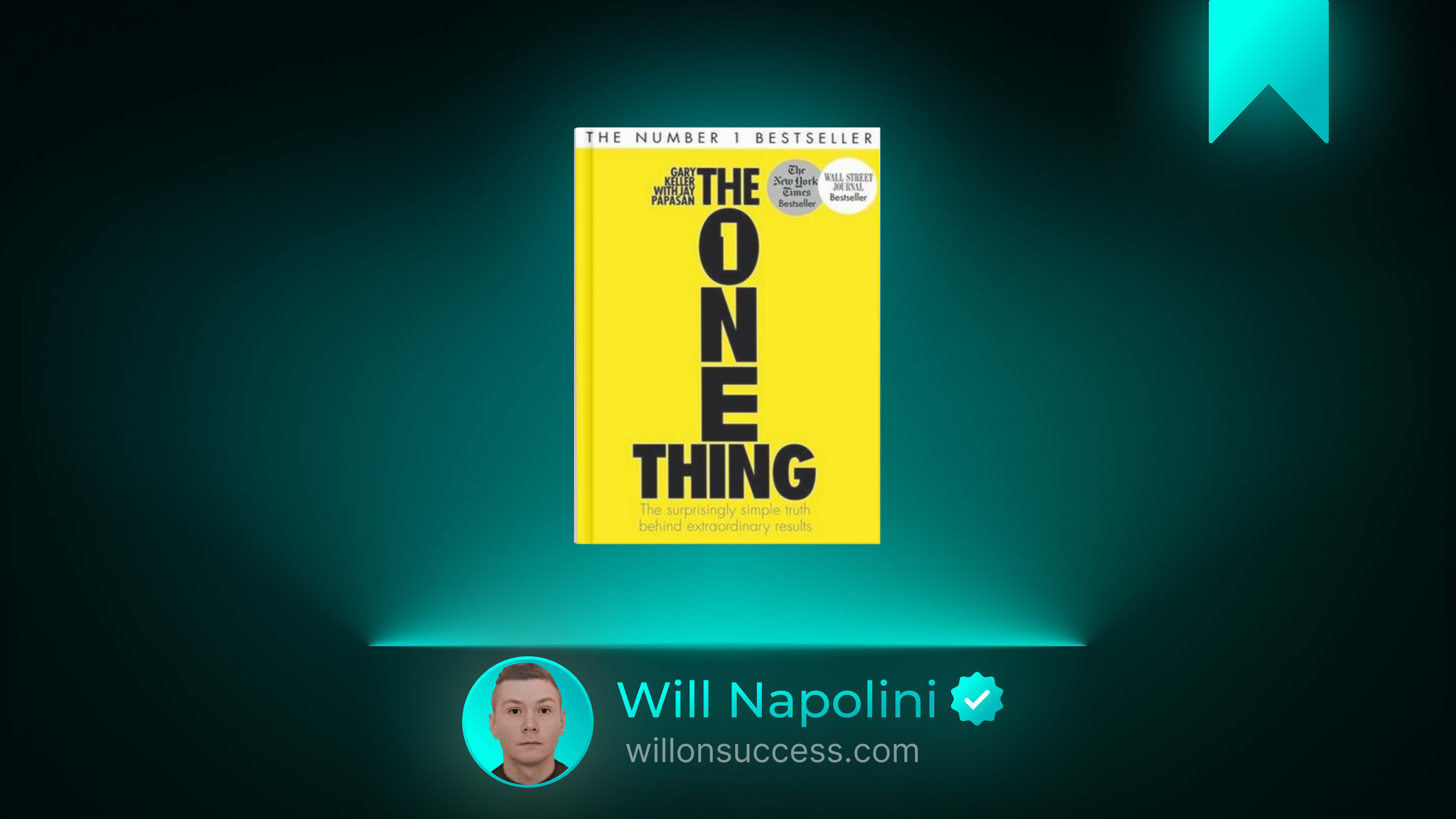
You have probably had one of those days—maybe a whole season of them—where you worked from early morning until late evening, checked every box, answered every message, handled every small emergency, and then lay in bed wondering why nothing meaningful actually moved forward. You were busy. You were exhausted. And yet the thing that mattered most, the project or the goal or the relationship that would genuinely change your trajectory, stayed exactly where it was the week before.
I want to show you why that happens. More importantly, I want to show you the single question that, once you truly adopt it, makes that pattern nearly impossible to repeat.
Gary Keller, the founder of one of the largest real estate companies in the world, spent decades watching talented, hardworking people spin their wheels. He noticed that the people who achieved outsized results were not working more hours, juggling more priorities, or possessing some rare genetic gift for discipline. They were doing something almost embarrassingly simple. They were choosing one thing—really one thing—and giving it their best energy before anything else touched their day.
He wrote The ONE Thing (with Jay Papasan) to distill that observation into a system anyone could follow. And the book’s central claim is both a relief and a challenge: you do not need to do more. You need to do less, but with a precision most people never develop.
The Domino That Starts Everything
Early in the book, Keller introduces an image I have not been able to get out of my head since I first encountered it. A physicist demonstrated that a single domino, properly placed, can knock over another domino fifty percent larger than itself. Set up a chain of progressively larger dominoes, and a tiny two-inch tile can eventually topple something the size of a building.
One small thing, correctly aimed, unleashes force far beyond its own size.
That is the architecture Keller wants you to build into your life. Not a sprawling to-do list of forty items. Not five goals pursued simultaneously. One. The right one. The one that, once completed, makes the next several problems easier or irrelevant.
Think about what that means practically. If you are starting a business, your one thing might not be designing a logo or building a website. It might be having one honest conversation with a potential customer to learn whether your idea solves a real problem. That single conversation knocks over a domino that makes a dozen later decisions obvious.
If you are trying to repair a strained relationship, your one thing might not be planning a grand gesture. It might be sitting down, putting your phone in another room, and asking one sincere question—and then listening to the answer without defending yourself.
The principle is not “do only one thing forever.” It is that at any given moment, there is one action carrying disproportionate weight, and most of us bury it under nine other tasks that feel urgent but are not.
The Focusing Question: A Tool You Can Carry Anywhere
The operational heart of the book is a single sentence Keller calls the Focusing Question:
What is the ONE Thing I can do right now such that by doing it everything else will be easier or unnecessary?
Read it slowly. Notice how specific it is. Not “What should I focus on this year?” Not “What are my priorities?” Those questions invite lists. This question invites a decision.
The phrase “right now” keeps you from escaping into someday-planning. The phrase “everything else will be easier or unnecessary” forces you to think in terms of leverage rather than volume. You are not asking what is important. You are asking what makes other important things shrink.
Keller suggests using this question at multiple scales. You can ask it about your life direction: What is the one thing I want my life to be about? You can ask it about your year, your month, your week. And every single morning, you can ask it about your day: What is the one thing I can do today, in the area that matters most to me, such that by doing it everything else becomes easier?
I have seen people struggle with this question because they want permission to have two answers. The question does not allow two. That is the point. It forces the ranking you have been avoiding.
The Six Lies That Keep You Scattered
Before Keller builds his system, he dismantles the assumptions that make focus feel impossible. He calls them “lies” not to be harsh, but because they sound reasonable while quietly sabotaging everything.
The first is that everything matters equally. It does not. You already know this, but you live as though your to-do list is a flat surface where all items carry the same weight. Keller pushes the Pareto principle further than most people take it. If twenty percent of your efforts produce eighty percent of your results, then within that twenty percent, there is a smaller twenty percent. And within that, one item. You are looking for the one.
The second lie is multitasking. You can alternate between tasks. You cannot focus on two simultaneously. Every time you switch, you pay a cognitive tax—a few seconds or minutes of reorientation that compounds into lost hours across a day.
The third is that you need a fully disciplined life. You do not. You need enough discipline to build one habit. Once the habit is automatic, the discipline is freed for the next challenge. Keller is not asking you to become a monk. He is asking you to be disciplined in one narrow lane long enough for momentum to take over.
The fourth is that willpower is always available. It is not. Willpower behaves more like a battery than a wellspring. It drains through the day as you make decisions, resist temptations, and manage stress. This is why Keller insists you do your one thing early, before the battery runs low.
The fifth lie is that a balanced life is the goal at every stage. Keller argues that extraordinary achievement requires periods of intentional imbalance—that you will lean heavily into one area while others get less attention temporarily. The goal is not permanent imbalance. It is the willingness to accept short-term asymmetry in service of something meaningful, and then to swing attention back to the people and areas you love.
The sixth is that thinking big is dangerous or unrealistic. Keller pushes back gently but firmly: small thinking protects you from disappointment, but it also guarantees a small result. You are allowed to aim at something that scares you.
Time Blocking: Protecting the One Thing from the World
Knowing your one thing is only half the equation. The other half is defending it.
Keller’s practical answer is time blocking. You choose a window—ideally four hours, though you can start with ninety minutes—and you reserve it in your calendar for your one thing. Not for email. Not for meetings that could be an email. Not for “quick favors.” You protect this block the way you would protect a doctor’s appointment or a flight you cannot miss.
He suggests blocking your time in layers: a block for your one thing, a block for planning and reviewing, and a block for rest. The rest block is not optional. It is structural. You cannot produce focused work from an exhausted mind, and pretending otherwise only delays the collapse.
What I find most honest about this section is Keller’s acknowledgment of what time blocking costs. You will have to say no. You will disappoint people who expect immediate responses. Things will feel slightly chaotic around the edges because you are not micromanaging every small fire. He calls chaos the tax you pay for extraordinary focus, and he does not pretend it is comfortable.
But the alternative—saying yes to everyone, responding to every ping, keeping all plates spinning—is a slower, quieter form of chaos. It just does not announce itself until years have passed and you realize you built no one thing.
Goal Setting to the Now
One of the most useful frameworks in the book connects your largest vision to your smallest daily action. Keller calls it “goal setting to the now,” and it works like this:
Start with your someday goal—the thing you want your life to be about or the achievement you are building toward. Then ask: Given that someday goal, what is the one thing I need to accomplish in the next five years? Then: Given that five-year goal, what must I accomplish this year? Then this month. Then this week. Then today. Then right now.
Each answer becomes the frame for the next question. You are building a chain of dominoes from the present moment all the way to the future you want. And because each domino is connected, your Tuesday-morning action is no longer random. It is load-bearing. It is part of a structure.
This matters because most people either live entirely in the abstract future (“Someday I will write that book”) or entirely in the reactive present (“I will just get through today’s inbox”). The chain connects the two. It gives your ordinary hours a reason.
The Four Thieves That Steal Your Focus
Even with a clear one thing and a blocked calendar, Keller warns that four forces will try to pull you off course.
The inability to say no. Every yes to a lesser thing is a no to your one thing. This is not cruelty. It is arithmetic.
The fear of chaos. When you stop attending to everything, some things will get messy. Emails will pile up. A project will stall. You must tolerate that discomfort long enough for the important work to compound.
Poor health habits. Sleep, movement, and nutrition are not luxuries layered on top of productivity. They are the foundation it rests on. You cannot produce focused, creative work from a body running on four hours of sleep and caffeine.
An environment that does not support your goals. The people around you, the physical space you work in, the digital inputs you allow into your attention—these either protect your focus or erode it constantly. Keller does not ask you to become ruthless with people. He asks you to be honest about what your environment makes easy and what it makes hard, and to adjust accordingly.
What This Looks Like on an Ordinary Tuesday
Let me make this concrete, because principles without application are just pleasant thoughts.
Imagine you are trying to shift careers. Your someday goal is to work in a field that engages you more deeply. Your five-year goal might be to be established in that new field. Your one-year goal is to build enough skill and credibility to make the transition. Your one-month goal is to complete a specific project or course. Your one-week goal is to finish three sections of that project.
And your one thing today, before email, before meetings, before the noise, is to sit down for ninety minutes and work through section one.
That is it. You protect those ninety minutes. You let the inbox wait. You accept that a colleague might need to schedule around you. You do the work. Then the rest of the day unfolds, and you handle what needs handling, but the domino that mattered most has already fallen.
Multiply that Tuesday by two hundred, and you are not the same person. You have built something. You have moved. Not because you worked eighteen-hour days, but because you aimed your best energy at the one point where it could do the most damage to the problem.
Who Will Benefit Most from This Book
If you feel perpetually busy but rarely productive, this book will feel like someone finally naming what is wrong. If you are someone who starts many projects and finishes few, who feels pulled in six directions and guilty about all of them, Keller’s framework offers a way out that does not require you to become superhuman.
Entrepreneurs, freelancers, and anyone without external structure will find it especially useful, because the book gives you the structure you are otherwise expected to generate from thin air.
That said, if you are in a season of life where genuine survival requires juggling many responsibilities simultaneously—a new parent, someone caring for an ill family member, someone holding down two jobs—the book’s insistence on radical single-focus may feel frustratingly out of reach. The principles still apply, but you may need to adapt them more gently, choosing one thing within a smaller window rather than blocking four unbroken hours.
The book is also light on emotional complexity. It treats focus largely as a systems problem. If your inability to concentrate is rooted in anxiety, unresolved grief, or a work environment that is genuinely toxic, no focusing question will fix that root. You may need support beyond what this book offers. Keller would likely agree. But the book itself does not dwell there.
One Small Step You Can Take Today
Here is what I would ask you to do before the end of the day. Not tomorrow. Today.
Take a blank piece of paper or open a blank document. Write this question at the top:
What is the ONE Thing I can do in the next few days, in the area of my life that matters most right now, such that by doing it everything else becomes easier or unnecessary?
Do not write a list. Do not write three things. Sit with the question until one answer rises above the rest. It might feel reductive. It might feel like you are ignoring important things. That discomfort is the sound of the lie “everything matters equally” losing its grip.
Write down the one answer. Then decide when you will do it. Put it in your calendar. Give it a specific hour. Tell one person in your life that you will be unavailable during that time.
Then, when that hour arrives, close the other tabs. Silence the phone. And begin.
You do not need to see the whole staircase. You do not need to topple the last domino today. You only need to push the first one, in the right direction, with your full attention.
A direction chosen with clarity, repeated over time, becomes a life. And the life it becomes will be yours—built not from a hundred scattered fragments, but from the steady, quiet force of one thing done well, again and again, until it becomes everything.