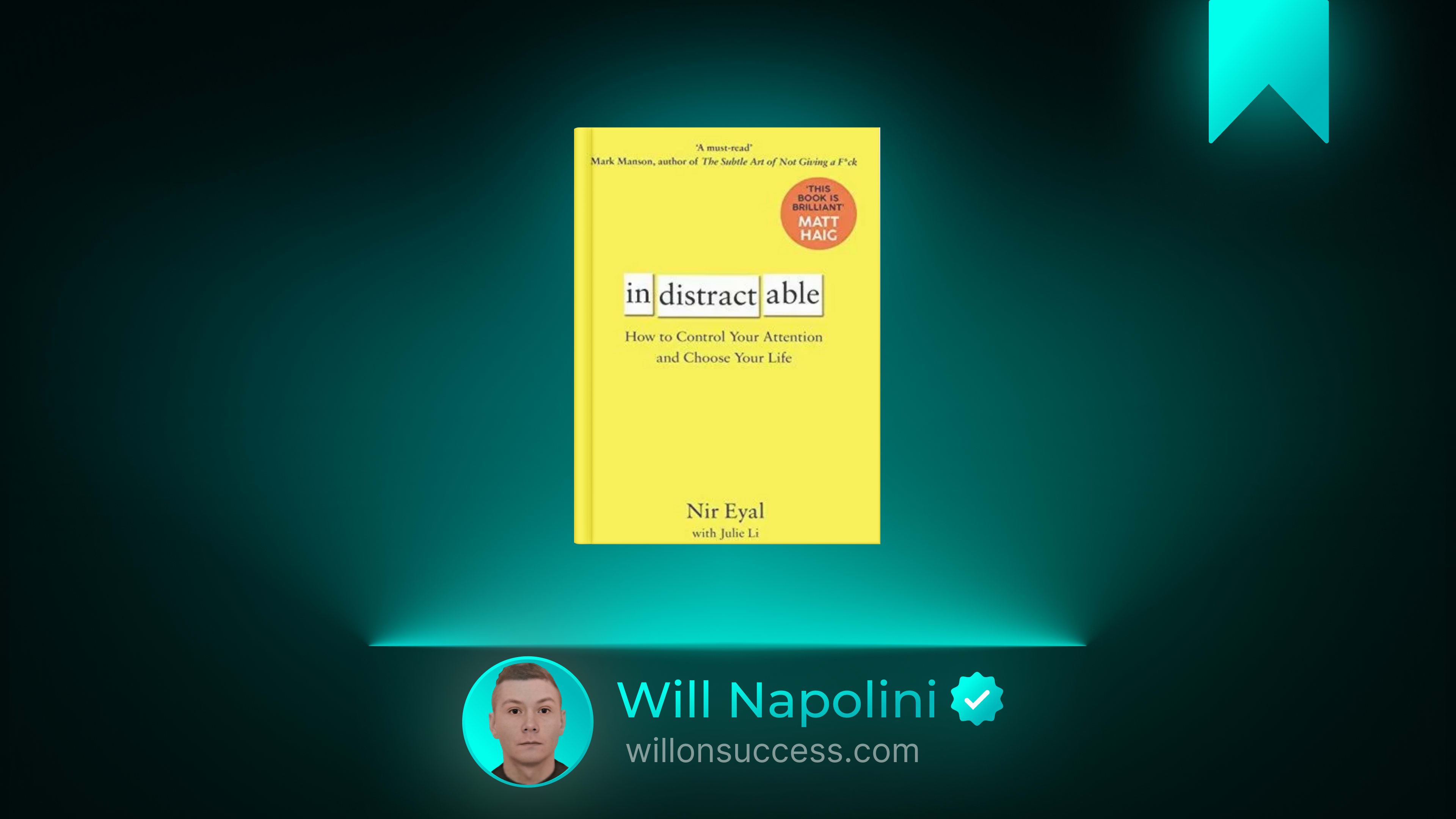
Indistractable: How to Reclaim Your Attention in a World Designed to Steal It
Have you ever sat down to do one hour of deep, meaningful work, only to blink and realize you have spent the last forty-five minutes scrolling through your phone, answering trivial emails, or reorganizing a desk that was already clean? You feel a familiar wave of shame. You tell yourself you are lazy, that your willpower is weak, or that your attention span has been permanently broken by modern technology.
If I could sit across the table from you right now, watching you carry the heavy guilt of a wasted afternoon, here is the first thing I would tell you: You are not broken, and your phone is not the primary culprit.
We have been sold a comforting lie about our lack of focus. We blame Silicon Valley, the algorithms, and the glowing screens for our inability to concentrate. We assume that if we just delete social media, turn off our notifications, or move to a quiet cabin in the woods, we will finally get our work done and find our peace. But escaping your environment does not fix the root of the problem, because you always bring your mind with you.
The Big Idea: The Hidden Root of Distraction
In his deeply practical and psychologically astute book, Indistractable: How to Control Your Attention and Choose Your Life, Nir Eyal dismantles the greatest myth of the digital age. He challenges us to stop telling ourselves that we are simply people with “addictive personalities” or naturally short attention spans.
Eyal reveals a profound, uncomfortable truth: Distraction is not a technology problem. It is an emotional regulation problem.
We do not scroll, snack, check our inboxes, or pick fights with our spouses because the apps are irresistible. We do it to escape uncomfortable internal feelings—boredom, anxiety, uncertainty, loneliness, or the fear of failure. In fact, time management is ultimately just pain management. When you feel the pain of a difficult task, your brain seeks immediate relief, and the nearest digital pacifier is always in your pocket.
To become indistractable is not to become a robot who never looks at a screen. Being indistractable simply means striving to do what you say you will do. It is the ability to sit with discomfort without needing to escape, allowing you to align your daily actions with your deepest values.
You cannot outrun your own discomfort, but you can learn to sit beside it until it loses its power over you.
The Tale of Two Spectrums: Traction vs. Distraction
To understand how to reclaim your focus, we have to change how we define it. Imagine a horizontal line. On the far right is Traction—actions that pull you toward what you truly want in life. On the far left is Distraction—actions that pull you away from your intentions.
Most people believe the opposite of distraction is “focus.” But Eyal points out that the true opposite of distraction is traction. And here is the catch: you cannot know if an action is traction or distraction unless you know what you intended to do in the first place.
Checking your email can be traction if you planned to do it. Scrolling through a social media feed can be traction if you scheduled twenty minutes to decompress and connect with friends. But if you do either of those things to avoid a difficult conversation, a hard project, or a quiet moment with your own thoughts, it is distraction.
Before you can master your focus, you must define your intentions. Without a plan, everything is a distraction.
The Core Principles of the Indistractable Model
How do you transition from a reactive leaf blown around by your impulses to the grounded architect of your days? Eyal outlines a brilliant, four-step model to help you master your inner and outer worlds.
1. Master Your Internal Triggers
The four-step model begins with mastering your internal triggers. Before you reach for your phone or open a new browser tab, there is always a preceding emotional trigger. It might be a tight chest before a difficult phone call, a yawn of boredom while reading a dense report, or a pang of loneliness on a quiet evening.
Instead of immediately giving in to the urge to escape, you must learn to observe the feeling with curiosity rather than judgment. Eyal suggests the “10-Minute Rule.” When you feel the intense urge to distract yourself, tell yourself you can give in, but you must wait exactly ten minutes. Often, the wave of emotional discomfort passes, the rational part of your brain comes back online, and you reclaim your agency. You learn that the urge to escape is just a feeling, and feelings are temporary.
2. Make Time for Traction
The second step is making time for traction. You cannot call something a distraction if you do not know what it is distracting you from. Eyal argues that timeboxing—the practice of scheduling every minute of your day in advance—is the single best productivity hack available.
This is not about rigidly chaining yourself to a desk or treating your life like a corporate factory floor. It is about making time for your values. If you value your health, timebox your workouts. If you value your family, timebox your evenings with them. When you schedule your life, you transform vague, easily broken intentions into concrete commitments. You stop reacting to whatever screams the loudest, and start executing what matters the most.
3. Hack Back External Triggers
Once you have handled your internal world, you must clean up your external one. Next, you must hack back your external triggers. External triggers are the pings, dings, red dots, and notifications that prompt you to act.
You must ruthlessly curate your environment. Turn off every non-human notification on your phone. If a notification does not come from a real, living person who needs your immediate attention, it does not deserve to interrupt your life. Change your digital and physical environment so that doing the right thing is effortless, and doing the wrong thing requires deliberate, difficult effort.
4. Prevent Distraction with Pacts
Willpower is a finite resource, and relying on it all day is a losing strategy. Finally, you prevent distraction with pacts. Pacts are pre-commitments that lock in your future behavior when your present self is tired or tempted.
This could be an “effort pact” (making it physically difficult to access a distraction, like using a website blocker that requires a complex password to override), a “price pact” (betting a friend $100 that you will finish your draft by Friday), or an “identity pact” (shifting your self-talk from “I can’t check my phone” to “I am not someone who checks their phone during dinner”). By building pacts, you protect your future self from the weaknesses of your present self.
Why This Matters on an Ordinary Tuesday
Why does this matter when you are just trying to get through the work week? Because your attention is the very fabric of your life. Whatever you pay attention to, you become.
If you cannot control your attention, you cannot control your career, your relationships, or your health. When you master these four steps, you stop living at the mercy of other people’s agendas and your own fleeting moods. You bring a sense of calm and presence to your workplace. You actually look your children in the eye when they speak to you, rather than half-listening while scrolling. You become a person of deep integrity, because your actions finally match your intentions.
Practical Application: Building Your Focus Muscle
Understanding these principles is a beautiful start, but reading without action changes nothing. You must build a daily practice that rewires your relationship with distraction.
- Track Your Triggers: Keep a small notepad on your desk. Every time you feel the urge to check your phone or open a new tab, write down the exact emotion you are feeling in that moment. Are you anxious? Bored? Overwhelmed? Naming the emotion strips it of its power.
- Build a Weekly Timebox: Take fifteen minutes every Sunday evening to plan your upcoming week. Block out time for your deep work, but also block out time for rest, chores, and guilt-free scrolling. If it is on the calendar, it is traction.
- The Notification Purge: Go into your phone’s settings right now. Turn off all notifications except for phone calls and direct text messages from real people. Let the apps wait for you, rather than you waiting for the apps.
Who Should Read This Book
Indistractable is a vital read for the knowledge worker drowning in emails, the parent who feels they are never truly “present” with their family, and the creative who struggles to finish what they start. It is a masterpiece for anyone who wants to take back their time without giving up the modern tools they need to live and work.
However, if you are looking for a magical app that will do the work for you, or a rigid system that demands you throw away your smartphone and live off the grid, this book will frustrate you. Eyal is not interested in digital asceticism. He demands that you take radical responsibility for your own emotional landscape and do the quiet, daily work of aligning your time with your values.
One Small Step to Take Today
You do not need to overhaul your entire life to begin reclaiming your attention. The practice begins the very next time you feel the urge to escape.
Here is your one small step for today: The next time you are working on something difficult and feel the sudden, burning urge to check your phone or open a distracting website, do not fight it. Instead, look at the clock and invoke the 10-Minute Rule. Tell yourself you are allowed to give in to the distraction, but you must wait exactly ten minutes.
Sit with the discomfort. Notice where it lives in your body. Watch it rise, peak, and eventually fade away.
When the ten minutes are up, you will likely find that the urge has vanished, and you are ready to return to your work. In that single moment, you have stopped being a slave to your impulses and started becoming the master of your mind.
Your attention is the currency of your life; spend it on what you truly value, or the world will gladly spend it for you.