Reclaiming Your Focus: A Mentor's Guide to Thibaut Meurisse’s Dopamine Detox
Notice what happens the next time you sit down to do something important. You open a document to write, or you pull out a textbook to study, or you simply sit across from someone you love with the intention of having a real conversation. Within three minutes, your hand drifts toward your phone.
You tell yourself you just need to check one notification. Twenty minutes later, you are deep in a scroll, feeling a vague sense of guilt, yet entirely unable to put the device down.
If you recognize this pattern, I need you to hear something very clearly: You are not lazy. You do not lack willpower. And you are not broken.
What you are experiencing is a hijacked reward system.
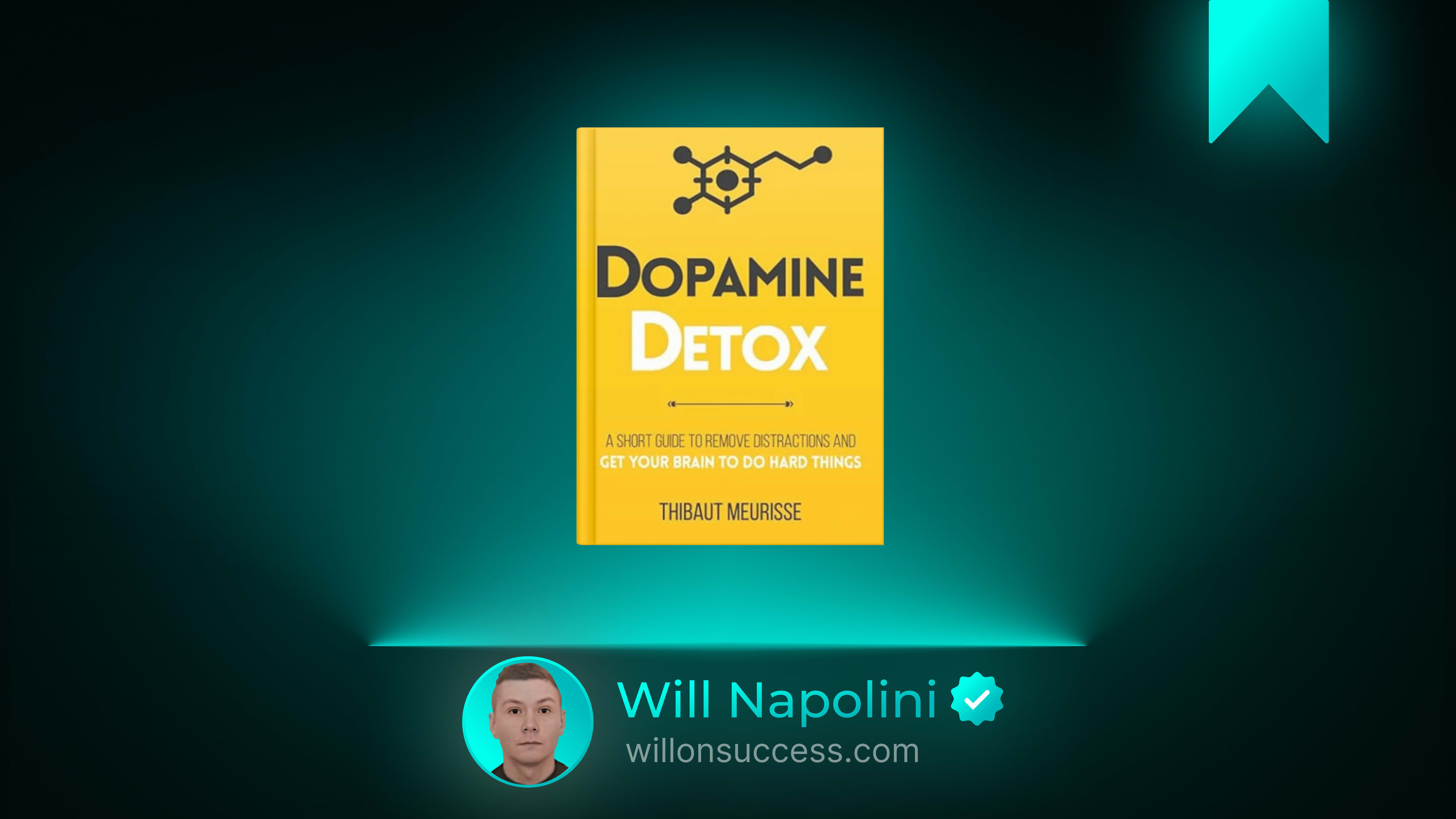
In his concise and highly practical book, Dopamine Detox, Thibaut Meurisse addresses a silent crisis that most of us feel but few of us know how to name. We are living in an environment engineered to overstimulate us, and until we understand how that overstimulation changes our brain, we will keep losing the battle for our own attention.
The Big Idea
The central premise of Meurisse’s work is straightforward but profound: your ability to do hard, meaningful things is directly tied to your brain’s baseline for stimulation.
When you flood your mind with cheap, effortless pleasures—endless social media scrolling, junk food, binge-watching, video games—you artificially raise your dopamine baseline. Dopamine is not just the “pleasure chemical”; it is the molecule of motivation, craving, and drive. When your baseline is artificially high, normal life feels incredibly boring.
Reading a book feels too slow. Working on a long-term project feels too tedious. Sitting quietly with your own thoughts feels unbearable.
Meurisse argues that the solution is not to try harder or to rely on sheer discipline. The solution is to step away from the noise and allow your brain to reset. By intentionally removing highly stimulating activities for a set period, you lower your baseline. And when your baseline drops, the ordinary, necessary tasks of life suddenly become engaging again.
The Story or Concept
To understand why this works, we have to look at how we process stimulation.
Imagine you are standing next to the massive speakers at a rock concert. The music is deafening. If someone standing five feet away tries to speak to you in a normal voice, you won’t hear them. In fact, you might not even realize they are trying to talk. The sheer volume of the speakers drowns out everything else.
But if you step outside the venue and walk in silence for twenty minutes, your ears begin to adjust. The ringing fades. And suddenly, when your friend speaks to you in that same normal voice, you can hear every word perfectly.
Your brain works the exact same way.
Modern digital entertainment and hyper-palatable foods are the rock concert. They blast your neural pathways with so much cheap dopamine that the quieter, more subtle rewards of real life—the satisfaction of finishing a difficult task, the joy of a slow walk, the peace of reading a physical book—are completely drowned out.
You cannot hear the quiet rewards because your environment is too loud. A dopamine detox is simply the act of stepping outside the concert hall so your ears can heal.
The Trap of Cheap Dopamine
Meurisse draws a critical distinction between two types of dopamine release: effort-based and cheap.
Effort-based dopamine is what you get when you work toward a meaningful goal. You study, you train, you build, you create. The reward comes after the effort. This type of dopamine is sustainable. It builds character, compounds over time, and leaves you feeling deeply fulfilled.
Cheap dopamine, on the other hand, requires zero effort. It is handed to you by algorithms designed to keep you hooked. You swipe, you click, you consume. The reward comes before any effort, and often without any effort at all.
When you rely on cheap dopamine, you train your brain to expect high rewards for zero work. Over time, your brain adapts. It down-regulates its dopamine receptors to handle the flood. This is why you can spend three hours on a streaming service and feel entirely unfulfilled, yet the thought of spending thirty minutes reading a dense, important book feels physically painful. Your brain is screaming for the easy fix, and it views the hard work as a threat to its comfort.
Every time you choose the easy thrill over the hard task, you are quietly voting for a life of spectatorship rather than creation.
The Healing Power of Strategic Boredom
We have been taught to fear boredom. We treat it as a negative state, a void that must be immediately filled with a podcast, a text message, or a video. We treat silence like an allergy. The moment it appears, we reach for our screens to suppress the symptoms.
But Meurisse positions boredom not as a problem to be solved, but as a necessary medicine to be swallowed.
When you remove cheap dopamine, you will feel bored. You will feel restless. You might even feel a mild sense of anxiety or irritability. This is the withdrawal phase. It is uncomfortable, but it is not dangerous. It is simply the feeling of your brain recalibrating.
What I have discovered in my own life, and what I have seen in the lives of countless others, is that boredom is the birthplace of clarity. When you stop feeding your mind a constant stream of other people’s thoughts, algorithms, and curated lives, your own thoughts finally have the space to surface. You remember what you actually care about. You remember the projects you abandoned because they were “too hard.” You remember who you are when no one is watching.
Strategic boredom lowers the volume of the world so you can finally hear yourself think. When you sit with boredom, you are not doing nothing. You are doing the heavy lifting of neurological repair.
Replacing Consumption with Creation
A detox is not merely about what you stop doing; it is about what you start doing in the space you reclaim.
If you remove your phone, your television, and your video games, you will be left with a vast expanse of unstructured time. If you do not have a plan for that time, you will likely relapse. Meurisse suggests filling the void with low-dopamine, high-meaning activities.
This means going for a walk without headphones. It means sitting with a notebook and writing down your thoughts. It means cooking a simple meal from scratch. It means reading a physical book, cleaning your living space, or simply sitting in a chair and looking out the window.
These activities do not provide the instant spike of a viral video. But they provide something much more valuable: presence. They anchor you in the physical world. They teach your brain that it can survive, and even thrive, without a constant drip of digital validation.
Why It Matters
You might be wondering why this matters so much. After all, isn’t it fine to relax with a phone or a show after a long day?
Of course it is. Rest is vital. But there is a profound difference between conscious rest and compulsive consumption.
When your dopamine baseline is chronically elevated, it bleeds into every area of your life.
- In your work, it manifests as chronic procrastination. You cannot start the difficult task because your brain is demanding the cheap thrill of a distraction.
- In your relationships, it manifests as impatience. You find yourself checking your phone while someone you love is speaking, because the conversation is moving slower than your overstimulated brain desires.
- In your personal growth, it manifests as stagnation. You know what you need to do to get healthy, to learn a new skill, to build a business, but you simply cannot summon the drive to do it.
Character before circumstances. You cannot build a resilient mind if you are constantly feeding it a diet of digital junk food. By resetting your dopamine, you are not just reclaiming your time; you are reclaiming your agency. You are giving yourself the neurological capacity to choose what is hard and meaningful over what is easy and empty.
Practical Application
Understanding the theory is valuable, but understanding without action changes nothing. So, how do you actually execute a dopamine detox?
Meurisse outlines a few variations, but the most effective starting point is the 24-hour reset. Choose a day—perhaps a Sunday—where you commit to stepping out of the concert hall.
Here are the rules for the reset:
- No screens. This means no smartphone, no computer, no television, and no tablet. (If you must use a screen for essential communication, keep it strictly utilitarian).
- No digital entertainment. No video games, no streaming, no podcasts, and no music.
- No junk food. Eat simple, whole foods. Drink water, tea, or black coffee.
- No shopping or unnecessary spending.
What do you do instead? You engage with the physical world. You take long walks. You stretch. You journal. You read physical books. You meditate. You prepare your meals. You have face-to-face conversations.
The first few hours will be difficult. Your hand will instinctively reach for your pocket. You will feel a phantom vibration. You will feel a sudden, intense urge to “just check the news.” Let the urge rise, acknowledge it, and let it pass. Do not fight it; just observe it.
By the afternoon, a strange thing will happen. The restlessness will begin to fade. Your mind will slow down. You will find yourself noticing the sound of the wind, the texture of the paper in your book, the taste of your food. You will feel a deep, quiet sense of peace that no app could ever provide.
The Micro-Detox Alternative If a 24-hour reset feels impossible right now, start with a daily micro-detox. Choose a two-hour window every evening—perhaps from 8:00 PM to 10:00 PM—where all screens are turned off and put in another room. Use this time to read, talk with your family, or prepare for the next day. Consistency before intensity. A daily two-hour boundary, maintained over a year, will change your life far more than a single weekend detox that you never repeat.
Who Should Read This Book
Dopamine Detox is a short, highly actionable guide. It is not a dense neurobiology textbook, nor does it pretend to be.
It is written for the person who feels overwhelmed, scattered, and frustrated by their own lack of focus. If you find yourself losing entire evenings to the internet, or if you feel a constant, low-grade anxiety when you are separated from your devices, this book will give you a clear, practical way out.
It may be less useful for someone looking for deep, academic research into neurochemistry, or for someone who already has a highly disciplined, minimalist relationship with technology.
But if you are tired of feeling like a passenger in your own mind, this book is a vital roadmap. It strips away the complexity and gives you exactly what you need to take back control.
One Small Step
You do not need to commit to a full 24-hour detox today. Change is built on small, consistent actions, not dramatic, unsustainable leaps.
Here is what I want you to do.
Tomorrow morning, do not touch your phone for the first sixty minutes after you wake up. Buy an analog alarm clock so you do not need your phone in the bedroom. When you wake up, get out of bed, drink a glass of water, and spend that first hour engaging with the physical world. Make coffee, look out the window, stretch, or write down three things you want to accomplish today.
Do not let the digital world dictate your mood before your feet have even touched the floor.
Final Thought
Your attention is the most valuable resource you possess. It is the raw material from which your life is built. Every time you give it away to a mindless distraction, you are stealing from your own future.
Reclaiming your focus is not about punishing yourself. It is about respecting yourself enough to demand a life of depth, meaning, and presence. The noise of the world will always be there, vying for your eyes and your mind. You cannot silence the world, but you can choose when to step outside and listen to the quiet.
A quiet mind is not an empty mind; it is a mind finally free to build.