Don't Give Up, Don't Give In: The Quiet Architecture of Unbreakable Resilience
Most survival stories end when the rescue helicopter arrives. The music swells, the survivor is wrapped in a blanket, and the credits roll. We are left with the comforting illusion that once the crisis is over, the hard part is behind us.
But if I could sit across the table from you, I would tell you a truth that took me a long time to accept: the rescue is rarely the end of the battle. Often, it is just the beginning of a much quieter, much more dangerous war.
When the external storm finally breaks, you are often left standing in the wreckage of your own mind. The adrenaline fades. The immediate threat vanishes. And suddenly, you are left alone with the memories, the resentment, the trauma, and the heavy, suffocating question of how you are supposed to just go back to “normal.”
Louis Zamperini knew this quiet war better than almost anyone. As an Olympic runner, a B-24 bombardier, a castaway who survived 47 days on a raft in the Pacific, and a prisoner of war who endured years of systematic torture, his physical survival is the stuff of legend. Laura Hillenbrand captured that physical survival brilliantly in her biography, Unbroken.
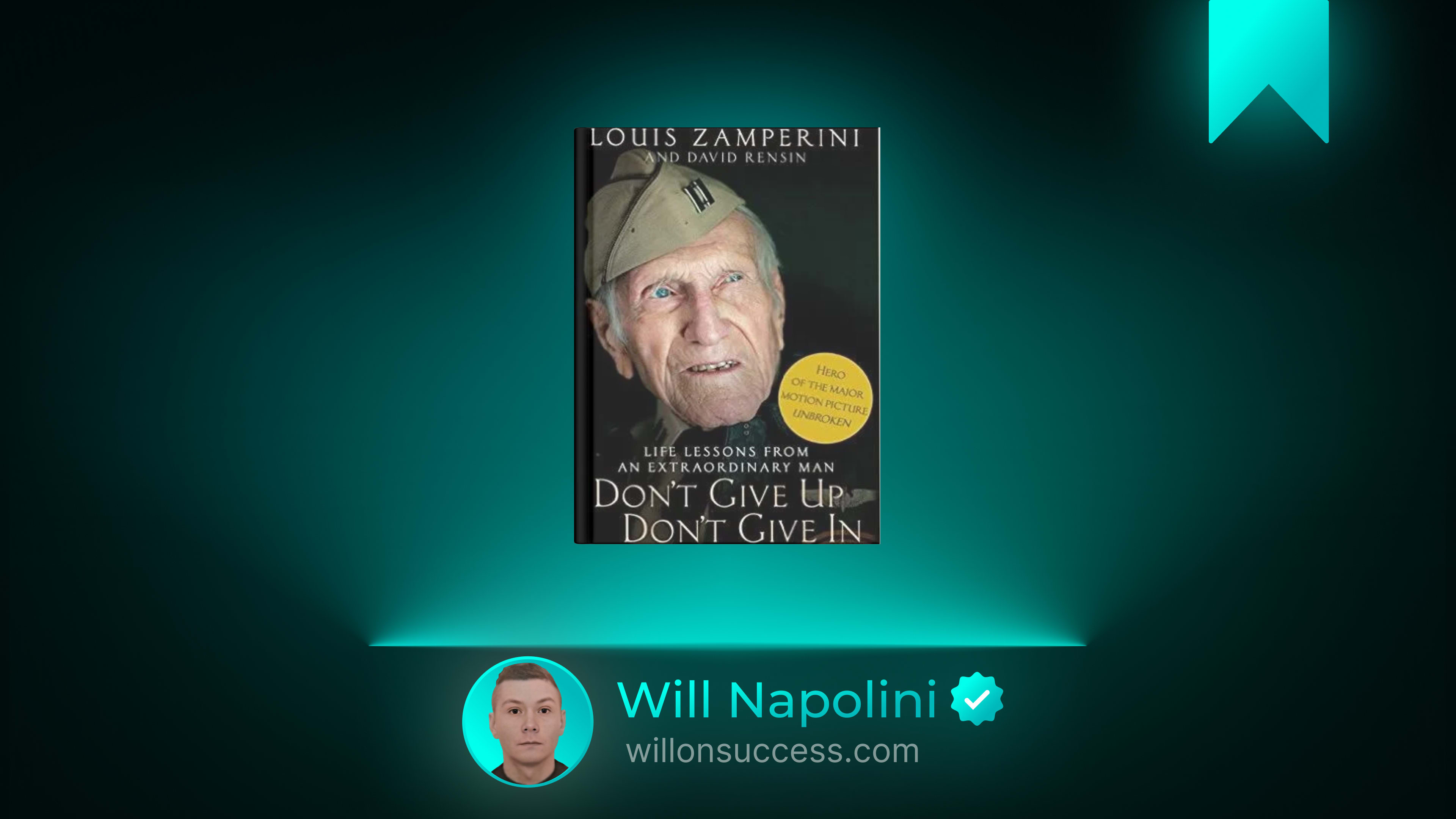
But Don’t Give Up, Don’t Give In is a different kind of book. Written with David Rensin near the end of Zamperini’s 97-year life, it is not a recounting of his suffering. It is a masterclass in his recovery. It is the distilled wisdom of a man who realized that surviving the war was only ten percent of the battle. The other ninety percent was surviving himself.
The Big Idea: Resilience Is a Daily Architecture
The central thesis of Zamperini’s final book is that resilience is not a genetic gift, nor is it a finite resource you burn through during a crisis. Resilience is an architecture. It is a structure you build brick by brick, day by day, through a series of deliberate, often unglamorous choices.
Zamperini’s greatest triumph was not that he refused to die on the raft or in the prison camp. His greatest triumph was that he refused to let his captors keep him in a psychological prison for the rest of his life. He discovered that true resilience requires you to eventually put down the armor that kept you alive, because the very defenses that save you in a crisis will suffocate you in peacetime.
You may be working hard to move past a difficult season in your own life—a divorce, a bankruptcy, a health crisis, a career failure—and wondering why you still feel so heavy. Zamperini’s answer is both challenging and deeply hopeful: You are still carrying the tools of survival into a season that requires the tools of living.
The Concept: The Prison You Build for Yourself
To understand Zamperini’s philosophy, you have to look at what happened when he finally came home to California. The war was over. He was a celebrated hero. He married his sweetheart, Cynthia. By all external metrics, he had won.
Internally, he was losing everything.
He was plagued by night terrors. He drank heavily to quiet the memories. He was consumed by a burning, toxic hatred for his former captors, particularly the sadistic guard known as “The Bird.” Zamperini was plotting a return to Japan, not to visit, but to find the men who had tortured him and kill them.
He was physically free, but mentally, he was still a prisoner of war. The hatred was a heavy anchor, and he was dragging it everywhere he went, tearing up the floorboards of his own marriage and his own mind.
The turning point—the moment that forms the philosophical core of this book—came when he attended a revival meeting, made a profound spiritual commitment, and made a decision that most people consider impossible: he chose to forgive his captors. He actually returned to Japan, visited the prisons, and told the men who had tortured him that he forgave them.
When he did this, the nightmares stopped. The urge to drink vanished. The heavy anchor was cut loose.
What I have learned from studying Zamperini’s life is that forgiveness is not a moral favor you do for the person who hurt you. It is a strategic necessity for your own survival. Holding onto a grudge does not punish the person who hurt you; it merely forces you to pay rent for a prison they already left.
The Major Principles of an Unbreakable Life
Zamperini did not leave behind a complex, ten-step corporate framework. He left behind a series of rugged, tested principles forged in the most extreme crucibles imaginable. Here are the most vital ones, translated for the battles you are fighting today.
Forgiveness Is a Strategy, Not Just a Virtue
We often misunderstand forgiveness. We think it means saying, “What you did was okay,” or “We are friends now.” Zamperini makes it clear that forgiveness has nothing to do with condoning the behavior. It has everything to do with reclaiming your own territory.
When you refuse to forgive, you are tying your emotional state to the person who wronged you. You are giving them the remote control to your nervous system. Every time you think of them, your heart rate spikes. Your cortisol flows. You suffer, while they are likely out living their life, entirely unaware of your internal turmoil.
Forgiveness is the act of cutting the rope. It is looking at the debt they owe you and saying, “I am canceling this debt, not because you deserve it, but because I refuse to spend the rest of my life acting as your debt collector.” When you forgive, you do not change the past. But you instantly change the future. You take your power back.
Dignity Is Built in the Smallest Details
On the raft in the Pacific, and later in the POW camps, the environment was designed to strip the men of their humanity. They were starved, beaten, covered in filth, and treated like animals. The captors’ goal was to make the prisoners feel like animals, because once a man believes he is an animal, he stops fighting to survive.
Zamperini’s counter-strategy was radical: he insisted on maintaining the perimeter of his dignity.
Whenever possible, he washed his face. He kept his uniform as neat as the conditions allowed. He stood up straight. He enforced small routines of discipline among his men. He understood a profound psychological truth: when the macro-environment is entirely out of your control, you must ruthlessly control your micro-environment.
You cannot control the storm that strips the roof from your house, but you can always control how you sweep the floor.
When you are going through a period of intense grief, depression, or failure, the temptation is to let everything slide. To stay in bed. To stop grooming yourself. To eat poorly. But Zamperini teaches us that dignity is not a feeling you wait for; it is an action you practice. By maintaining small standards of self-respect, you signal to your own brain that you are still a person of value, regardless of your current circumstances.
The Windshield Is Bigger Than the Rearview Mirror
Zamperini was relentlessly, almost stubbornly, forward-looking. He recognized early on that looking backward breeds bitterness, while looking forward breeds purpose.
There is a mechanical reason for this. When you drive a car, the windshield is massive, and the rearview mirror is tiny. The design is intentional. You need a wide, expansive view of where you are going, and only a narrow, fleeting glance at where you have been.
When we experience trauma or failure, we tend to invert this. We stare obsessively into the rearview mirror, analyzing every mistake, replaying every injustice, trying to rewrite a past that is already set in stone. Zamperini’s principle is to force your eyes back to the windshield. What is the next right step? What can I build today? Who can I help tomorrow? You cannot drive into the future while staring into the past.
Adaptability Over Rigidity
When Zamperini’s plane, the Lady Be Good, went down in the Pacific, his original plan—fly the mission, return to base, go home—died instantly. The men who suffered the most on the raft were often the ones who kept mourning the loss of the plane. They were angry at the ocean for not being the sky.
Zamperini survived because he possessed a ruthless adaptability. He accepted the new reality immediately. He was no longer a bombardier; he was a navigator of the sea. He learned to catch albatrosses, to collect rainwater, to fight off sharks.
In your own life, rigidity is the enemy of resilience. When the business fails, when the relationship ends, when the diagnosis comes, the original plan dies. You must allow yourself to mourn the plan. But then, you must immediately embrace the new reality. Ask yourself: “Given that this is where I am right now, what are the tools I have available, and what is the next move?” Adaptability is the willingness to let go of who you thought you were going to be, so you can become who you need to be right now.
Why It Matters on an Ordinary Tuesday
You might be reading this and thinking, “I am not stranded on a raft, and I am not in a prison camp. How does this apply to my life?”
The scale of your suffering may be different, but the mechanics of the human mind are identical.
You may be navigating a bitter divorce where your ex-spouse is trying to ruin you financially. The temptation is to let the hatred consume you, to spend hours plotting your revenge, to let the stress bleed into your relationship with your children. Zamperini’s principle of forgiveness asks you to cut the rope, not for their sake, but so you can be a present, peaceful parent.
You may have just lost your job and feel a profound loss of identity. The temptation is to stay in your sweatpants, avoid your friends, and let the shame dictate your daily routine. Zamperini’s principle of dignity asks you to wake up at the same time, shave, put on clean clothes, and treat your job hunt with the respect of a professional endeavor.
You may be staring at a mistake you made five years ago, beating yourself up daily for a bad investment or a cruel word. Zamperini’s principle of the windshield asks you to look at the road ahead. The past is a place of reference, not a place of residence.
Character is not forged in the easy moments. It is forged in the moments when the world strips you of your comforts, and you have to decide what kind of person you are going to be in the dark.
Practical Application
Philosophy without execution is just entertainment. Here is how you can build Zamperini’s architecture of resilience into your daily life.
The Resentment Ledger Take out a piece of paper. Draw a line down the middle. On the left side, write the name of a person or an institution that you are still deeply angry with. On the right side, write down exactly what this hatred is costing you. Is it costing you sleep? Is it costing you joy? Is it making you cynical with your children? Look at the cost. Then, write a single sentence at the bottom: “I cancel this debt today, not because they deserve it, but because I am taking my life back.” Burn the paper or throw it away. The feeling of forgiveness may take time to catch up to the decision, but the decision must come first.
The Dignity Audit Identify one area of your physical environment or daily routine that you have allowed to degrade because you are “too stressed” or “too busy.” It might be your unmade bed, your messy car, or your habit of eating junk food over the sink. Tomorrow morning, reclaim that single perimeter. Make the bed with military precision. Clean the car. Sit down at a table for your meal. Do not do it because it will change the world. Do it because it proves to yourself that you are still in command of your own ship.
The 90/10 Vision Rule For the next seven days, monitor your mental energy. When you catch yourself ruminating on a past failure or a past injustice, physically interrupt the thought. Say “Stop” out loud if you are alone. Then, immediately force your brain to answer a forward-looking question: “What is one thing I can do in the next hour to improve my current situation?” Train your brain to spend 90% of its energy on the windshield and only 10% on the rearview mirror.
The Adaptability Pivot Think of a goal you are currently pursuing that is clearly not working. You are pushing harder, but the door is locked. Stop pushing. Sit down and write out three completely different ways to achieve the underlying purpose of that goal, abandoning your current method entirely. If the plane goes down, stop trying to fly it. Build a raft.
Who Should Read This Book
Don’t Give Up, Don’t Give In is a short, conversational, and deeply moving book. It is essential reading for anyone who is carrying a heavy load of past trauma, resentment, or perceived failure. If you feel stuck in the “aftermath” of a major life crisis, Zamperini’s voice will feel like a firm, warm hand on your shoulder, reminding you that you are still alive, and therefore, you still have work to do.
It is also profoundly useful for leaders, parents, and coaches who need to teach resilience to others, because Zamperini speaks not from theory, but from the absolute extreme of human endurance.
However, I will offer one honest caveat. This is not a tactical book. If you are looking for a highly structured, data-driven framework for productivity, habit formation, or business strategy, this book will not provide it. It is a book about the soul. It is a book about the inner game of surviving your own mind. It requires a willingness to look honestly at your own bitterness and make the hard choice to let it go.
One Small Step
You do not need to forgive your deepest enemy today. You do not need to overhaul your entire life by sunset. You just need to prove to yourself that you are not a victim of your circumstances.
Here is your assignment for the next ten minutes: Identify one small thing in your immediate physical environment that is out of order. A pile of mail on the counter. a sink full of dishes. A chaotic desk.
Do not think about the massive problems in your life. Do not think about the people who have wronged you. Just walk over to that one small, chaotic space, and bring order to it. Wash the dishes. Sort the mail. Clear the desk.
As you do it, recognize what you are actually doing. You are not just cleaning. You are practicing dignity. You are looking at a small piece of chaos and saying, “I have authority here.”
The world will always have the power to knock you down. It will always have the power to introduce chaos into your life. But it does not have the power to make you stay down, and it does not have the power to make you bitter. Those choices belong entirely to you.
Resilience is not the absence of breaking. It is the refusal to stay broken.
Stand up. Wash your face. Look the day in the eye. The rescue helicopter has already arrived. Now, it is time to walk home.