Don't Believe Everything You Think: How to Stop Overthinking and Find the Peace You Already Have
If I could sit across the table from you right now, I would ask you a simple question: How much of your exhaustion today is physical, and how much of it is entirely manufactured by your own mind?
You know the feeling. You have been sitting at a desk, or lying in bed staring at the ceiling, doing absolutely nothing of physical consequence. Yet, you feel completely drained. Your chest is tight, your shoulders are heavy, and your mind is running a marathon of worst-case scenarios, replaying past conversations, and trying to solve problems that have not even happened yet.
We have been conditioned to believe that this mental noise is just the price of admission for being a responsible adult. We tell ourselves that if we just think hard enough, analyze deeply enough, and worry thoroughly enough, we will eventually figure it all out and finally be safe.
But what I have discovered, through years of my own painful over-analysis and through the profound simplicity of Joseph Nguyen’s work, is the exact opposite. The noise in your head is not keeping you safe. It is keeping you stuck.
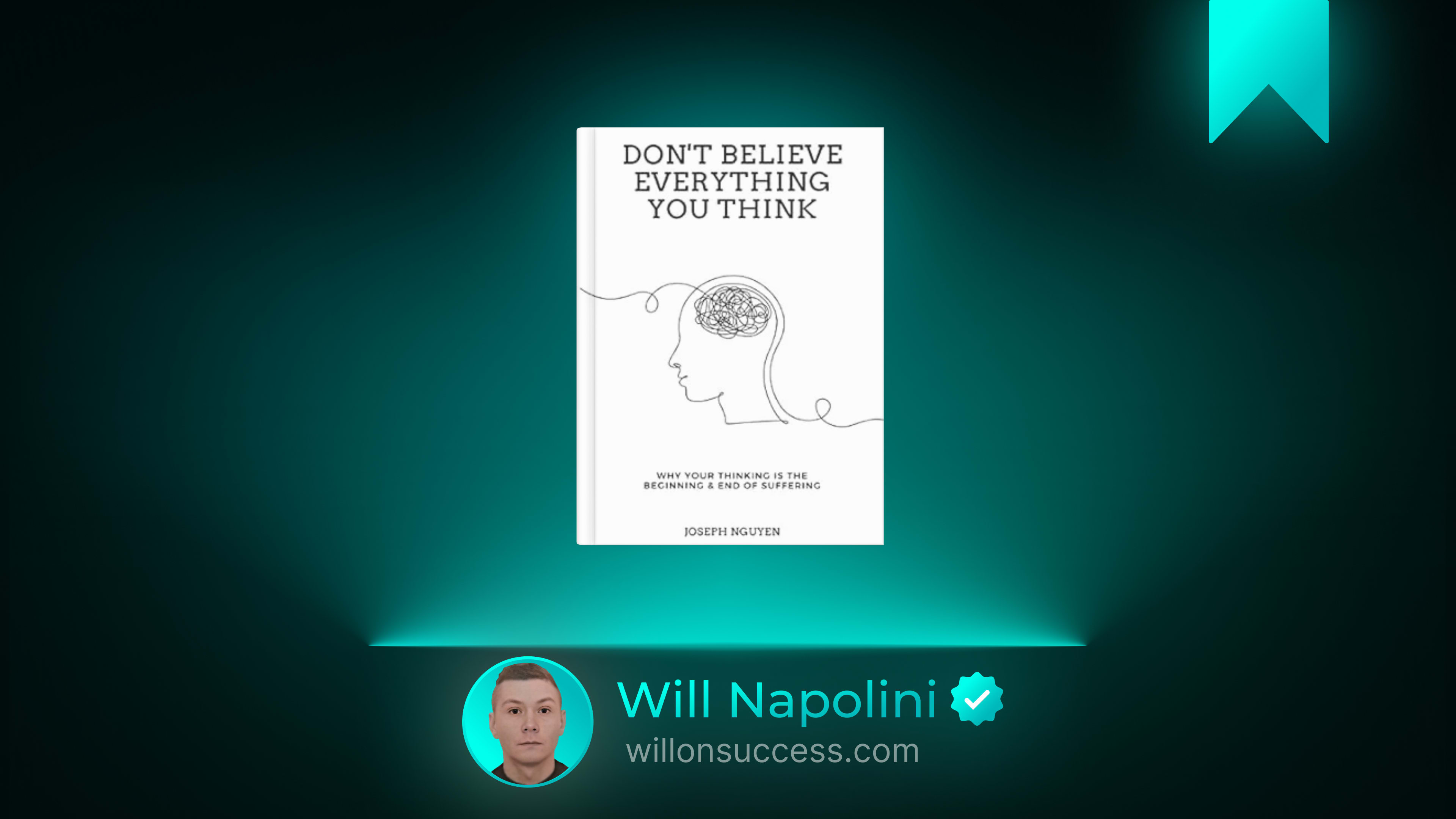
In his quietly revolutionary book, Don’t Believe Everything You Think, Nguyen dismantles the greatest illusion of the modern age: the belief that our circumstances dictate our feelings, and that more thinking is the solution to our problems.
The Big Idea: You Are Not Feeling Your Life
The central thesis of this book is a paradigm shift so fundamental that it changes the way you experience reality. Nguyen argues that we do not actually experience the external world. We only ever experience our thinking about the external world.
Think about two people sitting in the exact same traffic jam. One person is gripping the steering wheel, furious, mentally drafting the angry email they are going to send to their boss about being late. The other person is relaxed, using the unexpected pause to listen to a favorite podcast, entirely unbothered.
If the traffic jam were the cause of their feelings, both people would feel the exact same way. But they do not. The traffic is neutral. The only difference between the furious driver and the relaxed driver is their thinking in that exact moment.
When you truly understand this, a massive burden lifts from your shoulders. You realize that your anxiety, your frustration, and your self-doubt are not proof that your life is falling apart. They are simply proof that your current thinking is cloudy. You are not feeling your life. You are feeling your thinking.
The Concept: The Noun Versus the Verb
To understand how to quiet the mind, Nguyen introduces a distinction that is the absolute core of his teaching. It is the difference between a thought and the act of thinking.
A thought (the noun) is spontaneous. It is a mental event that arises naturally, uninvited, from the depths of your consciousness. Thoughts are neutral. A thought might be, “I need to buy milk,” or “The sky is beautiful today,” or even, “What if I fail this presentation?”
Thinking (the verb) is what happens when you engage with the thought. It is the active, compulsive process of analyzing, judging, ruminating, and spinning a narrative around the initial thought.
If a thought is a cloud passing through the sky, thinking is grabbing that cloud, pulling it down to the ground, and spending three hours trying to sculpt it into a castle while complaining that your hands are wet.
When the thought “What if I fail?” arises, that is just a thought. It is a spontaneous download. But when you engage with it—when you start thinking—you say, “If I fail, I will lose my job. If I lose my job, I will lose my house. Everyone will laugh at me. I am an imposter.”
The initial thought took a fraction of a second. The thinking took thirty minutes and ruined your afternoon.
Nguyen’s great insight is that you cannot stop thoughts from arising. Trying to stop your thoughts is like trying to stop your heart from beating; it is a biological and psychological impossibility. But you can absolutely stop thinking. You can stop engaging. You can let the thought pass through your mind the same way a bird flies through the sky, without leaving a trace.
The Inside-Out Illusion
Most of us live in what Nguyen calls an “outside-in” paradigm. We believe that our feelings are generated from the outside in. We think, “When I get the promotion, I will feel secure.” “When my partner finally apologizes, I will feel at peace.” “When the bank account reaches a certain number, I will stop worrying.”
This paradigm guarantees suffering, because it places the keys to your emotional well-being in the hands of a world you cannot control. You are perpetually waiting for the external environment to align perfectly so that you can finally feel okay on the inside.
Nguyen invites us into an “inside-out” reality. Your state of mind dictates your experience of the world, not the other way around.
When your mind is clear and quiet, a difficult conversation with a colleague feels like a manageable challenge. When your mind is cluttered and heavy with overthinking, that exact same conversation feels like a catastrophic threat. The colleague did not change. The circumstances did not change. Your state of mind changed.
Understanding this does not mean you ignore real-world problems. It means you stop trying to solve them while you are in a clouded state of mind. It means you recognize that the urgent need to “fix everything right now” is almost always a symptom of heavy thinking, not a genuine emergency.
The Danger of the Low State of Mind
One of the most practical and life-saving concepts in the book is the recognition of the “low state of mind.”
We all fluctuate through different states of mind. Sometimes we feel expansive, creative, resilient, and connected. Other times, we feel contracted, cynical, exhausted, and overwhelmed.
When you are in a low state of mind, your thinking becomes heavy. And because we do not realize that our feelings are coming from our thinking, we look out at the world and assume the world is the problem. In a low state of mind, your marriage looks like a mistake. Your career looks like a dead end. Your future looks bleak.
Here is the rule I have had to learn the hard way, and the one Nguyen emphasizes with profound clarity: Never try to solve a problem, make a major decision, or confront a relationship issue when you are in a low state of mind.
When you are in a low state of mind, your intellect is compromised. Your perspective is artificially narrowed. The problems you see are largely illusions created by the heaviness of your own thinking.
The mentor’s advice here is simple but requires immense discipline: Drop it. Step away. Go for a walk. Go to sleep. Do the dishes. Let the mud in the water settle. When your state of mind naturally lifts—and it always does, if you stop feeding it with heavy thinking—the problem that looked insurmountable yesterday will often reveal a simple, obvious solution today.
The Wisdom of the Uncluttered Mind
If we stop thinking, how do we get anything done? How do we make decisions, build businesses, or navigate complex relationships?
This is where the fear of quietness usually sets in. We are terrified that if we stop overthinking, we will become passive, lazy, or foolish. But Nguyen points to the concept of the uncluttered mind, which is the birthplace of intuition, flow, and true brilliance.
Intellect is the process of calculating. It is slow, laborious, and relies on past data. Intuition is the process of knowing. It is immediate, clear, and arises from the quiet space between your thoughts.
Think of a professional athlete in the middle of a game, or a musician lost in a performance. They are not thinking about the angle of their swing or the placement of their fingers. If they stop to analyze their mechanics in real-time, they choke. They perform at their highest level when the mind is entirely quiet, allowing the body and the subconscious to execute perfectly. This is the flow state.
When you stop compulsively thinking, you do not become less effective. You become profoundly more effective. You take action from a place of clarity rather than a place of compulsion. You do the work because it is the right thing to do in the moment, not because you are trying to soothe your anxiety about the future.
A quiet mind is not an empty mind. It is a clear mind. And a clear mind sees the next right step without needing a fifty-page strategic plan to justify it.
Why It Matters in Real Life
This is not just philosophical theory. This is the mechanics of daily living.
In your relationships, overthinking is the great destroyer of intimacy. When your partner says something slightly offhand, the spontaneous thought might just be the words they used. But the thinking writes a script: “They are pulling away. They don’t respect me. I need to bring this up tonight.” By the time you actually speak to them, you are arguing with a narrative you invented in your own head, not with the person sitting in front of you. Dropping the thinking allows you to actually see the person you love.
In your work, overthinking masquerades as productivity. We spend hours tweaking a presentation, researching endlessly, and seeking endless feedback, terrified of making a mistake. We confuse the motion of thinking with the action of doing. When you realize that your fear of failure is just a thought you are actively engaging with, you can close the laptop, hit “send,” and let the work speak for itself.
In your personal growth, overthinking keeps you trapped in analysis paralysis. You read ten books on habit formation, trying to find the perfect system, instead of just putting on your shoes and walking out the door. You cannot think your way into a new life. You have to act your way into it, and action requires the quiet courage of a mind that is not screaming at you to stay safe.
Practical Application
How do you actually stop thinking when the momentum of your mind feels like a runaway train? You do not fight it. Fighting your thoughts is just another form of thinking. Instead, you use these practices.
The “Drop the Rope” Technique Imagine your anxious thoughts are a monster on the other side of a pit, and you are playing tug-of-war with it. You are pulling with all your might, trying to drag the monster into the pit. But the monster is huge, and you are exhausted. The secret is not to pull harder. The secret is to just drop the rope. The monster is still there, yelling across the pit, but you are no longer engaged in the struggle. When a spiraling thought arises, notice it. Say, “There is a thought about money.” And then drop the rope. Do not argue with it. Do not try to solve it. Just let it sit on the other side of the pit.
The State of Mind Audit Before you react to an irritating email, before you bring up a grievance with your spouse, before you make a financial decision, pause and ask yourself: “What is my state of mind right now?” If the answer is heavy, tired, frustrated, or anxious, your only job is to delay the action. Tell yourself, “I am in a low state of mind. Nothing is as urgent as it feels right now. I will revisit this tomorrow.”
Follow the Breadcrumb, Not the Map Overthinkers want the entire map of the journey before they take the first step. They want to know how step one leads to step one hundred. Practice acting on intuition by following the breadcrumb. What is the one small, obvious, right thing to do in this exact moment? Do that. The next breadcrumb will reveal itself when you are ready for it. You do not need to figure out the next ten years today. You only need to navigate the next ten minutes.
Subtract, Do Not Add When we feel stuck, our instinct is to add. Add a new app, add a new morning routine, add a new podcast to listen to. Nguyen’s philosophy is about subtraction. When you feel overwhelmed, do not look for a new tool to manage the noise. Look for the thought you are holding onto that is creating the noise, and simply let it go. Peace is not something you acquire; it is what remains when you stop cluttering your mind.
Who Should Read This Book
Don’t Believe Everything You Think is a short, piercing, and deeply liberating read. It is essential for the chronic overthinker, the anxious achiever, and the person who feels like they are constantly running on a mental treadmill but getting nowhere. If your mind is a loud, chaotic place, this book will hand you the volume dial.
However, I want to be honest about what this book is not. It is not a clinical manual for severe psychiatric conditions, nor is it a step-by-step cognitive behavioral workbook. Nguyen’s approach is deeply rooted in a paradigm of non-duality and innate mental health—the idea that you are already whole and your peace is simply obscured by your thinking.
If you are someone who finds comfort in highly structured, analytical, ten-step frameworks for behavioral modification, Nguyen’s approach might feel too simple, or even frustratingly abstract. He is not asking you to restructure your thoughts; he is asking you to see through the illusion of them entirely. It requires a willingness to surrender control, which can be terrifying for those of us who use our intellect as a shield.
But if you are tired of fighting your own mind, and if you are ready to accept that the peace you are looking for is already sitting quietly beneath the noise, this book is a revelation.
One Small Step
You do not need to achieve enlightenment today. You just need to create a tiny gap between you and your thoughts.
Here is your assignment for the next hour: The next time you feel a sudden surge of a negative emotion—frustration in traffic, anxiety about an email, irritation with a family member—do not act on it immediately.
Pause. Take one breath. Ask yourself: “What am I thinking right now?”
Identify the specific thought that is generating the feeling. Look at it objectively, as if it were a leaf floating down a river. Do not judge the thought. Do not try to change the thought. Just observe it, and silently say to yourself, “This is just a thought. It is not a fact. And I do not have to engage with it.”
Let the leaf float by.
You have spent your entire life believing that the voice in your head is you. It is not. You are not the voice. You are the one listening to it.
The moment you realize that you are the listener, the voice loses its power over you. The noise of the world will not stop, and the spontaneous thoughts will continue to arise. But you will no longer be a prisoner to them.
Peace is not the absence of noise in the world around you. It is the refusal to argue with the noise inside you. Step out of the argument, and step back into your life.