The Power of Now: Why Your Mind Is the One Place You Keep Getting Lost
You are probably reading this while half-listening to a voice in your head that is already three steps ahead. It is rehearsing a conversation you will have tomorrow. It is re-running something someone said last Thursday. It is cataloguing what you have not finished, what you should have said, what might go wrong next week.
And here is the strange part: you have been doing this for so long that it feels like you. The voice and the person seem identical. You cannot remember the last time you simply sat in a chair without the narration running.
I want to talk to you about a book that made me stop and notice that voice for the first time. Not silence it. Not fight it. Just notice it, the way you notice a radio playing in the next room that you had forgotten was on.
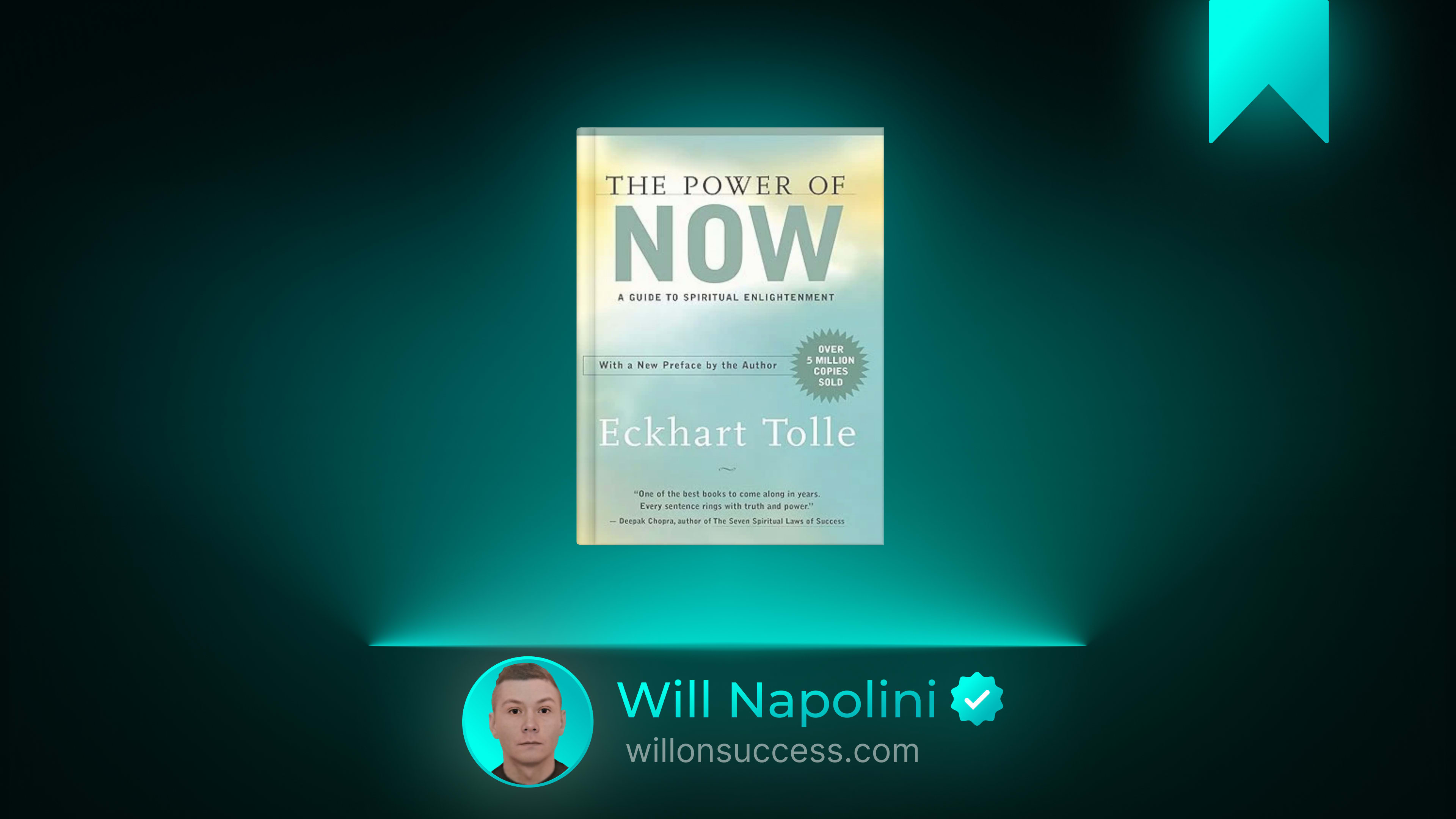
The book is The Power of Now by Eckhart Tolle, and its central claim is both simple and unsettling: almost all of the suffering you carry is not caused by your actual life in this moment. It is caused by your mind’s relentless commentary on your life—the stories about what was, what will be, what should be, what you fear might be.
The present moment, Tolle argues, is not where the problem lives. The present moment is where the problem cannot live, because in this exact second, you are breathing, you are here, and you can handle what is directly in front of you. What you cannot handle is the fictional weight of ten thousand tomorrows stacked on top of one Tuesday afternoon.
That is the idea. And if it sounds too simple, I understand. I thought so too, the first time I encountered it. Then I actually tried it.
The Night the Thinking Stopped
Tolle opens the book with a brief account of his own life before what he describes as a profound inner transformation. By his late twenties, he was living in a state of near-constant anxiety and depression. The mental noise was so loud and so punishing that, as he recounts it, the thought of not existing any longer felt like a relief compared to another hour inside his own head.
And then, one night, something shifted. He describes waking up in the early hours with a sense of absolute dread, and a single thought surfaced: I cannot live with myself any longer. But then he noticed the oddness of the sentence. If he could not live with himself, there had to be two of them—the “I” and the “myself” the I could not stand. One was the awareness. The other was the story the mind kept telling.
That recognition, he writes, cracked something open. The compulsive identification with thought loosened. What remained was a raw, quiet aliveness. Presence without commentary.
Now, I want to be honest with you. I did not have a dramatic midnight breakdown that rewired my consciousness in an instant. I doubt most readers will. What I found in this book was not a lightning bolt. It was a lens. A way of seeing the machinery of my own mind that I had never been handed before. And once you see the machinery, you can stop being ground up inside it.
That is what this book offers. Not a mystical experience delivered by mail. A lens. And a set of practices for using it.
You Are Not the Voice in Your Head
This is the foundation everything else rests on, so let me take it slowly.
Most of us operate under an assumption we never question: I am my thoughts. The inner monologue narrating your day, judging your performance, predicting disaster, replaying old wounds—that feels like the real you. The thinker and the thought seem to be the same entity.
Tolle’s most important move is to separate them. You are not the thinker. You are the awareness that can notice the thinker. The moment you step back and observe a thought—”Ah, there is the worry about the meeting again”—you have already proven that you are not the thought. You are the one watching it.
Think of it this way. You can look at your hand. That means you are not your hand; you are the one looking. In the same way, when you notice a thought, you are not the thought. You are the noticing.
This sounds abstract until you try it in the middle of a difficult afternoon. You are stuck in traffic, or waiting on a call that has been put on hold for eleven minutes, or lying awake at two in the morning. The mind starts its spiral. And instead of being swept into the current, you catch yourself: I am aware that I am feeling impatient right now. That tiny shift—from being the emotion to observing the emotion—creates a gap. And in that gap, you have a choice you did not have before.
You do not have to believe every thought that arrives. You do not have to obey every fear. You can watch the weather pass through without becoming the storm.
The Present Moment Is Not a Philosophy. It Is a Location.
Here is where the book gets practical, and where I think most readers either lean in or drift away.
Tolle insists, repeatedly, that the present moment is not a concept to admire. It is the only place where life actually happens. You cannot eat breakfast in yesterday. You cannot hug your child in next Thursday. Every real action, every genuine connection, every meaningful decision happens now, in this breath, in this room, with these hands.
And yet most of us treat the present as an obstacle. We endure it to get to the next thing. We sit through the commute to reach the office. We sit through the meeting to reach lunch. We sit through lunch to reach the afternoon. We sit through the years to reach retirement, and then we wonder where the time went.
The present becomes a hallway we rush through to get to a room that, when we arrive, turns out to be another hallway.
I have watched myself do this so many times. Washing dishes while mentally composing an email. Walking through a park while rehearsing an argument. Sitting across from someone I love while my eyes flick to my phone. The body is here. The mind is somewhere else entirely. And the strange cost is that I miss the actual life I am living while I am busy planning a better one.
Tolle’s invitation is not to become a monk. It is not to stop planning or setting goals. It is to stop making the present moment the enemy of the future you want. You can plan for next year while being fully alive in this hour. Those are not contradictions. In fact, the plans you make from a place of calm presence tend to be better than the ones you panic-draft at midnight while your mind is running laps.
Resistance Is Where the Pain Actually Lives
One idea in this book hit me harder than I expected, and I want to make sure you do not miss it.
Tolle draws a distinction between pain and suffering that sounds subtle but changes everything. Pain is real. Loss is real. Illness, failure, grief—these are part of being human, and no amount of positive thinking dissolves them. To pretend otherwise would be dishonest, and Tolle does not pretend.
Suffering, in his framework, is what gets added on top of pain by resistance. It is the story you wrap around the fact. The fact is: you lost the job. The suffering is the three-month loop of this shouldn’t have happened, I should have seen it coming, what will people think, I’ll never recover, this proves I am not enough. The event happened once. The mind replays it four hundred times a day, and each replay feels fresh.
I am not saying this to minimize anyone’s grief. I am saying that there is a difference between the wound and the hand you keep pressing into the wound. The wound needs time and care. The pressing can stop.
This does not mean you accept injustice. It does not mean you become passive. Tolle is clear about this: acceptance of the present moment is not the same as approval of the situation. You can fully accept this is what is happening right now while also taking decisive action to change it. In fact, action taken from acceptance tends to be clearer, steadier, and more effective than action taken from panic or rage, because you are responding to reality instead of to your story about reality.
The Pain-Body: The Old Wound That Wants Company
There is a concept in the book that I found genuinely useful as a practical tool, and it goes by the name Tolle gives it: the pain-body.
Think of it as an accumulation of old emotional pain that lives in you like a dormant weather system. Every unprocessed hurt, every swallowed anger, every grief you never fully let yourself feel—it does simply vanish. It settles. And under the right conditions, it activates. A comment from a coworker, a tone of voice from a partner, a Tuesday that goes slightly wrong, and suddenly the emotional reaction is enormous, disproportionate, ancient. You are not responding to the comment. You are responding to every comment that ever sounded like that one, compressed into a single charge.
The pain-body, as Tolle describes it, feeds on unconsciousness. It wants you to react automatically, to lash out, to spiral, to make someone else hurt the way you hurt. It perpetuates itself through drama and conflict.
But here is the part that matters: the moment you become conscious of it, its grip loosens. You feel the heat rising in your chest during an argument, and instead of saying the cutting sentence, you notice it. This is old pain talking. This is not just about the dishes. You do not suppress the feeling. You do not judge yourself for having it. You simply shine the light of awareness on it, and it begins to lose its automatic power.
I have found this idea more useful than almost any other in the book, because it gives you something concrete to look for. You stop asking, Why am I overreacting? in a tone of self-punishment, and start asking, What old hurt is this touching? That question alone changes the temperature of the moment.
Surrever Is Not Giving Up. It Is Putting Down the Weight.
The word “surrender” makes a lot of people flinch, and I understand why. It sounds like defeat. It sounds like lying down and letting life walk over you.
Tolle uses the word differently. For him, surrender means releasing the inner argument with what is. It means stopping the exhausted, full-time campaign of insisting that reality should be different from what it is, right now, in this moment. Not forever. Right now.
You can surrender to the fact that the flight is cancelled while still calling the airline to rebook. You can surrender to the fact that the conversation with your father was painful without replaying it for the next six weeks. You can surrender to the fact that you are tired tonight and let yourself rest without guilt.
What you are putting down is not your responsibility. You are putting down the extra, invisible weight of resisting your own life while you are trying to live it.
And here is what I have noticed, both in myself and in people I care about: the person who can say yes, this is hard, and I am here, and I will deal with what is in front of me tends to move through difficulty with more grace and more speed than the person who spends half their energy insisting the difficulty should not exist.
Where This Meets Your Ordinary Tuesday
Let me bring this out of the realm of ideas and into the kitchen, the commute, the office, the evening when the house is finally quiet.
At work, the practice of presence looks like this: you are writing the report, and you are actually writing the report. Not writing it while simultaneously dreading the performance review next month and replaying the awkward thing you said in Monday’s standup. One task. One attention. You will be surprised how much faster the work goes, and how much less tired you feel at five o’clock.
In relationships, it looks like this: when your partner or your friend is talking, you listen. Not while composing your response. Not while checking whether their story confirms something you already suspected. You let their words land in you before you build your reply. Most people are so hungry to be genuinely heard that the simple act of full attention can change the temperature of a relationship.
In your inner life, it looks like this: the anxious thought arrives at 11 p.m., the one about money, or health, or the thing you said three years ago. And instead of grabbing it and pulling it into a twenty-minute argument with yourself, you notice it. You say, quietly, I see you. You are a thought. You are not a command. And you return your attention to the breath, to the weight of the blanket, to the sound outside the window. The thought may come back. You notice it again. You are not fighting. You are simply no longer obeying.
Who Will Find This Book Useful, and Who Might Not
I want to be straightforward here, because not every book is for every person, and pretending otherwise does no one a favor.
If you overthink. If your mind runs a constant commentary that exhausts you. If you find yourself living mostly in regret about the past or anxiety about the future and struggling to feel at home in your own present. If you are spiritually curious but allergic to rigid dogma. If you have tried practical productivity systems and still feel a restlessness underneath the checklists. This book will likely speak to you in a way that surprises you.
If you are in the middle of acute crisis—severe clinical depression, active trauma, a situation that requires urgent practical intervention—this book is not a substitute for professional support. Tolle’s ideas can complement healing, but they are not a replacement for a therapist, a doctor, or a friend who will sit with you in the mess. You deserve that kind of help, and seeking it is its own form of presence.
And if you are the kind of reader who wants a step-by-step tactical manual with measurable benchmarks, the book’s contemplative, sometimes repetitive rhythm may test your patience. It reads more like a long, patient conversation than a curriculum. Give it permission to be what it is, and it will reward you. If it truly does not land, set it down without guilt. The right book finds you at the right time.
One Small Experiment for Tonight
I do not want to leave you with a concept. I want to leave you with something you can do before your head hits the pillow tonight.
Here it is.
Set a timer for two minutes. Sit in a chair. Put your hands in your lap. Close your eyes if that feels right, or keep them open with a soft gaze. And for two minutes, do nothing but notice. Notice the breath moving in and out. Notice the sounds in the room. Notice any thought that drifts through, and instead of following it down the hallway, simply say to yourself, thinking, and come back to the breath.
You will get distracted. Probably within eight seconds. That is not failure. The moment you notice the distraction is the moment the practice is working. You caught yourself. You stepped out of the stream and stood on the bank.
Two minutes. That is all. You do not need to meditate for an hour. You do not need to empty your mind. You need two minutes of noticing that you are here, in this body, in this room, alive, breathing, and not inside the story the mind is telling.
You start with two minutes. You let it be small. You let it be enough.
And tomorrow, if you remember, you do it again. Not because you are disciplined. Because you are curious about what it feels like to be fully in your own life for a few quiet minutes, without the narration.
The present moment has been here the whole time, waiting for you to arrive. It does not need you to fix yourself first. It does not need you to earn it. It is simply here, patient as stone, wide as the sky before weather moves in.
All you have to do is stop walking past it.
Step inside. You are already home.