The Untethered Soul: How to Stop Fighting Your Own Mind and Find Lasting Peace
Imagine you are trying to have a quiet, meaningful conversation with someone you care about, but there is a third person in the room who will not stop talking. This person critiques everything you say, worries about what might go wrong, replays old arguments, and constantly demands your attention.
If this happened in real life, you would likely ask this person to leave. Yet, most of us allow this exact dynamic to play out inside our own minds every single day.
We mistake this relentless inner chatter for ourselves. We believe the anxious narration is our identity, the critical commentary is our wisdom, and the fearful projections are our reality.
If I could sit across the table from you right now, I would tell you this: You are not the voice in your head. You are the one who hears it.
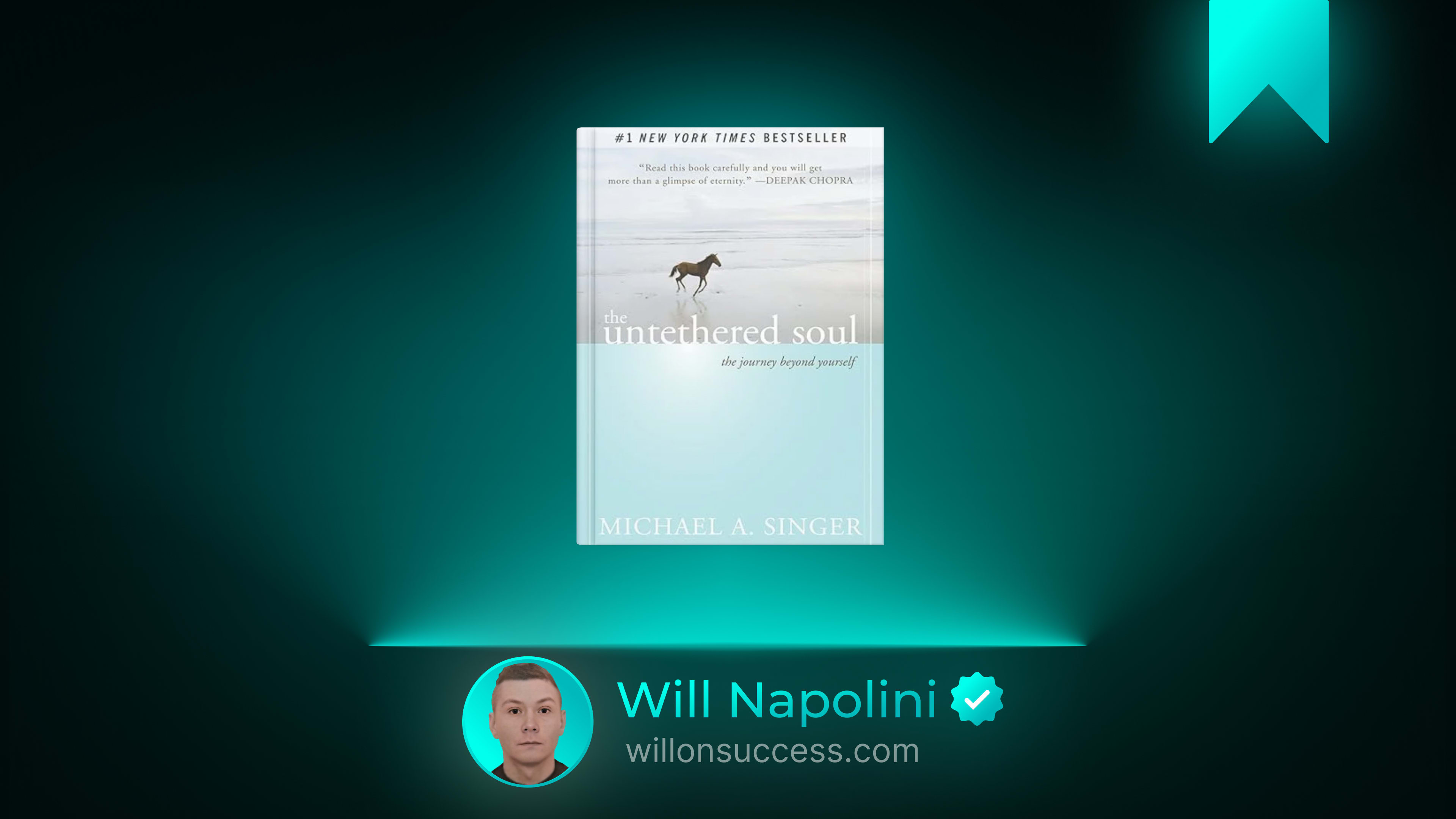
Michael A. Singer’s The Untethered Soul is not merely a book about feeling better. It is a precise, deeply practical manual for waking up from the trance of your own thinking. It offers a way out of the exhausting cycle of mental management and points you toward a profound, unshakable inner freedom.
You do not need to silence your mind to find peace. You simply need to change your relationship with it.

The Big Idea: The Witness and the Flow
The central thesis of The Untethered Soul is both simple and revolutionary: your true identity is not your thoughts, your emotions, or your personal history. Your true identity is the conscious awareness that observes them.
Singer calls this awareness the “witness.”
When you realize you are the witness, a fundamental shift occurs. You stop trying to control the uncontrollable waves of your mind and start recognizing them as passing weather. You learn that lasting peace does not come from arranging the outside world to your liking. It comes from refusing to let the outside world close your heart.
External results often begin with internal development. When you stop fighting your inner experience, you free up a massive reserve of energy. This is the energy of your own life force, waiting to be used for creation, connection, and growth, rather than being wasted on internal conflict.
The Core Concepts: The Roommate and The Thorn
To understand how we get trapped, Singer introduces two of the most powerful metaphors in modern personal-development literature.
The Inner Roommate
Imagine you have a roommate who follows you everywhere. This roommate is neurotic, easily offended, and constantly worried. They narrate your life: “Did I sound stupid in that meeting? They probably think I’m a fraud. I should have said something else.”
Because this voice speaks in the first person (“I am worried,” “I am angry”), you assume it is you. But it is not. It is a conditioned mechanism, a defense system built over years to protect you from uncertainty. The moment you can step back and say, “Ah, there is my inner roommate talking again,” you create space. In that space lies your freedom. You do not have to believe everything you think.
The Thorn in Your Arm
Singer asks you to imagine you have a sharp thorn embedded in your arm, resting right against a nerve. It causes you pain whenever it is touched.
You essentially have two choices. You can spend your entire life carefully maneuvering your arm, building elaborate routines, and demanding that everyone around you be gentle so that nothing ever bumps the thorn. Or, you can pull the thorn out.
Most of us choose the first option. We build our personalities, our careers, and our relationships around avoiding our deepest insecurities and past pains. We make the world safe for our thorn. But a life built around avoiding pain is not a life lived; it is a life managed. It makes you fragile.
True growth requires the courage to pull the thorn out. It will hurt temporarily, but it is the only way to be permanently free.
The Major Principles
You Are the Sky, Not the Weather
Your thoughts and emotions are like clouds passing across the sky. They are temporary, changing, and often dramatic. But you are the sky. The sky does not fight the storm; it simply holds the space for the storm to pass.
When you feel anger rising, the instinct is to either suppress it or act on it. Both reactions tie you to the emotion. The principle of the witness teaches you to do neither. You simply notice the anger. You feel the physical sensation of it in your body without attaching a story to it. By observing it without resistance, you allow it to move through you and dissolve.
What you repeat in private eventually becomes visible in your life. If you repeatedly practice observing your emotions without becoming them, you build an inner stability that no external crisis can easily shake.
Guard Your Inner Energy Relentlessly
Singer emphasizes that the most important thing in your life is your inner energy. In various traditions, it is called Chi, Shakti, or Spirit. It is the wellspring of enthusiasm, joy, and vitality within you.
This energy flows freely when your heart is open. It gets blocked when your heart closes.
Every time you get offended, hold a grudge, or retreat into fear, you are closing your heart. You might think you are protecting yourself, but you are actually cutting off your own life supply. The goal is not to become a doormat. The goal is to remain open and relaxed, even when difficult things happen, so that your inner energy can continue to flow and naturally clear out old, stagnant patterns.
The Practice of Relentless Letting Go
Letting go is not a one-time event. It is a moment-to-moment practice. It is the active decision to unclench your mental and physical grip on whatever is happening right now.
When you resist reality, you suffer. When you accept reality exactly as it is in this present moment, you regain your power to act effectively. Letting go does not mean you stop taking action. It means you stop fighting the fact of what has already happened, freeing you to deal with what needs to be done next.
Why This Matters in Your Daily Life
You may be working hard and still wondering why nothing is changing. You may be achieving your goals but still feeling a quiet sense of emptiness or anxiety. This is the cost of living entirely inside your head.
Consider how this applies to an ordinary Tuesday:
- At Work: A colleague criticizes your project. Your inner roommate immediately starts drafting a defensive reply, replaying past injustices, and spiraling into self-doubt. Instead of engaging the roommate, you notice the tightness in your chest. You relax your shoulders. You respond to the feedback objectively, leaving the emotional drama behind.
- In Relationships: Your partner forgets to do something they promised. The old pattern is to close your heart, withdraw, and punish them with silence. The untethered approach is to feel the initial disappointment, let it pass without building a story about what it “means,” and communicate your needs clearly from an open heart.
- With Yourself: You make a mistake. Instead of launching into a familiar internal lecture about your inadequacy, you observe the self-criticism with mild curiosity. You recognize it as an old, conditioned habit, and you choose to redirect your attention to the present task.
Peace is not the absence of noise. It is the presence of a witness who no longer argues with the noise.
Practical Application: Turning Insight into Action
Understanding these concepts is only the beginning. Action before intention is what changes your life. Here are three concrete ways to bring The Untethered Soul into your daily routine.
1. The “Hello” Centering Experiment
The next time your mind is racing with anxiety or endless to-do lists, stop and mentally shout “Hello!” inside your own head. Do it right now. Notice that you are the one who heard the shout. That simple act of directing your attention proves, experientially, that you are separate from the voice. You are the listener. Use this whenever you feel overwhelmed.
2. The Physical Release Check-In
Your mind and body are connected. When your mind resists, your body tenses. Set a timer for three random moments during your day. When it goes off, scan your body. Are your jaw, shoulders, or stomach clenched? Do not judge it. Simply drop your shoulders, unclench your jaw, and take one deep, slow breath. Signal to your nervous system that you are safe and that you are choosing to let go.
3. The Thorn Journaling Prompt
Take ten minutes this week to write down the answer to this question: “What pain or insecurity am I currently organizing my life to avoid?”
Be honest. Is it the fear of rejection? The fear of looking foolish? The fear of financial instability? Once you identify the thorn, you can stop building fortresses around it and start taking the small, brave steps required to remove it.
Who Should Read This Book
The Untethered Soul is a profound resource for anyone who feels held hostage by their own thoughts, anxiety, or emotional reactivity. If you are tired of the endless mental chatter and are ready to take responsibility for your inner state, this book will feel like a breath of fresh air. It is equally valuable for seasoned meditators and complete beginners.
However, if you are looking for a tactical productivity hack, a step-by-step business strategy, or a purely clinical psychology textbook, this may not be the right fit. Singer’s work is fundamentally spiritual. It asks you to look beyond the ego and confront the deepest layers of your own consciousness. It requires a willingness to be honest with yourself.
One Small Step
Do not wait for a massive life overhaul to begin. Transformation happens in the micro-moments.
Here is your single, immediate action: The next time you feel a surge of minor irritation today—a delayed train, a rude email, a spilled cup of coffee—do not argue with the feeling. Do not complain about it.
Pause. Drop your shoulders. Take one deep breath, and silently say to yourself, “I release this.”
Then, return to what you were doing.
You start small. You stay consistent. You let time do its work.
A small decision becomes a direction, and a direction repeated long enough becomes a life. The door to your inner freedom is not locked. It is only waiting for you to stop pushing against it, and simply walk through.