The Weight of the First Thing: Why Reordering Your Morning Changes the Architecture of Your Life
I want to ask you about the first sixty seconds of your day.
Before your feet touch the floor. Before the coffee brews. Before the house wakes up and demands your attention. Where does your mind go?
For most of us, the moment consciousness returns, the weight of the world crashes in. We mentally review the to-do list. We anticipate the difficult email. We feel the familiar, low-grade hum of anxiety that whispers, You are already behind. And almost instinctively, our hand reaches for the phone, inviting the noise of the entire planet into our beds before we have even taken a conscious breath.
We think this is just modern life. We think the exhaustion, the striving, and the quiet desperation are simply the taxes we pay for being responsible adults.
But what if the exhaustion isn’t a time-management problem? What if it is an architecture problem? What if the foundation of your day is cracking because you are building it on the wrong first thing?
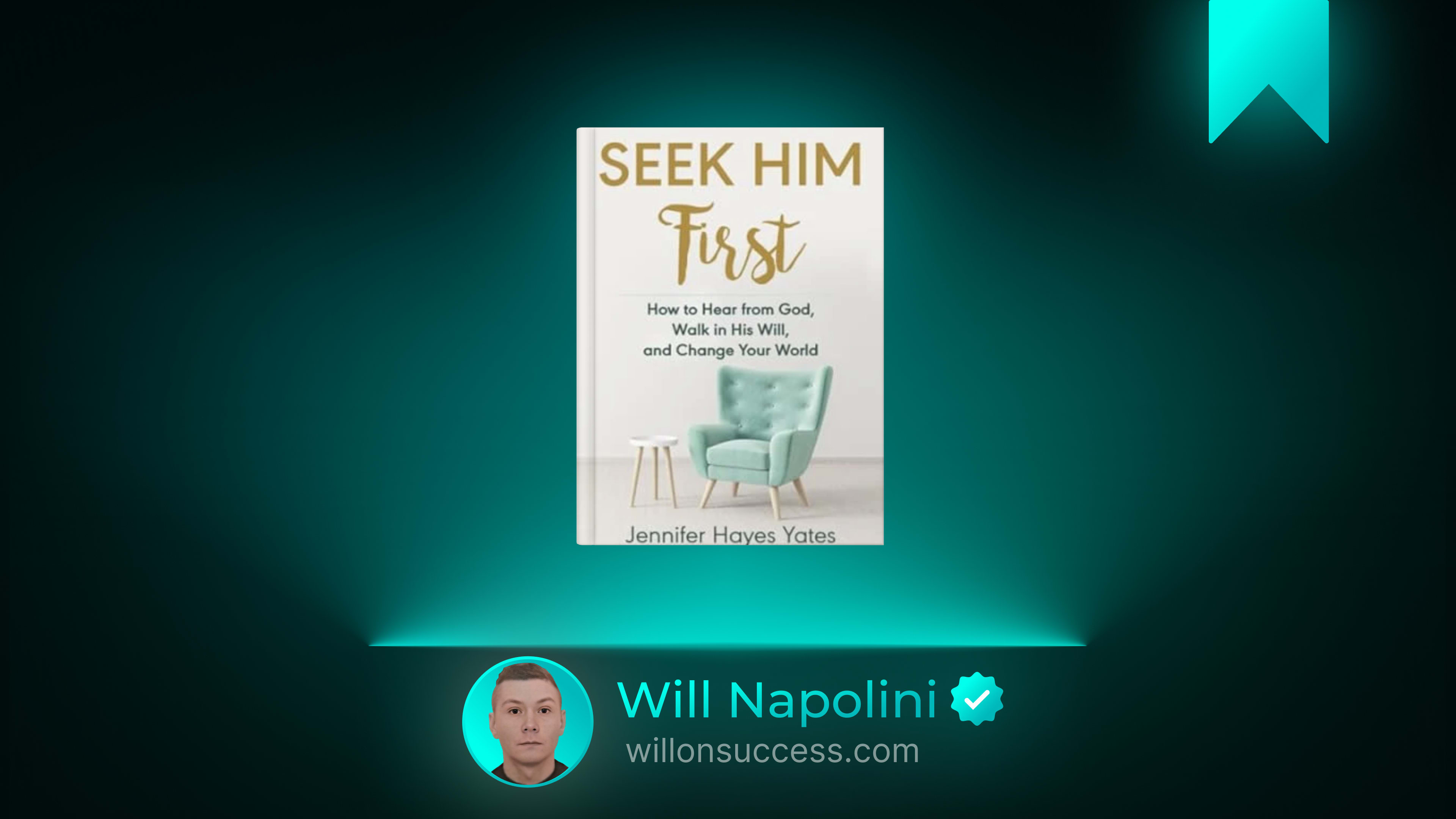
Jennifer Hayes Yates wrote Seek Him First to address a very specific, very modern kind of burnout. It is the burnout of the well-intentioned. The burnout of the person who loves their family, works hard at their job, and perhaps even serves faithfully in their community, yet feels a persistent, hollow ache at the end of the day.
The central thesis of the book rests on an ancient, radical premise found in the words of Jesus: Seek first the kingdom of God and his righteousness, and all these things will be added to you.
Notice the order. It does not say “Seek God also.” It does not say “Seek God when you have time.” It says first.
Yates argues that the human soul was not designed to carry the weight of the world. When we make our career, our children, our reputation, or even our ministry the “first thing” in our lives, we crush those good things under a weight they were never meant to bear. And we break ourselves in the process.
The invitation of this book is not to do less. It is to reorder your loves. It is the shift from a life of frantic striving to a life of quiet abiding.
The Story of the Kitchen and the Floor
To understand this shift, Yates draws our attention to one of the most famous domestic scenes in history: the story of Mary and Martha.
You likely know the story. Jesus visits their home. Martha is in the kitchen, distracted by the immense practical demands of hosting. She is chopping, stirring, sweeping, and growing increasingly resentful. Mary, meanwhile, is sitting quietly at Jesus’ feet, simply listening to him.
Martha finally snaps. She asks Jesus to tell Mary to get up and help. And Jesus offers a gentle but piercing correction: Martha, you are anxious and troubled about many things, but one thing is necessary. Mary has chosen the good portion.
What I have learned from sitting with this story over the years is that Jesus was not condemning hard work. He was not saying that cooking and cleaning are unspiritual. He was diagnosing the source of Martha’s work.
Martha was working from a place of anxiety. She was striving to earn approval, to control the environment, to prove her worth through her output. Mary, on the other hand, was receiving. She understood that before she could do anything for the Master, she needed to simply be with the Master.
Yates points out that most of us are living in Martha’s kitchen. We are so busy doing things for God, for our families, and for our careers that we have forgotten how to sit at the feet of the One who gives us life. We have traded the presence of God for the performance of productivity. And we wonder why we are so tired.
The Tyranny of the Second Thing
There is a principle I want you to hold onto, because it will change how you evaluate your entire life: When you make a good thing the first thing, it does not become better; it becomes an idol that crushes you.
Your career is a good thing. But if it is your first thing, you will sacrifice your health and your family on its altar, and eventually, it will break your heart.
Your children are a magnificent gift. But if they are your first thing, you will place the unbearable burden of your own identity and happiness on their small shoulders. You will hover, you will control, and you will crush them with your expectations.
Even ministry and serving others are good things. But if they become your first thing, you will become a hollow shell, pouring out water from a pitcher that is never being refilled.
Only the Creator can bear the weight of being first. When God is in the center, in the first position, everything else in your life finds its proper orbit. Your career becomes a vocation, not a savior. Your children become a joy, not a project. Your work becomes an offering, not a performance.
Seeking Him first is not about neglecting your responsibilities. It is about securing the foundation so that your responsibilities do not collapse on top of you.
You Cannot Hear the Whisper if You Are Running with the Sheep
One of the most profound themes in Yates’ work is the nature of how God speaks. We often expect divine guidance to come in booming voices, burning bushes, or dramatic, undeniable signs. When we don’t see the fireworks, we assume God is silent.
But the biblical pattern, and the pattern Yates highlights, is that God rarely shouts. He whispers.
Think about the prophet Elijah, who looked for God in the earthquake, the wind, and the fire, only to find Him in the “still, small voice” — the gentle whisper.
Why does the Creator of the universe speak in a whisper?
Because a shout forces you to pay attention, but a whisper requires you to draw near. A shout can be heard across a chaotic room; a whisper requires you to quiet the room, lean in, and focus your entire being.
If your life is a constant barrage of podcasts, notifications, news alerts, and background noise, you are not experiencing a silent God. You are simply standing in a hurricane trying to hear a breeze.
Seeking Him first requires the discipline of engineered quiet. It requires you to ruthlessly protect the margins of your life. You cannot hear the voice of the Shepherd if you are constantly running with the sheep. You must build pockets of silence into your day, not as a luxury, but as a survival mechanism for your soul.
The Difference Between Striving and Abiding
There is a profound difference between working hard and striving.
Working hard is a physical and mental exertion toward a goal. It is necessary, honorable, and good.
Striving, however, is an internal posture. Striving is the belief that the outcome depends entirely on you. Striving is the tight chest, the clenched jaw, the sleepless nights spent trying to manipulate circumstances to get the result you want. Striving is trying to do for God what only God can do through you.
Yates draws heavily on the invitation of Jesus: Take my yoke upon you and learn from me, for I am gentle and humble in heart, and you will find rest for your souls. For my yoke is easy and my burden is light.
A yoke is a wooden beam used to pair two oxen together to pull a plow. When Jesus invites us to take His yoke, He is not offering us a life without work. He is offering us a life of partnership.
When an older, experienced ox is yoked with a younger, inexperienced one, the older ox bears the brunt of the weight and sets the pace. The younger ox simply has to walk in step.
When you seek Him first, you are stepping into the yoke with the Master. You still walk the field. You still pull the plow. But the crushing weight of the outcome is no longer on your shoulders. The pace is set by His grace, not your anxiety. The burden becomes light because you are no longer pulling it alone.
Abiding is the daily, hourly choice to remain in the yoke. It is the choice to say, “I can do nothing of eternal value without You,” and then to actually wait for His strength before you move.
What This Looks Like on an Ordinary Tuesday
It is easy to read about abiding and presence when you are sitting quietly on a Sunday morning. But how does this translate to a Tuesday afternoon when the toddler is screaming, the client is demanding a revision, and the car needs new brakes?
This is where the rubber meets the road.
Seeking Him first does not mean you retreat to a monastery. It means you carry the monastery inside you into the chaos.
It looks like pausing for three seconds before you reply to that provocative email, silently asking, Give me Your words, not my flesh.
It looks like looking at your overwhelmed spouse and choosing to offer grace instead of a critique, because you have already received grace in the quiet of your morning.
It looks like realizing, mid-day, that your chest is tight and your breathing is shallow, and choosing to step into the hallway for two minutes of deep breathing and surrender, rather than pushing through on sheer willpower.
Peace is not the absence of a chaotic schedule. Peace is the presence of a centered soul. When you seek Him first, the chaos around you may not change, but the chaos inside you begins to settle. You become an anchor in the room, rather than another piece of debris caught in the storm.
The Architecture of the Morning Threshold
Understanding this is beautiful, but implementing it requires a system. You cannot rely on willpower to seek God first when your alarm goes off at 6:00 AM. Willpower is a finite resource, and in the morning, it is at its lowest.
You need a physical and mental architecture that makes the right choice the easiest choice.
Yates encourages the practice of giving God the “first fruits” of your day. Here is a practical way to build that threshold.
1. The Night Before Preparation The success of your morning actually begins the night before. Before you go to sleep, set up your physical space. Put your Bible or your devotional journal on the chair or the table where you plan to sit. Put your phone in another room, or at least across the room on a charger. Make the path to the phone difficult, and the path to the Word easy.
2. The First Fifteen Minutes When you wake up, do not touch the screen. The screen is a portal to the world’s demands. Give the first fifteen minutes of your consciousness to the Creator. You do not need a complex theological ritual. Simply open your hands, palms up, and pray a prayer of open-handed surrender: Lord, this day belongs to You. My schedule, my interactions, my successes, and my failures. I seek You first. Lead me.
3. The Micro-Pauses Throughout the day, set three alarms on your watch or phone. Label them “Breathe.” When the alarm goes off, you do not need to stop working. You just need to stop striving. Take one deep breath, acknowledge His presence in the room with you, and step back into the yoke.
Who Should Read This Book
Who it is for: If you are a high-capacity person who is secretly running on fumes, this book is a lifeline. If you are a parent, a leader, or a professional who feels the crushing weight of trying to manage every outcome, Yates’ gentle but firm call to abide will feel like a cool drink of water. It is especially powerful for those who have grown up in environments that rewarded performance and burnout, offering a deeply healing return to a grace-based life.
Who might find it less useful: If you are looking for a highly tactical, step-by-step business strategy or a rigorous time-management matrix, this is not the book for you. This book operates on the level of the soul, not the spreadsheet. It requires a willingness to slow down, to be vulnerable, and to examine the internal motivations behind your external actions. If you are not ready to confront your own striving, the message may feel frustratingly simple.
One Small Step
You do not need to overhaul your entire life today. You do not need to commit to an hour of silent meditation starting tomorrow. You just need to reclaim the very first moment of your day.
Here is your one small step for tonight:
Take your phone off your nightstand. Plug it in across the room, in the bathroom, or in the hallway. Place a physical book—a Bible, a journal, or a book that grounds you in truth—on your pillow or right next to your bed.
Tomorrow morning, when you wake up, let your feet touch the floor before your hand touches a screen. Give the first sixty seconds of your day to the One who gave you the breath to live it.
The Door Is Already Open
We spend so much of our lives trying to build a secure, meaningful, and successful life from the outside in. We gather the resources, we build the routines, we manage the schedules, and we hope that if we just work hard enough, we will finally feel a sense of peace at the center of it all.
But peace does not work from the outside in. It works from the inside out.
The invitation of Seek Him First is the invitation to stop managing the symptoms of your exhaustion and to start healing the root of your soul. It is the realization that you were never meant to be the general manager of the universe. You were only meant to be a beloved child, walking in step with a gentle Shepherd.
The yoke is ready. The burden is light. The whisper is waiting.
You do not have to strive to be loved. You do not have to perform to be seen. You only have to seek Him first, and trust that the One who holds the stars will also hold your Tuesday.
Put down the heavy weight of trying to do it all. Step into the yoke. And let Him carry the rest.