Think and Grow Rich by Napoleon Hill: Why Your Thoughts Are the Blueprint of Your Reality
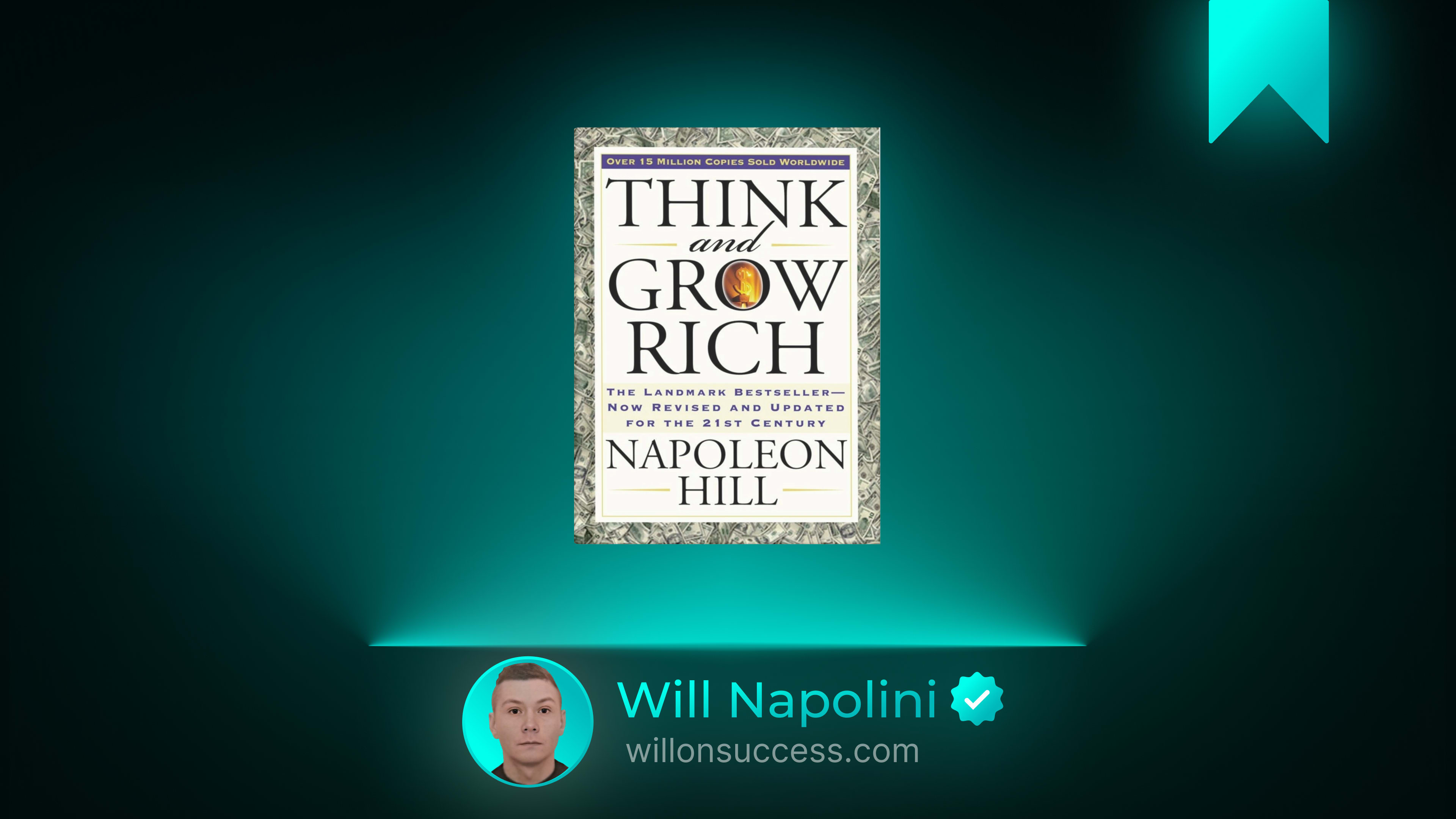
Have you ever noticed how some people seem to bend circumstances to their will, while others are constantly bent by circumstances?
You watch them build a business, navigate a crisis, or create wealth, and you wonder what invisible advantage they possess. You look at your own life—the effort you put in, the late nights, the sacrifices—and you wonder why the results do not seem to match the input. You work hard. You are smart. You want a better life. So why does the gap between where you are and where you want to be feel so impossibly wide?
If I could sit across the table from you right now, I would tell you something that might surprise you: the gap is rarely caused by a lack of talent, and it is almost never caused by a lack of hard work.
The gap is caused by a lack of psychological architecture.
Nearly a century ago, a man named Napoleon Hill published a book that attempted to solve this exact problem. Think and Grow Rich is not just a book; it is the bedrock upon which almost the entire modern personal-development industry was built. Hill spent decades studying the wealthiest and most successful people of his era—Andrew Carnegie, Thomas Edison, Henry Ford—trying to isolate the exact formula they used to turn their ideas into reality.
What he found was not a secret stock tip. It was not a shortcut. It was a psychological framework. And while the language of the book is unmistakably from 1937, the mechanics of human achievement it describes have not aged a day.
Here is what I have learned from studying Hill’s work, and here is how you can use it to stop drifting and start building.

The Big Idea: Thoughts Are Things
The central thesis of Think and Grow Rich is captured in a phrase that has become a cliché, but which Hill meant with absolute, literal seriousness: Thoughts are things.
Hill argued that wealth—and by extension, any meaningful achievement in art, leadership, or personal freedom—does not begin with capital, connections, or luck. It begins as a state of mind. Specifically, it begins with a burning desire, backed by unwavering faith, and translated into organized action.
Most people treat their thoughts as passing weather. A thought about starting a business comes, and they entertain it for a day, and then it blows away. A thought about getting in shape comes, and they buy a gym membership, and then it fades.
Hill’s discovery was that successful people do not treat their thoughts as weather. They treat them as blueprints. They take a single, dominant desire and they hold it in their mind with such intensity and focus that it eventually forces the physical world to rearrange itself around that desire.
You do not get what you want in life. You get what you are psychologically aligned with. And alignment is not an accident; it is a design.
The Man Who Swept Floors for Thomas Edison
To understand how this works, we have to look at the story Hill uses to open the book. It is the story of Edwin C. Barnes.
Barnes was an ordinary man with no money, no advanced education, and no connections. But he had a Definite Chief Aim. He did not just want to work for Thomas Edison. He wanted to become Edison’s business partner.
Notice the difference. A wish is a request you make to the universe. A burning desire is a demand you make of yourself.
Barnes hopped a freight train to Orange, New Jersey, and showed up at Edison’s laboratory. He looked like a tramp. Edison gave him a menial job sweeping floors and repairing equipment. Most people would have been insulted. Most people would have quit after a month, deciding that the “partnership” idea was a foolish dream.
But Barnes did not quit. He did not even complain. He simply worked, and he waited, and he kept his mind fixed entirely on his goal. He burned his bridges behind him; there was no retreat.
Years passed. Then, Edison invented a new dictating machine (the Ediphone) that his sales team could not figure out how to sell. Barnes saw his opportunity. He told Edison he could sell it. He did. He sold it so well that Edison gave him the exclusive distribution rights, and Barnes eventually became Edison’s partner, growing incredibly wealthy in the process.
Barnes succeeded because he understood a principle that most of us ignore: definiteness of purpose. He knew exactly what he wanted, and he was willing to start by sweeping floors to get it. He did not let his current circumstances dictate his internal reality.
A Wish Is Not a Desire (The Power of Definiteness)
If there is one mistake I see people make more than any other, it is confusing a wish with a desire.
You wish you had more money. You wish you were in a better relationship. You wish you had written that book. Wishing is passive. It requires nothing of you. It is a comfortable daydream that protects you from the pain of trying and failing.
A burning desire, Hill explains, is an obsession. It is a pulsating need that transcends everything else. And to turn a vague wish into a burning desire, Hill provides a precise, six-step formula.
I want you to look at these steps not as a mystical incantation, but as a cognitive behavioral tool. This is how you program your brain to recognize opportunities it would otherwise ignore.
- Fix the exact amount: Do not say, “I want to be rich.” Say, “I want to earn $150,000 a year.” The subconscious mind cannot act on vague targets.
- Determine exactly what you intend to give: There is no such thing as something for nothing. What service, what product, what value will you provide in return for this money?
- Establish a definite date: When will you possess this? A goal without a deadline is just a hallucination.
- Create a definite plan: Begin at once, whether you are ready or not, and put this plan into action.
- Write it down: Compose a clear, concise statement of the above four steps.
- Read it aloud: Read your written statement aloud twice daily. Once just before bed, and once just after waking up. As you read, see and feel and believe yourself already in possession of the money.
When you do this, you are not engaging in magical thinking. You are engaging the Reticular Activating System in your brain. You are telling your neurology, This is what matters. Filter out the noise and bring me the resources, the people, and the ideas that serve this goal.
Programming the Subconscious: You Are Already Using Auto-Suggestion
One of the most profound concepts in the book is auto-suggestion. This is simply the practice of feeding your subconscious mind specific thoughts until they become beliefs.
Here is the truth about your subconscious mind: it does not judge. It does not argue. It does not care whether a thought is true or false, helpful or destructive. It simply takes whatever you feed it most consistently and works to make it a reality.
Most people are using auto-suggestion every single day, but they are using it to their own detriment. You wake up and think, I am so tired. I am never going to get ahead. People like me don’t get those opportunities. You repeat those thoughts in the car, in the shower, before you go to sleep. And your subconscious says, Understood. I will make sure you remain tired, stuck, and blind to opportunities.
Hill’s instruction is to take the wheel.
You must deliberately inject thoughts of courage, faith, and capability into your mind. You do this through the repetition of your Definite Chief Aim. You do this by visualizing yourself already having achieved your goal, and—this is the critical piece—mixing emotion with the thought.
A thought without emotion is just data. A thought mixed with deep, visceral emotion is a command. When you can feel the pride, the relief, and the joy of your goal before it has happened, your subconscious accepts it as a memory of the future, and it begins moving you toward it.
The Illusion of General Knowledge
We are taught from a young age that we need to know a little bit about everything. We collect degrees, we memorize trivia, we pride ourselves on being well-rounded.
Hill draws a sharp distinction between general knowledge and specialized knowledge. General knowledge, no matter how vast, is of little use in the accumulation of wealth. Knowledge is only potential power. It only becomes actual power when it is organized into a definite plan of action.
To illustrate this, Hill tells the story of Henry Ford. During World War I, a Chicago newspaper called Ford an “ignorant pacifist.” Ford sued them for libel. In court, the newspaper’s lawyers tried to prove Ford was ignorant by asking him a barrage of general knowledge questions, like “How many soldiers did the British send to America in 1776?”
Ford finally grew tired of the game. He pointed his finger at the lawyer and said that if he really wanted to answer such foolish questions, he just had to reach over and press a button on his desk, and a specialist would come in and give him the exact answer. He did not need to clutter his mind with general trivia; his mind was reserved for organizing ideas and directing men who possessed specialized knowledge.
What I want you to take away from this is a massive permission slip. You do not need to know everything to succeed. You do not need to be the smartest person in the room. You need to know where to find the specialized knowledge you lack, and you need to know how to organize it into a plan.
Three Feet From Gold: The Master Key of Persistence
If you have ever started a project, hit a wall of resistance, and quit, you need to hear the story of R.U. Darby.
During the gold rush, Darby’s uncle went west to dig for gold. He staked a claim, worked the land, and finally struck a vein of shining ore. He needed machinery to bring it to the surface, so he quietly covered up the mine, went back to Maryland, and raised the money from relatives and neighbors.
They bought the machinery and went back to work. The first car of ore was mined and sent to a smelter. The returns proved they had one of the richest mines in Colorado. A few more cars, and they would be wealthy beyond their dreams.
But then, the vein of gold disappeared. They had hit a “fault” in the earth. They kept drilling, desperately trying to find the vein again, but there was nothing. Finally, they gave up. They sold their machinery to a junk man for a few hundred dollars and took the train home.
The junk man was smarter. He called in a mining engineer to look at the mine and do a little calculating. The engineer advised him that the project had failed because the previous owners were not familiar with “fault lines.” His calculations showed that the vein would be found just three feet from where the Darbys had stopped drilling.
The junk man mined the remaining ore, made millions of dollars, and walked away rich. Darby learned the lesson. He went on to make a fortune selling insurance, because he made a vow: I will never quit when a customer says no.
Here is what I have discovered about failure: defeat is almost always temporary. It is a testing mechanism. It is the universe asking, How badly do you want this?
Most people quit when they encounter temporary defeat. They interpret a setback as a stop sign. But the people who achieve great things interpret a setback as a detour. They pivot, they adjust their plan, but they never abandon the goal. Persistence is not a personality trait you are born with; it is a state of mind you cultivate by having a definite purpose and a burning desire.
The Master Mind: You Cannot Build Alone
There is a myth in our culture of the solitary genius. The lone wolf. The self-made entrepreneur.
Hill shatters this myth with his concept of the Master Mind. He defines it as the “coordination of knowledge and effort, in a spirit of harmony, between two or more people, for the attainment of a definite purpose.”
Andrew Carnegie, the man who essentially commissioned Hill to write this book, attributed his entire fortune to his Master Mind. He surrounded himself with men who knew more about steel, finance, and logistics than he did. He did not need to be the expert; he needed to be the conductor.
Hill argues that when two minds come together in harmony, they create a third, invisible, intangible force. You can see this in your own life. Think about the people you spend the most time with. Do they drain your energy, or do they expand it? Do they mock your ambitions, or do they challenge you to refine them?
You cannot build a great life in a vacuum. You need a challenge network. You need people who possess the specialized knowledge you lack, who share your vision, and who will hold you accountable when your faith wavers. If your current circle is committed to comfort and cynicism, you will have to find a new circle. Your environment is quietly shaping your behavior every single day.
Why This Matters on an Ordinary Tuesday
It is easy to read about Edison and Carnegie and feel inspired. But inspiration is cheap. How does Think and Grow Rich apply to you, on a random Tuesday in the middle of a chaotic month?
It applies when you are sitting at your desk, staring at a project that has stalled, and every instinct tells you to close the laptop and walk away. That is the moment of temporary defeat. Hill’s principles tell you to stop, re-evaluate your plan, and keep digging.
It applies when you are tempted to complain about the economy, your boss, or your lack of resources. Hill’s principles remind you that every adversity carries with it the seed of an equivalent or greater benefit, but only if you are looking for the seed instead of mourning the storm.
It applies when you catch yourself engaging in negative auto-suggestion. You make a mistake at work, and your inner voice says, I am so stupid, I always mess this up. Hill’s framework demands that you interrupt that thought and replace it. I made a mistake. I am learning the system. I will do it differently tomorrow.
You are already programming your mind every day. The only question is who is holding the pen.
Who Should Read This Book
If you are an entrepreneur, a creator, or someone who feels a deep, restless pull toward a life you have not yet built, this book is mandatory reading. It provides the psychological scaffolding required to endure the long, unglamorous middle phase of any great endeavor.
However, I want to be entirely honest with you about the reading experience. Think and Grow Rich was written in 1937. The language is formal, repetitive, and deeply rooted in the New Thought movement of the early 20th century.
The later chapters of the book delve into what Hill calls the “Sixth Sense” and the “Mystery of Sex Transmutation.” These sections can feel esoteric, mystical, and difficult to parse for a modern, pragmatic reader. If you are looking for a data-driven, step-by-step manual on index funds and real estate, this is not the book for you.
Read it for the psychology. Read it for the philosophy of persistence. Read it to understand how to align your subconscious mind with your conscious goals. If you can look past the dated vernacular, you will find a goldmine of practical wisdom.
Your One Small Step
Do not close this article and simply add “read Napoleon Hill” to a list of things you might do someday. Action is the bridge between the inner world of thought and the outer world of reality.
Here is what I want you to do today. It will take you less than ten minutes.
Take out a blank piece of paper. I want you to write down your Definite Chief Aim using Hill’s framework, adapted for your life right now.
Write down the exact financial or personal goal you want to achieve. Write down the exact date you intend to achieve it. And most importantly, write down exactly what you intend to give in return for it. What value will you provide? What skill will you master? What service will you render?
Keep it to one paragraph. Sign it.
Then, place that piece of paper where you will see it every morning and every night. Read it aloud. Do not just read the words; feel the reality of them. See yourself doing the work. Feel the satisfaction of the completed goal.
A wish is a request you make to the universe. A burning desire is a demand you make of yourself.
You have the blueprint. Now, pick up the tools and start building.