The Almanack of Naval Ravikant Summary: The Blueprint for Wealth and Peace
I used to believe there was a hidden tax on success. For a long time, I operated under the quiet assumption that if you wanted to build significant wealth, you had to sacrifice your peace of mind. The cultural narrative suggested that you could either be rich and stressed, or poor and happy, but you could not be both.
I have since learned that this is a false dichotomy. It is a lie we tell ourselves to justify our own exhaustion.
If you are feeling trapped in the cycle of trading your time for money, or if you are achieving your goals but still feel a persistent hum of anxiety beneath your ribs, I want to share a framework that will fundamentally shift how you view your life.
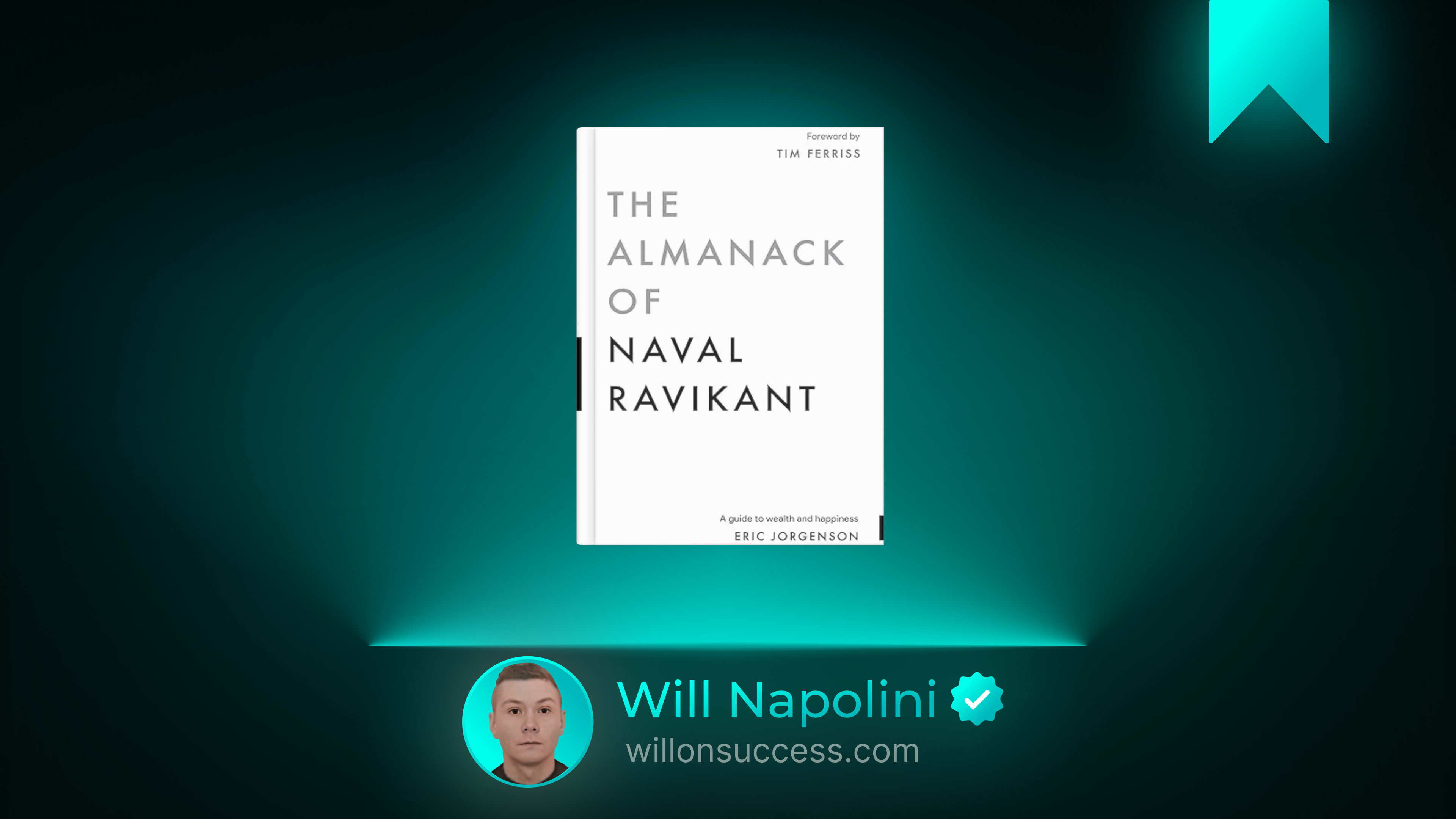
In The Almanack of Naval Ravikant, Eric Jorgenson curates the public wisdom of entrepreneur and philosopher Naval Ravikant. This is not a traditional book. It has no single narrative arc. Instead, it is a dense, highly concentrated distillation of mental models, business principles, and philosophical truths. But beneath the aphorisms and the business advice lies a profoundly simple, life-changing thesis.

The Big Idea: Wealth and Happiness Are Skills
The central premise of the almanack is that wealth and happiness are not traits you are born with, and they are not the results of blind luck. They are skills.
Just as you can learn to play the piano, just as you can learn to speak a new language, you can learn to generate wealth. And, perhaps more importantly, you can learn to be happy.
Most of us treat wealth as a matter of working harder, and happiness as a matter of changing our circumstances. Naval argues that both approaches are flawed. Wealth is not about the number of hours you work; it is about the judgment you apply and the leverage you use. Happiness is not about what happens to you; it is about the default state of your mind when you remove your desires.
When you understand that both are learnable skills, the game changes. You stop waiting for a lucky break, and you start building a system.
The Concept: The Three Forms of Leverage
To understand how wealth is actually created, we have to look at Naval’s framework for leverage.
Archimedes famously said, “Give me a lever long enough and a fulcrum on which to place it, and I shall move the world.” In the modern economy, your output is not determined by your effort; it is determined by your leverage.
Naval identifies three types of leverage:
- Labor: People working for you. This is the oldest form of leverage, but it is messy. Managing people requires immense emotional intelligence, and it is highly permissioned (you need people to agree to work for you).
- Capital: Money working for you. This is the leverage of the 20th century. It is highly scalable, but it requires permission. You need investors, or you need to have accumulated significant savings to begin with.
- Code and Media: Software, books, podcasts, and videos. This is the leverage of the new age.
This third form is the great equalizer. It is “permissionless leverage.” You do not need anyone’s permission to write a line of code, record a podcast, or publish an article. The marginal cost of replicating code and media is zero. A piece of software can work for you while you sleep, serving millions of users without requiring a single additional hour of your time.
The mistake most of us make is renting out our time. We are using zero leverage. We are trying to move the world with our bare hands.
Your Authentic Self Is Your Greatest Asset
When we talk about building wealth, we often default to the idea of “working hard.” But hard work alone will not make you wealthy. If hard work were the only requirement, construction workers and nurses would be the wealthiest people on earth.
Naval introduces the concept of “Specific Knowledge.”
Specific knowledge is knowledge that you cannot be trained for. If society can train you, it can train someone else to replace you. Specific knowledge is found by pursuing your genuine curiosity and passion rather than whatever is hot right now. It often feels like play to you, but looks like work to others.
Think about the people you know who are exceptionally good at what they do. They do not look like they are grinding. They look like they are in a state of flow. That is specific knowledge. It is the intersection of your natural inclinations, your unique background, and your deep curiosities.
When you operate in your zone of specific knowledge, you are not competing with anyone. You are simply being yourself. And because you cannot be trained to be you, you cannot be replaced. You escape competition through authenticity.
Desire Is a Contract You Make to Be Unhappy
The first half of the almanack is about wealth; the second half is about happiness. And this is where Naval’s wisdom becomes truly profound.
We tend to think of happiness as a destination. We tell ourselves, “I will be happy when I hit a million dollars,” or “I will be happy when I get that promotion.” But Naval, drawing heavily on Stoic and Buddhist philosophies, argues that happiness is not the result of getting what you want. It is the result of wanting less.
He frames desire in a very specific way: Every desire is a contract you make with yourself to be unhappy until you get what you want.
If you have twenty desires, you are essentially signing twenty contracts to be unhappy. You are carrying twenty heavy stones in your mind. Happiness, therefore, is not the accumulation of achievements; it is the subtraction of desires. It is the state of peace that remains when your mind is no longer constantly reaching for the next thing.
You do not need to become a monk to apply this. You simply need to recognize that the anxiety you feel is often the weight of your own unfulfilled expectations. Peace is available to you right now, in this exact moment, if you are willing to put down the stones.
Play Long-Term Games with Long-Term People
Wealth and relationships both rely on the most powerful force in the universe: compounding.
But compounding only works over long periods of time. In business, this means playing long-term games with long-term people.
When you constantly switch partners, switch industries, or switch strategies every time things get difficult, you reset the compounding clock to zero. Trust is the ultimate currency of wealth. When people know they can rely on you over a decade, they will offer you opportunities that are never advertised.
This applies to your personal life as well. The depth of your relationships is directly proportional to the time and consistency you invest in them. You cannot hack a deep friendship, and you cannot hack a lasting marriage. You can only build them through the quiet, unglamorous consistency of showing up, day after day, year after year.
Why This Matters on an Ordinary Tuesday
You might be reading this and thinking that this is great philosophy for a billionaire angel investor, but you are just trying to manage your household budget and get through a difficult week at work.
Here is why this matters for you, on an ordinary Tuesday.
Most of us are living in a state of quiet desperation because we are playing the wrong game. We are playing status games. We are trying to out-earn our neighbors, out-perform our peers, and prove our worth to people we do not even like. Status is a zero-sum game; for you to go up, someone else must go down. It is a game designed to make you miserable.
Wealth, on the other hand, is positive-sum. It is about creating value. When you shift your focus from “How can I look successful?” to “How can I build something useful?” the pressure lifts. You stop trying to impress, and you start trying to contribute.
Furthermore, realizing that happiness is a skill changes how you handle stress. When you are stuck in traffic, or dealing with a difficult client, or facing a financial shortfall, you realize that your peace of mind does not have to be held hostage by your circumstances. You can choose to drop the desire for the moment to be different than it is. You can choose peace.
Practical Application: Turning Principles into Behavior
Philosophy is useless if it does not change your behavior. Here is how you can apply the almanack to your life starting today.
1. The Specific Knowledge Audit Take a piece of paper and draw a line down the middle. On the left side, write down the tasks you do that feel like draining, difficult work. On the right side, write down the activities that feel like play to you, but which others might view as work. Look at the right side. That is where your specific knowledge lives. Your goal for the next year is to slowly migrate your career toward the right side of the page.
2. Build a Permissionless Asset You need to detach your income from your time. This week, start building a piece of permissionless leverage. Write an article, record a video explaining a concept you understand well, or write a simple script that automates a tedious task. Do not worry about making money from it immediately. Just focus on creating something that can be replicated without your direct involvement. Build the machine.
3. The Desire Subtraction Practice The next time you feel a spike of anxiety, frustration, or unhappiness, stop and ask yourself: Which desire am I holding right now? Are you angry because you desire the traffic to move faster? Are you stressed because you desire your colleague to agree with you? Identify the desire, recognize it as a contract for unhappiness, and consciously choose to cancel the contract. Let the moment be exactly as it is.
Who Should Read This Book
The Almanack of Naval Ravikant is a modern classic, but it requires a certain type of reader.
If you are looking for a highly structured, step-by-step business plan, or a technical guide on how to day-trade stocks, this book will not serve you. It is not a tactical manual. It is also not for the reader who wants a quick, easy path to riches; Naval is adamant that building wealth requires deep thinking and high accountability.
However, if you are an entrepreneur, a creator, or a knowledge worker who feels stuck in the trap of trading time for money, this book is essential. It is for the thinker who wants to understand the underlying mechanics of wealth creation. And it is equally for the seeker who wants to integrate the pursuit of success with the pursuit of inner peace. It bridges the gap between the boardroom and the monastery.
One Small Step
You do not need to overhaul your entire career or meditate for three hours a day to begin. You just need to change your relationship with your own mind for the next ten minutes.
Right now, sit quietly. Close your eyes. Notice the background hum of your thoughts. Notice what you are wishing was different. Notice the subtle tension in your jaw or your shoulders.
Pick just one small desire—perhaps the desire for this meeting to be over, or the desire for the weekend to arrive faster. Acknowledge it. And then, mentally let it go. Choose to be entirely at peace with this exact moment, exactly as it is.
The Path Forward
We spend so much of our lives running on a treadmill, believing that if we just run a little faster, we will finally arrive at a place of permanent security and happiness. But the treadmill only builds exhaustion.
True wealth is not the money in your bank account; it is the freedom in your calendar. And true happiness is not the absence of problems; it is the presence of peace.
You do not need to conquer the world to be successful. You only need to build a life that is authentically your own, create value for others, and cultivate a mind that is quiet enough to enjoy it. The skills are available. The leverage is waiting. The only thing left to do is begin.