Stop Grinding and Start Flowing: A Mentor's Guide to Greg McKeown’s Effortless
I want to ask you a question that might make you slightly uncomfortable. How much of your current exhaustion comes from doing the wrong things, and how much comes from doing the right things in the hardest possible way?
For years, I believed a dangerous lie. I believed that if something mattered, it had to be difficult. I believed that if I wasn’t suffering, I wasn’t trying hard enough. I thought the measure of my dedication was the amount of friction I was willing to endure.
You may have already done the hard work of figuring out what actually matters. You may have cleared away the trivial distractions and committed yourself to the essential. But if you are still running on fumes, still dreading the morning, still feeling like every meaningful achievement requires a pound of your flesh—then you have hit the ceiling of the “hustle” mindset.
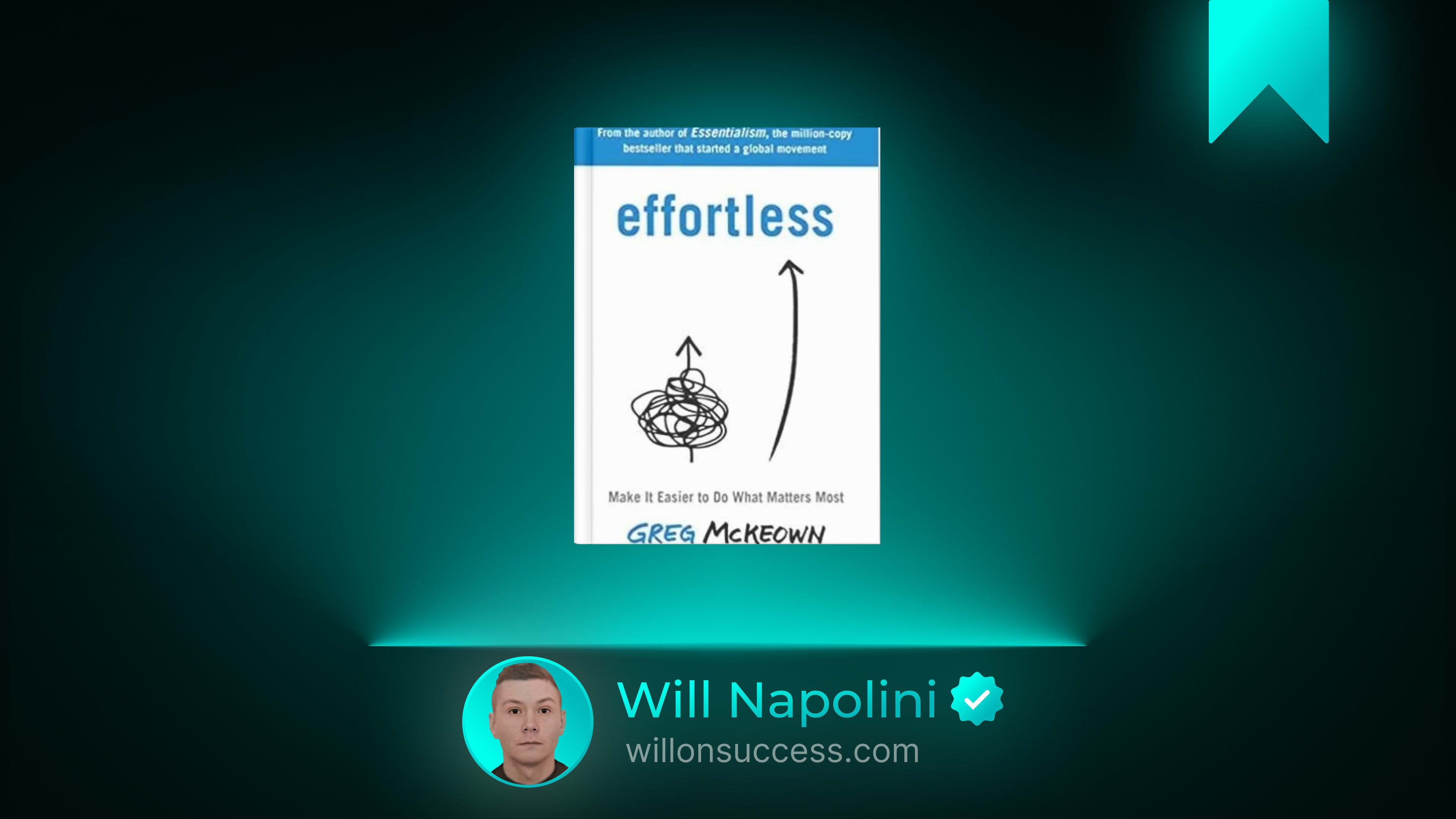
Greg McKeown’s Effortless: Make It Easier to Do What Matters Most is a quiet rebellion against the cult of struggle. It is the necessary companion to his previous work, Essentialism. If Essentialism is about doing the right things, Effortless is about doing them in the right way. And it argues, with profound clarity, that the assumption that meaningful work must be grueling is not just false. It is the very thing keeping you from the life you are trying to build.

The Big Idea
The central thesis of Effortless is simple but deeply counter-cultural: We have been conditioned to equate effort with value.
We assume that the harder we work, the better the result. We wear our exhaustion like a badge of honor. But McKeown argues that this is a false equation. Brute force is a terrible strategy for navigating a complex life. The goal is not to make the essential things easier to ignore; the goal is to make the essential things easier to do.
When you shift your approach from “How can I push harder?” to “How can I make this effortless?”, you stop fighting the current and start using the river. You move from a state of chronic depletion to a state of sustainable momentum. You realize that the highest quality of work, and the deepest quality of life, rarely comes from grinding your gears until they break. It comes from removing the friction so the gears can turn freely.
The Story: The Heavy Door
Imagine you are trying to open a heavy, solid oak door. You push with all your might. You brace your feet. You strain your shoulders. You sweat. You push until your muscles ache, but the door doesn’t budge. You step back, panting, and conclude that the door is simply too heavy, that you are not strong enough, or that the task is impossible.
Then someone walks by, smiles gently, and pulls the handle. The door swings open effortlessly.
The problem was never your strength. The problem was your assumption about how the door worked.
McKeown suggests that much of our burnout is the result of pushing doors that are meant to be pulled. We are applying brute force to problems that require a shift in perspective. We are trying to out-work bad systems, out-hustle unclear goals, and out-grind our own emotional baggage. Effortless is a guide to looking at the heavy doors in your life and asking, “What if I’m pulling when I should be pushing? What if this doesn’t have to be this hard?”
The Power of Inversion: What If This Could Be Easy?
Our brains are wired to assume difficulty. When faced with a big project, a difficult conversation, or a complex life change, our first thought is almost always, “This is going to be a grind.” We brace ourselves for the pain.
McKeown introduces a simple but profound cognitive inversion to break this pattern. Before you begin any significant task, ask yourself: “What if this could be easy?”
When you ask this question, you stop looking for ways to endure the pain and start looking for ways to remove the friction. You stop asking, “How can I survive this?” and start asking, “How can I simplify this?”
I have seen this single question salvage careers and transform relationships. It shifts you from a state of defensive endurance to creative problem-solving. You might realize that the 50-page report you are dreading could actually be a 5-page summary with an appendix. You might realize that the difficult conversation doesn’t require a three-hour emotional marathon, but a simple, ten-minute walk where you both agree to speak honestly without interrupting.
You do not need more motivation to push through the difficulty. You need the imagination to see that the difficulty might be optional.
Defining “Done” to Stop the Endless Treadmill
One of the primary causes of modern exhaustion is that we never actually finish.
We work on a task until we are too tired to continue, and then we call it a day. But the task isn’t done; it’s just paused. It sits in the back of our mind, consuming our cognitive battery, creating a low-grade, constant anxiety. We wake up the next day already behind.
McKeown argues that you must define what “done” looks like before you begin. Not just “work on the book,” but “write 1,000 words of chapter four.” Not “clean the house,” but “vacuum the living room and wipe down the kitchen counters.”
When you have a clear, concrete finish line, you can stop running when you cross it. You give yourself permission to rest. Consistency before intensity requires boundaries, and “done” is the ultimate boundary. If you do not define what completion looks like, your work will expand to fill every waking hour, and you will end every day feeling like you failed, even if you worked for fourteen hours.
The Courage to Pace Yourself (The Upper Bound)
We are culturally trained to set lower bounds for our habits. We say, “I will run at least one mile.” “I will read at least ten pages.” “I will make at least five sales calls.”
But we rarely set upper bounds. We rarely say, “I will run no more than three miles.” “I will write no more than two hours today.”
Without an upper bound, a good habit can easily become a tyrannical master. You push until you break, and then you have to spend three days recovering, which ruins your consistency. McKeown advocates for pacing by establishing a daily maximum.
This requires immense discipline. It means stopping when you still have energy left in the tank. It means walking away from the desk when you are in the middle of a great idea, so that you can easily pick it up again tomorrow.
Growth before achievement means you must protect the vehicle that is doing the growing. If you run your engine into the redline every single day, you do not get to your destination faster. You just blow the engine. Pacing is not laziness. Pacing is the strategic preservation of your most valuable asset: your future capacity to act.
Moving from Linear to Residual Results
Hard work usually yields linear results. You work for an hour, you get an hour of output. You stop working, the output stops. This is the trap of the endless treadmill. You are trading your finite time for finite results.
Effortless results, McKeown argues, are residual. You do the work once, and it continues to pay dividends long after you have stopped working.
This is the difference between solving a problem and building a system.
- Linear: Answering every question your team brings you, making yourself the bottleneck of your own success.
- Residual: Teaching your team the guiding principles of your decision-making framework, so they can make the decisions themselves.
- Linear: Cooking a healthy dinner every single night from scratch, exhausting yourself by 7:00 PM.
- Residual: Spending three hours on Sunday prepping the core ingredients, making the weeknight assembly effortless.
The mentor’s question to you is this: Are you just solving today’s problems, or are you building a machine that solves them for you forever? Principles before hacks. When you teach a principle, you give someone a compass. When you just give them a task, you make them dependent on your map.
Why This Matters on an Ordinary Tuesday
You might think of this as high-level strategy for CEOs or entrepreneurs. But the “hard way” destroys ordinary lives just as efficiently as it destroys companies.
If you are a parent, you can spend two hours every night fighting with your child to do their homework. You can nag, threaten, and bribe. That is the hard way. Or, you can sit down on a calm Saturday and co-create a simple, visual routine that they manage themselves. That is the effortless way.
If you are trying to get out of debt, you can rely on sheer willpower to resist every impulse purchase you see. That is the hard way, and it will eventually fail. Or, you can automate your savings and delete your shopping apps, removing the need for willpower entirely. That is the effortless way.
Burnout is rarely the result of doing too much of what you love. It is the result of doing what you love in a way that drains your soul. When you make the essential effortless, you don’t just get more done. You get your life back. You reclaim the evenings. You reclaim your patience. You reclaim the quiet joy of simply being present.
Practical Application
Understanding the theory will not change your life. Only the application will. Here is how you build the habit of effortlessness, starting today.
The “What If” Audit Look at your calendar for tomorrow. Identify the single task you are dreading the most. The one that feels heavy. Before you do it, take out a piece of paper and write down the question: “What if this could be easy?” Force yourself to write down three ways the task could be simplified, shortened, or delegated. Choose one of those simplifications and execute it.
Establish Your Daily Maximum Choose one area of your life where you tend to overwork or overcommit. Set a hard upper bound. If it is work, decide that you will close your laptop at 5:30 PM, no matter what is left undone. If it is exercise, decide you will never lift weights for more than 45 minutes. Write this boundary down. When you hit the limit, stop. Feel the discomfort of leaving something unfinished, and realize that you are protecting tomorrow’s energy.
Define “Done” Before You Start Tomorrow morning, before you begin your most important task, write down exactly what “done” looks like. Be ruthlessly specific. “Done means the draft is emailed to Sarah.” “Done means the garage floor is swept and the boxes are stacked.” When you achieve that specific state, stop. Acknowledge the completion. Give your brain the reward of a finished cycle.
Who Should Read This Book
Effortless is a masterclass in sustainable high performance. It is written for the person who is tired of being tired.
It is essential reading for chronic over-workers, perfectionists, parents juggling too many demands, and leaders who feel like they are carrying the weight of their entire organization on their shoulders. If you have already read Essentialism and know what you should be doing, but are burning out trying to execute it, this book is the missing piece of the puzzle.
It may be less useful for someone who is still drowning in trivial distractions and hasn’t yet figured out what their essential priorities are (if that is you, read Essentialism first). It is also not a book for those looking for a rigid, step-by-step technical manual. It is a book of mental models and paradigm shifts.
But for anyone who suspects that life doesn’t have to feel like a constant, uphill battle, this book offers a deeply hopeful, highly practical way forward.
One Small Step
You do not need to overhaul your entire life today. You just need to prove to yourself that you can choose the easier path without feeling guilty.
Here is what I want you to do. Think of one recurring friction point in your daily life. The thing that annoys you every single day. Maybe it’s looking for your keys. Maybe it’s deciding what to eat for lunch. Maybe it’s the transition from work-time to family-time.
Pick one. And today, spend fifteen minutes building a system that removes the friction. Put a bowl by the door for the keys. Write a lunch menu for the week. Create a five-minute “shutdown ritual” to close your laptop and transition your mind.
Do the work once, so you never have to fight that battle again.
Final Thought
We have been taught to romanticize the struggle. We have been told that the only things worth having are the things that leave us scarred and exhausted. But this is a profound misunderstanding of both human nature and the natural world.
A seed does not struggle to become a tree. It simply follows its design, drawing on the soil and the sun, growing effortlessly into what it was meant to be.
You do not need to bleed for your goals to be worthy of them. You do not need to destroy yourself to build a beautiful life. The highest form of discipline is not the ability to endure unnecessary pain. The highest form of discipline is the wisdom to remove it.
Stop pushing the heavy doors. Look at the handle. Pull.
The life you are working so hard to build is waiting for you on the other side, and you are allowed to arrive there with your energy intact.