Die With Zero: Why Your Bank Account Should Not Outlive You (And How to Spend Your Life, Not Just Save It)
Imagine you are at the very end of your life. You are sitting in a quiet room, looking back on the decades. A nurse or a lawyer walks in and hands you your final bank statement. You look down and see a balance of three million dollars.
Most financial advisors would call that a resounding success. They would say you won the game.
But if I were sitting across the table from you in that quiet room, I would ask you to look at that number differently. Because what a three-million-dollar deathbed balance actually means is that you traded thousands of hours of your finite, irreplaceable life to earn that money, and you never cashed it in. You worked for free. You sacrificed your time, your energy, and your presence with the people you love, to accumulate a number on a screen that you will never use.
You did not save that money. You just forgot to spend the life it was supposed to buy.
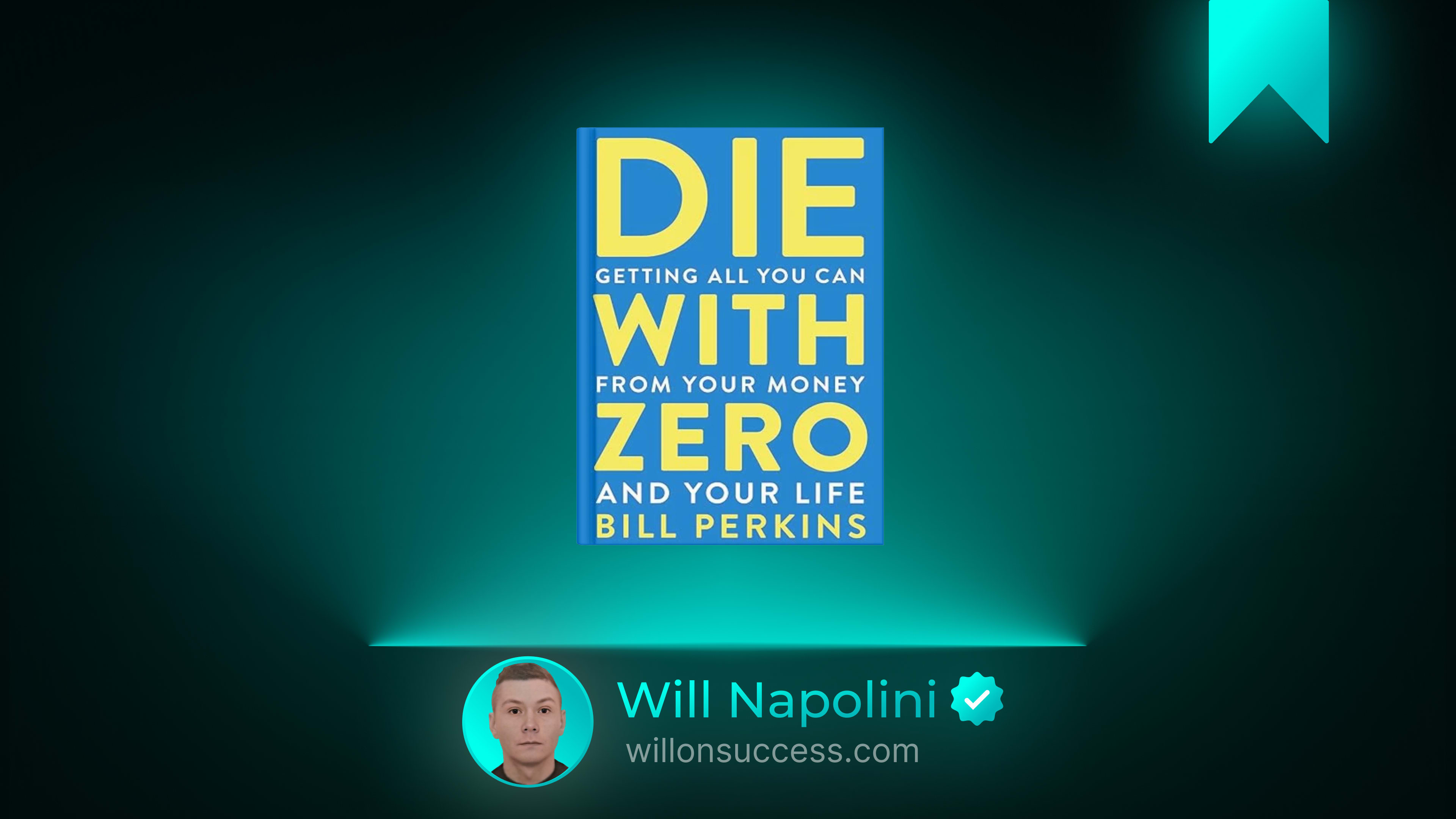
This is the uncomfortable, liberating premise of Die With Zero by Bill Perkins. Perkins is not a traditional financial guru. He is a former hedge fund manager and a professional poker player. He looks at life through the cold, precise lens of expected value, risk management, and utility. And his central conclusion is one that challenges almost everything we are taught about money: The goal of life is not to maximize your net worth. The goal is to maximize your life experience.
Money is merely a tool to acquire those experiences. If you optimize for the scoreboard instead of the game, you lose.

The Big Idea: Money is Stored Life Energy
To understand Perkins’ philosophy, you have to fundamentally change how you define money.
We tend to view money as a static object, a high score we are trying to push higher. Perkins asks you to view money as stored life energy. Every dollar in your bank account represents an hour, a day, or a week of your life that you traded to earn it.
When you spend a dollar, you are converting that stored life energy back into an experience, a convenience, or a gift. Therefore, the ultimate sin is not spending money. The ultimate sin is hoarding life energy you will never get the chance to convert back into living.
Perkins acknowledges that this sounds terrifying to a culture raised on the gospel of endless accumulation. We are taught to save for a retirement that might last twenty or thirty years, and out of a deep, evolutionary fear of running out, we keep saving long past the point of necessity. We become over-savers. We delay our joy. We tell ourselves we will take the trip, start the business, or spend the time with our children later, when the number is big enough.
But later is not guaranteed. And even if it arrives, your ability to use that money is not guaranteed.
The Triangle of Time, Health, and Wealth
The most profound conceptual framework in the book is the intersection of three resources: Time, Health, and Wealth.
Throughout your life, you possess these three resources in vastly different proportions, and you can only trade them in specific ways at specific ages.
When you are young, you have abundant Time and abundant Health, but you have no Wealth. You have the energy to backpack through the mountains, but you cannot afford the flight.
In middle age, you finally acquire Wealth, and you still have your Health, but you have no Time. You can afford the first-class ticket to the mountains, but you are working sixty hours a week and have a mortgage to pay.
In old age, you finally have Wealth and Time, but your Health has declined. You have the money and the free time to climb the mountain, but your knees will not carry you to the base camp.
Perkins points out the tragic irony of the traditional financial plan: we spend our youth and middle age sacrificing our time and health to accumulate wealth, only to arrive at old age with a massive pile of wealth and a body too frail to enjoy it.
You cannot spend money when your body says no. A dollar spent at thirty buys a memory that pays dividends for fifty years. A dollar spent at eighty buys a comfortable bed you barely feel. The utility of your money drops dramatically as your health declines. Therefore, you must intentionally deploy your capital during the seasons of your life when your health and time can actually absorb it.
Memory Dividends: The Compound Interest of Experience
If you invest ten thousand dollars in an index fund at age twenty-five, the financial compound interest will make it a massive sum by the time you are sixty-five. We understand this intuitively.
But Perkins introduces a concept called Memory Dividends. When you invest time and money into a meaningful experience, it pays an emotional and psychological return every single time you recall it, share it, or draw strength from it.
Think about a formative trip you took in your twenties, or a summer you spent learning to sail, or a year you lived in a foreign city. You have drawn on the memories of that experience for decades. It shaped your identity. It gave you stories to tell. It provided comfort during hard times. That experience has paid you a “memory dividend” every year since it happened.
Because memory dividends compound over time, the earlier you have the experience, the more valuable it is.
This is the mathematical argument against delaying your life. If you wait until you are sixty to take that trip to Italy, you only get to collect the memory dividends for the remaining twenty years of your life. If you take it at thirty, you collect the dividends for fifty years. Delaying an experience is not just postponing it; it is actively destroying the long-term emotional return on your investment.
The Architecture of Time Buckets
One of the most practical tools in the book is the concept of “Time Buckets.”
Most of us view the future as a long, flat highway. We think, I’ll do that when I retire. But life is not a flat highway. It is a series of distinct seasons, or buckets, and each bucket has a closing date.
There is a bucket for “traveling with young children.” That bucket closes when they become teenagers who would rather be anywhere else. There is a bucket for “playing competitive sports.” That bucket closes when your joints wear down. There is a bucket for “learning a physically demanding skill.”
If you save your money for the experience, but you wait until the bucket has closed, the money is useless for that purpose. You can buy the expensive ski gear at age seventy, but if the “skiing bucket” closed at fifty-five due to a bad back, the money cannot buy the experience.
Perkins challenges you to map out your life in five- or ten-year buckets and identify the experiences that belong in each one. Then, you must deliberately allocate money to fund those experiences while the bucket is still open. This requires breaking the trance of endless saving and giving yourself permission to spend on the current season of your life.
The Inheritance Mistake: Giving When It Matters
Die With Zero also tackles the deeply emotional topic of inheritance. Most parents want to leave money to their children. It feels like a final act of love and protection.
But Perkins applies his utility framework to inheritance. When do children actually need money the most? They need it when they are in their late twenties and thirties. They need it to help buy a first home, to start a family, to fund an education, or to take a risk on a business. The “utility” of a hundred thousand dollars to a thirty-year-old trying to build a life is astronomically high.
But how do most estates get distributed? They are distributed when the parents die. If you live to be ninety, your children will be in their sixties. By then, they likely have their own retirement savings, their homes are paid off, and their children are grown. Handing them a large sum of money at sixty is a nice bonus, but it does not fundamentally change the trajectory of their lives.
Perkins argues for giving your money away while you are alive, and while your children are young enough for the money to act as a catalyst rather than just a cushion. He calls this “giving with a warm hand” rather than “giving with a cold one.”
There is a secondary, deeply beautiful benefit to this approach: you get to see the impact of your generosity. You get to watch your children use your resources to build their lives. You get to share in their joy. You cannot do that from the grave.
Addressing the Fear: What If I Run Out?
I know what you are thinking. I can hear the objection rising in your chest. This sounds reckless. What if I spend my money on experiences and then live to be ninety-five? What if I run out of money and become a burden to my family?
This is a valid, rational fear. And Perkins does not ask you to ignore it. He asks you to solve it like a mathematician.
The risk of outliving your money is called “longevity risk.” In the financial world, you do not manage risk by just hoarding cash and making yourself miserable. You manage risk by transferring it.
Perkins advocates using financial products like annuities to cover your baseline survival needs. You calculate exactly how much money you need to generate a guaranteed, baseline income for the rest of your life, no matter how long you live. You buy an annuity or secure a pension to cover that floor. Once your survival is mathematically guaranteed by an institution, the rest of your capital is freed up. It is now “experience money.”
You can spend the experience money with absolute confidence, knowing your baseline is protected. You offload the risk of living too long to an insurance company, so you can reclaim the joy of living today.
Why This Matters on an Ordinary Tuesday
You might be reading this and thinking, This is great philosophy, but I have a mortgage, a car payment, and groceries to buy. I can’t just blow my savings on a trip to Italy.
Let me be very clear, just as Perkins is: Die With Zero is not a book for people who are struggling to meet their basic survival needs. If you are in high-interest debt, or if you do not have a safety net for emergencies, your first and only job is to secure your survival. The principles of memory dividends and time buckets only apply once you have crossed the threshold of basic financial security.
But if you have crossed that threshold, and you still find yourself hoarding, working late, and denying yourself joy out of a vague, undefined fear of the future, this book is your wake-up call.
It matters on an ordinary Tuesday because it changes how you view your daily choices. When your child asks you to play a game in the backyard, and you are tempted to say, “Not now, I need to finish this work to secure our financial future,” you will realize that the backyard game is the return on investment. The work is just the mechanism to fund the game. Do not let the mechanism consume the purpose.
It changes how you view a bonus at work. Instead of automatically routing it to a brokerage account you will not touch for thirty years, you might route a portion of it to a “Time Bucket” fund, explicitly designated for an experience you want to have this year.
It shifts your identity from a “hoarder of resources” to an “allocator of life energy.”
Practical Application: Building Your Life Portfolio
How do you translate this from a compelling idea into actual behavior? Here are three concrete steps to begin aligning your money with your life.
1. Calculate Your “Survival Floor” Sit down and calculate the absolute minimum monthly income you would need to survive if everything went wrong. Once you know that number, look at your current assets, pensions, and social security projections to see if that floor is covered. If it is, you have permission to stop obsessing over the total size of your nest egg and start focusing on how you deploy the surplus.
2. Map Your Time Buckets Take a piece of paper and draw a timeline of your life from your current age to age ninety. Divide it into five- or ten-year buckets. Inside each bucket, write down two or three experiences that are physically or temporally bound to that age. (e.g., “Take the kids to Disney,” “Learn to surf,” “Hike the Alps”). Look at the buckets for the next ten years. Are you actively funding them, or are you just hoping you’ll get to them “someday”?
3. The “Warm Hand” Audit If you plan to leave an inheritance, look at the ages your children (or nieces, nephews, or chosen family) will be when you realistically pass away. If they will be in their late fifties or sixties, ask yourself: Could a portion of this money change their lives more if I gave it to them in the next five years? You do not have to give it all away today. But you might decide to fund a down payment for them now, rather than leaving it in a will.
Who Should Read This Book
This book is essential reading for high-income earners who are miserable, chronic over-savers who feel guilty spending a dollar on themselves, and anyone who has achieved a level of financial stability but still feels trapped on the hamster wheel of endless accumulation. It is also profoundly useful for parents who are agonizing over estate planning and inheritance.
Who it might not be for: If you are currently struggling with debt, living paycheck to paycheck, or facing immediate financial instability, this book is not for you right now. The advice to “spend down your wealth” requires there to be wealth to spend down. Secure your foundation first. Additionally, if you have a deep psychological trauma around money and poverty, the idea of intentionally driving your bank account toward zero may trigger severe anxiety. Read it only when you are grounded enough to separate your self-worth from your net worth.
Your One Small Step
Understanding the mathematics of a life well-lived is valuable, but understanding without action changes nothing in your bank account or your calendar.
So here is what I would ask you to do today.
Think of one experience you have been putting off. You know the one. It is the trip, the project, the class, or the dinner you have told yourself you will do “when the time is right” or “when I have a little more saved up.”
I want you to take one concrete, irreversible step toward that experience before the sun goes down today.
Do not just “think about it.” Buy the non-refundable ticket. Pay the deposit for the class. Call the friends and lock in the date. Convert a small amount of your stored life energy back into actual life.
You will feel a spike of fear when you do it. That is normal. That is just the old programming trying to keep you safe in the cage of endless saving. Let the fear be there, and book it anyway.
Your bank account is a battery, and money is just stored life energy. If you die with a fully charged battery, it means you lived in the dark.
Start turning on the lights.