The Quiet Advantage: Why Deep Focus is the Ultimate Superpower in a Distracted World
I want to ask you about the last time you reached the end of a Tuesday feeling utterly exhausted, only to realize you had accomplished almost nothing of lasting value.
You know the feeling. You arrived at your desk with a clear intention. But then the inbox demanded attention. A colleague stopped by with an “urgent” question. Your phone buzzed with a notification you felt compelled to check. You spent the next eight hours putting out small fires, answering messages, and attending meetings. When you finally closed your laptop, you were drained. You were busy. But you were not effective.
There is a dangerous assumption hiding inside the way most of us think about success: the belief that visible busyness is a proxy for actual productivity. We have confused motion with progress. We have mistaken the frantic clearing of an inbox for the difficult, quiet work of building a meaningful life.
If I could sit across the table from you right now, I would tell you that the problem is not your work ethic. You are likely working harder than ever. The problem is the environment you are working in, and more importantly, the way you are allowing that environment to fracture your mind.
What you need is not another productivity hack or a louder motivational speech. You need a fundamental shift in how you value your own attention. You need to understand the concept of Deep Work.

The Big Idea: The Deep Work Hypothesis
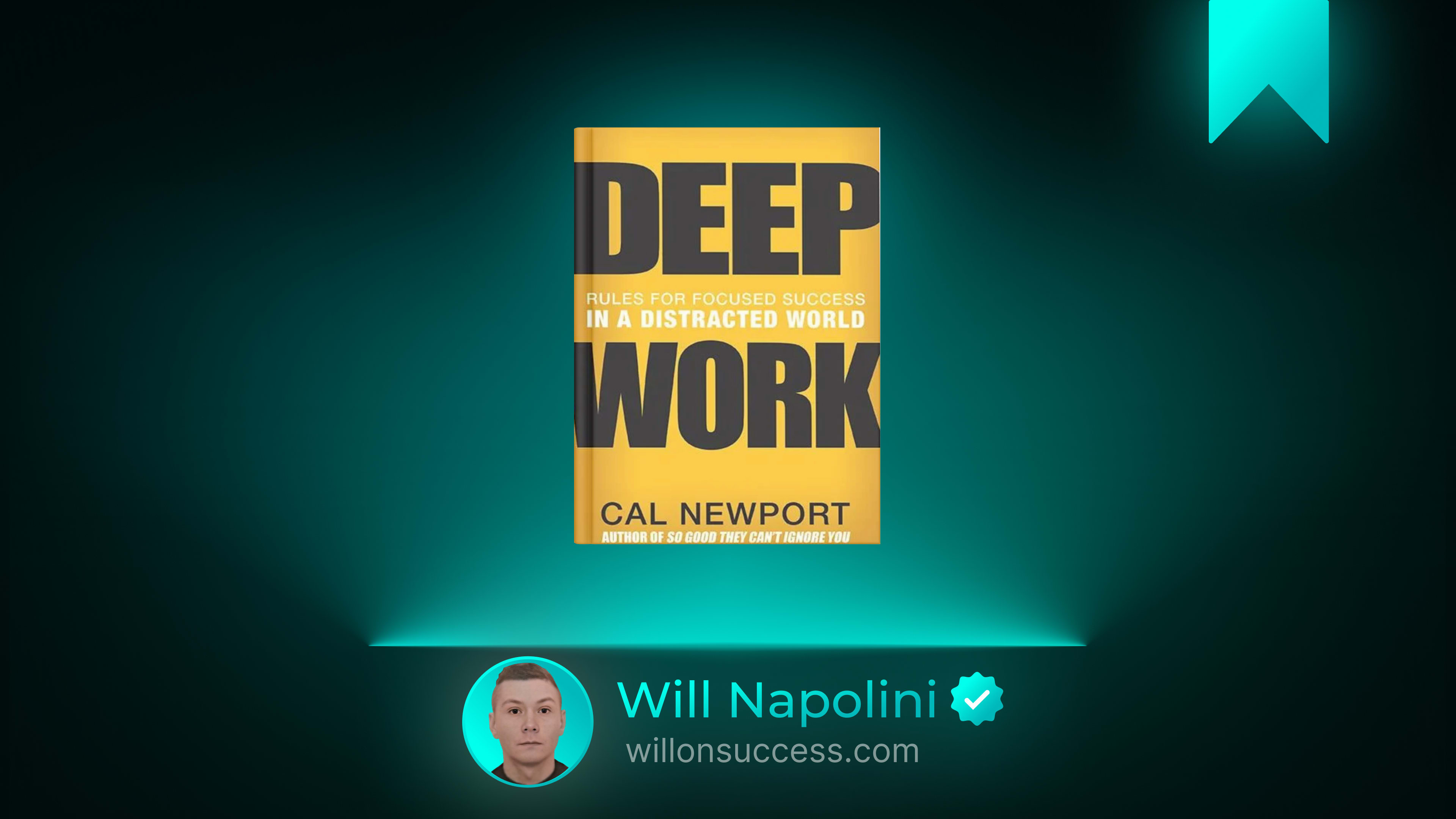
In his foundational book Deep Work, computer science professor and author Cal Newport draws a hard line between two types of effort.
Deep Work consists of professional activities performed in a state of distraction-free concentration that push your cognitive capabilities to their limit. These are the efforts that create new value, improve your skills, and are incredibly hard to replicate.
Shallow Work, on the other hand, consists of non-cognitively demanding, logistical-style tasks, often performed while distracted. These are the emails, the status meetings, the scrolling, and the administrative shuffling. They do not create much new value in the world, and they are easy to replicate.
Newport builds his entire thesis on what he calls the Deep Work Hypothesis:
The ability to perform deep work is becoming increasingly rare at exactly the same time it is becoming increasingly valuable.
Think about what that means for your life. In an economy driven by automation, artificial intelligence, and global competition, the people who will thrive are those who can master hard things quickly and produce at an elite level. Both of these requirements demand unbroken, intense focus.
Yet, look around. The modern workplace is designed to destroy focus. Open-plan offices, instant messaging expectations, and the relentless ping of social media are celebrated as “collaboration.” We are living in an era that actively punishes the very skill required to succeed within it.
This is not a reason to despair. It is a reason to hope.
Because when a skill becomes rare, its value skyrockets. If you can cultivate the ability to focus deeply while the rest of the world skims the surface, you will possess a quiet, undeniable advantage. Your habits are votes for the person you are becoming, and right now, you have the opportunity to vote for the person who builds, rather than the person who merely reacts.
The Invisible Thief: Attention Residue
To understand why deep work is so difficult, we have to look at the mechanism of distraction. You might believe that you are a master multitasker. You might think you can quickly check a text message, reply to an email, and immediately dive back into writing a complex report without losing a beat.
You cannot. And the reason is biological.
Newport highlights the research of business professor Sophie Leroy, who coined a term that perfectly describes our modern predicament: Attention Residue.
When you switch your attention from Task A to Task B, your focus does not instantly follow. A part of your brain remains stuck on Task A. If you glance at an email from your boss while trying to write a strategic proposal, your mind is now split. Even after you close the email and stare back at the proposal, a residue of your attention is still processing the email.
Imagine trying to paint a masterpiece while someone constantly taps your shoulder to ask about the grocery list. Even when they walk away, your brushstrokes are shaky because a piece of your mind is still at the grocery store.
When you work in a state of chronic distraction, you are perpetually operating with attention residue. You are never giving your brain the unbroken runway it needs to reach its highest cognitive capacity. You are trading your potential for the cheap dopamine hit of a cleared notification badge.
A fractured mind cannot build a lasting legacy. To do work that matters, you must protect your attention as fiercely as a master craftsman protects their tools.
The Four Rhythms of a Focused Life
One of the most common mistakes I see people make when trying to improve their focus is adopting an all-or-nothing mentality. They read about monks living in silent retreats and decide they need to quit social media, throw away their smartphone, and move to a cabin in the woods. When they inevitably fail to do this by Wednesday afternoon, they give up entirely.
Newport is highly practical about this. He recognizes that deep work requires a scheduling philosophy that actually fits your reality. He identifies four distinct approaches.
1. The Monastic Philosophy
This involves eliminating or radically minimizing all shallow obligations. Think of a novelist who retreats to a remote island to finish a manuscript, or a computer scientist who completely opts out of email and public speaking to focus purely on research. This works beautifully for a select few, but it is entirely impractical for most professionals.
2. The Bimodal Philosophy
This approach divides your time into clearly defined deep stretches and open stretches. The famous psychologist Carl Jung used this method. He would spend time in his busy Zurich clinic, engaging with patients and the public (shallow work), and then retreat to his isolated tower in Bollingen for days of unbroken writing and thinking (deep work). You might adopt this by taking a two-day “retreat” in a local hotel once a month solely to work on your most important strategic project.
3. The Rhythmic Philosophy
This is the most sustainable method for the vast majority of people. It involves creating a daily, consistent habit. You commit to doing deep work at the exact same time every single day—perhaps from 6:00 AM to 8:00 AM before the house wakes up, or from 8:00 AM to 10:00 AM before you open your inbox. The power here is not intensity; it is consistency. By turning deep work into a daily rhythm, you remove the friction of deciding when to do it.
4. The Journalistic Philosophy
This involves dropping into deep work whenever the opportunity arises in your schedule. This requires a high level of mental discipline and is generally only recommended for those who have already mastered the skill of focus.
Here is what I would tell you: Do not try to be a monk if you are a manager. Choose the Rhythmic Philosophy. Carve out ninety minutes at the start of your day. Guard that time with your life. Let the world wait until the sun is a little higher in the sky.
You Must Train Your Brain to Tolerate Boredom
We have forgotten how to be bored.
Think about the last time you stood in line at the grocery store, or waited for a friend at a coffee shop, or sat in a waiting room. What did you do? Within three seconds, your hand went to your pocket. You pulled out your phone. You scrolled. You consumed.
We have trained our brains to expect a constant stream of novel stimuli. But here is the difficult truth: if your brain is addicted to distraction, it will not suddenly know how to focus deeply just because you sat down at your desk and opened a blank document.
Deep work is a skill, much like playing the guitar or lifting weights. It requires the strengthening of neural pathways. And you cannot build those pathways if you constantly feed your brain the junk food of cheap dopamine.
To succeed at deep work, you must embrace boredom.
This does not mean you must stare at a wall for hours. It means you must intentionally create gaps in your day where you allow your mind to wander without reaching for a digital pacifier. Let your mind wander while you wash the dishes. Look out the window while you drink your morning coffee.
Newport suggests a practice called Productive Meditation. This involves taking a period of time where you are physically occupied but not mentally engaged—like walking the dog, commuting, or doing yard work—and using that time to focus intensely on a single, well-defined professional problem. When your mind inevitably wanders to what you are having for dinner, you gently but firmly bring it back to the problem.
You start small. You stay consistent. You let time do its work.
By training your brain to tolerate the absence of stimuli, you are building the cognitive endurance required to push through the difficult, frustrating moments of creating something truly valuable.
The Craftsman’s Approach to Your Tools
We live in a culture that treats every new technology as an inherent good. If an app can help you find a funny video, or a social network can help you reconnect with an old high school acquaintance, we adopt it without a second thought.
Newport calls this the Any-Benefit Mindset. We justify our digital tools by pointing to any possible benefit they might offer, while completely ignoring the massive costs they extract from our attention and time.
To do deep work, you must adopt the mindset of a craftsman.
A master carpenter does not fill their workshop with every gadget sold at the hardware store just because each tool might be useful. A craftsman evaluates a tool based on a strict criteria: Does this tool’s core function substantially improve my ability to do my specific work, and do its benefits heavily outweigh its negatives?
Look at the tools in your digital workshop. Look at the apps on your phone, the tabs on your browser, the notifications on your wrist.
Are they serving your craft, or are they stealing your focus?
You do not necessarily need to delete every social media account or throw your smartphone into the ocean. But you must ruthlessly audit your tools. If an app is designed by thousands of engineers to hijack your psychological vulnerabilities and keep you scrolling, it does not belong in the workshop of a serious professional.
Curate your environment. Make the right actions easier and the distracting actions harder. Put your phone in another room while you work. Block the websites that drain your time. You are the architect of your environment; stop letting algorithms design your day.
The Sacred Ritual of the Shutdown
There is a profound psychological phenomenon known as the Zeigarnik Effect. It dictates that our brains have a hard time letting go of uncompleted tasks. If you leave a project half-finished, or if you leave an inbox full of unanswered emails, those open loops will quietly occupy your working memory long after you have closed your laptop. They will interrupt your evenings, ruin your sleep, and prevent your brain from recovering.
You cannot work deeply if you never truly rest.
Intensity requires recovery. If you are always “half-working,” checking emails at the dinner table or drafting replies in bed, you are eroding the cognitive foundation you need for tomorrow.
Newport advocates for a strict, non-negotiable end to the workday: The Shutdown Ritual.
At the end of your workday, take ten to fifteen minutes to review your open loops. Look at your inbox. Look at your to-do list. Write down the exact steps you will take tomorrow to address the most pressing items. Close the tabs on your browser. Tidy your physical desk.
And then, speak a specific phrase out loud. Newport suggests the phrase: “Shutdown complete.”
It sounds almost silly, but it is a powerful psychological trigger. It signals to your brain that the day’s labor is finished. The open loops have been captured and contained. You are now free to be fully present with your family, to read a book, to take a walk, or to simply rest.
When you protect your evenings, you are not being lazy. You are investing in the deep work you will do the next morning.
Why This Matters on an Ordinary Tuesday
It is easy to read about deep work and imagine it as a concept reserved for famous novelists or elite software engineers. But what does this look like on an ordinary Tuesday?
It looks like taking back your agency.
When you prioritize shallow work, you are living a reactive life. You are allowing the agendas of other people—their emails, their requests, their social media posts—to dictate the flow of your day. You become a leaf blowing in the wind of everyone else’s urgency.
When you prioritize deep work, you become the author of your own life. You decide what matters. You decide where your energy goes.
Imagine arriving at work tomorrow and, instead of opening your email, opening the document that contains your most important strategic initiative. Imagine working on it with unbroken focus for two hours. By 10:00 AM, you will have produced more value than most people produce in a week. The rest of the day can be spent managing the shallow logistics, but you will walk out the door knowing you moved the needle on what truly matters.
You will stop wondering why you are working so hard but feeling so unfulfilled. You will start seeing the tangible results of your focused effort. Growth precedes achievement. By focusing on becoming someone capable of deep concentration, the external achievements you desire will naturally follow.
Who Should Read This Book
Deep Work is an essential read for knowledge workers, writers, programmers, students, entrepreneurs, and anyone whose primary value in the marketplace is generated by their brain. If you are paid to think, solve complex problems, or create, this book will change the trajectory of your career.
However, I must be honest: this book is less applicable if your literal job description requires you to be constantly available and reactive. If you are an emergency room doctor, a crisis-management PR executive, or a customer support agent whose sole metric is response time, the monastic or bimodal approaches to deep work will conflict with your reality. Even then, you can use the principles of time-blocking and the shutdown ritual to protect whatever margins of peace you can find.
Newport’s writing is clear, heavily researched, and devoid of the fluffy “manifestation” rhetoric that plagues the self-help industry. It is a practical, rigorous manual for the modern mind.
One Small Step to Take Today
Understanding is valuable, but understanding without action changes nothing. You do not need to overhaul your entire life tonight. You just need to prove to yourself that you can direct your own attention.
Here is your assignment for today:
Tonight, before you go to sleep, take a blank piece of paper or open a blank document. Take ten minutes to time-block tomorrow.
Divide your working day into blocks of time (e.g., 30 or 60 minutes). Assign a specific task to every single block.
- 8:00 AM - 10:00 AM: Deep Work on Quarterly Strategy (Phone in another room).
- 10:00 AM - 11:00 AM: Process Email and Slack.
- 11:00 AM - 12:00 PM: Team Meeting.
If an unexpected interruption happens tomorrow, do not abandon the system. Simply take a moment to rewrite the blocks for the remainder of the day.
Give every minute a job. If you do not intentionally schedule your day, someone else will gladly schedule it for you.
The Door Opens
The world is getting louder. The distractions are getting smarter, faster, and more engineered to keep you trapped in the shallows. It is entirely possible to spend your entire life skimming the surface, reacting to the urgent, and leaving your deepest potential completely untapped.
But it is also possible to choose the quiet path.
You have the power to step away from the noise, close the door, and focus your mind on something difficult and beautiful. The things that make your life meaningful and your career successful are rarely the things that feel urgent in the moment. They are built in the quiet spaces, through sustained, unbroken effort.
Take responsibility for your attention. Protect your focus. Trust the process of depth over the illusion of speed.
Because what you build in the quiet hours eventually echoes in the noisy world.