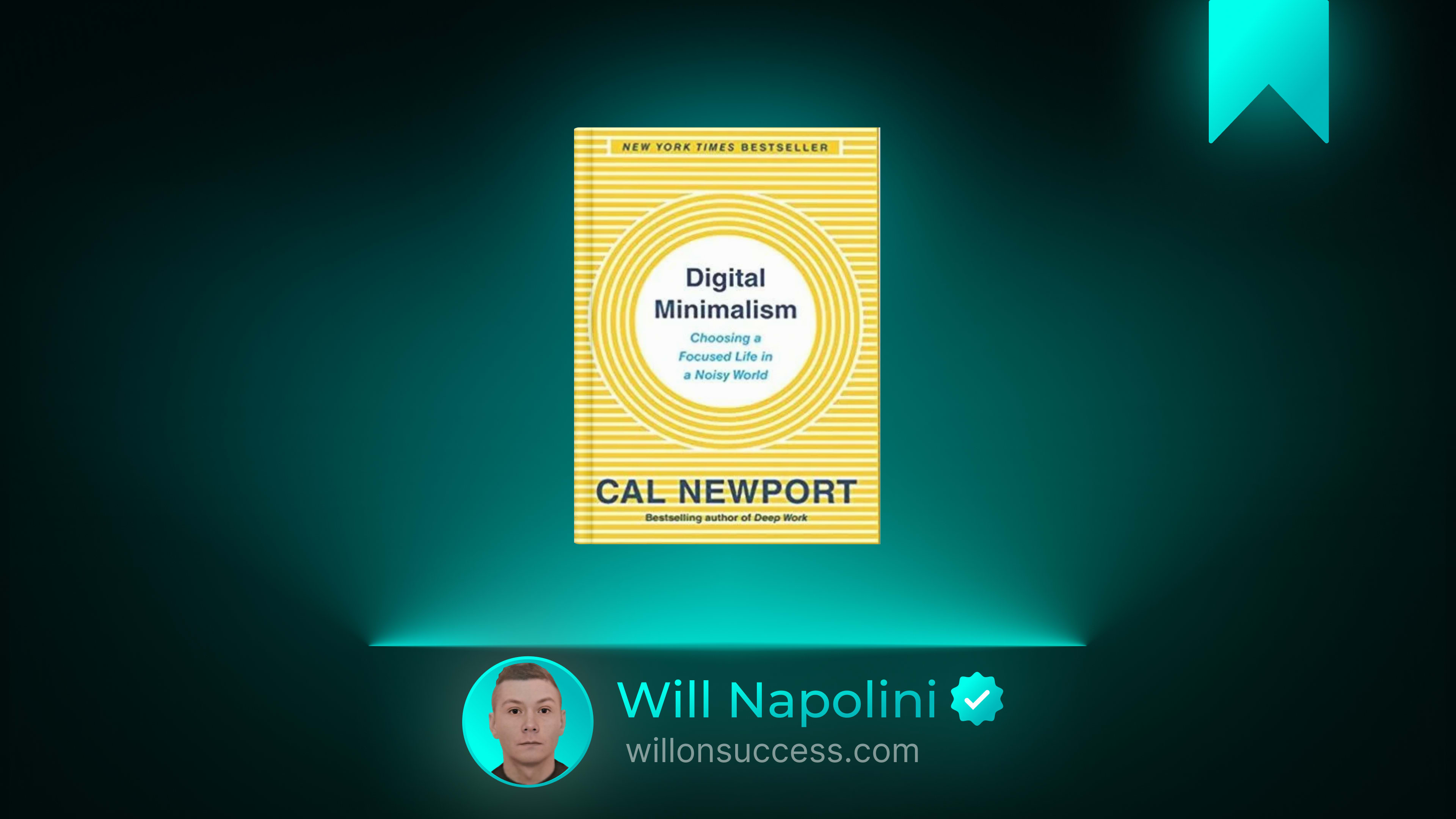
Digital Minimalism: How to Reclaim Your Attention in a World Designed to Steal It
You know the feeling. You step into an elevator with a stranger. The doors close. There is an awkward, three-second silence. Before you can even register the discomfort, your hand twitches. It slides into your pocket, pulls out the glowing rectangle, and your eyes drop to the screen. You do the same thing in the line at the grocery store. You do it while waiting for the kettle to boil. You do it in the final, quiet moments before you fall asleep, and in the first hazy seconds after you wake up.
If I could sit across the table from you right now, I would ask you to pause and look at that reflex.
You likely tell yourself a story about this habit. You tell yourself you are just checking the time, or catching up on the news, or staying connected with friends. But if we are being brutally honest, you and I both know the truth. You are not checking the phone because you need to. You are checking it because the silence of the elevator felt uncomfortable, and the screen is the most reliable pacifier you have ever known.
We tend to view our digital exhaustion as a personal failing. We buy apps to limit our screen time. We set alarms. We make New Year’s resolutions to “do better.” And when we inevitably fail, we blame our lack of discipline.
But Cal Newport, a computer science professor and author of Digital Minimalism, wants you to understand a fundamental, liberating truth: Your lack of discipline is not the problem. The problem is that you are trying to out-willpower a supercomputer.
You are not weak. You are outgunned. And until you understand the architecture of the trap you are in, you will never be able to walk out of it.
The Big Idea: You Did Not Slide Into This Life; You Were Engineered Into It
The central thesis of Digital Minimalism is that our current relationship with technology is not the result of a series of rational, conscious choices. We did not carefully decide to fragment our attention, sacrifice our sleep, and outsource our emotional regulation to social media feeds.
Instead, we were nudged into this reality by an “attention economy.” Tech companies, driven by the financial imperative to keep users engaged, have engineered their platforms using the exact psychological mechanisms found in casino slot machines. The pull-to-refresh feature, the red notification badges, the intermittent variable rewards—these are not accidental design choices. They are behavioral hacks, deployed by thousands of brilliant engineers whose sole job is to bypass your prefrontal cortex and wire your dopamine receptors directly to their servers.
Newport argues that trying to fight this asymmetrical war with “life hacks” or minor tweaks is a losing battle. You cannot moderate a slot machine.
The solution is not to throw your smartphone into the ocean and move to the woods. Newport is not a Luddite. The solution is to adopt a philosophy he calls Digital Minimalism.
Digital minimalism is a philosophy of technology use in which you focus your online time on a small number of carefully selected and optimized activities that strongly support things you value, and then happily miss out on everything else. It is the shift from using technology as a constant, low-grade pacifier, to using it as a deliberate, high-impact tool.
The 30-Day Digital Declutter: Why Moderation Fails
If you want to change your relationship with food, you might try eating a little less sugar. If you want to change your relationship with alcohol, you might limit yourself to one glass of wine with dinner. Moderation works for many things.
It does not work for the attention economy.
When you try to “just check social media a little less,” you are leaving the behavioral triggers intact. The apps are still on your home screen. The notifications are still pinging. The psychological grooves in your brain are still deep. You will spend all your willpower just trying to resist the urge, and eventually, your willpower will run out.
Newport proposes a radical alternative: The Digital Declutter.
This is not a “detox.” A detox implies you are taking a brief break before returning to your old habits. A declutter is a hard reset. For thirty days, you take a complete break from all optional technologies. No social media. No news sites. No YouTube. No video games. You strip your digital life down to the absolute bare minimum required for your job and your basic logistical survival.
During those thirty days, you do not just sit in an empty room staring at the wall. You actively use the time to rediscover analog joys, to rebuild your attention span, and to figure out what you actually value when you are not being told what to value by an algorithm.
At the end of the thirty days, you do not automatically let the apps back in. You start from a blank slate. For every piece of technology, you ask two questions: Is this the best way to support my core values? and If yes, how do I restrict its use to maximize its benefit and minimize its harm?
If an app fails the test, it stays deleted. If it passes, it returns with strict operating procedures. You transition from being a passive consumer of technology to an active architect of your digital life.
The Crisis of Solitude Deprivation
One of the most profound psychological insights in the book is the concept of solitude deprivation.
Throughout human history, solitude was a default state. When you were walking to the well, chopping wood, or riding a horse, you were alone with your thoughts. Newport defines solitude strictly: it is not just being physically alone. It is a state in which your mind is free from input from other minds.
When you listen to a podcast while walking, you are not in solitude; you are listening to another mind. When you read a news feed while waiting in line, you are absorbing the thoughts of a journalist. When you scroll through social media, you are processing the curated lives of hundreds of other people.
Because we now carry a portal to infinite human input in our pockets, we have eradicated solitude from the human experience. We are never alone with our own minds.
Why does this matter? Because the human brain requires solitude to process emotions, to synthesize information, and to construct a coherent sense of self. When you constantly feed your brain external input, you rob it of the time it needs to do its background processing. The result is a low-grade, chronic anxiety. We feel untethered, reactive, and emotionally fragile because we never give our minds the quiet space required to regulate themselves.
Reclaiming your attention is not just about productivity. It is about reclaiming the psychological space required to actually know who you are.
High-Quality Leisure: The Antidote to the Void
When you first remove the digital pacifiers from your life, you will encounter a terrifying emotion: boredom.
We have been trained to view boredom as a bug in the human operating system, a negative state that must be immediately eradicated with a screen. But boredom is not a bug. It is the space where the operating system updates itself. It is the precursor to creativity, to deep thought, and to genuine rest.
However, you cannot just sit in the void. If you remove digital distraction but do not replace it with something meaningful, you will eventually crawl back to the screen. Newport’s solution is the cultivation of High-Quality Leisure.
High-quality leisure has two main characteristics. First, it requires active, often physical, engagement. It is the difference between watching a video about woodworking and actually building a birdhouse in your garage. Second, it often involves a “strenuous” element—it requires you to learn a skill, solve a problem, or use your hands.
Think about the hobbies of previous generations. People fixed motorcycles. They knitted complex patterns. They played musical instruments. They restored old furniture. These activities demand deep focus. They provide a profound sense of competence and tangible reward.
When you fill your evenings and weekends with high-quality leisure, you no longer need the cheap, passive dopamine of a social media feed. You have built a life that is inherently interesting. You do not need to escape your life by looking at a screen, because your actual life is engaging enough to hold your attention.
Conversation Over Connection: The Social Media Paradox
We often justify our constant digital use by claiming it keeps us “connected” to our friends and family. Newport dismantles this illusion by drawing a sharp line between connection and conversation.
Connection is low-bandwidth. It is liking a photo. It is leaving a brief comment. It is sending a text message with an emoji. It requires very little emotional or cognitive effort, and it provides very little psychological nourishment.
Conversation is high-bandwidth. It is sitting across from someone, reading their body language, hearing the inflection in their voice, and navigating the beautiful, messy, unscripted flow of real-time human interaction.
The tragedy of the digital age is that we have allowed low-bandwidth connection to crowd out high-bandwidth conversation. We text our friends all day, which gives us the false sensation that we have “caught up,” so we never actually call them or meet them for coffee. We mistake the map for the territory. We mistake the digital shadow of a relationship for the relationship itself.
Digital minimalism demands a “conversation-centric” approach to your social life. You use digital tools to coordinate logistics—setting up the time and place to meet. But the actual relating, the actual bonding, happens face-to-face, or at the very least, voice-to-voice over a phone call. You stop using text messages as a substitute for presence.
Why This Matters on an Ordinary Tuesday
You might be reading this and thinking, This sounds like a massive lifestyle overhaul. I have a demanding job, kids to raise, and a household to run. I don’t have time to build birdhouses or do a 30-day declutter.
I understand. But I want to challenge you to look at the hidden cost of your current digital habits.
Think about an ordinary Tuesday evening. You finish work. You are exhausted. You sit on the couch and open your phone to “relax.” Two hours pass in a blur of scrolling. You feel no more rested than when you started; in fact, your eyes ache, your mind feels fuzzy, and you feel a vague sense of guilt for not playing with your kids or talking to your partner.
Now imagine the alternative. You finish work. You put your phone in a drawer. You spend twenty minutes cooking dinner, actually tasting the food. You spend an hour playing a board game with your kids, or working on a puzzle, or just sitting on the porch watching the evening settle in. You go to bed with a quiet mind, having actually rested.
Digital minimalism is not about adding more work to your life. It is about subtracting the friction, the anxiety, and the distraction that are currently draining your energy. It is about getting your life back.
Practical Application: Building Your Architecture of Focus
How do you translate this philosophy into daily action without turning into a digital hermit? Here are three concrete systems you can implement immediately.
1. Dumb Down Your Smartphone Your phone does not need to be a supercomputer. Turn your screen to grayscale (black and white). This instantly removes the slot-machine allure of the bright red notification badges and colorful app icons. Next, delete all “infinity pool” apps (social media, news, endless feeds) from your phone. If you want to check them, force yourself to do it on a desktop computer. Finally, turn off all notifications except for human-to-human communication (phone calls and direct text messages). Your phone should only buzz when a real person is trying to reach you, not when an algorithm wants your attention.
2. Schedule “Conversation Hours” Stop the endless, low-bandwidth texting throughout the day. Instead, tell your close friends and family: “I’m trying to be less on my phone during the day, but I’d love to catch up properly. I’m free to talk on the phone between 5:00 PM and 6:00 PM on Tuesdays and Thursdays.” Concentrate your socializing into high-bandwidth windows. You will be amazed at how much deeper your relationships become when you actually hear each other’s voices.
3. Leave the Phone at Home Start practicing short bursts of intentional solitude. When you go for a walk around the block, leave the phone on the kitchen counter. When you go to the grocery store, leave it in the glovebox of your car. Train your brain to tolerate the minor discomfort of being unreachable for thirty minutes. Relearn how to observe the world without a lens between you and reality.
Who Should Read This Book
Digital Minimalism is essential reading for anyone who feels a persistent, low-grade anxiety about their screen time, anyone who finds their attention span fracturing when they try to read a book or watch a long movie, and anyone who feels that their digital life is crowding out their actual life. It is particularly powerful for knowledge workers who need deep focus, and for parents who want to model healthy technology habits for their children.
A fair warning: This is not a book of gentle “life hacks.” Newport is a computer scientist and a philosopher of productivity. His approach is rigorous, systematic, and demands a genuine willingness to change your behavior. If you are looking for a way to keep using social media exactly as you do now, but just “feel a little less guilty” about it, this book will frustrate you. It requires you to confront the reality that the tools you are using are actively working against your best interests.
Your One Small Step
Understanding the mechanics of the attention economy is valuable, but understanding without action changes nothing in your daily life.
So here is what I would ask you to do today. Not tomorrow. Today.
Open the settings on your smartphone and find the notifications menu. I want you to turn off every single notification that is not generated by a real human being trying to communicate with you directly.
Turn off the breaking news alerts. Turn off the social media likes. Turn off the email pings. Turn off the game reminders. Turn off the app update badges.
When you are done, your phone should only buzz or light up when a friend texts you, a family member calls you, or your calendar reminds you of a meeting.
You will feel a sudden, strange quiet. You might even feel a spike of panic, wondering what you are missing. You are missing nothing. You are just reclaiming the right to decide when to look at your screen, rather than letting a server in a distant data center summon you like a bellhop.
The screen is a tool. But a tool only serves you when you are the one holding the handle. Put the device down. Look up. Your life is happening right now, and it has been waiting for you to arrive.