Discipline Equals Freedom: Why Doing the Hard Thing is the Only Way to Get What You Actually Want
There is a dangerous lie we tell ourselves about what freedom looks like.
We imagine it as the absence of constraints. We picture sleeping in until the sun is high, eating whatever we crave, skipping the workout because we are tired, and leaving the difficult project for tomorrow because we do not “feel” like doing it today. We convince ourselves that if we just had enough money, or enough time, or enough success, we could finally put down the heavy burden of discipline and just be.
But if I could sit across the table from you right now, I would ask you to look closely at the people who actually live that way. The people who always yield to their immediate impulses. The people who never force themselves to do the hard thing.
Are they free?
No. They are prisoners. They are prisoners of their own fluctuating moods, prisoners of their declining health, prisoners of their mounting debts, and prisoners of the quiet, gnawing regret that comes from knowing they are capable of more. They are tethered to the tyranny of their own feelings.
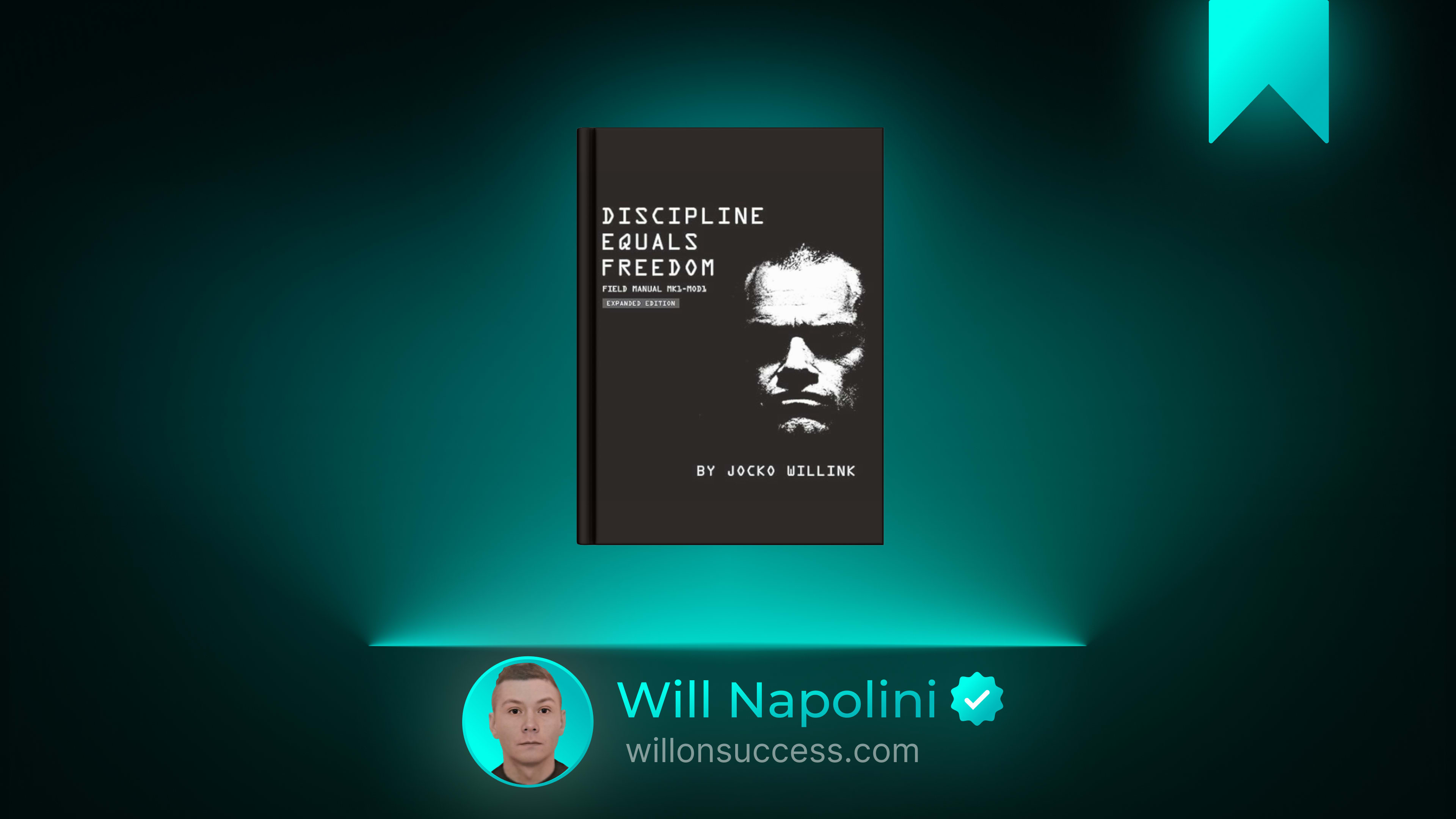
Jocko Willink, a retired Navy SEAL commander who led Task Unit Bruiser in the brutal battle of Ramadi, built his post-military life around a single, counterintuitive truth. It is the title of his field manual, and it is the thesis I want you to carry with you today: Discipline Equals Freedom.
This is not a motivational slogan. It is a mechanical law of human nature. And once you truly understand it, it changes the way you approach every single hour of your life.
The Big Idea: The Paradox of the Tollbooth
We tend to view discipline and freedom as opposites. We think discipline is the cage, and freedom is the open sky.
Willink argues that discipline is not the cage. Discipline is the key to the cage.
If you want financial freedom, you must have the discipline to save, invest, and live below your means. If you want the freedom of a healthy, mobile body in your later years, you must have the discipline to eat clean and train hard today. If you want the freedom of uninterrupted time with your family in the evening, you must have the discipline to focus ruthlessly and manage your time during the workday.
Freedom is not the absence of constraints. Freedom is the mastery of them.
Every area of your life where you feel trapped is an area where you have lacked the discipline to build the infrastructure of freedom. You are standing at the tollbooth, refusing to pay the coin, and wondering why the gate will not lift. Willink’s book is a blunt, unsentimental reminder that the toll must be paid. Every single day.
The Watch at 4:30 AM: Claiming the First Victory
If you follow Jocko Willink on social media, you know his most famous daily ritual. Every morning, he posts a picture of his watch. The time on the watch is always the same: 4:30 AM.
People often ask him why he wakes up so early. They assume it is because he needs the extra hours to run his companies, write his books, and manage his podcast. But Willink corrects them. He does not wake up at 4:30 AM because he needs the time. He wakes up at 4:30 AM to secure a psychological victory before the world even knows he is awake.
At 4:30 AM, there are no emails demanding his attention. There are no clients calling. There are no emergencies. There is only him, the dark, and the decision to get out of bed.
When the alarm goes off, his brain will offer him a dozen logical reasons to stay under the warm covers. You worked late yesterday. You have a hard day ahead. You need the rest. This is the moment of negotiation. And Willink’s rule is simple: Do not negotiate.
By putting his feet on the floor when every fiber of his being wants to stay in bed, he wins the first battle of the day. He establishes dominance over his own mind. By the time the sun comes up and the chaos of the world begins, he has already proven to himself that he is in charge.
You do not need to wake up at 4:30 AM. But you do need a 4:30 AM. You need a daily, non-negotiable action that proves to yourself that your commitments are stronger than your comfort.
Motivation is a Myth; Discipline is the Engine
One of the most liberating realizations in Willink’s philosophy is his absolute dismissal of motivation.
We spend an enormous amount of time waiting to feel motivated. We watch inspiring videos, we read quotes, we wait for the perfect mood to strike so we can finally tackle the garage, write the business plan, or start the diet.
Willink points out a brutal biological fact: Motivation is a feeling. And feelings are fickle. They are driven by your blood sugar, your sleep quality, the weather, and the last conversation you had. If you build your life on the foundation of motivation, your life will collapse the first time it rains.
Discipline, on the other hand, is not a feeling. It is a decision. It is a mechanical process.
When you do not feel like working out, you do not try to motivate yourself. You just put on your shoes. When you do not feel like having the difficult conversation with your business partner, you do not wait for the right mood. You just pick up the phone.
You stop asking yourself, How do I feel about this? and you start asking, What needs to be done? You detach your actions from your emotions. You realize that you can be tired, frustrated, and completely unmotivated, and you can still execute the task.
Motivation is a spark, but discipline is the engine. The spark is nice when you have it, but the engine is what gets you up the mountain.
The Alchemy of “Good”: Reframing the Obstacle
In combat, things go wrong. Constantly. The supply drop lands in the wrong zone. The vehicle breaks down. The enemy shifts positions. In business and in life, the exact same thing happens. The deal falls through. The client cancels. You get injured. The market crashes.
The average person reacts to these setbacks with frustration, victimhood, or despair. They ask, Why is this happening to me?
Willink teaches a one-word protocol for dealing with failure, setbacks, and bad news. When a subordinate came to him in Ramadi to report that a mission was compromised or a piece of gear was broken, Willink would simply look at them and say:
“Good.”
We didn’t get the promotion? Good. We have more time to build our skills so we are undeniable next time. The project got canceled? Good. We can redirect our energy to the other initiative we’ve been neglecting. You tore your meniscus and can’t run? Good. Now you have three months to focus entirely on upper body strength and mobility, and to study the nutrition you’ve been ignoring.
This is not toxic positivity. This is not pretending that the setback doesn’t hurt. This is tactical Stoicism. It is the immediate, aggressive refusal to adopt a victim mindset.
When you say “Good,” you short-circuit the brain’s panic response. You force your mind to stop looking at what was lost, and start looking for the advantage hidden inside the new reality. You take the raw, heavy material of failure and you immediately begin forging it into a weapon.
Default Aggressive: Stop Waiting for Permission
There is a concept in the military called “Default Aggressive.” It means that when the plan breaks down—and the plan always breaks down—you do not freeze, and you do not wait for headquarters to tell you what to do. You take the initiative. You look around, assess the situation, and you move toward the objective.
Willink applies this to everyday life. Most people live in a state of “Default Passive.” They wait to be told what to do. They see a piece of trash on the floor and step over it because “it’s not my job to clean.” They see a flaw in a company process but say nothing because “no one asked my opinion.” They wait for the perfect instructions before they take the first step.
Default Aggressive means you take radical ownership of your environment. If you see a problem, you fix it. If you see a gap in your knowledge, you research it. If you need to make a decision and you only have 70% of the information, you make the call and adjust on the fly, rather than suffering from analysis paralysis.
You stop waiting for the world to give you permission to be effective. You become the kind of person who walks into a room and immediately makes it better, simply because you refuse to tolerate the status quo.
The Physical Foundation: You Cannot Out-Think a Weak Body
It is impossible to discuss Willink’s philosophy without discussing the physical body. He is adamant that the mind and the body are not separate entities; they are one system.
You cannot build a resilient, disciplined mind inside a weak, neglected body. If you are eating garbage, if you are sedentary, if you are chronically sleep-deprived, your brain does not have the biological fuel required to exert willpower. Willpower is not just a psychological concept; it is a metabolic resource.
Willink’s dietary and fitness advice is as stripped-down and unsentimental as his worldview. He advocates for eating real, whole foods, eliminating sugar, and training hard every single day. It does not matter if you are a powerlifter, a runner, or someone who just does push-ups in their living room. The modality matters less than the consistency.
Physical training is the ultimate classroom for discipline. The weights do not care about your feelings. The pavement does not care about your excuses. When you force your body to do hard things, you are literally wiring your brain to tolerate discomfort. You are building the neurological pathways that will allow you to sit still and focus on a difficult spreadsheet, or to stay calm when your toddler is screaming in the grocery store.
You build the fortress of the mind by first laying the stones of the body.
Why This Matters on an Ordinary Tuesday
You might be reading this and thinking, This is intense. This sounds like a lifestyle for a Navy SEAL, not for a parent trying to get three kids to school, or an accountant trying to survive tax season.
But I want to challenge you to look at the quiet desperation of the undisciplined life.
Think about an ordinary Tuesday. You hit snooze three times. You rush out the door, stressed and irritable. You snap at your partner. You get to work and immediately open your email, letting other people’s priorities dictate your morning. You eat a heavy, sugary lunch because you didn’t pack a healthy one, and you spend the afternoon fighting off a brain fog. You get home, collapse on the couch, and watch television until midnight, promising yourself that tomorrow will be different.
That is not freedom. That is a slow, comfortable suffocation.
Now imagine the alternative. The alarm goes off. You do not negotiate. You get up. You drink a glass of water, you move your body for twenty minutes, and you sit in silence for ten minutes before the house wakes up. When the chaos of the morning begins, you are grounded. When a crisis hits at work, you say, “Good,” and you solve it. You go to bed tired, but you go to bed with the deep, quiet satisfaction of someone who kept their promises to themselves.
Discipline does not make your life harder. It makes your life yours.
Practical Application: Building Your Architecture of Execution
How do you take the raw intensity of Jocko Willink’s philosophy and build it into a sustainable daily system? Here are three concrete protocols to implement immediately.
1. The “No-Negotiation” Morning Protocol Identify one small, non-negotiable action you will take the moment your feet hit the floor. It could be making your bed perfectly. It could be drinking a large glass of water. It could be doing twenty squats. The action matters less than the rule: There is no negotiation. When the alarm goes off, you do not ask yourself how you feel. You execute the protocol. You win the first battle before your brain has time to mount a defense.
2. The “Good” Journal Keep a small notebook on your desk. For the next seven days, every time something goes wrong—a delayed flight, a rude email, a broken appliance—write down the event, and write the word “Good” next to it. Then, write one sentence explaining the hidden advantage. “The client canceled the meeting. Good. I now have two hours to finish the quarterly report without interruptions.” Train your brain to automatically hunt for the tactical advantage in every setback.
3. The Evening Setup Discipline in the morning is actually created the night before. Willpower is a finite resource, and decision fatigue is real. Before you go to sleep, lay out your workout clothes. Pack your lunch. Write down the three most important tasks for tomorrow on a physical piece of paper. When you wake up, you should not have to make a single decision about what to do. You just execute the plan your past self built for you.
Who Should Read This Book
Discipline Equals Freedom is essential reading for anyone who is paralyzed by overthinking, anyone who is waiting for the “perfect time” or the “right mood” to start, and anyone who feels like they are constantly reacting to life rather than driving it. It is a powerful antidote to the modern epidemic of comfort and victimhood.
A fair warning: This book is a field manual, not a therapy session. Willink’s voice is direct, militaristic, and entirely unsentimental. He does not spend time exploring the deep psychological roots of your procrastination or offering gentle self-compassion exercises. If you are dealing with deep trauma, clinical depression, or burnout, this book’s “just do it” ethos might feel abrasive or unhelpful. It is best utilized when you are mentally grounded but behaviorally stuck, and you need a stark, unvarnished kick in the pants to get moving.
Your One Small Step
Understanding the mechanics of discipline is valuable, but understanding without action changes nothing in your life.
So here is what I would ask you to do today.
Look at your schedule for tomorrow morning. Find the exact minute you usually wake up. Now, set your alarm for fifteen minutes earlier.
Put your phone or alarm clock across the room, so you physically have to stand up to turn it off.
When it goes off tomorrow, do not think. Do not assess how tired you are. Do not look out the window to see if it’s raining. Just stand up, turn it off, and use those fifteen minutes to do one thing that your future self will thank you for. Drink your water. Stretch. Read two pages of a book. Stare out the window in silence.
You will feel a spike of resistance. That is just the old programming trying to keep you safe in the cage of comfort. Let the resistance be there, and step forward anyway.
You do not need more motivation. You do not need a better plan. You just need to stop negotiating with the person in the mirror.
The gate is locked, but you have always held the key. Turn it.