The Quiet Beliefs That Build or Break a Life: Jim Rohn's Philosophy for Successful Living
You can change your job, your city, your schedule, your wardrobe, and your goals, and still find yourself standing in the same place a year later, wondering why nothing truly shifted.
I have seen this happen. I have watched people rearrange every visible part of their lives with enormous effort and sincerity, only to drift back to the same patterns, the same income level, the same relationships, the same quiet dissatisfaction. And the reason is rarely a lack of effort. The reason is that they changed the furniture without examining the foundation.
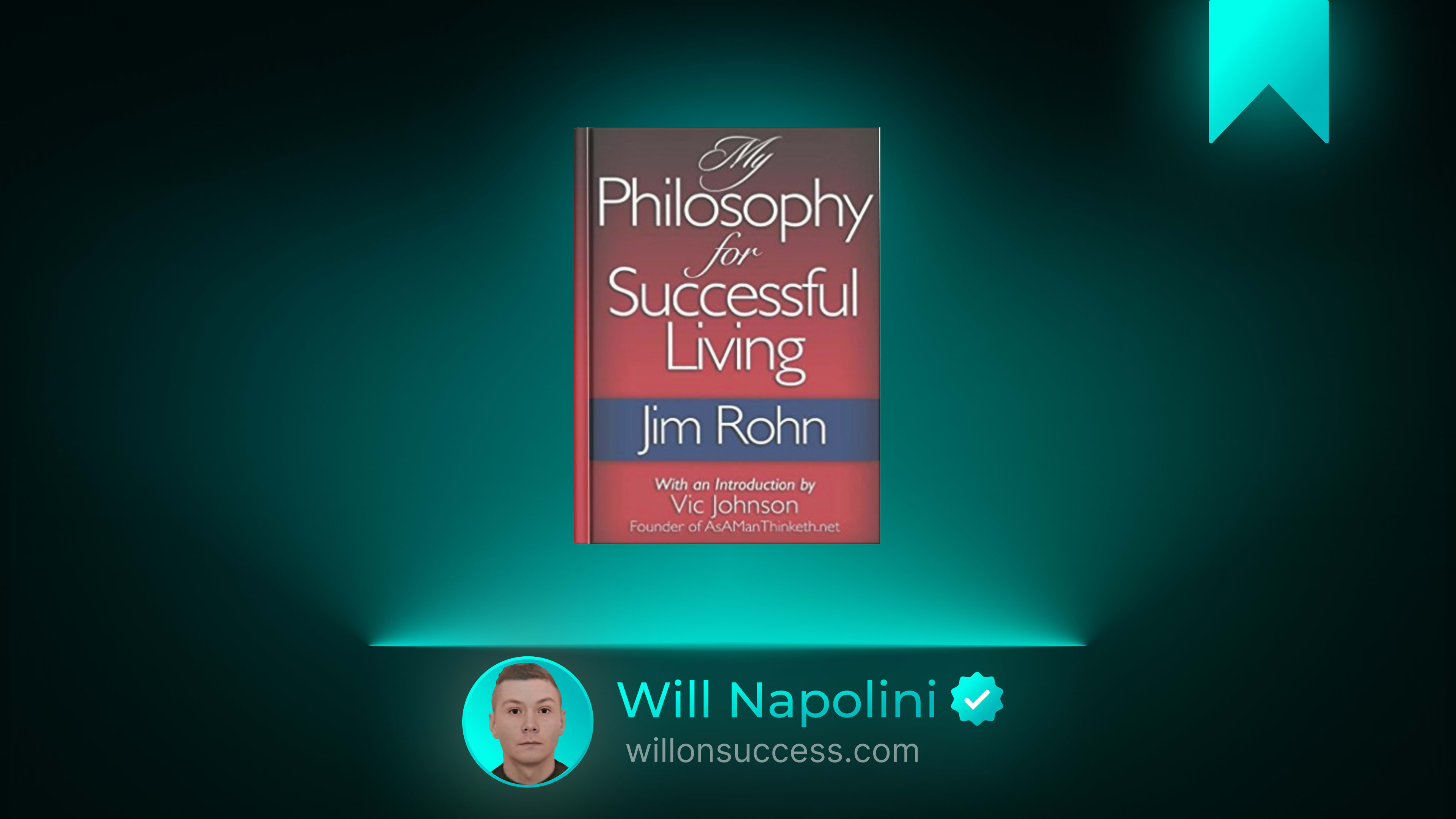
Jim Rohn spent nearly five decades teaching one idea above all others, and My Philosophy for Successful Living is that idea distilled into its clearest form. The idea is this: your life does not grow beyond the quality of the beliefs you carry about it. Not your circumstances. Not your connections. Not your luck. The quiet, often invisible set of assumptions you hold about work, money, time, relationships, and your own worth. Rohn called this set of assumptions your “philosophy,” and he believed it was the single most powerful force shaping your days.
If that sounds abstract, stay with me. By the end of this, you will see exactly how it operates on a Tuesday afternoon when you decide whether to open the book or the television, whether to make the call or postpone it, whether to save the extra hundred dollars or spend it because you feel you deserve a break.
The philosophy is not a grand worldview pinned to a wall. It is the thousand small answers you give to the question: What do I believe is possible for me, and what do I believe is true about how the world works?
The Big Idea: You Cannot Outperform Your Own Beliefs
Rohn’s central argument, stated plainly, is that your external results are a faithful mirror of your internal philosophy. Not your wishes. Not your hopes. Your beliefs.
You can want financial security with every fiber of your being, but if deep down you believe that money is scarce, that people like you do not build wealth, or that wanting more is somehow greedy, your actions will quietly sabotage your stated desires. You will earn and spend. You will start and stall. You will approach the edge of what you want and then, almost without noticing, step back.
This is not mysticism. Rohn was intensely practical. His point was mechanical: beliefs shape attitudes, attitudes shape actions, actions repeated become results. If the results are not what you want, tracing them back through actions and attitudes will almost always lead you to a belief that needs repair.
What I appreciate about Rohn’s framing is that it removes both blame and helplessness. You are not a victim of your past. But you are also not powerless. You can change the philosophy. It is difficult, and it is slow, but it is entirely within your reach. And once you do, everything downstream begins to shift.
The Seasons: A Framework for Understanding Where You Are
One of the most enduring images Rohn used, and one that runs through this book, is the metaphor of the four seasons. He did not treat it as poetry. He treated it as a diagnostic tool.
Winter represents the hard seasons. Loss. Failure. Illness. Economic downturn. The period when the ground is frozen and nothing seems to grow. Rohn’s instruction for winter is simple: do not pretend it is not winter. Do not rage at the cold. Instead, use the winter to strengthen yourself, to learn, to prepare. Winter is not permanent. But you must not waste it by pretending spring has already arrived.
Spring is opportunity. New beginnings. The moment when conditions shift and growth becomes possible. Rohn’s warning here is equally pointed: do not miss spring. Do not be so bruised by winter that you fail to plant when the soil softens. Opportunity has a season. If you do not plant in spring, there is nothing to harvest later.
Summer is the season of growth and protection. The crops are in the ground, but they are vulnerable. Pests. Drought. Neglect. You must tend what you have planted. You must guard it. In life, this is the season of discipline, of showing up daily, of protecting your progress from distraction and complacency.
Fall is harvest. And here Rohn introduces a principle I think is essential: you harvest exactly what you planted, in the quantity you planted it. You cannot plant one seed and expect a forest. You cannot skip spring and blame autumn for its emptiness. The harvest is honest. It reflects your earlier choices with perfect accuracy.
What struck me most about this framework is how it removes the panic so many people feel. If you are in a winter season right now, in your career, your health, your relationships, your finances, Rohn would say: This is winter. It is real. It is painful. But it is not the whole year. Use it. Learn in it. Strengthen yourself in it. Spring is coming, and you will need to be ready to plant.
And if you are in spring, if something new is becoming possible for you, his urgency is equally clear: Plant now. Do not wait for perfect conditions. Do not wait until you feel certain. The season will not hold forever.
The Two Pains: Discipline and Regret
Rohn drew a line that I have returned to many times in my own life. He said that every person must choose between two kinds of pain: the pain of discipline, or the pain of regret. The difference is that discipline weighs ounces, while regret weighs tons.
The small discipline is the alarm clock at five-thirty. The page read before bed. The conversation you have instead of avoiding. The money set aside before the impulse purchase. The extra repetition at the gym when your body is asking to stop. Each one is small. Almost negligible in isolation.
But Rohn insisted that small disciplines, repeated daily, compound into a life of substance. And small errors in judgment, also repeated daily, compound into a life of quiet erosion. Skipping the workout once means nothing. Skipping it every day for a year means something. Skipping the hard conversation once is understandable. Making avoidance a pattern is corrosive.
What you repeat in private eventually becomes the visible architecture of your life. Not the dramatic choices. The quiet, Tuesday-afternoon choices that no one sees and no one applauds.
This is why Rohn placed so much emphasis on the word discipline without apology. He did not treat it as punishment. He treated it as the bridge between a goal and its fulfillment. Without the bridge, the goal remains a pleasant image on the far bank of a river you never cross.
Work Harder on Yourself Than on Your Job
If there is one sentence that captures Rohn’s teaching, it is his insistence that personal development is not a luxury added on top of a career. It is the engine of the career. He taught that your level of income and impact will rarely exceed your level of personal growth.
The implication is uncomfortable but liberating. If you want your external circumstances to change, the most efficient lever is not a new strategy, a new market, or a new connection. It is you. Your skills. Your knowledge. Your emotional maturity. Your ability to think clearly under pressure. Your capacity to lead, to listen, to create, to adapt.
Rohn was a relentless advocate of reading, of study, of what he called self-education. He believed that the books you read, the ideas you expose yourself to, the conversations you choose, were not leisure. They were construction materials. You were building the person who would either rise to meet opportunity or shrink from it.
I would put it this way: you do not attract what you want. You attract what you are. And the fastest way to change what you are is to feed your mind deliberately, daily, with ideas that stretch it.
This does not require a degree. It does not require money. It requires twenty minutes and the decision to read something challenging instead of something merely comforting. Rohn often said that formal education earns you a living, but self-education can build you a life. The distinction is between acquiring credentials and acquiring wisdom. Both matter. But only one compounds endlessly.
The Ants and the Quiet Accumulation
Rohn loved the image of the ant, and he returned to it often. Ants do not perform. They do not announce their work. They do not wait for inspiration. They gather, steadily, relentlessly, in season and out. They prepare in summer for a winter they cannot yet see. And they carry many times their own body weight, one small journey at a time.
The ant philosophy, as Rohn framed it, contains a principle I think most of us need to hear: consistency outperforms intensity every time. The person who saves fifty dollars a week for ten years outbuilds the person who saves two thousand dollars in January and nothing for the rest of the year. The person who writes three hundred words every morning outproduces the person who waits for a weekend of inspiration that never arrives.
You do not need a dramatic overhaul. You need a small, repeatable action that you protect fiercely. The ant does not look at the distance to the colony and despair. It picks up the crumb. It walks. It arrives. It goes back for the next one.
Pick up the crumb. Walk. Arrive. Go back.
Your Associations Are Shaping You Whether You Notice or Not
Rohn spoke candidly about the power of the people around you. Not in a mystical sense. In a practical, observable sense. The people you spend time with shape your standards, your vocabulary, your sense of what is normal, what is acceptable, what is possible.
If everyone around you treats mediocrity as reasonable, you will slowly begin to treat it as reasonable too. Not because you are weak. Because you are human, and humans calibrate to their environment.
This is not about cutting people off cruelly. Rohn was not advocating that. He was advocating awareness. He was asking you to notice who is influencing your thinking, your habits, your expectations, and to be intentional about adding voices that stretch you, challenge you, and model a way of living you admire.
A single conversation with the right person can reframe a problem you have been circling for months. A single book from someone who walked the path ahead of you can save you years of stumbling. Seek those voices. Protect your access to them. Be generous in return.
Why This Matters on an Ordinary Afternoon
Let me bring this down to the ground.
It is three o’clock. You are tired. The task in front of you is tedious. No one will notice if you cut a corner. No one will applaud if you do it well. Your phone is bright with distraction. Your mind whispers that you have done enough, that you deserve to coast, that tomorrow will be better.
This is where philosophy becomes visible. Not on a stage. Not in a journal. Here. In the small negotiation between what is easy and what is true.
If your philosophy says, I do what needs doing even when I do not feel like it, because that is how I build something I respect, you sit back down. You finish the task. You close the day with the quiet satisfaction of a person who kept a promise to themselves.
If your philosophy says, I will do it when I feel motivated, when conditions are perfect, when someone notices, you close the laptop. You scroll. You feel a small, familiar ache. And tomorrow, the same negotiation begins again.
Neither version is dramatic. Both are real. And repeated over months and years, they produce entirely different lives.
Rohn understood this. His entire teaching was aimed at that three-o’clock moment. At giving you a philosophy sturdy enough to hold when motivation fades, when no one is watching, when the work is unglamorous and the reward is distant.
A Practical Place to Begin
If you want to put this book into motion, here is what I would suggest. Not a grand overhaul. A small, honest examination.
First, write down five beliefs you currently hold about your work, your money, and your future. Not what you wish were true. What you actually believe. Be honest. If the belief is People like me do not get to have that, write it down. If it is I will start when things calm down, write it down. You cannot repair what you will not look at.
Second, choose one small discipline and protect it for thirty days. Not five disciplines. One. Reading ten pages before bed. Walking twenty minutes each morning. Writing in a journal for five minutes. The specific action matters less than the act of keeping the promise to yourself. You are building evidence that you are someone who follows through.
Third, audit your inputs for one week. Notice what you read, watch, listen to, and who you spend time with. You do not have to change everything. Just notice. Ask yourself: Is this feeding the person I am becoming, or is it feeding the person I am trying to outgrow? Awareness precedes change. You cannot redirect a current you have not noticed.
Fourth, plant one seed this week that belongs to a future season. Sign up for the course. Make the phone call. Save the fifty dollars. Write the first paragraph. Do it imperfectly. Do it before you feel ready. Spring does not wait for your confidence. It only asks for your hands in the soil.
Who Should Read This Book
If you are early in your personal development journey and you want a clear, warm, no-nonsense introduction to how thinking shapes living, this book is an excellent starting point. Rohn’s language is simple. His ideas are layered but never pretentious. He speaks like a kind, sharp-eyed mentor who has seen thousands of people make the same mistakes and wants gently to spare you a few of them.
If you are someone who has read extensively in personal development and you are looking for novel frameworks or cutting-edge research, this book may feel familiar. Rohn’s ideas have been absorbed into so much of the genre that they can seem obvious in hindsight. But familiar is not the same as practiced. And Rohn’s gift is not novelty. It is clarity. He says the thing you already know but have not yet acted on, and he says it in a way that makes acting feel possible.
If you are in a winter season, if you feel stuck, if you have been waiting for circumstances to improve before you begin, this book will challenge you without shaming you. Rohn does not yell. He invites. He asks questions. He trusts you to answer them honestly.
The book is short. You can read it in an afternoon. But I would encourage you to read it slowly. Let a single paragraph sit with you for a day before moving to the next. Rohn’s ideas are seeds, not bullet points. They need time in the soil.
One Small Step
Here is what I want you to do before you close this article.
Take a blank sheet of paper or open a blank note on your phone. At the top, write one sentence: What do I believe is true about my future?
Then write for three minutes. Do not edit. Do not judge. Do not perform. Just let the honest answer come. If the answer is hopeful, notice that. If the answer is fearful or resigned, notice that too. Do not try to fix it in this moment. Just look at it.
Because you cannot change a philosophy you have not yet seen. And seeing it, honestly, without flinching, is the first act of rebuilding.
Rohn believed that a single idea, truly understood and acted upon, could redirect a life. Not a hundred ideas. One. The right one, held firmly, practiced daily, allowed to compound.
You do not need to overhaul everything by Friday. You need to find one belief worth changing, one small discipline worth keeping, one seed worth planting while the season still allows.
The soil is ready. Your hands know what to do. And the harvest, patient and honest, is already leaning toward the person you are becoming.
Plant today.