Dan Kennedy's Case for Living Like You Still Have Work to Do
Most people do not fail because they lack talent or opportunity. They fail because they are comfortable. Not wealthy-comfortable. Not successful-comfortable. Just comfortable enough to stop being honest with themselves about what they are avoiding, what they are deferring, and what they have quietly decided to leave undone.
Dan S. Kennedy has spent a career being aggressively, almost offensively, honest about that drift. He built his reputation in the world of direct-response marketing and entrepreneurial strategy, writing books with titles that practically dare you to look away. No fluff. No soft-focus inspiration. No gentle nudges. He looks at your business, your schedule, your excuses, and your vague someday-plans, and he says, in effect: This is not working. You know it is not working. Here is what actually works. Now do it or stop pretending you want the result.
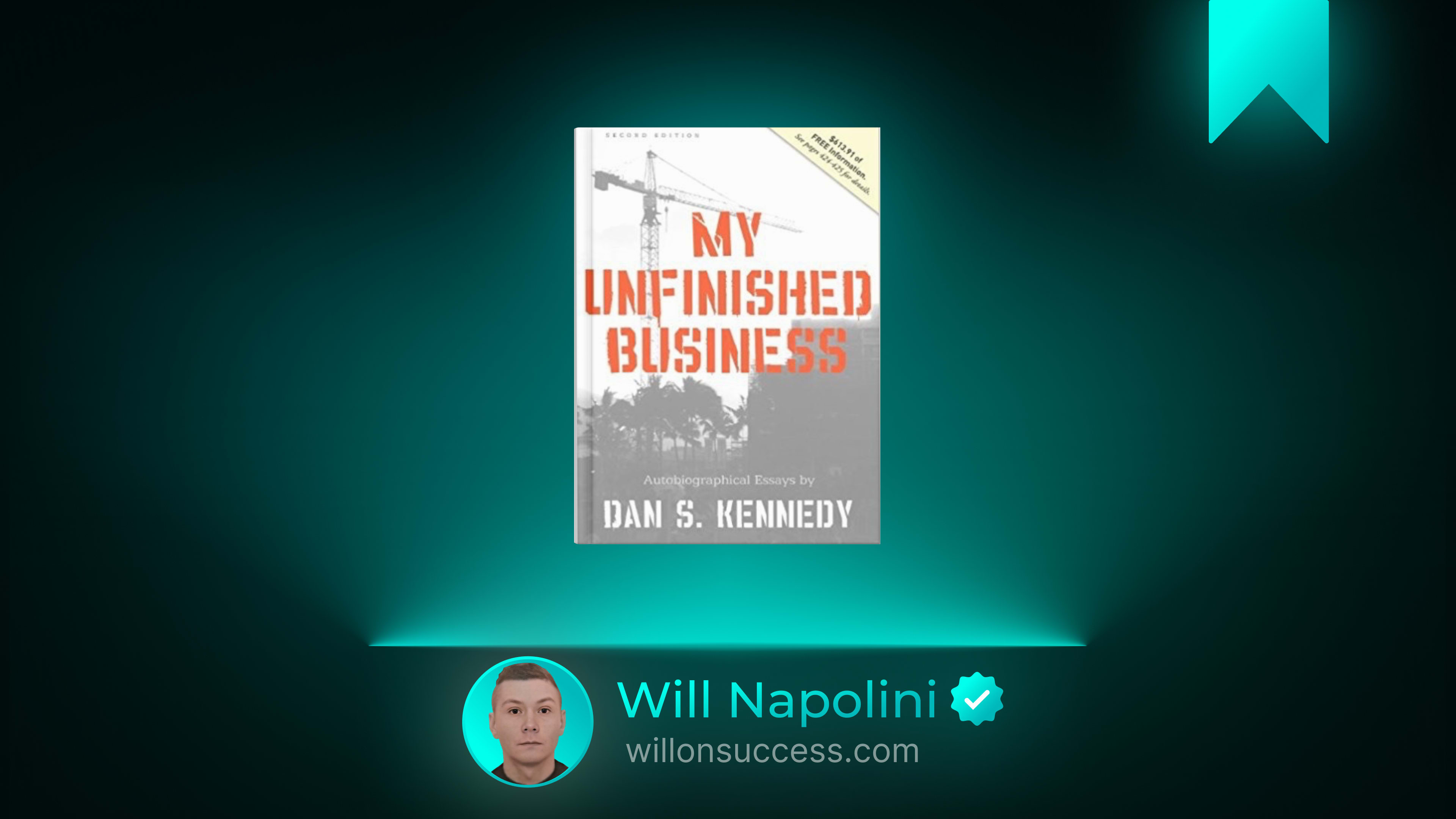
My Unfinished Business carries that same energy, but turns it inward. It is Kennedy examining his own life, his own unfinished work, his own unfinished thinking, and inviting the reader to do the same. Not in a sentimental, journaling-by-candlelight way. In a blunt, clear-eyed, roll-up-your-sleeves way. The title itself is a provocation. Unfinished. Not failed. Not broken. Unfinished. Still in progress. Still requiring your hands, your attention, your honesty.
If you have been living as though the main work of your life is behind you, or as though it will begin someday when conditions improve, this book is a cold glass of water in the face. And I mean that as a compliment.
The Big Idea: Comfortable Is the Most Dangerous Place to Be
Kennedy’s central argument, the thread running through everything he writes and teaches, is that most people settle into a kind of quiet surrender they mistake for stability. They have a job. They have a routine. They have a set of beliefs about what is possible for them. And they defend that small territory fiercely, not because it fulfills them, but because it is known. Because the alternative, actually building something, actually asking for more, actually risking being wrong, feels too uncertain to face.
He calls this out without cruelty but without softness. The person who has been “thinking about starting a business” for six years is not in a planning phase. They are in a hiding phase. The person who says they will get serious about their finances next quarter, next year, after the kids are older, after the promotion, is not waiting for the right time. They are rehearsing a postponement until it becomes permanent.
Kennedy’s philosophy strips away the dignity of that postponement. He does not say it to shame you. He says it because he has watched too many capable, intelligent people talk themselves into a smaller life than the one they actually want, and he finds it genuinely tragic. Not in a weeping way. In a this is solvable and you are choosing not to solve it way.
The “unfinished business” of the title is not just Kennedy’s. It is yours. The project you shelved. The skill you never developed. The conversation you never had. The business you never launched. The standard you never enforced. The life you described to yourself at twenty-five and then quietly abandoned somewhere around thirty-two because the mortgage got complicated and the fear got louder.
Kennedy is asking you to look at that pile. Not to feel guilty about it. To pick something up and finish it. Or consciously, deliberately, set it down and choose something else. But stop pretending the pile is not there.
Speed Beats Perfection Every Single Time
One of Kennedy’s most insistent principles, woven through his marketing work and his personal philosophy alike, is the primacy of speed. Not recklessness. Not carelessness. But the understanding that a good decision made today and acted upon will almost always outperform a perfect decision made next month.
He watched, over decades in business, as people agonized. They researched endlessly. They compared options. They sought more information, more opinions, more certainty. And while they deliberated, someone else with half their knowledge and twice their nerve shipped the product, made the call, launched the campaign, and captured the opportunity.
Kennedy’s view is that imperfection in motion is worth more than excellence in theory. A rough first draft you actually write beats the masterpiece you only outline. A clumsy sales conversation you actually have beats the perfect pitch you rehearse in the shower for three weeks and never deliver. A small business that opens its doors and learns from real customers beats the flawless business plan that lives in a drawer.
This is not an argument against thinking. Kennedy is a strategist. He plans. He calculates. He measures. But he distinguishes sharply between strategic thought and anxious delay. Strategic thought asks: What is the smartest next step? Anxious delay asks: What if I am wrong? What if it is not good enough? What will people think?
The first question produces action. The second produces paralysis dressed up as preparation.
If you have been “getting ready” for something for longer than the thing itself would take to attempt, Kennedy would look at you across the table and say, very calmly, that you are not preparing. You are hiding. And he would be right.
Build Systems, Not Just Effort
Kennedy made his name in direct-response marketing, a field obsessed with one question: Can we measure what works? Not what sounds impressive. Not what wins awards. Not what feels creative. What actually produces a result you can count, track, and repeat.
He brought that same obsession into how he thinks about business and life. He is deeply skeptical of effort that cannot be traced to an outcome. He is suspicious of activity that feels productive but produces nothing measurable. He wants to know: What did you do, what happened because you did it, and can you do it again tomorrow?
This translates into a principle that applies far beyond marketing: build systems, not just habits of effort. A system is a repeatable process that produces a result regardless of your mood, your energy level, or your motivation on any given day. A system for acquiring clients. A system for managing money. A system for learning. A system for maintaining relationships. A system for protecting your time.
The person who relies on inspiration to work is at the mercy of inspiration. The person who has a system works whether they feel inspired or not. And over months and years, the system wins every time. Not because it is glamorous. Because it is reliable.
Kennedy would say that most people do not have a discipline problem. They have a structure problem. They are trying to white-knuckle their way through chaos, and they blame themselves for lacking willpower when the real issue is that they have no structure to support the behavior they want.
You do not need more willpower. You need a system that makes the right action the path of least resistance.
The Contrarian Advantage: Stop Trying to Be Liked by Everyone
Kennedy built his career on being deliberately, strategically different. In a business world obsessed with fitting in, with safe branding, with not offending anyone, he went the other direction. He was loud. He was specific. He was polarizing. He attracted the people who resonated with his message and repelled the people who did not, and he considered that a feature, not a flaw.
This principle extends beyond marketing into how he thinks about life and work. Kennedy is skeptical of the desire to be universally approved. He sees it as a quiet tax on ambition. If you need everyone to think you are reasonable, you will never do anything bold. If you need everyone to agree with your choices, you will make only choices that threaten no one, which means you will make only choices that change nothing.
He would not tell you to be rude for its own sake. He is not celebrating cruelty. But he is asking a pointed question: Are you making decisions based on what is true and what works, or are you making decisions based on what will make the fewest people uncomfortable?
The entrepreneur who underprices because they are afraid of being seen as expensive. The employee who never speaks up in meetings because they are afraid of being seen as difficult. The parent who never sets a boundary because they are afraid of being seen as unkind. The artist who never shows the work because they are afraid of being seen as presumptuous.
All of them are paying the approval tax. And the tax compounds. Year after year, the unlived life gets more expensive.
Kennedy’s alternative is not aggression. It is clarity. Know what you stand for. Say it plainly. Let the people who disagree disagree. Build your work, your business, your life, for the people it is actually for, and stop diluting it to appease the people it was never meant to serve.
Time Is the One Asset You Cannot Earn Back
Throughout his work, Kennedy treats time with a seriousness that borders on ferocity. He is not sentimental about it. He is practical. Time is the only resource that is strictly non-renewable. You can lose money and earn it back. You can lose a client and find another. You can lose a job and get a new one. You cannot lose an hour and get it back. You cannot get back the Tuesday you spent in meetings that should have been emails. You cannot get back the year you spent building something someone else wanted instead of the thing you actually cared about.
He guards his own time aggressively. He says no frequently. He is suspicious of obligations that serve other people’s priorities at the expense of his own. He treats his calendar not as a shared public resource but as a private asset to be defended.
And he extends this to the reader. The question he keeps asking, in different forms, is: Are you spending your time, or is it being spent on you? There is a difference between a full schedule and a purposeful one. You can be busy from seven in the morning until ten at night and have accomplished nothing that matters to you. Activity is not the same as progress. Motion is not the same as direction.
If you looked at your last seven days honestly, how much of that time was spent on the things you say matter most? Not the things that are urgent. Not the things other people needed. The things you would defend as your actual priorities if someone pressed you.
If the answer is uncomfortable, that discomfort is useful. It is the starting point for a conversation with yourself about what you are actually building versus what you are merely enduring.
Wealth Is a Skill, Not a Windfall
Kennedy thinks about money differently from most people, and he is blunt about it. He does not treat wealth as something that happens to you, a matter of luck or inheritance or being in the right place. He treats it as something you build through a specific set of skills: the ability to identify value, to communicate it, to deliver it, to charge appropriately for it, and to keep more than you spend.
He is skeptical of the employee mindset, not because employment is wrong, but because it trains you to trade time for money at a fixed rate and then hope someone gives you a raise. He would rather see people develop the ability to create value directly, to solve problems that people will pay for, to build assets that generate income independent of their hourly presence.
This is not a get-rich-quick philosophy. Kennedy is impatient with hype. His approach is grounded in work, in learning, in developing genuine expertise, in serving a specific group of people well enough that they choose you over alternatives. It is slow. It is unglamorous. It requires you to become good at something and then to tell people clearly what you are good at and why it matters to them.
But the compounding effect of that approach, over years, is substantial. The person who builds a skill, builds a reputation, builds a client base, and builds systems to serve them is building an asset. The person who merely shows up and collects a paycheck is renting their time. Both are valid choices. But only one builds something you own.
What This Looks Like in Practice
Let me bring Kennedy’s philosophy down from the abstract and into the concrete.
You have a project you have been talking about for two years. A book. A course. A small business. A renovation. Kennedy would say: stop talking about it. Set a date. Tell one person the date. Do the first ugly, imperfect step this week. Not next week. This week. The world does not owe you readiness. You owe the world the thing you keep saying you will make.
You are spending three hours a day on activities that produce nothing you value. Scrolling. Meetings that could be emails. Obligations you accepted out of guilt. Kennedy would say: audit it. Track it for three days. See where the time actually goes. Then cut one hour and redirect it to the thing you say you do not have time for. You will find the time. You always had it. You were spending it on something less important and calling it unavoidable.
You are undercharging, under-asking, under-promoting yourself because you are afraid of being seen as too much. Kennedy would say: raise the price. Make the ask. Send the email. Post the work. The people who matter will respect you more for it. The people who do not matter were never your market.
You have been waiting for permission. For the right credential. For someone to tell you that you are qualified, ready, authorized to begin. Kennedy would say: no one is coming to give you permission. The people you admire started before they felt ready. They figured it out in the doing. Give yourself the permission you are waiting for, and start.
Who Should Read This Book
If you are an entrepreneur, a freelancer, a small business owner, or someone thinking seriously about becoming one, Kennedy’s thinking will feel like oxygen. He speaks your language. He understands the specific loneliness of building something without a safety net. He understands the temptation to overthink, to undercharge, to hide behind busywork instead of doing the work that actually moves the needle.
If you are someone who has been stuck in planning mode, in research mode, in waiting mode, for longer than you care to admit, this book will make you uncomfortable in the best way. Kennedy does not coddle. He does not validate your reasons for waiting. He looks at them, acknowledges them briefly, and then asks you to set them aside and act.
If you prefer gentle encouragement, soft language, and the reassurance that everything will work out in its own time, this is not your book. Kennedy’s tone is direct, sometimes sharp, occasionally irreverent. He is not trying to be your friend. He is trying to be useful. And for many readers, that directness is exactly the medicine they need.
If you are looking for a step-by-step tactical manual, this is more philosophical than procedural. The principles are clear, but you will need to translate them into your own context. Kennedy gives you the lens. You still have to look through it at your own life and decide what to change.
One Small Step
Here is what I want you to do today. Not this weekend. Today.
Take five minutes. Get a piece of paper or open a blank document. Write down one piece of unfinished business that has been sitting in the back of your mind. The project. The conversation. The decision. The skill. The thing you keep saying you will get to but never do.
Write it down in one sentence. Not a paragraph. Not an essay. One sentence. I have not yet started the business I told myself I would build. Or: I have not yet asked for the raise I know I deserve. Or: I have not yet forgiven the person I need to forgive in order to stop carrying this weight. Or: I have not yet made the health decision I have been postponing for eighteen months.
Look at that sentence. Do not judge yourself for the delay. Do not spiral into guilt. Just look at it clearly.
Then write one small action you can take within the next forty-eight hours. Not the whole project. One action. One phone call. One paragraph. One email. One walk to the place where the thing lives. One conversation. One search query. One small, concrete, observable step that moves the pile by one item.
Do that step. Not perfectly. Not when you feel ready. Do it the way you would pull a splinter: quickly, with a small wince, and then relief.
Because the unfinished business in your life is not a monument to your failures. It is a list of things you still get to do. And the fact that they are unfinished means they are still possible. The door is not locked. You have simply been standing in front of it, waiting for someone to open it for you.
No one is coming. But your hand is already on the handle.
Turn it. Walk through. Do the work. And let the comfort of the small, safe, known life lose its grip on you, one honest decision at a time.
The business is unfinished. That is not a tragedy. That is an invitation. And invitations expire.
Answer this one today.