The Ruthless Math of Reclaiming Your Life: A Summary of No B.S. Time Management
You can work eighty hours a week, answer every message the second it arrives, and attend every meeting on your calendar, yet still end the year feeling exhausted and further from your goals than when you started. I have watched this happen to incredibly smart, driven people. They confuse motion with progress. They mistake a crowded schedule for a meaningful life. If I could sit across the table from you right now, I would ask you one simple question: Are you managing your time, or is your time quietly managing you?
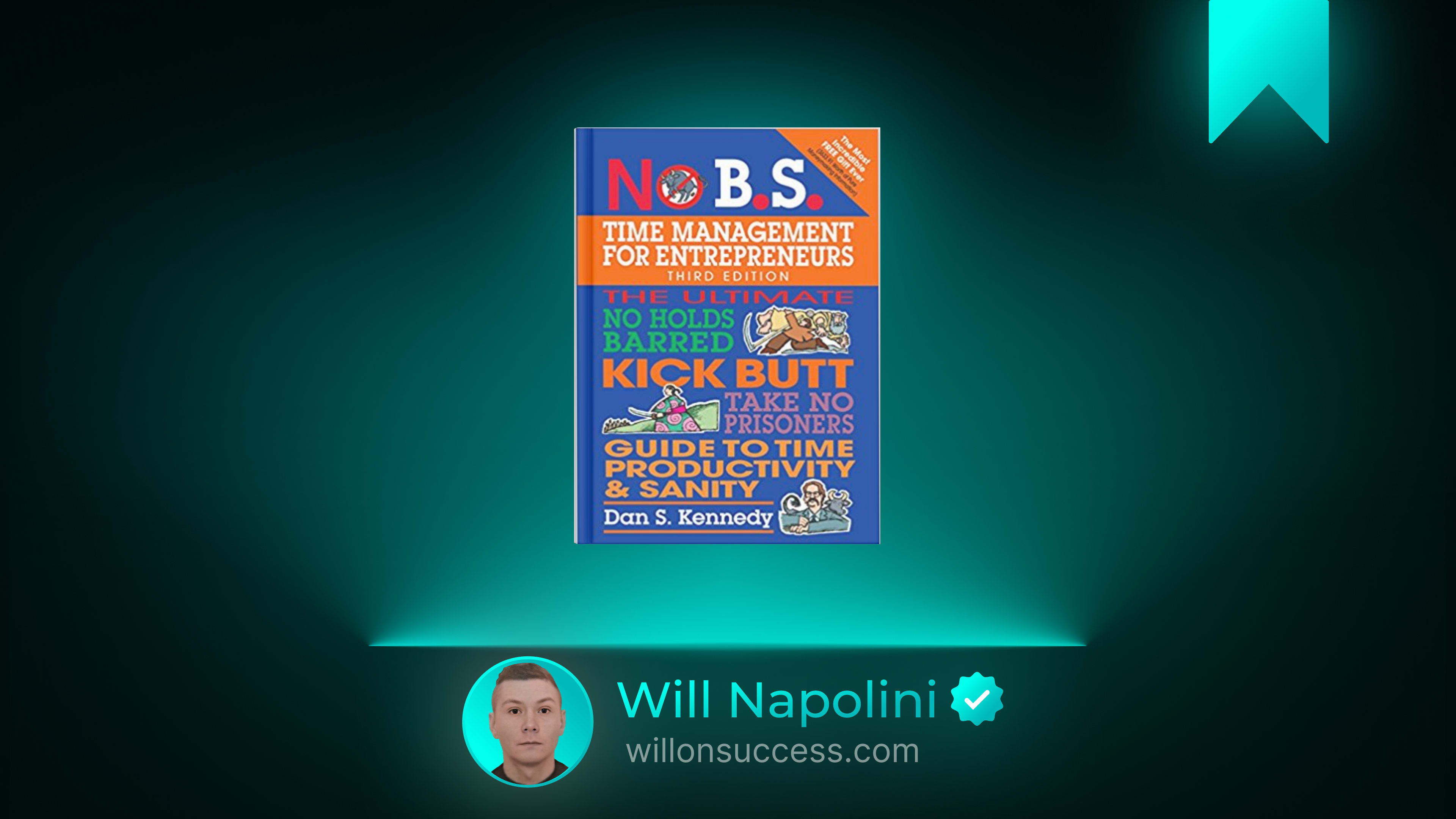
In his unapologetically blunt book, No B.S. Time Management for Entrepreneurs, Dan S. Kennedy strips away the polite fictions we tell ourselves about productivity. His central thesis is as simple as it is uncomfortable: Time is not just money. Time is a strictly finite resource, and until you treat your own hours with a ruthless, almost obsessive level of financial valuation, you will never be truly effective. The goal is not to squeeze more tasks into your day. The goal is to radically elevate the value of the tasks you choose to do, and aggressively eliminate everything else.
The Governing Number
Imagine you want to earn a specific amount this year. You take that target number, divide it by the realistic hours you intend to work, and arrive at a precise hourly rate. Kennedy calls this your “governing number.”
Let’s say your math tells you your time is worth $350 an hour. That number is no longer an abstraction. It becomes a filter for every decision you make. Suddenly, that unnecessary fifteen-minute phone call isn’t just a quick chat; it is an $87 expense. The weekly staff meeting that could have been an email just cost the company $1,400 of your time. When you attach a literal price tag to your minutes, you stop giving them away for free.
Your Governing Number Dictates Your Reality
Most people operate with a vague sense of their own value. Kennedy argues you need a precise, non-negotiable number. If your governing number is $200 an hour, you cannot justify spending two hours formatting a spreadsheet when you could pay someone $30 an hour to do it. You must systematically divest yourself of tasks that fall below your hourly rate. You are not just managing a schedule; you are managing a portfolio of minutes. And like any good investor, you must cut the losing assets to protect your wealth.
Beware the Time Vampires
We all know them. The colleagues who stop by your desk to chat. The clients who demand endless revisions. The open-door policy that sounds so noble but actually turns your office into a buffet for distractions. Kennedy famously compares these interruptions to “Time Vampires.” They don’t steal your money; they drain your life force.
You have to build a fortress around your calendar. This means learning the hardest word in the English language: No. Every time you say yes to something trivial, you are saying no to something vital. You cannot build a meaningful life if you are constantly surrendering your boundaries to people who do not respect your time.
Fire Yourself (The Art of Ruthless Delegation)
This is where most ambitious people fail. You believe that if you want something done right, you have to do it yourself. That belief is the ceiling on your success. To grow, you must actively fire yourself from the routine, the mundane, and the tasks you simply do not enjoy.
But delegation is not just dumping work on someone else. It requires a system. You must define what needs to be done, ensure it is understood, explain why it matters, teach the process without micromanaging, and set a clear deadline. And here is the hardest pill to swallow: you must accept that “good enough” is often good enough. If someone else can achieve 85% of your result, delegate it. You need to free up your hands to do the 100% work that only you can do.
Engineer Your Environment
Willpower is a finite resource. If you rely on it to stay focused, you will eventually fail. Instead of fighting your environment, design it to work for you. Kennedy suggests populating your workspace with “psychological triggers”—visual cues that remind your subconscious mind of your priorities. Put a clock where you can see it. Hang up images that represent your financial goals. Schedule your day in strict, thirty-minute blocks. When your environment constantly whispers your goals back to you, discipline stops feeling like a punishment and starts feeling like a natural rhythm.
Why It Matters
Why should you care about this aggressive approach to time? Because burnout is rarely caused by doing too much of the right work; it is caused by doing too much of the wrong work. When you spend your days on low-value tasks, you experience the friction of effort without the reward of progress. That friction destroys your spirit.
By applying these principles, you stop measuring your day by how many boxes you checked off a to-do list, and start measuring it by the actual value you created. You move from being a busy employee in your own life to being the CEO of your own time.
Practical Application
Understanding this is not enough. You have to act. Here is how you can begin shifting your relationship with time today:
- Calculate your Governing Number: Take your desired annual income and divide it by 2,000 (or your actual working hours). Write that number on a sticky note and put it on your monitor.
- Audit your “Vampires”: Look at your calendar for the past two weeks. Highlight every meeting or task that did not directly generate revenue, move a major project forward, or bring you genuine joy. Next week, decline, delegate, or delete three of them.
- Implement the “Touch It Once” Rule: When you open an email or pick up a piece of mail, make a decision immediately. Do it, delegate it, schedule it, or delete it. Never put it back in the pile to “deal with later.”
Who Should Read This Book
No B.S. Time Management is essential reading for entrepreneurs, freelancers, agency owners, and anyone whose income is directly tied to their output. If you feel like you are running on a treadmill, sweating profusely but going nowhere, this book will hand you the off-switch.
However, if you are looking for a gentle, comforting guide that tells you to “just do your best” and “find balance” through soft affirmations, this book’s tough-love, profit-driven tone might feel abrasive. It is not for the faint of heart. It is for the person who is ready to stop making excuses and start making progress.
One Small Step
Before you close this tab and return to your inbox, I want you to do one thing. Grab a piece of paper and calculate your Governing Number. Don’t guess. Do the actual math. Once you have that number, write it at the top of your to-do list for tomorrow. Let it be the silent judge of every task you attempt.
Final Thoughts
You do not need more hours in the day. You need more intention behind the hours you already have. Time is the soil in which your life grows; what you plant in it is entirely up to you. Stop giving your minutes away to the highest bidder of distraction, and start investing them in the person you are trying to become.
Your calendar is a blueprint of your future. Make sure you are the one holding the pen.