Willpower Doesn't Work – Why Designing Your Environment Beats White-Knuckling Every Time
I want you to picture the last time you tried to change something through sheer force of intention. Maybe it was a diet that lasted eleven days. Maybe it was the alarm you set for 5:30 a.m., silenced four times before you finally dragged yourself upright, already feeling defeated before your feet touched the floor. Maybe it was the promise to write, to exercise, to stop scrolling, to be patient with your children, to finally start the project you keep describing to friends as “something I’m working on.”
You tried. You genuinely tried. And for a while, the effort held. Then Tuesday arrived with its particular exhaustion, or Wednesday brought an unexpected stress, and the whole structure—built entirely on the thin wire of your resolve—snapped.
And you told yourself the familiar sentence: I just don’t have enough discipline.
What if that sentence is wrong? Not partially wrong. Fundamentally wrong. What if the problem was never your character, your commitment, or your capacity for suffering? What if the problem was that you were trying to swim upstream in a river you never thought to redirect?
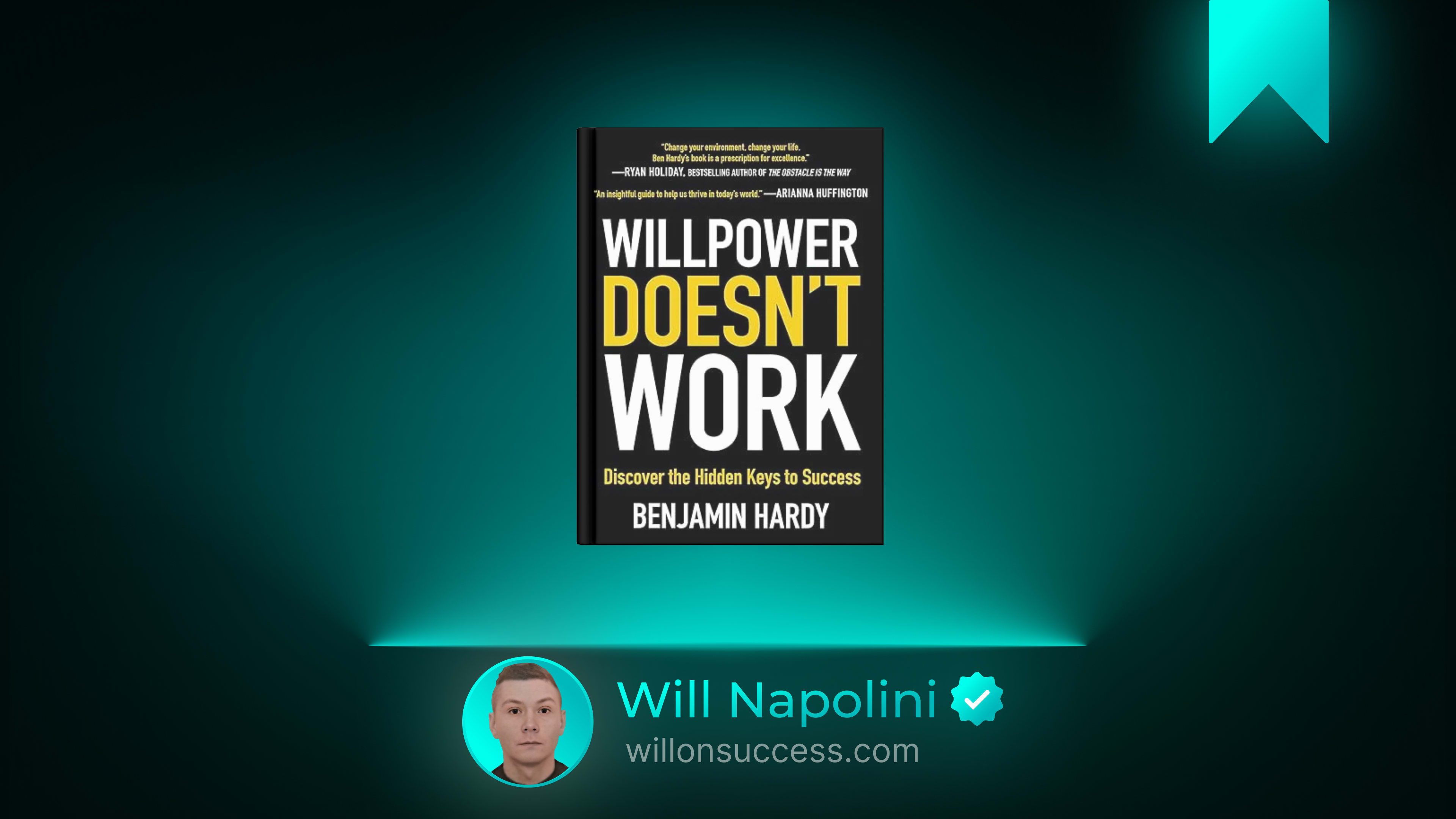
That is the question Benjamin Hardy asks in Willpower Doesn’t Work, and I think it is one of the most liberating questions a person can encounter.

The Big Idea: Stop Wrestling Yourself and Start Building the Room
Hardy’s central argument is deceptively simple, and I want to state it plainly before we go deeper:
Your environment shapes your behavior far more powerfully than your internal motivation does. If you want to change your actions, change the space in which those actions happen. Design the conditions. Remove the need for heroic self-control. Make the right choice the easy choice, the default choice, the only choice.
This is not a dismissal of effort. Hardy is not saying you can become someone new while lying on the couch. He is saying that effort, directed at rearranging your surroundings, produces vastly more lasting results than effort directed at overriding your own impulses every single hour of every single day.
Think of it this way. You can spend your life building a stronger and stronger dam to hold back a river. Or you can dig a channel that sends the water where you actually want it to go. The dam requires constant maintenance, constant vigilance, constant strength. The channel, once dug, works while you sleep.
Willpower is the dam. Environment design is the channel.
Why the “Just Push Through” Philosophy Fails You
I have watched people pour years into the push-through method. They white-knuckle their way through cravings, distractions, and exhaustion, treating every small lapse as evidence of a moral failing. They believe that if they simply wanted it badly enough, the internal war would stop.
It does not stop. Because the war is not the path. The war is the obstacle.
Hardy draws on behavioral research showing that self-control functions like a muscle that fatigues with use. Every decision where you override your immediate impulse draws from a limited reserve. By evening, after a full day of small negotiations with yourself—resist the snack, ignore the notification, stay focused on the report, be pleasant in the meeting you dreaded—your reserves are depleted. And in that depleted state, the old patterns rush back in. Not because you are weak. Because you asked one finite resource to carry the entire weight of your transformation, and it buckled.
I should note here that the specific research on “ego depletion” that informed much of this conversation has been debated and challenged in subsequent replication attempts. The science is more nuanced than a simple battery metaphor. But the practical observation underneath remains solid, supported by broader research in behavioral psychology and environmental design: people are profoundly shaped by the cues, defaults, and structures around them. You do not need the depletion model to be perfectly accurate for the book’s core advice to work. The advice works because environments genuinely do govern behavior. You can verify this in your own life within a week.
The person who keeps junk food in the pantry and tries not to eat it is fighting a harder battle than the person who simply does not buy junk food. The second person is not more disciplined. The second person made one decision at the grocery store and then stopped negotiating.
That distinction changes everything.
Design the Room, Not the Resolve
Hardy spends considerable energy on a principle I think is the book’s most practical gift: you are not a fixed self moving through neutral space. You are a person in constant dialogue with your surroundings. The room speaks to you. The phone on the nightstand speaks to you. The layout of your kitchen, the apps on your home screen, the people you see daily, the sounds and sights and textures of your ordinary hours—all of it is instruction. All of it is pulling you toward some behavior and away from another.
Most of us have never consciously designed that instruction. We inherited it. We moved into an apartment and arranged the furniture for aesthetics, not for the life we wanted to build. We kept the television in the bedroom because it was there. We left social media notifications on because turning them off felt like a small, unnecessary friction. We stocked the kitchen the way our parents stocked theirs. We accepted the default.
And then we wondered why we kept defaulting.
Hardy’s invitation is to become the architect of your own days. Not in a grand, overwhelming sense. In the small, concrete, Tuesday-morning sense. Where is your phone when you sleep? What is the first thing you see when you walk into your kitchen? Is your running gear visible, or buried in a drawer? Is the book you want to read on the nightstand, or on a shelf across the room? Is the project file open on your desktop, or hidden inside three folders?
These are not trivial questions. They are the questions that determine whether your best intentions survive contact with a tired Wednesday evening.
Forcing Functions: Lock the Door Behind You
One of the concepts Hardy develops that I have found genuinely useful in my own life is what he calls “forcing functions”—situations or structures that remove the option of retreat. You make a decision once, and then you build a constraint that makes reversing that decision difficult or impossible.
A writer who books a nonrefundable cabin for a week to finish a manuscript is using a forcing function. A person who tells a friend they will run together at 6 a.m. every Saturday is using one. Someone who deletes a shopping app from their phone and does not reinstall it is using one. Someone who pays for a year of classes upfront, so the money is already spent and the only question is whether to show up, is using one.
The genius of a forcing function is that it converts a repeated decision into a single decision. You are no longer asking yourself every morning, Do I feel like doing this? You decided last month. The structure holds. You simply show up.
I have seen this principle rescue people from years of on-again, off-again effort. The person who “decides” to meditate every morning and then renegotiates that decision at 6:15 while still half-asleep will lose most of those negotiations. The person who signed up for a thirty-day guided program, paid in advance, and told their partner they are doing this—that person has a structure that carries them through the mornings when motivation is absent.
You do not need to feel ready. You need to have built a context in which the action happens whether you feel ready or not.
Rest Is Not the Enemy of Progress
There is a section of the book that I think is quietly radical, especially in a culture that treats exhaustion as a badge. Hardy argues that peak performance requires genuine recovery. Not a Sunday afternoon of guilty half-rest while you check email. Actual rest. The kind where your nervous system downshifts, where your mind wanders without purpose, where you are not optimizing or producing or improving.
This matters for the willpower conversation because a depleted, chronically stressed person has almost no capacity to override their environment. If you are running on five hours of sleep and constant low-grade anxiety, no amount of environmental design will fully compensate. You need the rest itself. You need the margin.
I would frame it this way: you cannot build the channel while you are drowning. Sometimes the most productive thing you can do for your long-term goals is close the laptop, go outside, and let your mind be unproductive for an hour. That is not laziness. That is maintenance of the only instrument you have.
Decide Once and Protect the Decision
A principle that runs through the book like a thread through fabric: the most effective people are not the ones making the best decisions every hour. They are the ones who make a decision firmly, once, and then protect it from being reopened.
Every time you revisit a decision—Should I work out today? Should I stick to the budget this week? Should I actually write, or is today the exception?—you reopen the negotiation. And every negotiation costs energy. And some days, you will lose the negotiation, not because the decision was wrong, but because you were tired, or distracted, or emotionally raw.
Hardy’s counsel is to close the negotiation. Decide. Build the structure. Then stop litigating.
This does not mean you can never change course. It means you do not change course at 11 p.m. when you are depleted and the old comfort is whispering. You change course deliberately, in a calm moment, with a clear head. You redesign the environment. But you do not let every difficult Tuesday veto the architecture you built on a clear Saturday morning.
What This Looks Like on an Ordinary Thursday
Let me make this concrete, because abstraction is where good ideas go to die.
If you want to write more: Do not rely on feeling inspired at 9 p.m. after dinner and the dishes and the news. Instead, leave your writing document open on your computer the night before. Put a sticky note on the screen that says the first sentence you plan to write. Remove the browser shortcut to your most distracting site. Make the act of starting require almost zero friction.
If you want to eat differently: Do not stock the kitchen with the foods you are trying to avoid and then white-knuckle past them three times a day. Buy different food. Arrange the fruit where you see it first. Put the vegetables at eye level in the refrigerator. Make the desired meal the one that requires the fewest steps to prepare.
If you want to be more present with your family: Put the phone in a drawer during dinner. Not face-down on the table. In a drawer. In another room if necessary. The physical separation is the forcing function. You are not relying on your willpower to not glance at it. You are making the glance require getting up, walking to another room, opening a drawer. That small friction is enough. Most of the time, it is more than enough.
If you want to protect your focus at work: Close every application you do not need for the task in front of you. Use a website blocker during deep work blocks. Put on headphones, even if you are not listening to anything, because the headphones signal to your brain and to others that you are in a mode. Design the physical and digital space so that the focused state is the one with the least resistance.
None of this requires you to become a different person. It requires you to arrange the furniture of your life so that the person you already want to be can actually show up.
Who This Book Will Serve, and Who Might Want More
If you are someone who has tried and failed at the same change repeatedly—who has downloaded the habit tracker, set the alarm, made the plan, and watched it dissolve by day four or day nine—this book will feel like someone finally handing you a different tool instead of telling you to grip the old one tighter. It is for the person who is exhausted by the mythology of discipline, who suspects that the problem is not a lack of character but a lack of design.
It is especially useful for people navigating a transition—starting a business, changing careers, rebuilding health after a disruption, parenting young children while trying to maintain some creative or professional work. In those seasons, willpower is genuinely scarce. You cannot afford to spend it on resisting your own kitchen counter. You need the environment to carry more of the load.
Where the book may leave some readers wanting more is in the depth of psychological exploration. Hardy is practical and direct. He is not writing a meditation on the roots of self-sabotage or a clinical guide to addiction. If your struggle with a behavior is deeply entangled with trauma, compulsion, or mental health conditions, the environmental strategies here are useful but likely insufficient on their own. You may need therapeutic support alongside the redesign, and there is no shame in that. The book is a powerful tool. It is not every tool.
One Small Step, Right Now
Here is what I would ask you to do today. Not tomorrow. Today, while the recognition is still warm.
Walk through one room in your home or one space in your workplace—the room where you spend the most unstructured time—and ask yourself a single question: What in this room is quietly pulling me toward the behavior I am trying to stop, and what is missing that would make the behavior I want slightly easier?
Then change one thing. Move one object. Remove one item. Add one visible cue. Put the book on the pillow. Take the charger out of the bedroom. Set the running shoes by the door where you cannot step over them. Open the document. Close the tab.
One adjustment. Small enough to take two minutes. Significant enough to shift the current.
You do not need to overhaul your entire life before dinner. You need to dig one small channel and watch the water begin to follow it.
You are not broken because the old approach failed you. You were using a strategy that asks too much of a single, finite, human resource and then blames you when that resource runs dry. You deserve a method that works with your nature instead of against it. You deserve a life where the right action is not a daily act of heroism but a quiet, supported default.
Build the room. Then let the room build you.
The channel is waiting to be dug. And the water—your energy, your attention, your one finite and precious life—is ready to flow somewhere new. All it needs is a direction you choose, once, with your hands in the soil, before the current decides for you.