Who Not How – Why the Smartest Question You Can Ask Is Not 'How Do I Do This?'
I want you to think about the last goal you set for yourself. The project you wanted to launch. The skill you wanted to learn. The renovation, the fitness plan, the book, the business idea, the reorganization at work. And I want you to notice the very first question that formed in your mind when you imagined doing it.
If you are like most people I have talked to over the years, that question was some version of: How am I going to do this?
How do I learn web design? How do I fit a workout routine into my schedule? How do I handle the accounting for my side business? How do I write the proposal? How do I renovate the kitchen myself and save money? How do I become the kind of parent who is patient and present when I barely slept and the house is chaos?
And then the second thought arrives, almost automatically: I don’t have time to figure all that out. And the goal quietly slides into the drawer marked “someday.”
What if I told you that the single most expensive question in your life is not whether you have the discipline, the talent, or the hours. It is the word how. And that replacing it with one other word changes almost everything.
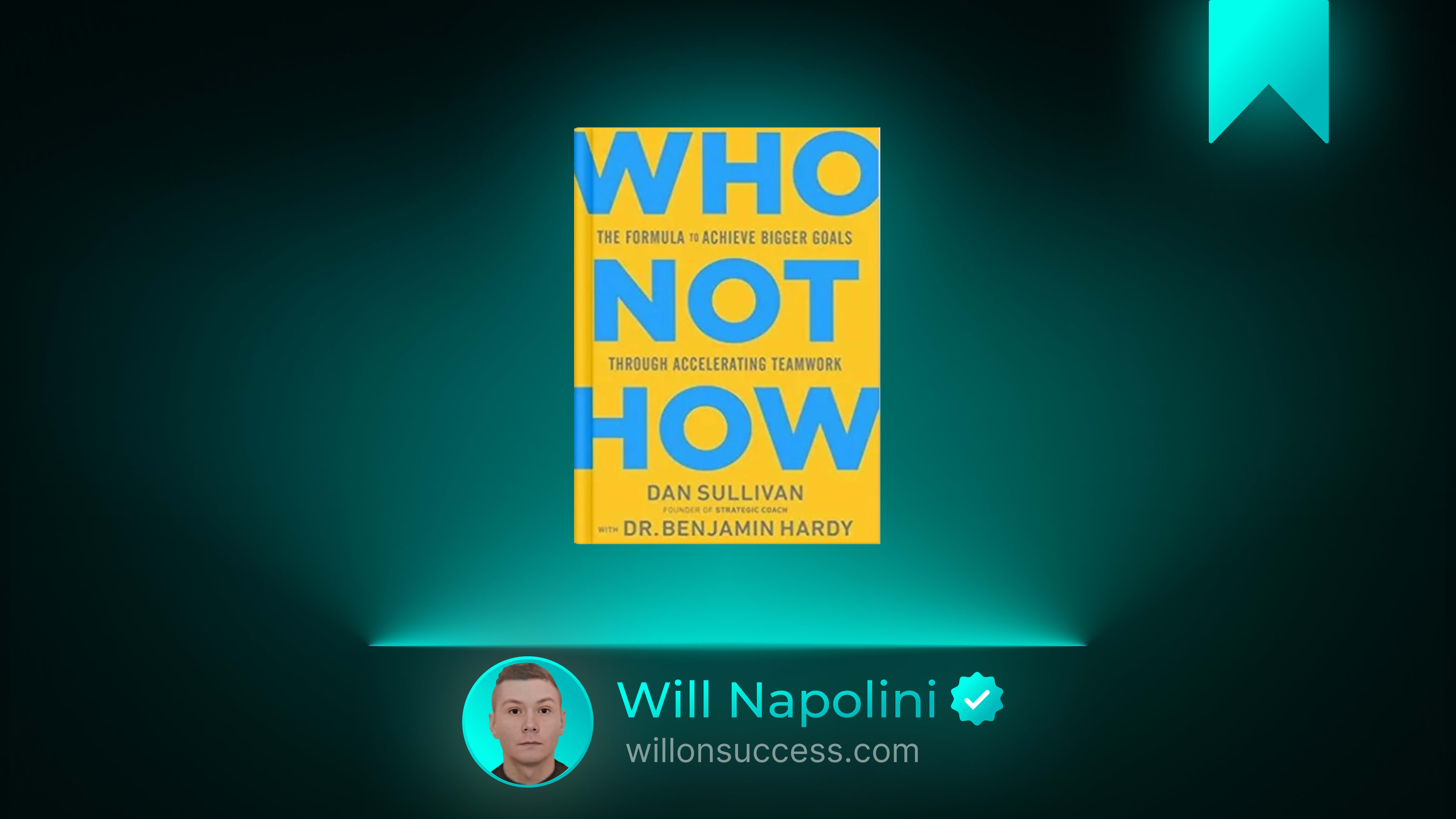
That is the argument at the center of Who Not How, written by Dan Sullivan, the founder of Strategic Coach, alongside organizational psychologist Benjamin Hardy. The book is not long. The idea is not complicated. But the idea, once it truly lands, rearranges the way you approach every goal, every project, and every season of growth for the rest of your life.

The Big Idea in One Sentence
When you face a challenge, a goal, or a task you do not know how to do, stop asking “How do I do this?” and start asking “Who can do this, or who can help me do this?”
That is the whole thesis. And I know what you might be thinking: That sounds like delegation. That sounds like hiring. That sounds like something only wealthy business owners can afford.
I thought something similar the first time I encountered the idea. But Sullivan and Hardy are not only talking about paying someone. They are talking about a fundamental orientation toward every problem, every ambition, and every area of your life. They are talking about whether you approach the world as a solo operator who must personally acquire every skill, or as a node in a vast network of people whose strengths complement yours.
The shift is not logistical. It is philosophical. And it changes what you believe is possible for you.
Why “How” Thinking Quietly Ruins You
Let me be honest about what “how” thinking actually costs, because I do not think most people see the full price tag.
When you ask “How do I do this?” you are volunteering to become a beginner at something. That is fine if the thing genuinely excites you, if it sits inside your strengths, if learning it is part of the joy. But most of the time, the “how” tasks are the ones you dread. The tax filing. The website maintenance. The meal planning. The difficult conversation with the contractor. The spreadsheet. The scheduling.
You take these on because you believe you should be able to handle them. Because asking for help feels like admitting inadequacy. Because somewhere along the way, you absorbed the message that self-sufficiency is the highest virtue and that needing others is a quiet failure.
So you grind. You watch tutorials at eleven at night. You do a mediocre job at something that would take a specialist twenty minutes. You sacrifice the hours you could have spent on the work that actually lights you up, the work that is genuinely yours to do. And you call it responsibility.
Sullivan and Hardy point out that this is not responsibility. It is a slow, socially acceptable form of self-sabotage. You are spreading yourself so thin across every “how” that you never go deep in any direction. You stay busy. You stay exhausted. And the thing you actually wanted to build—the novel, the company, the relationship, the body, the life—stays half-finished because you spent your Tuesday night figuring out invoicing software instead of writing chapter four.
The “how” question keeps your world the size of one person’s skills, one person’s hours, one person’s energy. And one person, no matter how talented, is a very small world.
Your Grinding Is Someone Else’s Joy
Here is the insight that shifted something permanent in me: the task that feels like sandpaper to your brain might feel like music to someone else’s.
You hate organizing events. Your friend thrives on it. You dread numbers. Your colleague lights up around a spreadsheet. You cannot stand editing video. Your nephew does it for fun. You freeze when you have to negotiate a contract. A mentor of yours once told me she considers negotiation the most interesting puzzle in business.
This is not a coincidence of personality. It is the reason other people exist. Every skill, every tedious task, every specialized knowledge area is someone’s natural habitat. When you insist on doing it yourself, you are not being noble. You are denying that person the chance to do what they are built for, and you are doing a worse job than they would.
Sullivan, who has spent decades coaching entrepreneurs through his Strategic Coach practice, has seen this pattern thousands of times: the founder who will not let go of the bookkeeping, the creative who insists on managing every administrative detail, the leader who believes that if they want something done right they must do it themselves. And every single one of them is slower, more exhausted, and more resentful than they need to be.
The moment they ask “Who?” instead of “How?”, something unlocks. Not just in their schedule. In their identity. They give themselves permission to be excellent at the two or three things that are truly theirs, and to trust others with the rest.
This Is Not About Being Rich or Having a Staff
I want to address the objection directly, because it is the one that stops most people from taking the idea seriously.
“I can’t afford to hire anyone.”
Sometimes that is literally true, and I will not pretend otherwise. But Sullivan and Hardy are not only talking about employment. The “who” question has a much wider radius.
Who in my family enjoys cooking and would trade meals for help with yard work? Who in my friend group already knows how to navigate the permit process I am dreading? Who in my professional network would be glad to review my proposal in exchange for me proofreading theirs? Who in my community runs a skill-share group? Who could I learn alongside instead of learning alone?
The “who” might be a paid professional. It might be a friend. It might be an online community. It might be a mentor, a classmate, a neighbor, a colleague you ask for a thirty-minute conversation. The point is not the transaction. The point is that you stop assuming the answer must come from inside your own skull.
You are not required to be a one-person orchestra. You are allowed to be part of an ensemble.
The Cost of Waiting for “How” to Resolve Itself
Sullivan and Hardy spend time on something I think is underappreciated: the cost of delay.
Every week you spend trying to figure out the “how” yourself is a week the project does not advance. A month of YouTube tutorials on plumbing is a month your renovation does not happen. A year of teaching yourself graphic design at midnight is a year your brand looks amateurish while you wait for competence to arrive.
Time is the one resource you cannot manufacture. You can borrow money. You can learn skills eventually. You cannot get back the Tuesday you spent fighting with a software interface when a phone call to someone who knew it would have taken ten minutes.
The “who” question does not just improve quality. It compresses time. It lets you arrive at the destination while the “how” thinker is still reading the map in the parking lot.
It Applies to Every Domain, Not Just Business
One of the strengths of the book is that Sullivan and Hardy walk the principle through multiple areas of life, not only entrepreneurship. And I think this matters because most of us have already accepted the “who” logic at work—we understand that a company needs departments, specialists, collaboration—but we abandon it the moment we walk through our own front door.
Health: Instead of “How do I design a workout program?” you ask, “Who can guide me?” A trainer, a running group, a friend who has already navigated the same injury you are recovering from. You do not have to become an exercise scientist. You have to find the person who is one, or who is a few steps ahead of you.
Relationships: Instead of “How do I fix this argument pattern by myself?” you ask, “Who can help us see what we cannot see?” A counselor. A trusted friend who will tell you the truth. A book group. You are not weak for bringing in perspective. You are wise.
Learning: Instead of “How do I teach myself this subject from scratch?” you ask, “Who has already learned this and can shorten my path?” A teacher. A mentor. A structured course. A study partner. The “how” approach to learning is the slowest road through the forest. The “who” approach is a guide who knows the trail.
Parenting, home, creativity, finances: The principle holds. You do not have to be the expert in every room of your life. You have to be the person who knows how to find the right expert, the right partner, the right ally for each room.
The Humility Hidden Inside the Question
There is something Sullivan and Hardy touch on that I find quietly profound, and it does not get enough attention.
Asking “Who?” requires you to admit you do not know. To say, openly, “This is not my strength. I need help. I need someone whose gifts are different from mine.” In a culture that celebrates the self-made individual, the lone genius, the person who grinds through everything solo, that admission feels vulnerable.
But think about what it actually does. It says to another person: You matter. Your skill matters. You have something I need, and I respect it enough to ask. That is not weakness. That is one of the most generous things you can offer someone—the recognition that their particular gift has value, and that you trust them with a piece of your life.
Every time you ask “Who?” you are building a relationship. Every time you insist on “How?” you are building a wall.
Over years, the difference compounds. One person accumulates a network of mutual trust, shared purpose, and genuine connection. The other accumulates a to-do list and a slow burnout.
What This Looks Like on an Ordinary Thursday
Let me make this concrete, because principles without practice are just pleasant thoughts.
Say you have been wanting to start a small consulting practice on the side. You are good at the actual consulting. But you have been stalled for four months because you keep telling yourself you need to figure out the website, the invoicing system, the legal structure, the marketing plan, the scheduling tool. Five “hows” standing between you and the first client.
The “who” reframe: Who in your circle has built a simple website and could set one up in an afternoon? Who is an accountant and could spend thirty minutes telling you the right legal structure? Who already uses an invoicing platform and could walk you through it over coffee? Who among your former colleagues would be happy to be your first referral source?
Suddenly the five obstacles are five conversations. And conversations take an hour each. You could have all five done within two weeks. The “how” version would have taken you six months of evenings and produced something half as good.
You do not need to be wealthy to use this principle. You need to be willing to ask, to trade, to accept help, and to offer your own strengths in return.
Who Should Read This Book, and Who Might Not Need It
Who Not How will land hardest if you are someone who carries too many “hows” simultaneously. The solo founder doing everything. The parent managing every household system alone. The freelancer who is also the marketer, the accountant, and the IT department. The person who has a list of dreams in a drawer, each one blocked by a skill they have not yet acquired. If you recognize yourself in that description, this book will feel like someone opening a window in a room you forgot was sealed shut.
It will also resonate if you lead a team but still struggle to truly delegate—if you assign tasks but hover, if you say “just bring it to me and I will finish it,” if you secretly believe no one will do it as well as you would. Sullivan’s decades of coaching entrepreneurs give the book real weight in that territory.
Where it may be less useful: if you are in a genuinely constrained season where asking for help is not yet realistic, where you must build foundational skills before you can bring others in, or where the “who” you need simply is not accessible yet. The principle is sound, but life has seasons where you do have to learn the “how” first, simply because no other option exists. The book is better at inspiring the mindset shift than at addressing the messy edge cases where resources are genuinely scarce.
Still. Even in those seasons, the question “Who can I ask?” is worth holding. The answer might be “no one, not yet.” But the asking keeps your eyes open. And eyes that are open notice opportunities that eyes fixed on a solo path will walk right past.
One Small Step You Can Take Before This Day Ends
Here is what I want you to do. It is small. It is specific. And it will cost you nothing but a few minutes of honesty.
Think of one goal you have been putting off. One project, one task, one area of growth where you have been stuck in the “how.” You know the one. It surfaced the moment you read that sentence.
Now write down three names. Three people who could help, guide, teach, collaborate, or simply point you in the right direction. Not three people you would hire. Three people who exist in your life or within one degree of it. A friend. A colleague. A community. A professional you could email. A family member who has done the thing you are trying to do.
You do not have to contact them today. You do not have to commit to anything. Just write the three names. Let yourself see that you are not actually alone in the maze. That there are people who know the corridor you are standing in front of. That the “how” you have been dreading has probably already been solved by someone who would be glad to share the answer.
You do not have to build the whole life by hand. You never did. The people who seem to move fastest are not stronger than you. They simply stopped trying to carry every beam alone.
Your next step is not a skill to acquire. It is a name to write down, a message to send, a door to knock on. The “who” is already out there, doing the very thing that is stalling you, often happily, often waiting for someone to ask.
Go ask.