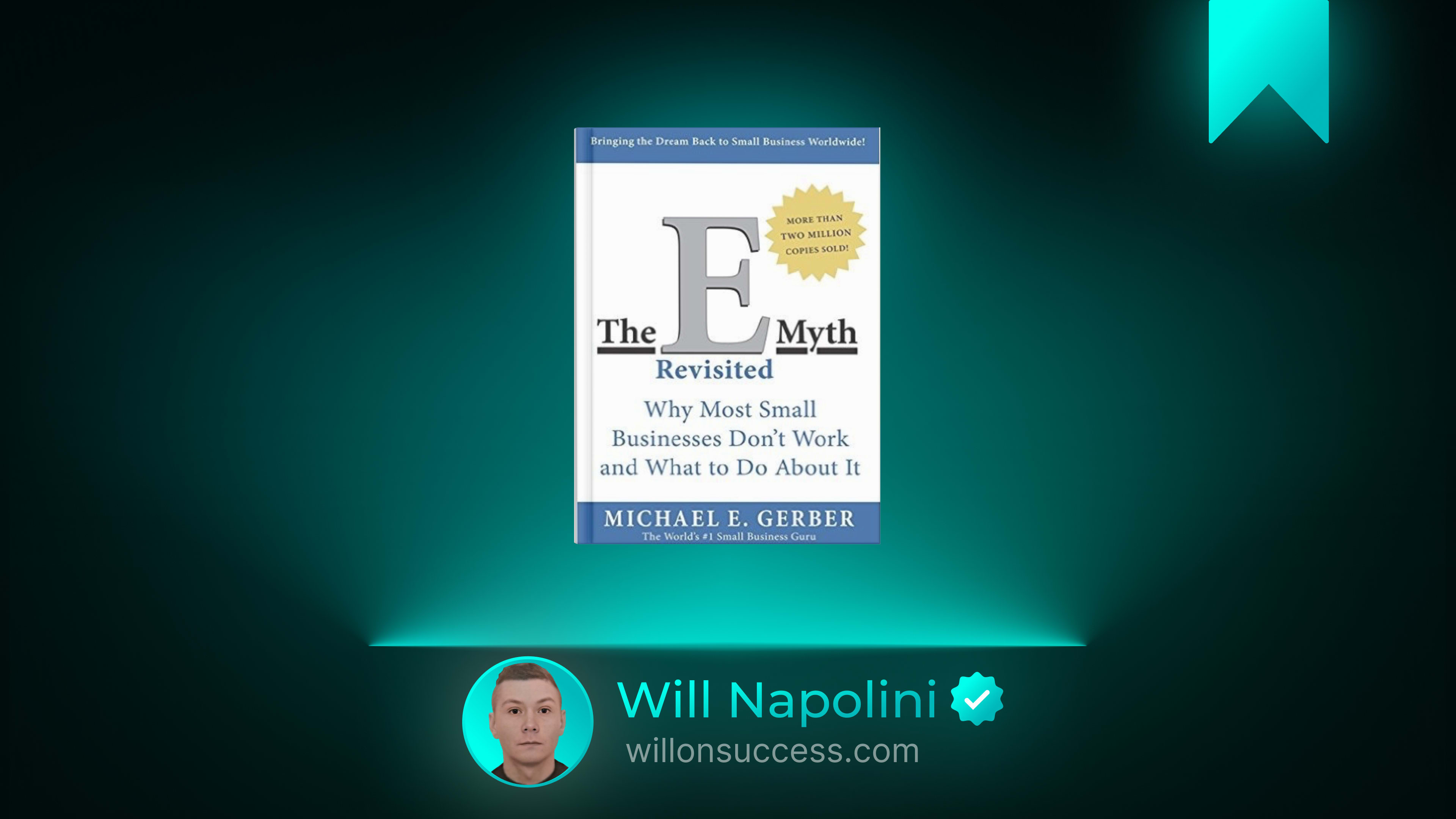
The E-Myth Revisited by Michael E. Gerber: Why Knowing How to Do the Work Is the Exact Reason Your Business Is Failing
Imagine waking up at three in the morning. Your back aches. Your mind is racing. You are staring at the ceiling, doing the mental math of payroll, rent, and a client who just refused to pay an invoice. You started this venture because you loved the craft. You loved the freedom. You wanted to be your own boss. But as you lie there in the dark, a quiet, terrifying realization creeps in: you did not build a business. You just bought yourself a terrible, low-paying job with a crazy boss.
And the crazy boss is you.
If you have ever felt trapped by the very thing you created to set you free, I want to introduce you to an idea that will change the way you look at your work.
Michael E. Gerber’s The E-Myth Revisited is built around a single, devastating insight: knowing how to do the work is not the same as knowing how to run a business that does the work. In fact, knowing how to do the work is often the exact reason the business fails.
Gerber calls this the “Entrepreneurial Myth,” or the E-Myth. The myth is the belief that small businesses are started by true entrepreneurs—visionaries who risk capital for profit, driven by a grand design. The reality, Gerber argues, is vastly different. Most small businesses are started by Technicians who suffer from an “entrepreneurial seizure.” One day, they look at their boss, look at their paycheck, and think, Why am I doing all the work while they get the profit? I can do this myself.
So they leave. They open a shop. They start an agency. They launch a freelance practice. And immediately, they fall into the Fatal Assumption. They assume that because they understand the technical work of the business, they understand the business itself.
They do not. And that confusion is the root of almost every burnout, bankruptcy, and quiet misery in the world of small enterprise.
Let us walk through the architecture of this trap, and more importantly, how to build your way out of it.

The War Inside Your Head
To understand why this happens, you have to understand that you are not one person. When it comes to work, Gerber suggests there are three distinct personalities living inside you, and they are constantly at war.
First, there is The Entrepreneur. This is the visionary. The dreamer. The part of you that lives in the future, seeing possibilities, designing grand systems, and craving expansion. The Entrepreneur looks at a small bakery and sees a global brand.
Second, there is The Manager. This is the pragmatist. The part of you that craves order, predictability, and spreadsheets. The Manager lives in the past, analyzing data, building protocols, and trying to create a tidy, functioning machine out of the Entrepreneur’s wild dreams.
Third, there is The Technician. This is the doer. The part of you that lives in the present, loves the tactile reality of the work, and just wants to be left alone to bake the pie, write the code, or design the logo. The Technician does not care about the five-year plan. The Technician cares about the task in front of them right now.
Here is the tragedy of most small businesses: The Entrepreneur has the vision, the Manager builds the plan, but when the alarm goes off on Monday morning, the Technician takes over. The Technician is the strongest personality because the Technician knows how to produce immediate results. The Technician gets the dopamine hit of checking off a task.
So, the Technician runs the business. And the Technician’s idea of a good business is one where they get to do the technical work all day without anyone bothering them. The business becomes a mirror of the Technician’s personal stamina. If you get sick, the business stops. If you get tired, the business shrinks. If you want to take a vacation, the revenue drops to zero.
You have not built a system. You have built a monument to your own exhaustion.
The Shift: Working ON the Business, Not Just IN It
This is the most famous phrase from the book, and for good reason. It is the exact hinge upon which your professional freedom swings.
Working in the business means doing the technical work. It is baking the pies, writing the copy, cutting the hair, fixing the plumbing. It is necessary, especially in the beginning. But it does not scale. It is entirely dependent on your physical presence and your finite energy.
Working on the business means stepping back and looking at the enterprise as a machine. It is designing the system that bakes the pies. It is writing the manual that trains the next copywriter. It is building the architecture that allows the work to happen beautifully, consistently, without you having to touch every single piece of it.
I know how hard this shift is. When you are drowning in client work, stepping back to write a standard operating procedure feels like a luxury you cannot afford. It feels like a distraction from the “real work.” But I promise you, as someone who has watched brilliant people burn out on the hamster wheel: the system work is the real work. The technical work is just the output of the system.
If you do not build the machine, you will forever be the gears. And gears do not get to go on vacation. Gears just grind until they break.
The Franchise Prototype: Building a Machine That Runs Itself
Gerber proposes a radical thought experiment. He tells you to build your business exactly as if you were going to franchise it.
Now, you might hate the idea of franchising. You might run a high-end boutique consulting firm, or a solo therapy practice, or a custom woodworking shop. You might have zero intention of opening a thousand locations. That does not matter.
The Franchise Prototype is not about scaling to a thousand locations. It is about adopting the mindset of a franchisor. A franchisor cannot rely on the brilliance of the person behind the counter. They have to build a system so robust, so simple, and so foolproof that it can be operated by someone with minimal experience and still produce a perfect result every single time.
When you build your business using the Franchise Prototype, you stop asking, How do I do this better? and you start asking, How do I build a system that does this better, even when I am not in the room?
You document everything. You create checklists. You build onboarding processes. You turn your tacit, unspoken knowledge into explicit, transferable instructions. You stop being the hero who swoops in to save the day, and you become the architect who designed a day that does not need saving.
Orchestration: The Quiet Power of Consistency
Gerber outlines a three-step process for business development: Innovation, Quantification, and Orchestration.
Innovation is not just inventing a new product. In this context, it means finding a better way to do a routine task. It is realizing that if you change the script you use when answering the phone, you close more sales.
Quantification is measuring the impact of that innovation. You track the numbers. You prove that the new script actually works.
But Orchestration is the most important step, and the one most creative people resist. Orchestration means making the innovation the standard. It means doing it the exact same way, every single time, without deviation.
Creative people hate this. They want to tweak. They want to improvise. They feel that standardization kills the soul of the work. But Gerber argues the opposite. Orchestration is what creates the foundation of trust. When a client knows exactly what to expect from you, they relax. When your team knows exactly how to execute a process, they stop wasting energy on confusion and start using their energy for true, high-level creativity.
You cannot innovate at the highest level if you are still improvising the basics. Orchestration frees you from the mundane so you can actually be creative where it matters.
Why This Matters on an Ordinary Tuesday
You might be reading this and thinking, This is great for a bakery or a retail shop, but I am a solo freelancer, a consultant, or a knowledge worker. My business is my brain. I cannot franchise my brain.
I understand the objection. But the principle still applies.
Even if you are a solo practitioner, you have processes. You have a way you onboard a client. You have a way you research a topic. You have a way you send an invoice. Right now, those processes live entirely in your head. They are subject to your mood, your energy levels, and your memory.
When you apply the E-Myth to knowledge work, you start externalizing your brain. You build templates for your emails. You create a standardized discovery document for new clients. You build a checklist for launching a project.
Why? Because every time you have to reinvent the wheel, you are draining the cognitive battery you need for the actual, high-value work. By systematizing the repetitive, administrative, and structural elements of your work, you protect your creative energy for the moments that truly require your unique genius.
You stop being a scattered artist and you become a reliable professional. And in a world full of flaky, unpredictable talent, reliability is the ultimate competitive advantage.
Who Should Read This Book
You should read The E-Myth Revisited if you are a small business owner, a solopreneur, a freelancer, or an agency founder who feels like you are working eighty hours a week just to keep the lights on. If you are terrified of taking a vacation because the entire operation will collapse in your absence, this book is your intervention.
You should read it if you are a highly skilled Technician—a brilliant coder, a gifted designer, an excellent chef—who is trying to transition into a leadership or ownership role and is frustrated by your team’s inability to “just do it the way I do it.”
I want to be honest about the book’s limitations. It was originally published decades ago, and some of the specific examples feel dated. The narrative device—Gerber talking to a pie baker named Sarah—can feel a bit repetitive and overly scripted if you read it all in one sitting. Furthermore, the book is heavy on philosophy and mindset, and lighter on the granular, tactical “how-to” of modern software and digital systems. You will have to supply the modern tools; Gerber supplies the timeless architecture.
But the core premise is as urgent today as it was when the book first hit the shelves. Perhaps more so, in an era where the barrier to entry for starting a business is lower than ever, meaning more Technicians than ever are accidentally buying themselves terrible jobs.
One Small Step
I am not going to ask you to write a three-hundred-page operations manual today. I am not going to ask you to hire a team you cannot afford.
I am going to ask you to do one small thing that begins the shift from Technician to Architect.
Pick one recurring task in your work that you do at least once a week, and write down the exact, step-by-step process for doing it.
Not a summary. Not a few bullet points. A literal, foolproof guide. Imagine you are handing this document to someone who has never done your job before, and they need to execute this task perfectly while you are on a flight with no Wi-Fi.
What software do they open? What is the exact subject line of the email? Where do they save the file? What are the three most common mistakes they might make, and how do they avoid them?
Write it down. Put it in a folder called “Systems.”
Next time you do that task, follow your own instructions. Tweak them if they are wrong. Add a step if you missed one.
You have just built the first brick of your Franchise Prototype. You have just taken one tiny piece of your business out of your head and put it into the world, where it can eventually be operated by someone else. Or, at the very least, where it can be operated by you on a day when you are tired, distracted, and running on empty.
A business that requires your constant, frantic presence is not a business. It is a beautifully disguised cage.
You do not have to live in the cage forever. You can build the door. You can forge the key. You can step outside, look back at the machine you built, and watch it run.
The work is waiting. But the real work is not doing the thing. The real work is building the system that does the thing.
Start building.