Built to Sell: Why Your Business Needs to Work Without You (And How to Make It Happen)
You built it. Every client, every late night, every difficult conversation. You carried the weight because no one else understood the work the way you did. And somewhere along the way, the business that was supposed to give you freedom became the one thing you can never walk away from.
If that sounds familiar, I want to walk you through a book that changed the way I think about what it means to own a business. Not to run one. Not to survive inside one. To own one the way an owner should—where the thing you built has value beyond your daily presence.
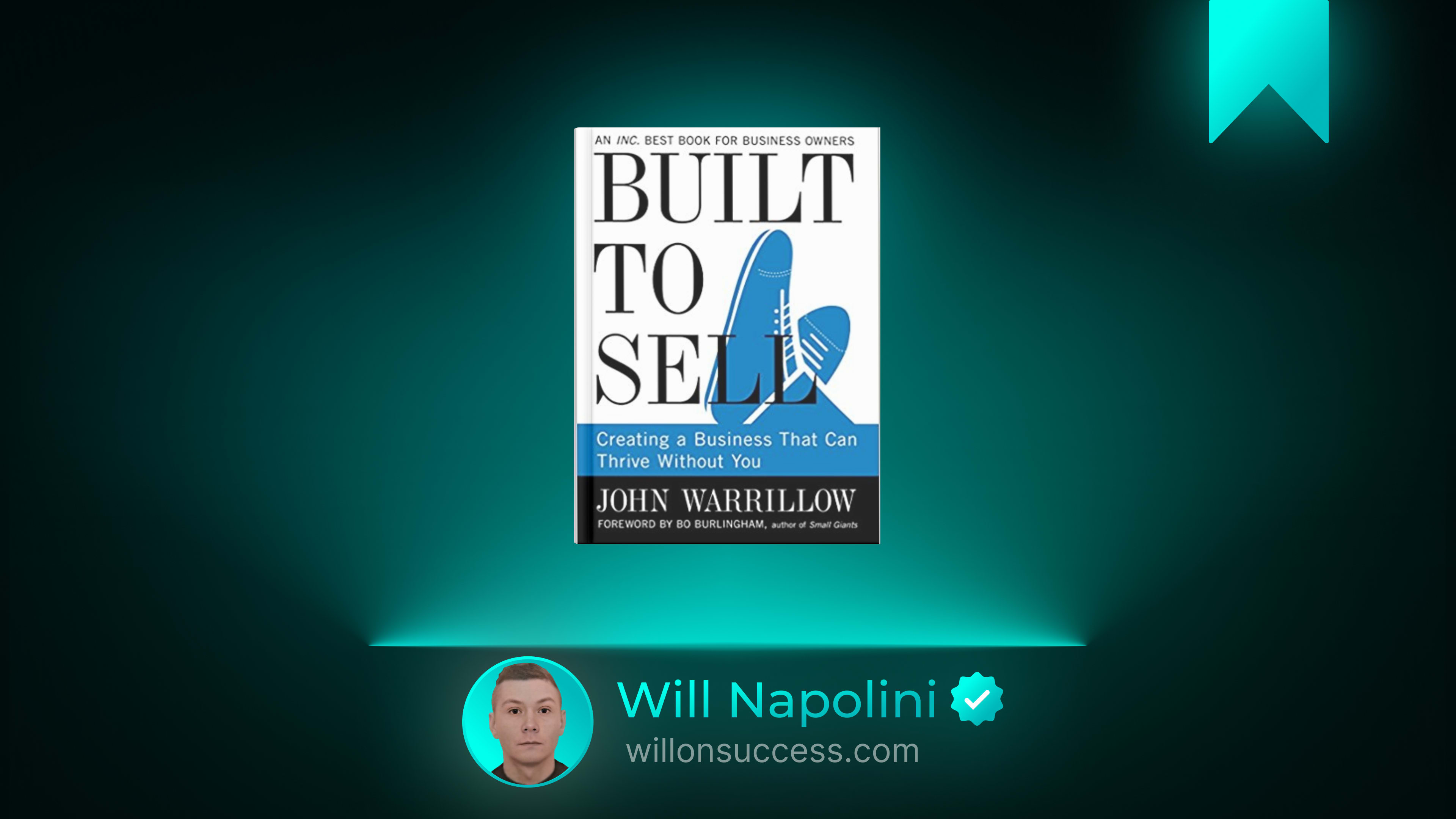
The book is Built to Sell by John Warrillow, and its central argument is deceptively simple: a business that cannot function without you is not really a business. It is a job you created for yourself, with the added stress of payroll, clients, and no vacation.
That stings. I know. But sit with it for a moment, because the relief that follows is real.

The Trap Most Founders Walk Into Without Seeing It
Warrillow tells his ideas through a story rather than a textbook structure, and that choice matters. The protagonist, Alex, runs an advertising agency. He is talented. He is hardworking. He is exhausted. Every significant client relationship flows through him. Every important creative decision lands on his desk. When he considers selling the business, a broker gives him the news he dreaded: the company is essentially worthless without Alex attached to it.
This is not a dramatic failure. This is the quiet, ordinary tragedy of thousands of service businesses. The founder becomes the product. Clients buy you, not a system. Revenue depends on your relationships, your judgment, your presence in the room.
Warrillow is not describing laziness or poor planning. He is describing a structural problem. You can be the most disciplined person in your industry and still build something that collapses the moment you step back for two weeks. Effort alone does not create a sellable business. Architecture does.
The question the book keeps returning to is this: if you disappeared for three months, would your business grow, stay steady, or fall apart?
Be honest with yourself about the answer. That honesty is where the real work begins.
The Mentor Who Asks the Uncomfortable Question
In the story, Alex meets a mentor figure named Ted Gordon, who has built and sold several companies. Ted does not hand Alex a checklist. He asks questions that reframe everything.
The most important reframe: stop thinking of yourself as someone who does the work for clients, and start thinking of yourself as someone who builds a machine that does the work consistently, regardless of who is operating it.
That distinction sounds obvious on the page. In practice, it is one of the hardest psychological shifts a founder can make. Because doing the work feels safe. Doing the work means you control quality. Doing the work means the client is happy. Stepping back means trusting a process you designed, executed by people you trained, without your hands on every detail.
Ted pushes Alex toward what the book calls a Standard Service Offering. Instead of the agency saying yes to every project a client dreams up—each one unique, each one requiring Alex’s personal creative input—the agency narrows its focus to one repeatable service. One thing, done exceptionally well, delivered through a defined process.
This feels counterintuitive. Your instinct says, “If I narrow down, I lose opportunities.” Warrillow’s argument is the opposite. When you try to be everything, you are nothing that can be systematized. When you choose one thing, you can build a repeatable delivery system. You can train people. You can create quality standards. You can make the work teachable.
A teachable business is a sellable business. An unteachable business is a prison with nice stationery.
Your Expertise Is Not the Product. Your Process Is.
Let me make this concrete, because abstraction will not help you on a Monday morning when the phone is ringing and three clients need things.
Imagine you run a small marketing consultancy. Right now, every project starts with you sitting across from a client, diagnosing their problem, crafting a custom strategy, overseeing execution, adjusting on the fly. You are brilliant at it. Clients love you. And you cannot take a holiday without your phone buzzing every forty minutes.
Now imagine instead that you have identified the one service you deliver better than almost anyone—say, a specific type of brand positioning workshop followed by a 90-day messaging implementation. You have written down every step. You have created templates. You have trained two team members to run the workshop while you observe. You have a checklist for the implementation phase. You have a review meeting structure. You have a feedback loop.
You are still the architect. But you are no longer the only builder.
Warrillow’s insight is that this shift does not diminish your value. It multiplies it. A client does not care whether you personally ran the workshop. The client cares whether the outcome is excellent and consistent. If your process guarantees that outcome, the process is the product. You are free to work on the business rather than being consumed inside it.
This is not about removing yourself from work you love. It is about removing yourself from work that only you can do, so that the business has a foundation wider than one person’s calendar.
Recurring Revenue Changes the Entire Equation
Another principle Warrillow develops through the narrative is the power of recurring or ongoing revenue over one-off projects. When every dollar requires you to win a new sale, you are perpetually starting from zero. Your pipeline is only as strong as your last month of hustle.
But when your service naturally extends into ongoing support, maintenance, or subscription-style delivery, something shifts. Revenue becomes more predictable. You can plan. You can hire. You can invest in training without panicking about next quarter. And critically, a buyer sees a business with recurring revenue as far more valuable than one that must re-win every contract.
Think of it like the difference between a farmer who must find a new plot of land every season and a farmer who tends the same orchard year after year. The orchard requires patience. But once the trees are established, the harvest compounds. You are not starting over. You are building on what is already rooted.
If your business currently runs project to project, ask yourself: what part of what I deliver could become ongoing? What follow-up, maintenance, or advisory layer could extend the relationship beyond a single engagement? You do not need to reinvent your business overnight. You need to identify one thread of continuity you can weave through what you already do.
The Sales Process Must Survive Without Your Handshake
One of the most practical lessons in the book concerns how new business comes in the door. In many founder-led companies, sales happen because the founder is charismatic, well-connected, or personally trusted. The founder goes to the meeting. The founder shakes the hand. The founder closes.
Warrillow argues that for a business to be truly sellable—and truly free—the sales process must be systematized. Someone else must be able to communicate the value of the Standard Service Offering, answer the common objections, and close the deal. The founder’s personal charm cannot be the sales strategy, because personal charm does not transfer.
This does not mean you stop selling. It means you document what you say, how you handle objections, what materials you show, and what the follow-up sequence looks like. You make your sales instinct into a sales system, and then you train someone to run it.
At first, that person will not close as well as you. That is acceptable. You are building something larger than your personal batting average. You are building a process that improves over time, that multiple people can operate, that does not collapse when you need to focus on strategy, family, or rest.
Cash Flow Discipline Is Not Optional
Warrillow also addresses a practical reality that many founders neglect: cash management. In the story, Alex learns that growing a business can actually worsen cash flow if you are not careful. You hire ahead of revenue. You take on projects with long payment terms. You invest in systems before the income supports them.
The book encourages a disciplined approach to cash—understanding your numbers, maintaining reserves, and not letting growth seduce you into spending money that has not yet arrived. This is not glamorous advice. It will not make for an inspiring social media post. But I have seen good businesses suffocate not because they lacked clients, but because the founder never looked closely at when money came in versus when it had to go out.
You do not need an MBA. You need a simple weekly habit: look at what is coming in, what is going out, and what is sitting in the account. Fifteen minutes. Every week. Non-negotiable.
What This Looks Like on an Ordinary Tuesday
Let me bring this down to the ground, because principles without application are just decoration.
Suppose you run a small design studio. Right now, you personally meet every client, sketch every concept, revise every draft, and manage every deadline. You have been doing this for six years. You are good. You are also tired.
The Built to Sell approach would look something like this over the next six months:
You identify the one service you deliver most consistently—let us say, brand identity packages for small restaurants. You write down the exact steps: discovery call, mood board presentation, two revision rounds, final file delivery, and a 30-day support window. You create templates for each stage. You train one team member to run the discovery call using a script you developed. You train another to handle revisions within defined boundaries.
You do not fire yourself. You move to reviewing final work and handling the occasional high-stakes client. But the engine no longer requires you to turn every gear by hand.
Six months later, a broker could look at your studio and see a business with a defined product, a trained team, a repeatable process, and revenue that does not vanish if you take a month off. That business has value independent of your name. That is what “built to sell” means. And even if you never sell, you have built something rarer than money. You have built a life where your time belongs partly to you again.
Who Should Read This Book
If you own a service-based business—consulting, design, marketing, legal, accounting, coaching, agency work—and you feel like the business would crumble without your daily involvement, this book was written for you. It is especially valuable if you have been running your company for a few years and sense that you have hit a ceiling that no amount of extra hours will break through.
It is also valuable if you are thinking about eventually selling, partnering, or simply wanting a vacation that does not involve answering email from a beach.
If you run a highly specialized, one-person practice where you are the irreplaceable expert—a surgeon, a specialist attorney, a solo artist—the book’s principles still apply, but the path to implementation will look different. You will need to adapt the ideas rather than follow them literally.
The book is short, reads quickly, and uses narrative rather than dense theory. If you prefer heavy academic frameworks, you may find it light. But do not mistake accessibility for shallowness. The ideas are simple. Executing them is not.
The Deeper Lesson Beneath the Business Advice
Here is what I keep returning to after sitting with this book.
Warrillow is teaching a business principle, yes. But underneath it, he is pointing at something personal. Many founders build businesses that depend on them not because they lack delegation skills, but because they are afraid of what they become without the work. If you are not the person solving every problem, meeting every client, holding everything together—who are you?
That question is terrifying. And I think it is why so many capable people stay trapped inside businesses they could restructure. The restructuring requires more than new processes. It requires a small, quiet act of trust. Trust that your value is not identical to your daily labor. Trust that the thing you built can stand on its own legs if you give it the chance.
You do not have to solve that fear all at once. You just have to be willing to document one process this week. Train one person on one task. Step back from one meeting and let someone else run it. Then notice that the world did not end. Then do it again next week.
You start small. You build the system one piece at a time. You let the structure become strong enough to hold the weight you have been carrying alone.
Your One Small Step
Here is what I would ask you to do today. Not this month. Today.
Take one piece of work you did this week—something you did personally, something that required your specific knowledge or judgment—and write down the steps you followed. Not a polished manual. Just a rough list. What did you do first? What came next? What decisions did you make, and what information did you use to make them?
That rough list is the seed of a process. It is the first plank in a boat that can sail without you holding the tiller.
You do not need to finish the boat today. You need to lay one plank. Then tomorrow, you lay another. And the day after, another. And one morning, months from now, you will look up and realize the thing you built can carry the weight without you standing in the center of it, exhausted, holding it all together by force of will.
A business that runs without you is not a business you have lost. It is the first real thing you have truly built.