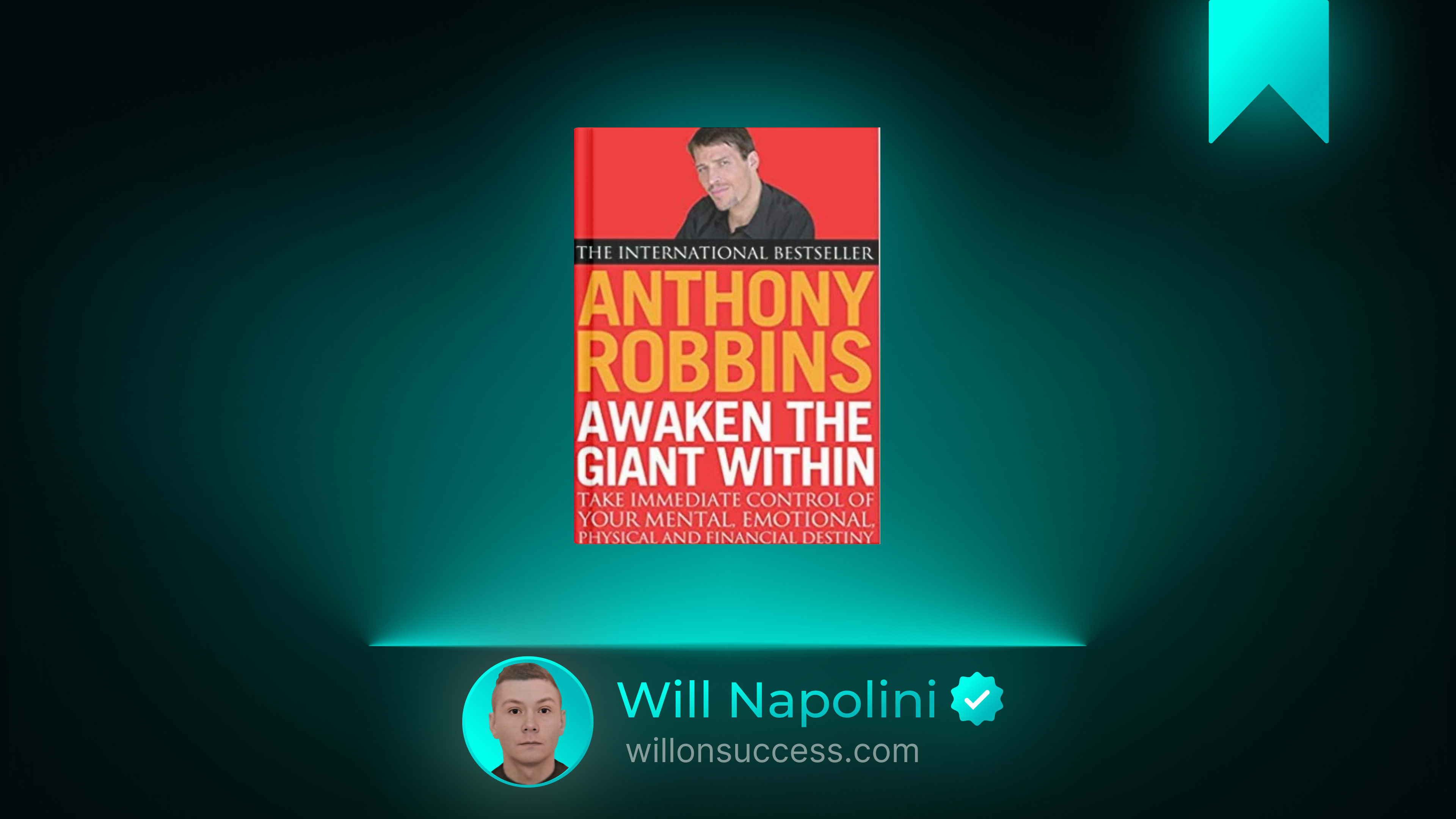
Awaken the Giant Within by Tony Robbins: How to Master Your Decisions and Wire Your Mind for Change
There is a specific kind of exhaustion that has nothing to do with physical labor. It is the exhaustion of knowing exactly what you need to do, and yet finding yourself entirely unable to do it.
You know you should eat better. You know you should have that difficult conversation. You know you should start the project you have been talking about for three years. And yet, day after day, you watch yourself choose the path of least resistance. You end up frustrated, not because you lack the knowledge, but because you feel like a passenger in your own body, watching your habits run the show.
If I could sit across the table from you right now, I would tell you that this gap between what you know and what you do is not a failure of character. It is a failure of emotional engineering.
Tony Robbins wrote Awaken the Giant Within to close that gap. It is a massive, dense, and unapologetically intense book, originally published in the early 1990s. Robbins writes with a megaphone, but the truth he is shouting is actually quite quiet: your life is not the result of your circumstances. It is the result of your decisions. And more importantly, it is the result of how you have unconsciously wired your nervous system to respond to pain and pleasure.
Here is what I have learned from studying his work, and what I want you to understand about the mechanics of your own mind.

The Big Idea: Destiny Is Shaped in the Moment of Decision
The central thesis of this book is that the defining factor in your life is not your background, your resources, or your innate talent. It is your capacity to make a true decision.
Most of us do not make decisions. We make preferences. We say, “I would like to lose weight,” or “I think I should start saving money.” These are wishes. They are hopes. They leave the door open for retreat.
Robbins points out that the word decision comes from the Latin root decidere, which literally means “to cut off.” When you make a true decision, you cut off any other possibility. You burn the boats. You no longer entertain the option of failure or retreat. You simply find a way to make it happen.
This is not about blind optimism. It is about a fundamental shift in identity. When you shift from a preference to a decision, you stop negotiating with yourself. The internal debate ends, and the execution begins.
The Story of the Thermostat: Why We Self-Sabotage
To understand why we so often fail to sustain the changes we want, we have to look at how the human nervous system operates.
Imagine a house with a thermostat set to 70 degrees. If the temperature drops to 65, the heater kicks on. If it rises to 75, the air conditioning kicks on. The system will do whatever it takes to return to 70 degrees.
Human beings operate on a psychological thermostat. We all have an internal “set point” for what we believe we deserve in our relationships, our finances, and our health. When your external reality exceeds your internal set point—say, you suddenly make more money than you feel comfortable with, or you enter a relationship with someone who treats you better than you believe you deserve—your psychological air conditioning kicks in. You unconsciously self-sabotage to bring your reality back down to your familiar set point.
Robbins argues that you cannot sustain a new level of success until you consciously raise your internal thermostat. You have to change your baseline expectations. You have to turn your “shoulds” into “musts.”
Turn Your “Shoulds” Into “Musts”
Here is a principle I have seen play out in countless lives, including my own: people do not do what they should do. They do what they must do.
Think about your own life. There are dozens of things you know you should do. But they remain undone because there is no real consequence for ignoring them. But the things you must do—the things tied to your survival, your deepest values, or your non-negotiable commitments—get done.
If you want to change your life, you must raise your standards. You have to take the things that are currently in the “should” category and move them into the “must” category.
How do you do this? You attach massive emotional leverage to the outcome. You decide, with absolute clarity, that you will no longer tolerate the current state of affairs. You draw a line in the sand. You stop saying, “I should get out of this toxic job,” and you start saying, “I must leave this environment, or it will slowly erode my spirit.”
When a “should” becomes a “must,” human beings become incredibly resourceful. The brain stops looking for excuses and starts looking for solutions.
The Master Controllers: Pain and Pleasure
If you want to understand why you do what you do, you only need to understand two forces: the desire to avoid pain, and the desire to gain pleasure.
Robbins calls this the Pain-Pleasure Principle. Every single behavior you engage in, every habit you hold, and every choice you make is driven by your nervous system’s attempt to avoid pain or experience pleasure.
The problem is not that we are driven by these forces. The problem is how we have wired them.
Over the years, through repetition and environment, you have unconsciously wired pain to the things that would help you, and pleasure to the things that hurt you. You have wired the pain of effort, discomfort, and vulnerability to the idea of starting a business or going to the gym. You have wired the immediate, soothing pleasure of a dopamine hit to scrolling on your phone or eating processed food.
To change a behavior, you do not need more willpower. You need to rewire the associations.
You must consciously link massive, unbearable pain to the behavior you want to stop. And you must link massive, visceral pleasure to the behavior you want to adopt. Willpower is a finite resource; it runs out when you are tired. But the nervous system’s drive to avoid pain and seek pleasure is an inexhaustible engine. If you can get that engine to work for you instead of against you, change becomes almost automatic.
The Architecture of Your Words
One of the most fascinating and immediately applicable concepts in the book is what Robbins calls “Transformational Vocabulary.”
We tend to think of words as mere descriptions of our feelings. Robbins argues that words are actually prescriptions for our feelings. The words you habitually use to describe your experience actually alter your physiological state and your nervous system.
If you walk into a meeting and someone asks how you are, and you say, “I’m completely overwhelmed and furious,” your body responds to those words. Your blood pressure rises. Your breathing becomes shallow. You have literally commanded your nervous system to enter a state of stress.
But what if you changed the vocabulary? What if, instead of “overwhelmed,” you said you were “in high demand”? What if, instead of “furious,” you said you were “a little peeved” or “curious about their perspective”?
The circumstances have not changed, but your emotional experience of them shifts immediately. People who master their lives use a vocabulary that empowers them. They downgrade their negative words (turning “devastated” into “challenged”) and upgrade their positive words (turning “fine” into “phenomenal”).
You are the architect of your internal reality, and language is the building material. Be incredibly careful about the words you use to describe your life, because your brain will believe them.
The Invisible Rules of the Game
Why is it that some people feel incredibly successful and happy while making a modest living, while others feel like miserable failures despite having millions in the bank?
Robbins explains that we all have an invisible rulebook in our heads. These rules dictate what must happen in order for us to feel happy, successful, loved, or secure.
The trap is that most of us have written rules that make it very easy to feel bad, and very hard to feel good.
Your rule for feeling successful might be: “I need to make a million dollars, have a perfect marriage, never get sick, and have everyone admire me.” If that is your rule, you are guaranteeing your own misery. It is almost impossible to meet that criteria.
Conversely, your rule for feeling stressed might be: “If someone doesn’t text me back immediately, it means they don’t respect me.” You have made it incredibly easy to feel bad.
To take control of your emotional destiny, you must rewrite your rules. You need to design a rulebook where it is incredibly easy to feel good, and very hard to feel bad. Make your rule for feeling successful something like: “If I wake up today and give my best effort to the things I can control, I am successful.”
When you change the rules of the game, you suddenly start winning.
Why This Matters on an Ordinary Tuesday
It is easy to read about pain, pleasure, and life-altering decisions and think this applies only to grand, cinematic moments. But the reality is that your life is built on ordinary, unremarkable Tuesdays.
It matters when you are sitting on the couch at 8:00 PM, exhausted from work, and the choice is between opening the laptop to work on your side project or turning on the television.
If your “should” is weak, and your associations are wired to the immediate pleasure of the television, you will turn on the TV. Every time.
But if you have done the work—if you have linked the massive pain of future regret to the act of turning on the TV, and linked the deep pleasure of future freedom to opening the laptop—you will open the laptop. Not because you have magical discipline, but because you have intelligently designed your internal environment.
You are not a victim of your impulses. You are the programmer of your own mind. But you have to sit down at the keyboard and write the code.
A Practical Application: The Pain and Pleverage Exercise
If you want to apply this immediately, here is an exercise adapted from the book’s core frameworks. Pick one habit you want to break, or one behavior you want to stop. Do not just think about it; write it down.
Step 1: The Pain of the Status Quo Write down what this habit is costing you right now. But do not just write “it’s bad.” Get visceral. How is it affecting your health? Your relationships? Your self-respect? What will your life look like in five years, ten years, twenty years, if you do not change this? Feel the weight of that future. Make the pain of staying the same greater than the pain of changing.
Step 2: The Pleasure of the Alternative Now, write down the new behavior you want to adopt. What will your life look like if you master this? How will you feel when you look in the mirror? What doors will open for you? How will it impact the people you love? Make the pleasure of the new behavior vivid, compelling, and magnetic.
Step 3: The Interruption Pattern Finally, create a physical interruption. The moment you feel the urge to engage in the old habit, do something completely unexpected to break the neurological loop. Do ten push-ups. Snap a rubber band on your wrist. Say the word “Cancel!” out loud. You are short-circuiting the old wiring so you can consciously choose the new path.
Do this exercise honestly. You will feel a physical shift in your body when the leverage finally tips.
Who Should Read This Book
Awaken the Giant Within is a foundational text in the personal development canon, but it is not for everyone.
If you are someone who feels stuck, who knows what to do but cannot seem to force yourself to do it, this book is a masterclass in the psychology of human drive. It is incredibly useful for entrepreneurs, salespeople, leaders, and anyone who needs to generate their own internal momentum.
However, you should know what you are getting into. This is a massive book, written in the high-octane, slightly repetitive style of the early 1990s. Robbins is a performer, and his writing reflects the intensity of his live seminars. If you prefer quiet, minimalist, highly academic, or strictly scientific approaches to psychology, his tone may feel overwhelming or overly enthusiastic.
But if you can look past the stylistic delivery and extract the underlying psychological frameworks, you will find a treasure trove of practical tools for mastering your own mind.
One Small Step, Right Now
You do not need to overhaul your entire psychological framework before you go to sleep tonight. You just need to draw one line in the sand.
Look at your life right now. Find one area where you have been operating in the land of “should.” I should call my parents more. I should start walking in the mornings. I should clean out the garage.
Take that single “should” and elevate it to a “must.”
Tell yourself: “I must do this.” Then, take one immediate, tangible action that proves to your nervous system that you are no longer negotiating. Make the phone call. Put your walking shoes by the door. Throw away the first bag of trash in the garage.
Cut off the option of retreat.
A preference leaves the door open for you to change your mind. A decision locks the door behind you and forces you to find the window.
You are not waiting for motivation to strike. You are not waiting for the perfect moment. The giant within you does not wake up because the circumstances are right; it wakes up because you decide it is time.
Draw the line. Make the cut. Step forward.