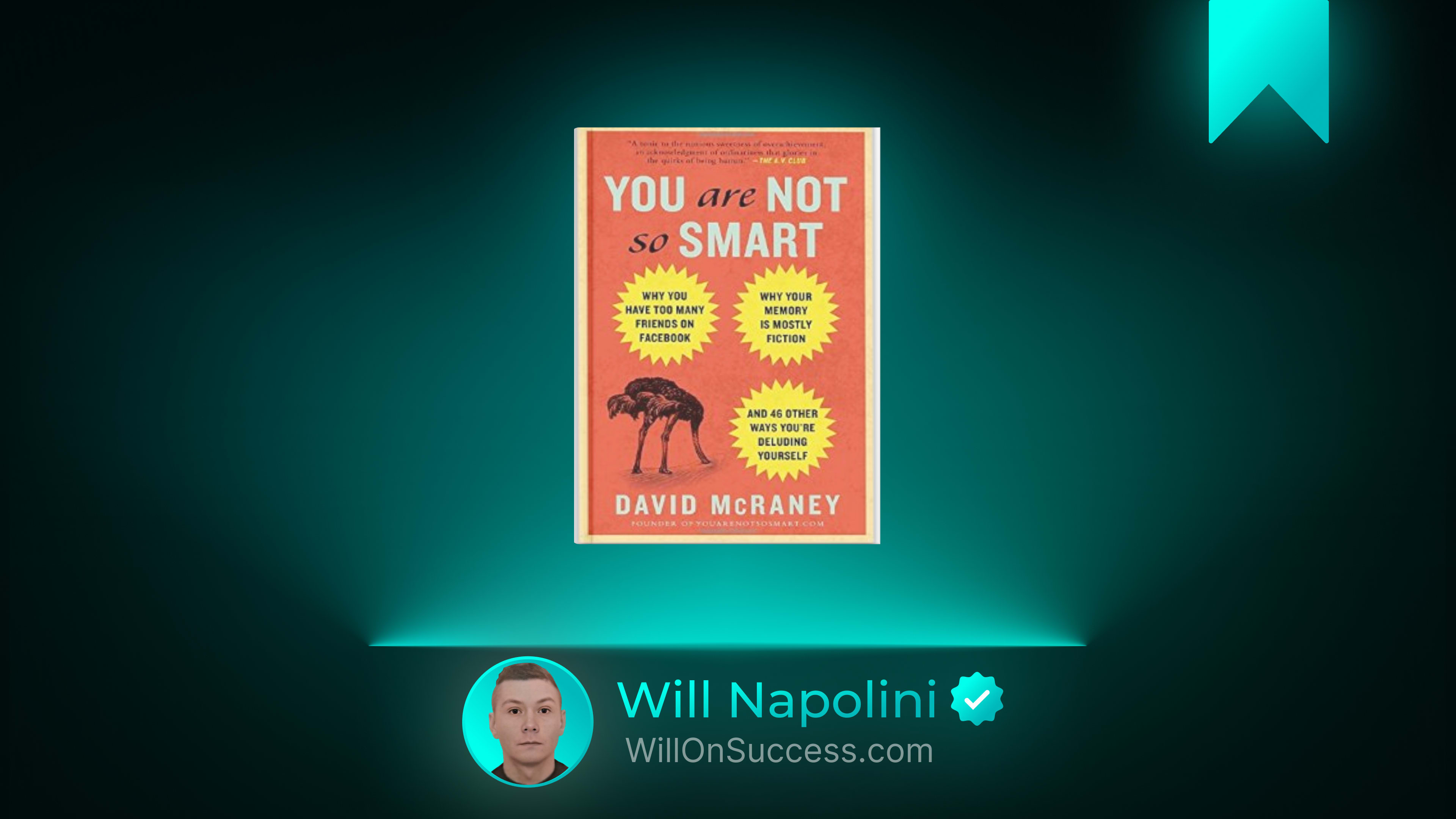
You Are Not So Smart by David McRaney: The Uncomfortable Case for Intellectual Humility
I want you to try something. Think of a belief you hold strongly. A political position. A conviction about how the world works. A judgment you made about someone years ago that you still carry.
Now ask yourself honestly: how much of that belief is built on evidence you examined carefully, and how much is built on the first story you heard, the first emotion you felt, the first person you trusted? And if I asked you to list every piece of information that contradicted your belief—every fact that pointed the other way—could you? Or would you have to think for a long time, because that information slid off you the moment it arrived?
If the second answer is more honest than the first, you are not broken. You are human. And that gap between how you think you think and how you actually think is the entire subject of David McRaney’s You Are Not So Smart.
The title sounds like an insult. It is not. It is an invitation. McRaney wrote the book—originally as a popular blog before expanding it—around forty-eight cognitive biases, heuristics, and logical fallacies that operate beneath your awareness every single day. Not to mock you. To introduce you to the machinery behind your own decisions, so you might, just barely, gain a small amount of distance from it.
I first encountered these ideas years ago, and the experience was genuinely unsettling. Not because any single bias was shocking. But because the cumulative weight of them revealed something I had never seriously considered: I was not the rational, self-directed thinker I assumed myself to be. I was a pattern-matching, story-telling, ego-protecting creature who experienced those shortcuts as truth and mistook them for careful reasoning.
That realization did not make me smarter. But it made me more careful. And careful, over time, is more valuable than clever.
The Big Idea: Your Brain Is Not a Scientist. It Is a Storyteller with a Deadline.
McRaney’s central argument is straightforward once you see it, though it takes the whole book to fully absorb.
Your brain did not evolve to be accurate. It evolved to be fast. To keep you alive in environments where a slow, careful analysis of every rustle in the grass meant getting eaten. So it developed shortcuts. Rules of thumb. Quick pattern-matches that were right often enough to keep your ancestors breathing.
Those shortcuts never went away. They still run your thinking. But the environments they were built for are gone. You no longer need to decide in half a second whether the shape in the brush is a predator. You need to decide whether to trust a news article, whether to invest in a company, whether your memory of a conversation is accurate, whether the person you disagreed with is wrong or simply seeing something you have not yet seen. And for those decisions, speed is not the same as accuracy. Sometimes it is the opposite.
The result is a mind that feels coherent, confident, and in control—but is frequently confabulating, pattern-matching incorrectly, protecting its own ego, and constructing after-the-fact explanations for decisions it already made emotionally. You experience this as certainty. You experience your biases as common sense. You experience your blind spots as objectivity.
McRaney is not saying you are stupid. He is saying you are not so smart as you believe. And that distinction is everything. It is the difference between despair and humility. You cannot fix what you do not see. But once you see the machinery, you can at least stop pretending it is not there.
Your Memory Is a Reconstruction, Not a Recording
One of the most disorienting ideas in the book concerns memory. Most of us carry an implicit model of memory as a filing cabinet. You experience something, the brain stores it, and later you retrieve the file, play it back, and see what happened.
That model is wrong.
McRaney draws on well-established research showing that memory is reconstructive. Every time you recall an event, your brain rebuilds it from fragments, filling in gaps with inference, emotion, and whatever narrative makes sense to you now, in the present. And then it saves the reconstruction as if it were the original. You are not playing back a recording. You are re-painting a picture each time, and each painting differs slightly from the last.
This means your most vivid memories—the argument you are still angry about, the moment you fell in love, the conversation you replay before sleep—are not fixed documents. They are living stories that shift with your current mood, your current beliefs, and the number of times you have recalled them. The more you rehearse a memory, the more you overwrite the original with your latest reconstruction.
Why does this matter? Because so many of our judgments—about other people, about our own past, about who we are—are built on memories we treat as evidence. If the evidence is shifting sand, the conclusions built on it are less stable than we assume.
I have had to sit with this idea for a long time. It does not mean you should trust nothing. It means you should hold your memories with slightly looser fingers. You should leave room for the possibility that the other person remembers the conversation differently not because they are lying, but because their brain reconstructed it through a different emotional lens.
You See What You Expect to See
McRaney devotes significant attention to confirmation bias, and for good reason. It is arguably the most pervasive and damaging bias in the collection.
Confirmation bias is the tendency to seek out, notice, remember, and give weight to information that supports what you already believe, while overlooking, dismissing, or forgetting information that challenges it. You do not do this consciously. You do not sit down and decide to be unfair to opposing evidence. Your attention simply slides toward the confirming data like water finding a groove.
He pairs this with the Texas sharpshooter fallacy—the image of a person firing bullets randomly at the side of a barn, then walking up, drawing a target around the tightest cluster of holes, and declaring themselves a marksman. You do this with data. You look at a messy, random world, find a pattern that suits your existing belief, circle it, and call it proof. You ignore the ninety-seven bullet holes that do not fit the target.
The clustering illusion works similarly. You see a streak—a run of bad luck, a string of coincidences—and your brain insists it means something. It must mean something. You cannot accept that randomness sometimes produces patterns that look intentional. So you construct a narrative. You assign cause. You feel certain.
And the certainty feels earned. That is what makes it so difficult to question.
You Are Not as Independent as You Believe
The social chapters of the book are among the most humbling. McRaney covers the bystander effect—the well-documented phenomenon in which the presence of other people reduces the likelihood that any one person will help in an emergency. Not because people are cruel. Because each individual looks around, sees others not acting, and concludes that the situation must not be as urgent as it first appeared. Responsibility diffuses. Everyone waits. No one moves.
He covers the bandwagon effect, the tendency to adopt beliefs or behaviors because many others hold them. You do not think your way to a position independently and then discover that others agree. Often, you absorb the position because others hold it, and then construct rational arguments afterward to justify what was essentially social conformity.
He covers groupthink, the way a cohesive group can suppress dissent, silence the person who sees the flaw, and arrive at a confident consensus that no individual member would have reached alone.
These are not character flaws. They are social instincts. You are a creature that survived by belonging to a group. Belonging required alignment. Alignment required suppressing the impulse to disagree. That wiring is still in you. And it activates every time you sit in a meeting, scroll through a comment section, or sit at a family dinner where everyone shares the same political assumption.
You do not have to stop belonging. But you can learn to notice the moment your desire for agreement begins to override your honest perception. That noticing is small. It is also everything.
Your Ego Has a Full-Time Job: Protecting You from the Truth
Several of the biases McRaney covers serve a single function: protecting your self-image.
The self-serving bias leads you to attribute your successes to your own skill and your failures to bad luck or external circumstances. When you do well, it is because you are capable. When you do poorly, it is because the system was unfair, the timing was bad, the instructions were unclear. You are not doing this to be dishonest. You are doing it to maintain a stable sense of yourself as competent.
The Dunning-Kruger effect describes the tendency for people with limited knowledge in a domain to overestimate their competence, while people with deep knowledge tend to underestimate theirs. The less you know, the more confident you feel, because you do not yet know enough to recognize what you do not know. The expert, surrounded by the vastness of the field, feels uncertain. The novice, standing on a small island of knowledge, mistakes the island for the continent.
The illusion of control leads you to believe you have more influence over outcomes than you actually do. You roll dice harder when you need a high number. You choose your own lottery numbers as if selection improves odds. You attribute a successful project entirely to your decisions and overlook the role of timing, luck, and the contributions you never saw.
None of these are moral failings. They are the ego doing what it was built to do: maintaining a coherent, functional self-concept so you can get out of bed and operate. But they also mean that your self-assessment is systematically skewed. And if you build major decisions on a skewed self-assessment, the decisions will carry that distortion.
Anchors, Framing, and the Invisible Architecture Around You
McRaney spends considerable time on the ways your judgment is shaped by context you do not notice.
The anchoring effect is one of the most robust findings in behavioral psychology. The first number you encounter—the initial price on a tag, the first figure mentioned in a negotiation, the suggested donation on a charity form—sets a reference point that pulls every subsequent judgment toward it. You believe you are evaluating independently. You are not. You are adjusting from an anchor you never chose.
The mere exposure effect shows that you develop a preference for things simply because you have encountered them before. A song you disliked on first listen becomes tolerable on the fifth, pleasant on the twentieth. A brand you have seen advertised repeatedly feels more trustworthy than an unfamiliar one, not because of any difference in quality, but because familiarity reads as safety.
These influences are not dramatic. They are quiet. They do not announce themselves. They shape your preferences, your purchases, your votes, and your judgments in ways you would deny if asked. And that invisibility is precisely what makes them powerful.
Why This Matters on an Ordinary Thursday
You might be reading this and thinking, Interesting, but what do I actually do with it? That is the right question.
Knowing about confirmation bias does not automatically cure you of it. Knowing about the anchoring effect does not make you immune to the next price tag you see. McRaney does not claim that awareness erases bias. He claims that awareness creates a small gap between stimulus and response. And in that gap, you have a choice you did not have before.
On an ordinary Thursday, this might look like the following.
You read a headline that confirms something you already believe. Your chest loosens with the satisfaction of being right. You are about to share it, to add it to the growing file of evidence that your worldview is correct. And then you pause. You ask: Would I be giving this the same attention if it contradicted me? You do not have to change your mind. You just have to notice the asymmetry.
You are in a meeting. Everyone is agreeing. The decision feels obvious. And then you feel a small, quiet discomfort—a sense that something is being overlooked. The group’s momentum is pulling you toward silence. You speak anyway. Not loudly. Not aggressively. You say, “I want to make sure I understand the downside. What are we missing?” The room shifts. The conversation deepens. You did not save the world. You interrupted a reflex.
You are remembering an argument from last year. You feel the familiar heat, the certainty of your own version. And then you let one small thought in: What if my memory has edited this? What if the other person experienced something slightly different? You do not have to call them. You do not have to apologize. You just have to loosen your grip on the story by one degree.
These are not dramatic transformations. They are small acts of intellectual honesty. But repeated over months, they change the texture of your thinking. You become less certain. More curious. Less reactive. More willing to say, “I might be wrong,” and mean it.
Practical Experiments You Can Try
McRaney’s book is diagnostic. It names the problem. But you can build small practices around the diagnosis.
Argue the other side. Once a month, take a belief you hold strongly and write the best possible argument against it. Not a straw man. Not a weak version. The strongest case someone could make. You do not have to change your mind. But you should be able to understand why a thoughtful person might disagree with you. If you cannot, your belief may be thinner than you think.
Wait before deciding. When you encounter a number—a price, a salary, a statistic—notice the first figure you saw. Ask yourself whether your judgment is being pulled toward that anchor. If possible, seek a second independent source before committing.
Keep a decision journal. When you make a significant choice, write down what you decided, why, and what you expect to happen. Review it six months later. You will discover, with uncomfortable clarity, how often your predictions were shaped by overconfidence, hindsight bias, or wishful thinking. This is not punishment. It is calibration.
Notice the narrative. When you catch yourself explaining why something happened—why the project failed, why the relationship ended, why you made a particular choice—ask whether you are reporting what actually occurred or constructing a story that flatters your ego and simplifies the chaos. Both have value. But they are not the same thing.
Who Should Read This Book
If you enjoy understanding why you make the decisions you make—if you have ever caught yourself in an irrational moment and thought, Where did that come from?—this book will feel like someone handing you the schematic for your own wiring.
It is especially valuable for people in roles that require judgment: leaders, managers, investors, journalists, therapists, teachers, anyone who makes decisions that affect others. The biases McRaney describes are not abstract. They are active in every hiring decision, every performance review, every editorial choice, every financial projection.
The book is less suited to someone looking for a deep, technical treatment of cognitive science. McRaney writes for a general audience. Each chapter is short, conversational, and example-driven. If you want the underlying research in full academic detail, you will need to go elsewhere. But if you want a clear, engaging, sometimes funny tour of the ways your own mind misleads you, this is one of the most accessible entry points available.
One honest caveat: reading forty-eight biases in sequence can feel overwhelming. It can produce a kind of paralysis, a sense that your thinking is so riddled with error that no conclusion can be trusted. If you feel that way, set the book down. The goal is not to distrust yourself into silence. The goal is to add one small layer of care to a process that was previously running on autopilot.
One Small Step
Here is what I would ask you to do today.
Think of one opinion you have held for a long time. Something you feel quite sure about. Now spend ten minutes—just ten—reading or thinking about the strongest argument on the other side. Not to change your mind. Not to prepare a rebuttal. Simply to understand it from the inside.
When you finish, ask yourself one question: Did I approach that opposing view with genuine curiosity, or was I already building my counterargument before I finished the first sentence?
The answer will tell you something. Not about whether your opinion is right or wrong. But about whether your mind is open enough to know the difference.
You are not so smart. None of us are. And that is not an ending. It is the only honest starting point from which clearer thinking becomes possible. The mind that admits its own distortion is already one step closer to seeing what is actually there.
The mirror is warped. It has always been warped. But now you know where the bends are. And knowing where the bends are is the beginning of seeing yourself—and the world—a little more true.