You Don’t Need a Better Brain. You Need Better Lenses.
Have you ever watched someone solve a complex problem with an ease that made you feel quietly inadequate?
You are staring at a mess of conflicting data, a tangled interpersonal conflict, or a strategic roadblock at work, feeling entirely overwhelmed. Then someone else walks into the room, looks at the exact same mess, asks two simple questions, and suddenly the path forward is obvious.
It is tempting to look at people like that and assume they simply have better brains. We tell ourselves they are naturally smarter, faster, or more intuitive. We chalk it up to genetics or some mysterious, unteachable genius.
But what I have learned from studying high performers, and what I want to offer you today, is a different explanation. They do not necessarily have better brains. They have better lenses.
When you look at a problem through the wrong lens, it looks impossible. When you look at it through the right lens, the solution reveals itself.
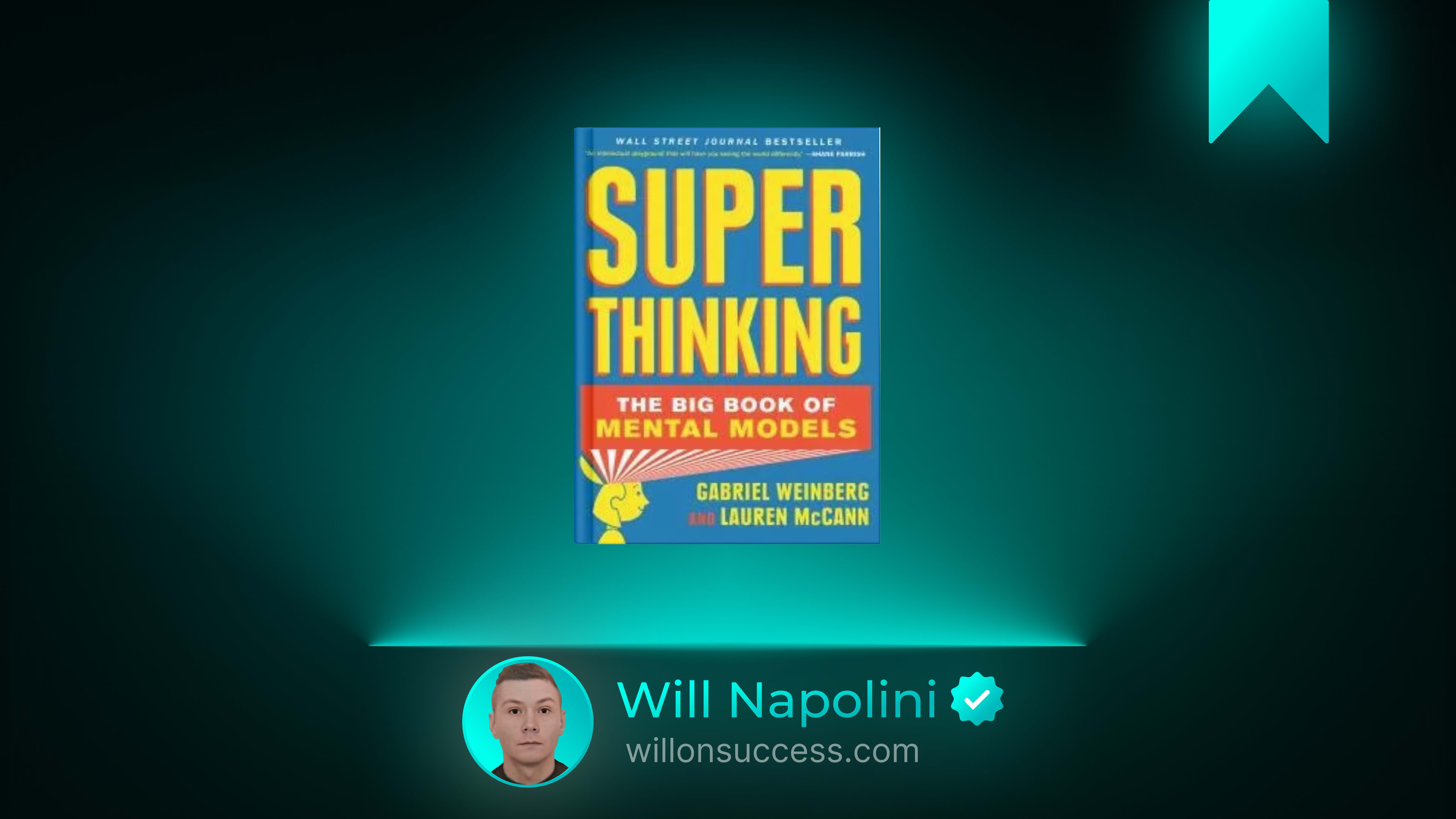
Gabriel Weinberg, the founder and CEO of DuckDuckGo, and his wife Lauren McCann wrote Super Thinking: The Big Book of Mental Models to hand you those lenses. The book is a massive, practical compilation of over three hundred “mental models”—the foundational concepts from physics, biology, economics, psychology, and mathematics that govern how the world actually works.
Their central argument is profoundly liberating: you do not need to be a genius to make brilliant decisions. You just need to understand the big ideas from the big disciplines, and you need to know when to apply them.
Let me show you how to build that toolkit, and why it might be the most important investment you make in your own mind.

The Big Idea: The Latticework of Mental Models
A mental model is simply a compressed, reusable explanation of how a part of the world works. It is a shortcut your brain uses to understand reality without having to relearn everything from scratch every morning.
You already use them. “Supply and demand” is a mental model from economics. “Critical mass” is a mental model from physics. “Confirmation bias” is a mental model from psychology.
The problem is that most of us only have a few mental models, usually drawn from our specific profession or our limited life experience. And as the old saying goes, to the person with only a hammer, every problem looks like a nail.
If your only mental model is “work harder,” you will try to solve a failing marriage by working longer hours to provide more money. If your only mental model is “optimize for efficiency,” you will strip the joy and spontaneity out of your family vacations. When you lack a diverse toolkit, you force reality to fit your limited models, rather than adjusting your models to fit reality.
Weinberg and McCann draw heavily on the philosophy of Charlie Munger, who famously argued that you must have a “latticework of mental models” hanging from multiple disciplines. When you have models from biology, you understand ecosystems and adaptation. When you have models from engineering, you understand feedback loops and breaking points. When you hang them together in a latticework, you can look at a single problem—a business decision, a health crisis, a creative block—and view it through five or six different lenses simultaneously.
The truth emerges at the intersection of those lenses. That is what super thinking is. It is not about knowing everything. It is about having the right frameworks to figure out what matters.
First Principles: Stripping Away the Assumptions
One of the most powerful models in the book, borrowed from physics and engineering, is First Principles Thinking.
Most of us reason by analogy. We look at what other people are doing, we look at how things have always been done, and we make slight iterations. I will start a podcast because my friend started a podcast. I will structure my morning routine this way because a CEO said it works for them. Reasoning by analogy is fast and efficient, but it traps you inside the boundaries of other people’s assumptions.
First principles thinking requires you to boil a problem down to its fundamental, undeniable truths, and then build up from there.
Imagine you want to start a business, but you believe you need a million dollars in venture capital because “that is how startups work.” That is reasoning by analogy. First principles thinking asks: What is fundamentally true about this business? I need a product. I need a way to deliver it. I need customers to pay me. Do I actually need a million dollars to test if someone will pay for this? No. I need a landing page and a hundred dollars.
When you feel stuck in your career or your life, it is usually because you are reasoning by analogy. You are accepting the default assumptions of your industry, your family, or your culture. First principles thinking is the act of taking a sledgehammer to those assumptions and asking, What is actually, physically, undeniably true here?
It takes more energy. But it is the only way to discover a path that is genuinely yours.
Second-Order Thinking: Asking “And Then What?”
If First Principles helps you find the right starting point, Second-Order Thinking keeps you from driving off a cliff.
Every decision has consequences. But most people only look at the first-order consequences—the immediate, visible results of an action. Second-order thinking forces you to look at the consequences of the consequences. It asks the vital question: And then what?
Let us look at how this plays out in real life. First-order thinking says: I am exhausted and stressed, so I will skip the gym and eat takeout on the couch. The immediate consequence is comfort and relief. Second-order thinking asks: And then what? Tomorrow, my energy will be lower. My baseline anxiety will be higher. I will have reinforced the neural pathway that says “stress equals avoidance.” In six months, my health will decline, and my capacity to handle stress will be severely diminished.
In business, a manager might fire a low-performing but highly social employee. First-order consequence: the team’s immediate output metrics go up. Second-order consequence: the rest of the team realizes that loyalty and culture do not matter, psychological safety plummets, and the top performers start updating their resumes.
Weinberg and McCann point out that extraordinary performance rarely comes from making brilliant first-order decisions. It comes from consistently avoiding the catastrophic second- and third-order consequences that trap everyone else.
Before you make a significant decision this week, pause. Do not just ask what will happen tomorrow. Ask what will happen next month, and next year, as a result of tomorrow. The ability to endure a small first-order pain for a massive second-order gain is the hallmark of a mature mind.
Hanlon’s Razor: The Relationship Saver
Not all mental models are about logic and strategy. Some of the most vital ones are about emotional regulation and human connection. My favorite, and one that the book highlights as essential for navigating the modern world, is Hanlon’s Razor.
The principle states: Never attribute to malice that which is adequately explained by stupidity, ignorance, or exhaustion.
Think about the last time someone cut you off in traffic, or a colleague sent you a terse, unhelpful email, or your partner snapped at you over something trivial. Your brain’s default setting is to assume malice. They are disrespecting me. They are selfish. They are trying to undermine me.
This assumption triggers your fight-or-flight response. It floods your body with cortisol. It ruins your afternoon. It damages the relationship.
Hanlon’s Razor offers a different lens. What if that colleague is just profoundly sleep-deprived because their toddler was sick? What if the driver who cut you off is rushing to the hospital? What if your partner is just carrying a cognitive load they haven’t articulated?
I want to be clear: Hanlon’s Razor does not mean you accept abusive behavior. It does not mean people are never malicious. But it recognizes a fundamental truth about human nature: most people are not out to get you. Most people are just overwhelmed, distracted, tired, and doing the best they can with the limited bandwidth they have.
When you apply Hanlon’s Razor, you stop taking the world so personally. You replace anger with curiosity. You respond to the terse email with, “Hey, sounds like you have a lot on your plate, how can I help clarify this?” instead of firing back a defensive reply. It is a mental model that acts as a shock absorber for your emotional life.
Inversion: Designing for Failure to Ensure Success
When we want to achieve a goal, our instinct is to ask, How do I succeed? We look for the magic formula, the secret habit, the perfect strategy.
The mental model of Inversion, a favorite of mathematicians and Stoic philosophers, suggests you flip the problem upside down. Instead of asking how to succeed, ask: How could I guarantee absolute failure?
If you want to improve your health, do not ask how to get a perfect physique. Ask: How could I guarantee I become deeply unhealthy? The answers are easy: I could sit on the couch all day. I could eat highly processed food. I could sleep four hours a night. I could drink my calories.
Once you have the list of guaranteed failures, your strategy becomes incredibly simple: Avoid doing those things.
Weinberg and McCann emphasize that it is often much easier to avoid stupidity than it is to strive for brilliance. You do not need to be the smartest investor in the world; you just need to avoid the catastrophic mistakes that wipe people out. You do not need to be the perfect parent; you just need to avoid the behaviors that deeply damage your child’s trust.
Inversion removes the paralysis of trying to find the “perfect” path. It gives you a clear, actionable list of guardrails. If you stay inside the guardrails, success tends to take care of itself over time.
The Map Is Not the Territory: The Danger of Abstraction
There is a meta-model in the book that I think is crucial for anyone who works with data, spreadsheets, or strategic plans. It is the reminder that The Map Is Not the Territory.
A map is a mental model. It is a simplified, reduced representation of reality designed to help you navigate. But a map leaves out the potholes. It leaves out the weather. It leaves out the stray dog crossing the road. If you confuse the map for the actual territory, you will drive straight into a ditch.
In our modern lives, we confuse the map for the territory constantly. We look at our bank account balance (the map) and assume we are financially secure (the territory), forgetting that the map doesn’t show the impending engine repair our car needs. We look at a company’s employee satisfaction survey (the map) and assume the culture is healthy (the territory), ignoring the quiet resentment brewing in the breakroom. We look at our social media follower count (the map) and assume we have a community (the territory).
When you make decisions based purely on metrics, dashboards, and theories, you are navigating by the map. Super thinking requires you to regularly fold up the map, walk outside, and look at the actual territory. Talk to the actual customer. Feel the actual morale of the team. Look at the actual condition of your body. The model is useful, but reality is the final arbiter.
Why This Matters on an Ordinary Tuesday
You might be wondering how to hold three hundred mental models in your head without getting a headache. You don’t.
The goal of Super Thinking is not memorization. The goal is recognition.
When you internalize these models, they become a quiet, background operating system for your life. You are sitting in a meeting, and someone proposes a solution that solves the immediate problem but creates a massive downstream bottleneck. Before you even know why, a flag goes up in your mind. Wait. What are the second-order consequences here?
You are arguing with your spouse, and they say something sharp. Instead of escalating, a quiet voice whispers, Hanlon’s Razor. They are exhausted, not malicious. You take a breath. You de-escalate.
You are about to launch a project, and instead of just visualizing success, you spend ten minutes doing an inversion exercise, identifying the three most likely points of failure and building contingencies for them.
This is not about becoming a cold, calculating robot. It is about reducing the amount of unnecessary friction, stupidity, and avoidable pain in your life so that you have the energy to focus on what actually matters: your relationships, your craft, your health, and your peace of mind.
Who Should Read This Book
If you are a lifelong learner, a founder, a manager, or simply someone who feels overwhelmed by the complexity of modern decision-making, this book is a goldmine. It is essentially an encyclopedia of practical wisdom. Weinberg and McCann do a beautiful job of taking dense academic concepts and translating them into clear, actionable business and life advice, drawing on Weinberg’s experience scaling DuckDuckGo in a highly competitive market.
Because it covers over three hundred models, it is not a book you read in one sitting like a novel. It is a reference manual. It is a book you keep on your desk, read a few chapters at a time, and return to when you are facing a specific type of problem.
It will be less useful if you are looking for a single, unified narrative or a highly emotional, story-driven memoir. It is dense, structured, and highly tactical. If you prefer learning through deep, immersive storytelling rather than frameworks and principles, you might find the format a bit dry. But if you want the raw tools, this is where they are kept.
Practical Application: Building Your Cognitive Toolkit
Understanding a mental model is easy. Making it a habit is hard. Here is how you can start integrating super thinking into your daily life without getting overwhelmed.
1. The “Model of the Week” Practice Do not try to learn fifty models at once. Pick one. Just one. Let’s say you pick Inversion. For the next seven days, look for opportunities to apply it. When you plan your week, ask how you could guarantee it goes terribly. When you plan a date night, ask how you could guarantee it is miserable. By focusing on one model, you train your brain to recognize its utility. Next week, pick another.
2. The Decision Journal The biggest barrier to good decision-making is our flawed memory. When things go well, we think we are geniuses. When things go poorly, we blame bad luck. Start a simple decision journal. When you make a significant choice, write down:
- The decision you are making.
- The mental models you are using to make it.
- What you expect to happen (first and second-order consequences). Review it six months later. You will quickly see which models serve you well and where your blind spots are.
3. The Pre-Mortem Before starting any new project, habit, or initiative, gather your team (or just yourself) and say: “Imagine it is one year from now, and this project has been a total, unmitigated disaster. Write down the story of exactly what went wrong.” This forces inversion and breaks the psychological trap of blind optimism. You will uncover risks you would have otherwise ignored.
One Small Step
I want you to try one specific shift today. It requires no tools, only a slight adjustment in how you view the people around you.
Sometime in the next twelve hours, someone will inevitably frustrate you. A driver will be reckless. A coworker will drop the ball. A family member will be short-tempered. A barista will get your order wrong.
In that exact moment, before the anger rises in your chest, I want you to consciously apply Hanlon’s Razor.
Take one deep breath and say to yourself: “They are not doing this to me. They are likely just tired, distracted, or struggling with something I cannot see.”
You do not have to excuse bad behavior. You do not have to accept poor service. But you must protect your own inner peace. Notice how quickly the physical tension leaves your shoulders when you stop assuming the world is hostile. Notice how much energy you save when you stop fighting imaginary enemies.
We spend so much of our lives trying to acquire more information, more data, more facts, hoping that if we just know enough, we will finally make the right choices. But information without a framework is just noise.
The quality of your life is not determined by how much you know. It is determined by the quality of your decisions. And the quality of your decisions is determined by the lenses through which you view the world.
You do not need to be born a genius. You just need to build a better toolkit.
Pick up a new lens today. Wipe it clean. Hold it up to the problem that has been staring you down. You might be surprised at how clearly you can finally see.