Think Again by Adam Grant: Why the Smartest Thing You Can Do Is Change Your Mind
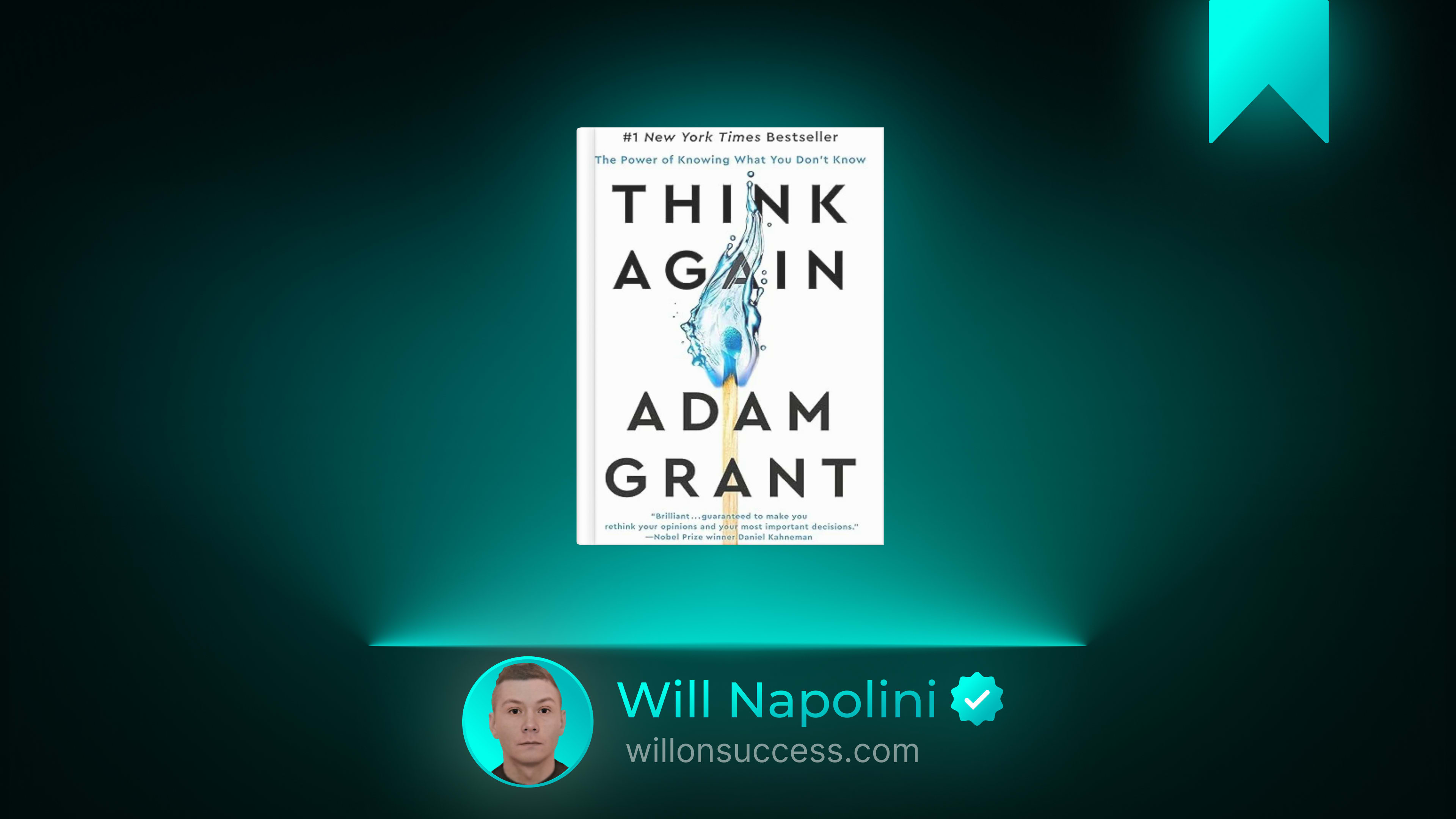
Have you ever held onto a decision long after the evidence quietly told you it was time to let go? Maybe it was a career path you chose at twenty-two. Maybe it was a strategy at work that used to deliver results. Maybe it was a belief about yourself—I’m not a creative person, I’m bad with money, I already missed my window—that you repeated so often it calcified into identity.
You are not alone in that. And the discomfort you feel when I name it? That discomfort is exactly where Adam Grant begins.
Think Again: The Power of Knowing What You Don’t Know is not a book about being smarter. It is a book about being more willing to be wrong. And if I could sit across the table from you right now, I would tell you that this single shift—treating your own mind as something you are allowed to update—may be the most practical skill you develop this year.
The Central Claim: Your Brain Is Designed to Defend, Not to Update
Grant’s thesis is straightforward and, once you see it, almost uncomfortable in its simplicity:
Human beings are wired to protect their existing beliefs far more aggressively than they are wired to test them. We treat our opinions like possessions. We treat our plans like contracts. We treat our past decisions like verdicts. And in a world that changes faster than our certainties can keep up, that wiring becomes a liability.
The people who thrive, Grant argues, are not the ones who are always right. They are the ones who have made rethinking a habit. They have built what he calls confident humility—a genuine trust in their ability to figure things out, paired with an honest admission that they do not yet have all the answers.
That combination is rare. And it changes everything.
The Three Modes You Default To (and the One You Need)
One of the most useful frameworks in the book is Grant’s description of the mental roles we slip into without noticing. He identifies three default modes:
The Preacher. You defend your beliefs. You already know the truth, and your job is to protect it and deliver it to others.
The Prosecutor. You attack someone else’s beliefs. You are not interested in understanding; you are interested in winning.
The Politician. You say whatever will earn approval. Your position shifts based on who is in the room.
Each of these modes has one thing in common: none of them is actually searching for truth. They are searching for comfort, victory, or acceptance.
The alternative Grant proposes is what he calls the Scientist mode. In this mode, you treat your opinions as hypotheses. You treat your decisions as experiments. You treat being wrong not as a failure of character but as data. You ask, What would it take to change my mind? before someone else has to force the question on you.
I have watched this distinction play out in real life more times than I can count. I have seen talented people stall for years—not because they lacked ability, but because they had dressed a ten-year-old decision in the robes of identity and could not bring themselves to undress it. And I have seen others, with less natural talent but more willingness to say I was wrong, quietly pull ahead.
The scientist mode is not about lacking conviction. It is about holding your convictions with open hands rather than a locked fist.
Your Identity Is the Strongest Cage
Here is the part of the book that I think cuts deepest, and the part I want you to sit with for a moment.
Grant describes what he calls identity foreclosure—the moment you take a belief, a role, or a plan and fuse it so tightly to your sense of self that questioning it feels like self-betrayal. You are no longer someone who works in marketing. You are a marketer. You are no longer someone who chose this city. This city is you. You are no longer someone who believes this political view. This view is your tribe, your history, your people.
Once a belief becomes identity, rethinking it feels like a death. So you stop rethinking. You protect the belief not because the evidence supports it, but because your ego has moved in and redecorated.
This is why changing your mind is so hard. It is not a logic problem. It is an identity problem.
And recognizing that is the first crack in the cage.
You do not have to abandon your values to rethink a strategy. You do not have to lose yourself to update a plan. What you are protecting, in most cases, is not your core self. It is a version of your story that you wrote years ago and have been defending ever since because editing it feels like admitting the draft was imperfect.
It was imperfect. That is fine. Drafts are supposed to be revised.
The Confidence Trap: Why the Least Sure People Often Know the Most
Grant draws on well-established research around the Dunning-Kruger effect to make a point that should humble all of us: the people who are most certain about a subject are often the ones who know the least about it. Meanwhile, people with genuine expertise tend to feel less certain, because they can see the edges of what they do not know.
He contrasts two unhelpful extremes. On one end, the armchair quarterback—someone who speaks with total confidence about a domain they have never actually entered. On the other end, the impostor—someone with real competence who cannot bring themselves to act because they are paralyzed by what they do not yet know.
The sweet spot, Grant argues, is in the middle. Confident humility. You trust your capacity to learn, adapt, and figure things out. And you remain honest about the gaps in your current knowledge. You do not need to know everything before you begin. But you do need to be willing to update as you go.
I think about this often. I have seen people wait for a certainty that will never arrive, and I have seen others charge forward with unearned confidence and crash. The ones who build something lasting are usually the ones who say, I think this is the right direction, and I will adjust as I learn.
That sentence contains more wisdom than most five-year plans.
Binary Bias and the Comfort of Two Options
Another idea in the book that I find quietly powerful is what Grant calls binary bias—our tendency to reduce complex questions into two opposing choices. You are either for this or against it. The strategy is either a success or a failure. You either commit fully or you quit.
Reality, of course, is almost never binary. There are usually five, ten, twenty options hiding behind the two you can see. But binary thinking is fast, and it is comfortable, and it lets you feel like you have resolved something when you have actually just flattened it.
Grant encourages a practice that sounds simple but requires discipline: complexifying. When you encounter a question, resist the urge to sort it into two camps. Ask, What are the third and fourth and fifth positions here? Seek out the nuance you would rather skip.
This matters in your career, in your relationships, in your politics, in the way you talk to yourself about your own progress. You are not either a success or a failure. You are a person in the middle of a process, and the middle is where all the real work happens.
Rethinking in Relationships: The Art of Actually Listening
One section of the book that moved me more than I expected is Grant’s discussion of motivational interviewing. The idea is this: when you want to help someone change their mind—whether it is a colleague resisting a new approach, a friend stuck in a pattern, or even yourself arguing with your own stubbornness—the worst strategy is to argue harder.
The better strategy is to ask questions. To listen. To help the other person hear their own reasoning out loud, because often, in the hearing, they discover the gaps themselves.
Grant presents this not as a manipulation technique but as a form of respect. You treat the other person as capable of rethinking. You do not bludgeon them into agreement. You create the conditions where they can walk toward a new conclusion on their own feet.
I have tried this in my own life, and I will be honest: it is harder than it sounds. My instinct, when I disagree with someone I care about, is to build the strongest case I can and present it like a closing argument. What I have learned, slowly, is that my closing argument usually makes the other person grip their position tighter. But a genuine question—What would change your mind about this? What part of this feels most uncertain to you?—opens a door that no argument can force.
Building a Challenge Network
Grant makes a practical point that I think most of us overlook: the people around you shape what you are willing to rethink.
If everyone in your circle agrees with you, celebrates your certainty, and treats your opinions as finished products, you will stop updating. Not because you are closed-minded, but because the environment gives you no reason to open.
What you need, Grant suggests, is a challenge network—a small group of people who respect you enough to disagree with you honestly. Not critics who tear you down. Not yes-men who keep you comfortable. But people who will say, I think you might be wrong about this, and here is why, and who genuinely want you to arrive at the best answer rather than the most comfortable one.
Building that network is an act of courage, because it means voluntarily inviting discomfort into your life. But the alternative—surrounding yourself only with agreement—is a slow, quiet way of going stale.
Escalation of Commitment: Why You Keep Doubling Down
There is a concept Grant explores that I have seen ruin more careers and relationships than almost anything else: escalation of commitment. This is the tendency to pour more time, money, and energy into a failing course of action simply because you have already invested in it. The sunk cost whispers, You have come too far to turn back. And you listen.
You stay in the role that stopped fitting three years ago. You keep funding the project that the data says is not working. You keep defending the decision because admitting it was wrong feels more expensive than continuing to pay for it.
Grant’s reframe is one I return to often: the investment you have already made is gone regardless of what you do next. The only question that matters is whether the next hour, the next dollar, the next year is well spent. And if the answer is no, then the most rational, most courageous thing you can do is redirect.
Walking away from something you built is not the same as failure. Sometimes it is the most honest form of growth.
What This Looks Like on an Ordinary Tuesday
All of this sounds good in principle. But principles only matter when they meet a Tuesday morning.
So let me make it concrete.
You are at work, and a project you proposed is underperforming. Your instinct is to defend it, to find reasons it will turn around, to treat the criticism as a personal attack. The scientist mode asks instead: What is the data actually telling me? What would I advise a friend in this situation?
You are in a conversation with someone whose view irritates you. The preacher mode wants to correct them. The prosecutor mode wants to dismantle them. The scientist mode asks: Is there a piece of their argument I have not considered? What would I need to see to update my position?
You are lying awake at two in the morning, replaying a career decision you made five years ago. The identity-foreclosed version of you says, This is who I am now. It is too late. The rethinking version says, That decision made sense with the information I had then. I have more information now. What does that change?
You do not have to overhaul your life by Thursday. You just have to let one honest question in.
Who Should Read This Book
If you are someone who values being right more than being accurate, this book will challenge you in the best way. If you have ever felt trapped by a decision, a belief, or a version of yourself that no longer fits, Grant gives you language and permission to update.
It is particularly useful for leaders, managers, educators, and anyone who regularly needs to change other people’s minds, because Grant’s insights about persuasion are genuinely counterintuitive and practical.
I will be honest about where it may be less useful. If you are already deeply comfortable questioning your own thinking—if rethinking is second nature to you—some of the material will feel familiar. And parts of the book, particularly the organizational and team-focused sections, may feel more relevant to readers in leadership or management roles than to someone navigating a purely personal transition.
But the core ideas—confident humility, identity flexibility, the scientist mode—are universal. They apply whether you are running a company or deciding whether to change your morning routine.
Your One Small Step
I do not want you to close this article and simply feel inspired. Inspiration without action is just a pleasant mood, and it fades by dinner.
So here is what I would ask you to do, today, before the day gets away from you:
Pick one belief, decision, or plan you have been defending for longer than the evidence supports. It might be small. It might be the way you run a weekly meeting. It might be the story you tell yourself about why you cannot pursue a particular goal. It might be an opinion you repeat in conversations without ever examining it.
Write it down. Then write this question beneath it:
What would I need to see, learn, or experience to change my mind about this?
You do not have to change your mind today. You do not even have to change it this month. But you do have to open the window. You do have to let a little air into the room.
Because here is what I have come to believe after years of watching people grow and stall and grow again: the mind that never changes is not strong. It is brittle. And the mind that can change—deliberately, honestly, without shame—is the mind that builds a life worth living.
You are allowed to revise your story. You were always allowed. The only thing you have to do is pick up the pen.