Why You Feel Stuck (And How to Unlock What’s Already Inside You)
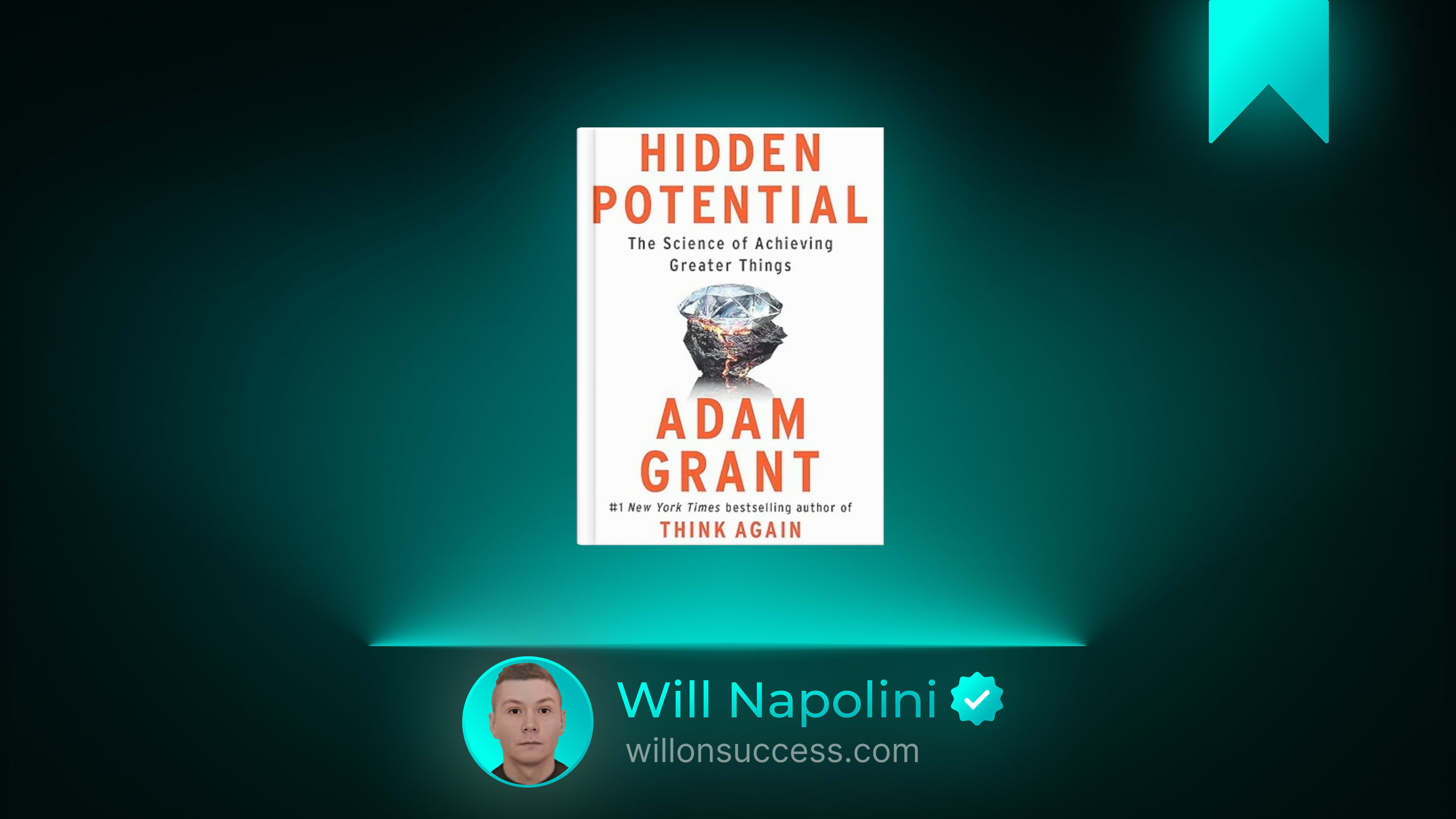
I want to show you an idea that might change the way you measure your own worth.
For most of my life, I believed potential was a fixed container. I thought some people were born with a gallon jug and others with a thimble, and no amount of effort could turn a thimble into a bucket. When I struggled, I assumed I had simply reached the rim of my capacity. When I saw others succeed effortlessly, I assumed they had been gifted a larger vessel.
What I discovered later—and what Adam Grant illuminates so clearly in Hidden Potential—is that we have been measuring the wrong thing entirely. We obsess over the height of the jump while ignoring the quality of the scaffold.
You may be working hard and still wondering why nothing is changing. You may feel like you are running on a treadmill, expending maximum energy for zero displacement. The problem is likely not your engine. The problem is that you are trying to fly without building a runway.
Grant’s central thesis offers a profound relief: Achievement is not merely a reflection of innate talent. It is a reflection of the systems, relationships, and character skills you construct around yourself. Potential is not a starting point. It is a distance traveled.
If I could sit across the table from you right now, I would tell you to stop asking “How talented am I?” and start asking “How strong is my scaffolding?”
The Distance Between Where You Are and Where You Could Be
We live in a culture obsessed with prodigies. We celebrate the natural athlete, the gifted musician, the intuitive coder. This creates a dangerous illusion that excellence is primarily about biology rather than architecture.
Grant reframes potential as the gap between your current performance and your possible performance. That gap is not closed by wishing or even by raw grit alone. It is closed by scaffolding.
In construction, scaffolding is temporary. It exists solely to help workers reach heights they could not access safely on their own. Once the structure is complete, the scaffolding comes down. In personal development, we often treat support structures as permanent crutches or signs of weakness. Grant argues the opposite: Scaffolding is the essential mechanism of growth.
This distinction matters because it shifts your focus from internal deficiency to external design. You do not need to become a different person. You need to build better supports for the person you are becoming.
When you view your struggles through this lens, shame loses its grip. Struggle is no longer evidence of inadequacy. It is simply data indicating where your scaffolding needs reinforcement.
Character Skills Are the Foundation of Cognitive Growth
We tend to separate “soft skills” from “hard skills.” We assume character is nice to have, but competence is what pays the bills. Grant dismantles this hierarchy. He argues that character skills—proactivity, discipline, determination, and curiosity—are not just moral virtues. They are the prerequisite infrastructure for learning anything else.
Think of character skills as the operating system and cognitive skills as the applications. You can have the most sophisticated software in the world, but if your OS is corrupted, nothing runs smoothly.
I have seen this play out repeatedly. I have watched brilliant people stall because they lacked the proactivity to seek feedback. I have watched average performers soar because they possessed the discipline to practice when motivation vanished.
Grant emphasizes that these skills are learnable. They are not personality traits etched in stone at birth. Proactivity is a muscle. Discipline is a habit. Curiosity is a stance you choose to adopt.
The implication is staggering. If you feel stuck intellectually or professionally, the bottleneck may not be your intelligence. It may be that you have neglected the character infrastructure required to deploy your intelligence effectively.
You cannot think your way out of a problem you behaved your way into. But you can behave your way into new levels of thinking.
Your Environment Is Quietly Shaping Your Behavior
Scaffolding is not just internal. It is profoundly relational and environmental. Grant introduces the concept of “developmental networks”—not networking for career advancement, but networking for capability expansion.
Most of us curate our social circles based on affinity. We surround ourselves with people who validate our existing identity. But growth requires friction. It requires people who see capacities in us that we cannot yet see in ourselves.
I remember a period in my own life when I felt stagnant. I was surrounded by friends who loved me dearly but who also reinforced my limitations. They comforted me in my frustration rather than challenging my assumptions. It wasn’t until I intentionally sought out mentors and peers who operated at a level above my current comfort zone that movement resumed.
These relationships were uncomfortable at first. They exposed gaps I preferred to ignore. But they also provided the blueprint for what was possible.
Your environment includes more than people. It includes the information you consume, the spaces you inhabit, and the routines you automate. Every element of your surroundings is either scaffolding or sabotage.
Ask yourself honestly: Does my current environment make the right actions easier or harder? Am I surrounded by echoes or architects?
You do not rise to the level of your goals. You fall to the level of your systems and your company.
Imperfection Is the Curriculum, Not the Failure
One of the most liberating ideas in Hidden Potential is the reclamation of imperfection. We have been taught that mistakes are deviations from the path. Grant suggests they are the path itself.
Perfectionism is not high standards. Perfectionism is fear masquerading as excellence. It keeps you small because it prevents you from attempting anything where failure is statistically probable. And since all meaningful growth occurs at the edge of competence, perfectionism guarantees stagnation.
Grant discusses the concept of being a “sponge” versus being a “filter.” Sponges absorb everything indiscriminately. Filters selectively process information. But before you can filter effectively, you must be willing to get wet.
I have learned that the fastest learners are not those who avoid errors. They are those who shorten the cycle between error and correction. They treat mistakes as tuition payments for wisdom.
When you release the demand for flawless execution, you unlock the ability to iterate. Iteration is the engine of hidden potential. Mastery is not a straight line upward. It is a spiral of attempt, failure, adjustment, and renewed attempt.
Your stumbles are not evidence that you lack potential. They are evidence that you are finally using it.
Why This Matters on an Ordinary Tuesday
Abstract principles mean nothing if they dissolve in the face of Monday morning emails and Thursday afternoon fatigue. So what does this look like in real life?
It looks like stopping the comparison game. When you understand that everyone has different scaffolding, comparing your behind-the-scenes struggle to someone else’s highlight reel becomes obviously absurd. You begin to compare yourself only to your previous self, measuring distance traveled rather than absolute altitude.
It looks like requesting specific feedback instead of fishing for validation. Instead of asking “Did I do okay?”, you ask “What is one thing I could do differently next time to improve X?” This transforms criticism from a personal attack into architectural material.
It looks like designing your day around your character skills, not just your task list. Before tackling a complex project, you might spend ten minutes cultivating curiosity by asking three genuine questions. Before entering a difficult conversation, you might practice discipline by rehearsing your listening stance.
It looks like auditing your relationships. You might realize that one friendship is purely recreational while another is developmental. Both have value, but confusing them leads to disappointment. You stop expecting your drinking buddy to be your career coach, and you stop expecting your mentor to always be fun.
Most importantly, it looks like patience. Scaffolding takes time to erect. The building does not rise overnight. But every plank you lay makes the next level accessible.
You are not failing because you are broken. You are struggling because you are under construction. And construction is messy, loud, and necessary.
Practical Application: Building Your Scaffold Today
Understanding is valuable, but understanding without action changes nothing. Here is how to translate Grant’s insights into behavior this week.
Conduct a Scaffolding Audit Take thirty minutes with a journal. Draw three columns: Internal Supports, Relational Supports, Environmental Supports. List what currently exists in each category. Then list what is missing. Be specific. Don’t write “more discipline.” Write “a morning routine that protects my first hour for deep work.” Don’t write “better friends.” Write “one monthly meeting with someone two steps ahead in my field.” Identify the single biggest gap and commit to addressing it within seven days.
Practice Character Skills Deliberately Choose one character skill you’ve neglected. Treat it like a technical skill. If you choose proactivity, set a daily alarm to identify one situation where you’ve been passive and take one small initiative. If you choose curiosity, commit to asking two open-ended questions in every conversation today without offering your own opinion. Track your attempts, not just your successes.
Reframe One Recent Failure Think of a recent setback that still stings. Rewrite the narrative using the scaffolding framework. Instead of “I’m not good enough,” write “My preparation system failed me here.” Instead of “They’re naturally smarter,” write “They had access to resources I haven’t built yet.” This isn’t positive thinking. It’s accurate diagnosis. Accurate diagnosis enables effective treatment.
Create a Feedback Loop Identify one person whose judgment you trust and who has demonstrated competence in an area where you want to grow. Ask them specifically: “I’m trying to improve X. Would you be willing to observe my next attempt and give me one piece of actionable feedback afterward?” Make it easy for them to say yes. Make it safe for them to be honest. Then listen without defending.
Embrace Strategic Discomfort Growth lives outside your current competence. Schedule one activity this month where you are guaranteed to be a beginner. Take a class where you’ll be the worst student. Volunteer for a task that stretches your character skills. Normalize the feeling of ineptitude. It is the sensation of scaffolding being assembled.
Who Should Read This Book
Hidden Potential will resonate deeply if you’ve ever felt underestimated, if you’ve plateaued despite effort, or if you suspect your environment is capping your growth. It is essential reading for educators, managers, parents, and anyone responsible for developing others. Grant provides both the philosophical framework and the practical tools to nurture potential systematically rather than accidentally.
Readers seeking quick motivational fixes or secret productivity hacks may find the book’s emphasis on character and relationships frustratingly slow. This is not a book about optimizing your current trajectory. It is about questioning whether you’re on the right path at all.
If you believe talent is destiny, this book will challenge you. If you believe effort alone is sufficient, this book will refine you. If you’re ready to stop waiting for permission to grow and start building the infrastructure for your own ascent, this book belongs in your hands.
One Small Step
Close this article and do one thing before you open another tab.
Identify one relationship in your life that has the potential to be developmental but currently isn’t. Send a message today saying: “I admire your approach to [specific skill]. I’m working on developing that in myself. Would you be open to a brief conversation sometime in the next few weeks where I could learn from your experience?”
Do not wait until you feel ready. Do not wait until you have something impressive to offer. Reach out as a learner.
Potential is not discovered in solitude. It is unlocked in connection.
The scaffold you build today determines the height you reach tomorrow. Start laying the first plank now.