The Architecture of the Soul: Waking Up in a World Asleep
Have you ever felt like you are living two entirely different lives at the exact same time?
There is the life you live on the surface: the one governed by deadlines, bank accounts, social expectations, and the relentless, grinding machinery of the modern world. And then, behind your eyes, there is a vast, quiet, eternal watcher. A part of you that feels entirely untouched by the chaos, simply observing it all with a strange, detached stillness.
Most of us spend our entire lives trying to optimize the surface life while completely starving the watcher. We buy the planners, we take the supplements, we chase the promotions, hoping that if we just build a perfect external life, the internal void will finally close.
If I could sit across the table from you, I would tell you that the void is not a flaw in your design. It is a signal. It is your deepest self reminding you that you are not merely a fragile physical body fighting a hostile universe for survival.
What if the reason you feel so perpetually exhausted is not because you are doing too much, but because you have forgotten what you actually are?
The Big Idea
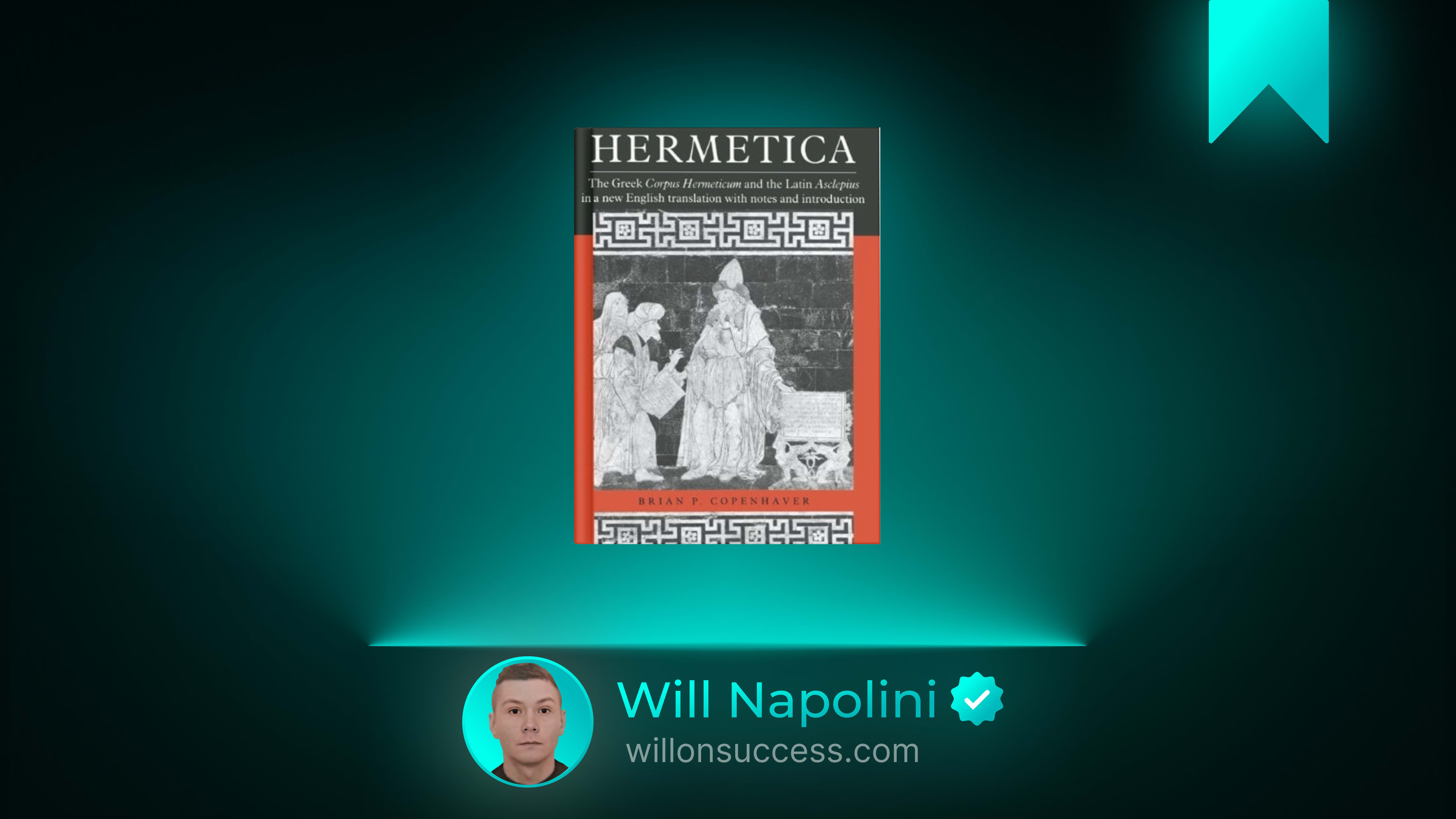
Brian P. Copenhaver’s translation of the Hermetica is a masterpiece of modern scholarship that rescues one of the most important spiritual texts in human history from centuries of misunderstanding. Written in the early centuries of the common era in Greco-Roman Egypt, the Corpus Hermeticum is often mistakenly lumped in with later Renaissance magic or superficial modern “manifestation” trends.
But Copenhaver strips away the occult clutter to reveal what the text actually is: a rigorous, profound, and deeply practical philosophical manual for spiritual awakening.
The central thesis of the Hermetica is that humanity suffers from a collective amnesia. We are divine beings who have become intoxicated by the material world, trapping ourselves in anxiety, fear, and the illusion of death. The antidote is not found in external rituals or blind faith, but in gnosis—a direct, experiential, and deeply personal knowledge of the Divine Mind that already resides within you.
The Story and the Concept
The Hermetica is not a narrative story; it is a series of dialogues and revelations, primarily between the legendary sage Hermes Trismegistus and his students, or between Hermes and the Divine Mind itself.
The most famous and foundational text within the collection is the first treatise, known as Poimandres. It begins with Hermes in a state of deep, silent contemplation. His physical senses are entirely withdrawn, and his consciousness expands. In this profound stillness, a vast, limitless presence appears to him.
Hermes asks, “Who are you?”
The voice replies, “I am Poimandres, the Mind of the Supreme. I know what you wish, and I am with you everywhere.”
Poimandres then shows Hermes the true architecture of the universe. He reveals that before the physical world existed, there was only an infinite, holy Light—the Nous, or Divine Mind. From this Light, the universe was spoken into existence. But then, humanity was created with a dual nature. We were given a spark of the Divine Mind, making us immortal and limitless. But we were also clothed in physical matter, making us subject to time, decay, and fate.
The tragedy of the human condition, Poimandres explains, occurred when the primal human looked down into the material world, saw their own beautiful reflection in the waters of nature, and fell in love with it. We became so captivated by our physical forms and the sensory pleasures of the earth that we forgot our divine origin. We became “drunk” on the material world.
The rest of the Hermetica is the roadmap for sobering up. It is the process of turning away from the reflection in the water, remembering the Light, and ascending back to our true nature.
The Illusion of the Material Trap
When Poimandres describes humanity falling in love with its reflection in the water, he is describing the exact psychological trap we find ourselves in today.
We are obsessed with the reflection. We curate our digital avatars, we measure our worth by our physical appearance, and we tie our identity to the things we own. We drink deeply from the waters of cheap dopamine, endless consumption, and social comparison. And just like the ancient text warns, we become intoxicated. We fall asleep to our higher nature.
When you are drunk on the material world, every minor inconvenience feels like a mortal threat. A lost client, a rude comment, a delayed flight—these things send your nervous system into a panic because you believe the material world is all there is. You believe that if your physical circumstances are threatened, you are threatened.
I have learned that anxiety is almost always a symptom of spiritual amnesia. It is the panic of a limitless being that has temporarily forgotten its limits are an illusion.
Responsibility before excuses means taking ownership of your attention. You cannot blame the algorithm, the economy, or your demanding boss for your intoxication. You must make the deliberate, difficult choice to look away from the reflection in the water. You must practice the art of spiritual sobriety. When you stop drinking the poison of constant external validation, the fog begins to clear, and the quiet watcher behind your eyes finally steps forward.
The Divine Mind is Already Within You
One of the most radical and liberating ideas in the Hermetica is its definition of God.
The text does not describe a distant, angry deity sitting on a cloud, keeping a ledger of your sins and demanding your worship. Instead, it describes the Divine as Nous—the Supreme Mind, the infinite intelligence that permeates and sustains all of reality.
And here is the crucial pivot: the Hermetica teaches that this Divine Mind is not just “out there.” It is the very faculty of awareness inside your own head.
When you are truly present, when you act with profound compassion, when you create something beautiful, or when you sit in deep silence and feel the vastness of existence—that is not just “you” thinking. That is the Nous experiencing itself through you.
This completely shatters the imposter syndrome and spiritual inferiority that plagues so many seekers. You do not need to climb a mountain, find a secret guru, or read a thousand books to “find” the divine. You cannot find what you already are.
Growth before achievement means realizing that your spiritual journey is not an excavation; it is a remembering. You are not a fragile body trying to reach the divine. You are the divine, temporarily experiencing the limitations of a fragile body to learn what it means to create, to love, and to overcome.
The Conquest of the Ultimate Fear
If there is one shadow that dictates almost every human decision, it is the fear of death.
We build empires, we hoard wealth, we avoid risks, and we cling to toxic relationships, all in a desperate, subconscious attempt to outrun our own mortality. The material world tells us that death is the ultimate failure, the final erasure of everything we have built.
The Hermetica addresses this fear with a breathtaking, logical compassion. Poimandres teaches Hermes that in a universe created by an infinite, perfect Mind, nothing is ever truly destroyed. Death is not an erasure; it is merely a dissolution of the physical vessel and a transformation of the soul’s state.
The physical body returns to the elements, but the spark of the Nous—the true “you”—simply sheds its heavy coat and returns to the source of Light.
When you truly internalize this, the entire architecture of your life changes. You stop making decisions based on the terrified need to preserve your ego, and you start making decisions based on the desire to express your soul. You realize that the only true “death” is living an entire lifetime completely disconnected from your divine nature.
Character before circumstances means building a life so aligned with your deepest truths that when the physical body finally fails, you can walk into the dark with absolute serenity, knowing you have already lived in the Light.
Why This Matters in Your Life
You might be reading this and thinking, This is beautiful ancient philosophy, but I still have to pay my mortgage and manage my team.
But the Hermetica is not an escape from reality; it is the ultimate tool for mastering it.
When you operate from the level of the material reflection, you are reactive. You are a leaf blown around by the winds of circumstance. But when you anchor yourself in the Nous—the deep, observing awareness within you—you become unshakeable.
In your career, this internal shift makes you a profoundly effective leader. You stop leading from a place of ego and insecurity, and you start leading from a place of clear, unattached vision. You can navigate a crisis without panicking because your identity is not tied to the quarterly results.
In your relationships, it allows you to love people for their divine spark, rather than just their utility to you. You become capable of deep forgiveness, because you recognize that the people who hurt you are also suffering from the same spiritual amnesia that you are.
In your daily life, it cures the chronic exhaustion of modern living. You stop trying to squeeze more productivity out of your physical body, and you start drawing energy from the infinite well of your inner stillness.
Practical Application
Understanding the philosophy of the Hermetica is profound, but understanding without action changes nothing. If you want to wake up from the intoxication of the material world, here is how you begin.
The Practice of Sacred Silence Hermes did not receive his vision while checking his email or listening to a podcast. He received it when his physical senses were entirely withdrawn. You must carve out a daily sanctuary of absolute silence. For fifteen minutes a day, sit in a quiet room with no input. No music, no guided meditation, no books. Just sit and observe the watcher behind your eyes. Let the mind chatter, and simply watch it. This is the gym where your connection to the Nous is built.
The Mirror Fast We spend hours staring at our reflections—in physical mirrors, in our cameras, and in the feedback of others. For the next three days, radically reduce your time looking at your own reflection. Cover the mirror in your bedroom. Turn off the self-view on your video calls. Stop checking your own social media posts. Break the trance of falling in love with your physical avatar, and redirect that energy into your internal life.
The “Gnosis” Journal Gnosis is not intellectual knowledge; it is experiential knowing. At the end of each day, do not just write down what you did. Write down one moment where you felt deeply, undeniably alive and connected. It might have been the taste of your morning coffee, the feeling of the wind on a walk, or a moment of deep laughter with a friend. Train your brain to recognize the presence of the divine in the ordinary.
Audit Your Intoxications Identify the “wine” you are drinking to numb the discomfort of being human. Is it doom-scrolling? Is it alcohol? Is it overworking? Is it gossip? Name your intoxicant. You do not have to achieve perfect sobriety today, but you must consciously choose to put the cup down for one hour every evening. Reclaim your mind from the things that put it to sleep.
Who Should Read This Book
Copenhaver’s Hermetica is essential reading for the seeker who has outgrown superficial self-help. It is for the person who has achieved external success but feels a hollow ringing in their chest. It is for the philosopher, the mystic, and the exhausted professional who suspects that there must be a deeper architecture to reality than just earning, spending, and dying.
It is important to note that this is an ancient, dense, philosophical text. Copenhaver’s translation is rigorous and academic, designed to present the text as it was understood in late antiquity, rather than through the lens of later occult traditions. It requires patience, contemplation, and a willingness to sit with complex ideas. If you are looking for a light, breezy, five-step guide to morning routines, this book will frustrate you.
But if you are willing to engage with it slowly, reading a few paragraphs a day and letting them echo in your mind, it will fundamentally rewire your understanding of who you are and why you are here.
One Small Step
Tonight, before you go to sleep, turn off all the lights and lie in the dark.
Close your eyes and ask yourself the same question Hermes asked in the beginning: Who is the one listening to my thoughts right now?
Do not try to answer it with words. Just feel the presence of the awareness that is asking the question. Rest in that silent, infinite space for just five minutes.
You do not need to go out and conquer the world to find your power. You do not need to earn your right to exist. You just need to close your eyes, turn away from the reflection in the water, and remember the Light.
The universe is not something you are trapped inside. It is something you are looking out from.