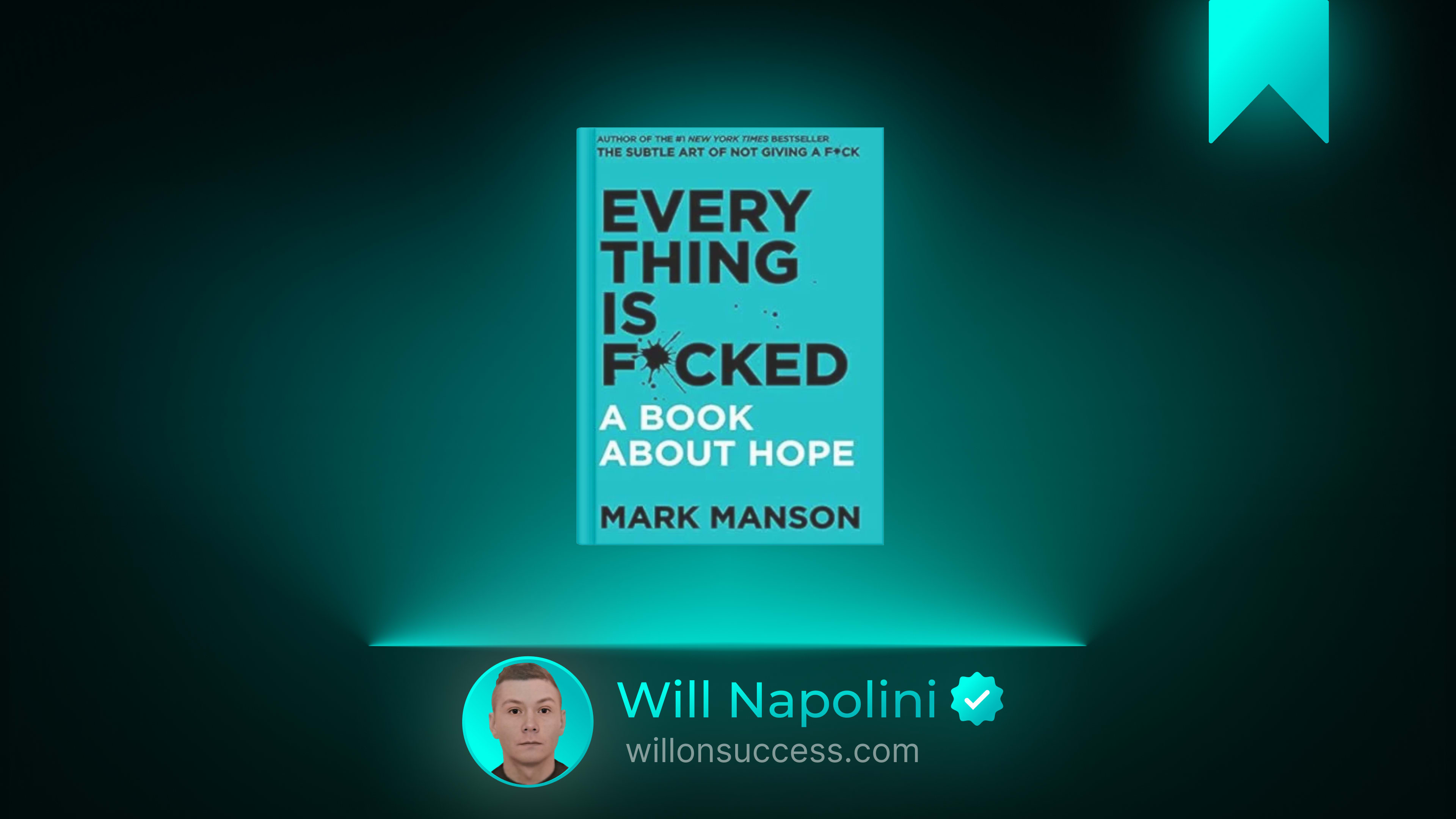
Everything Is F*cked by Mark Manson: Finding Real Hope When the World Won't Stop Feeling Broken
Here is a strange and uncomfortable fact. By almost every measurable standard—poverty, disease, violence, literacy, life expectancy—human life has never been better than it is right now. You are safer, healthier, and more connected than any generation that came before you. And yet, walk into any room of reasonably comfortable people and ask how they feel, and you will hear some version of the same word: overwhelmed. Anxious. Stuck. Hopeless.
Things are getting better. And we feel worse.
That contradiction is the engine of Mark Manson’s second book, Everything Is F*cked: A Book About Hope. The title sounds nihilistic. The book is not. It is, in its own blunt and irreverent way, one of the more honest attempts I have seen to answer a question most self-help books quietly avoid: What do you do when the world is genuinely difficult, when your suffering is real, and when no amount of positive thinking fixes any of it?
Manson does not offer comfort. He offers something more durable than comfort. He offers a framework for building hope that does not depend on circumstances improving first.
I want to walk you through the ideas that I think matter most in this book, because I believe they address something many of us are carrying right now and cannot quite name.
The Big Idea: Hope Is Not the Belief That Things Will Be Fine
Most of us treat hope as a prediction. We say, “I hope it works out,” as though hope means expecting a favorable outcome. And when the outcome looks uncertain or bleak, we conclude that hope is irrational. That we are fooling ourselves.
Manson challenges that definition entirely. His central argument is that hope is not the belief that everything will be okay. Hope is the willingness to act regardless of whether you can guarantee the outcome. Hope is a practice, not a forecast.
He draws on psychological research—particularly the work of C.R. Snyder on hope theory—which identifies three components of genuine hope: a sense of agency (I can do something), a sense of pathways (there are routes forward), and a sense of meaning (this matters to me). Remove any one of those three, and hope collapses. Not into despair, exactly. Into paralysis. Into the feeling that nothing you do would make a difference, so why bother.
That paralysis is what Manson sees spreading through modern culture. Not because life is objectively terrible. But because we have lost the ability to locate meaning and agency inside our own lives, and we keep looking for it in external validation, comfort, and certainty instead.
Two Brains, One Problem
One of the most useful frameworks in the book is Manson’s division of the mind into what he calls the Thinking Brain and the Feeling Brain.
The Thinking Brain is your rational, analytical mind. It plans. It calculates. It writes the to-do list and researches the options and constructs the logical argument for why you should change your habits or leave the job or have the difficult conversation.
The Feeling Brain is the older, deeper system. It runs on emotion, sensation, memory, and impulse. It is the part of you that flinches before you think, that craves before you decide, that decides before you realize a decision has been made.
Here is the uncomfortable insight: the Feeling Brain drives the car. The Thinking Brain is in the passenger seat, narrating the journey after the fact, convincing you that you chose this road for perfectly rational reasons.
You already know this is true. You know because you have read the book, understood the argument, agreed with every point—and then done the same thing you always do. You know because you have decided, clearly and rationally, to change something, and then felt yourself pulled in the old direction by a current you could not argue with.
Manson’s point is not that the Feeling Brain is the enemy. It is that you cannot out-think a feeling. You can only redirect it. And you redirect it not through more analysis but through new experiences, new values, and new patterns of action that gradually reshape what the Feeling Brain considers normal.
This matters because so many of us try to solve emotional problems with intellectual solutions. We read another article. We build another spreadsheet of pros and cons. We wait until we feel ready. And readiness never comes, because readiness is not a thought. It is a shift in the deeper system. And that shift happens through doing, not through deciding.
Pain Is Not the Problem. Avoiding Pain Is.
One of the ideas in this book that I found both confronting and ultimately liberating is Manson’s insistence that suffering is not a malfunction to be eliminated. It is a structural feature of conscious life. You will lose things. You will fail. You will be rejected. You will age. People you love will die. No optimization strategy removes this.
He leans on ideas that go back to the Stoics and forward through Nietzsche and into modern psychology: the attempt to avoid all pain creates more pain, not less. The person who refuses every risk lives inside a constant, low-grade anxiety about protecting what they have. The person who cannot tolerate discomfort avoids every meaningful challenge and then suffers the slow, quiet ache of a life unlived.
Manson’s reframe is not “embrace suffering” in some masochistic sense. It is simpler and harder than that: choose your suffering. Decide what is worth hurting for. Decide which problems you want to have. Because you will have problems. The only variable is whether they are problems you chose because they lead somewhere, or problems that were assigned to you by default because you never made a selection.
A musician practices scales until her fingers ache because she chose the pain that leads to mastery. A parent loses sleep for years because she chose the pain that leads to raising a child she loves. The pain is real. But it is meaningful pain. And meaningful pain is bearable in a way that empty comfort never is.
The question the book keeps pressing is: What is worth your pain? Not what is easy. Not what is comfortable. What is worth the cost you will inevitably pay?
The Trap of Using Yourself as a Means
Manson draws heavily on Immanuel Kant’s moral philosophy, and he does something I rarely see a popular book do well: he makes Kant feel relevant to a Tuesday afternoon.
Kant’s core ethical idea, simplified, is this: never treat a person—yourself included—merely as a tool for getting something else. Every person has inherent worth. Using someone, or using yourself, as a pure instrument strips away that worth and replaces it with a transaction.
Manson applies this inward. He argues that much of modern unhappiness comes from treating yourself as a means to an end. You work only to earn approval. You exercise only to be admired. You create only to be validated. You perform a version of yourself for an audience, and the actual you—the one who is tired, uncertain, imperfect—gets buried under the performance.
When you treat yourself as a tool for producing results, you can never rest. Because a tool is only valuable while it is being useful. The moment it stops producing, it is discarded. And if that is your relationship with yourself, then every pause feels like a threat. Every failure feels like proof that you are worthless.
The alternative Manson points toward is not dramatic. It is simply this: do some things because they matter to you, not because they will be rewarded. Rest because you are a person, not a machine. Create because the act of making something is meaningful, regardless of whether anyone applauds.
This is harder than it sounds in a culture that measures worth by output. But it is the foundation of a hope that does not collapse the moment the external validation stops arriving.
The “Do Something” Principle
Toward the practical end of the book, Manson offers a principle that I have found genuinely useful, and I want to give it to you clearly.
Most of us believe the sequence goes like this: first you feel inspired, then you take action. Motivation comes first. Action follows.
Manson reverses it. Action comes first. Motivation follows. You do not wait until you feel like doing the thing. You do the thing, and the feeling of engagement, of momentum, of purpose, arrives after you have started. He calls this the “Do Something” principle.
If you are stuck—if you cannot start the project, make the call, have the conversation, begin the change—do not wait for the feeling. Do the smallest possible version of the action. Write one sentence. Put on your shoes. Open the document. Make the first three words of the phone call.
The Feeling Brain learns through experience, not through intention. It needs evidence. And the only evidence it accepts is action.
You start before you are ready. You move before you feel like moving. And the feeling catches up, a few steps behind, slightly out of breath.
This is not a trick. It is how the deeper mind actually works. And knowing it removes one of the most paralyzing lies we tell ourselves: that we need to feel motivated before we are allowed to begin.
Why This Book Matters Right Now
I think this book arrives at a moment when many people are quietly exhausted by the pressure to be fine. To be optimized. To have a personal brand, a five-year plan, a gratitude practice, and a clear answer to the question “What is your purpose?”
Manson gives you permission to not have all of that figured out. He gives you permission to be uncertain. To be in the middle of something without knowing how it ends. To build a small, imperfect life and call it enough.
But he does not let you off the hook. The permission to be uncertain is not permission to be passive. You still have to choose your values. You still have to decide what you will suffer for. You still have to act, even when the outcome is unclear. You still have to treat yourself and the people around you as more than instruments for your own comfort.
That combination—compassion for your confusion, insistence on your responsibility—is rare. And I think it is exactly what makes this book land for the people who need it most.
Who Should Read This Book
This book will speak most directly to you if you are in your twenties, thirties, or forties and feeling a vague, persistent sense that something is off—not a crisis, exactly, but a slow drift. You are doing the things you are supposed to do. You are not in obvious danger. And yet something feels hollow. You cannot articulate why. You just know that the script you were handed does not seem to be producing the life you were promised.
It will also help if you are someone who has read plenty of self-help and feels immune to it. Manson’s irreverence, his willingness to say “this is hard and you might fail and the world is genuinely messed up,” cuts through the glossy optimism that makes a lot of personal-development writing feel dishonest.
That said, if you are looking for a structured, step-by-step system with worksheets and thirty-day plans, this is not that book. It is philosophical. It is discursive. It draws on Kant, Nietzsche, Buddhism, and psychology in ways that are more exploratory than prescriptive. If you need concrete frameworks, you will get the why here more than the how. You will need to build the daily practice yourself, using the direction the book gives you.
And I will be honest: Manson’s tone is blunt, profane, and deliberately provocative. If that style grates on you, it may take some patience to get past the delivery to the ideas underneath. The ideas are worth the patience. But the packaging is not for everyone.
One Small Step You Can Take Today
Here is what I would ask you to do. Tonight, before you go to sleep, take three minutes and write down the answer to one question:
What is one thing I have been avoiding not because I cannot do it, but because I am waiting to feel ready?
Do not analyze it. Do not build a plan. Just name it. The conversation you keep postponing. The application you have not sent. The creative work sitting in a drawer. The boundary you know you need to set.
Then ask yourself: What is the smallest possible version of this I could do tomorrow? Not the whole thing. Not the finished version. The first sentence. The first two minutes. The first step of putting on your shoes and walking out the door.
Do that small thing tomorrow. Not because you feel inspired. Not because you have a guarantee it will work out. Because you decided it matters, and because action is how you teach your deeper self what you value.
You do not need the world to stop being difficult before you begin. You never did. You only need to decide what is worth your attention, your effort, and yes, your pain. And then begin. Imperfectly. Uncertainly. With no guarantee.
That is not naive optimism. That is the only kind of hope that has ever actually worked.
The ground beneath you does not need to be solid for you to take a step. It just needs to be there. And it is. Right now. Under your feet. Waiting for you to move.