Eye of the Needle by Ken Follett: A Thriller About the Moment Duty Meets the Human Heart
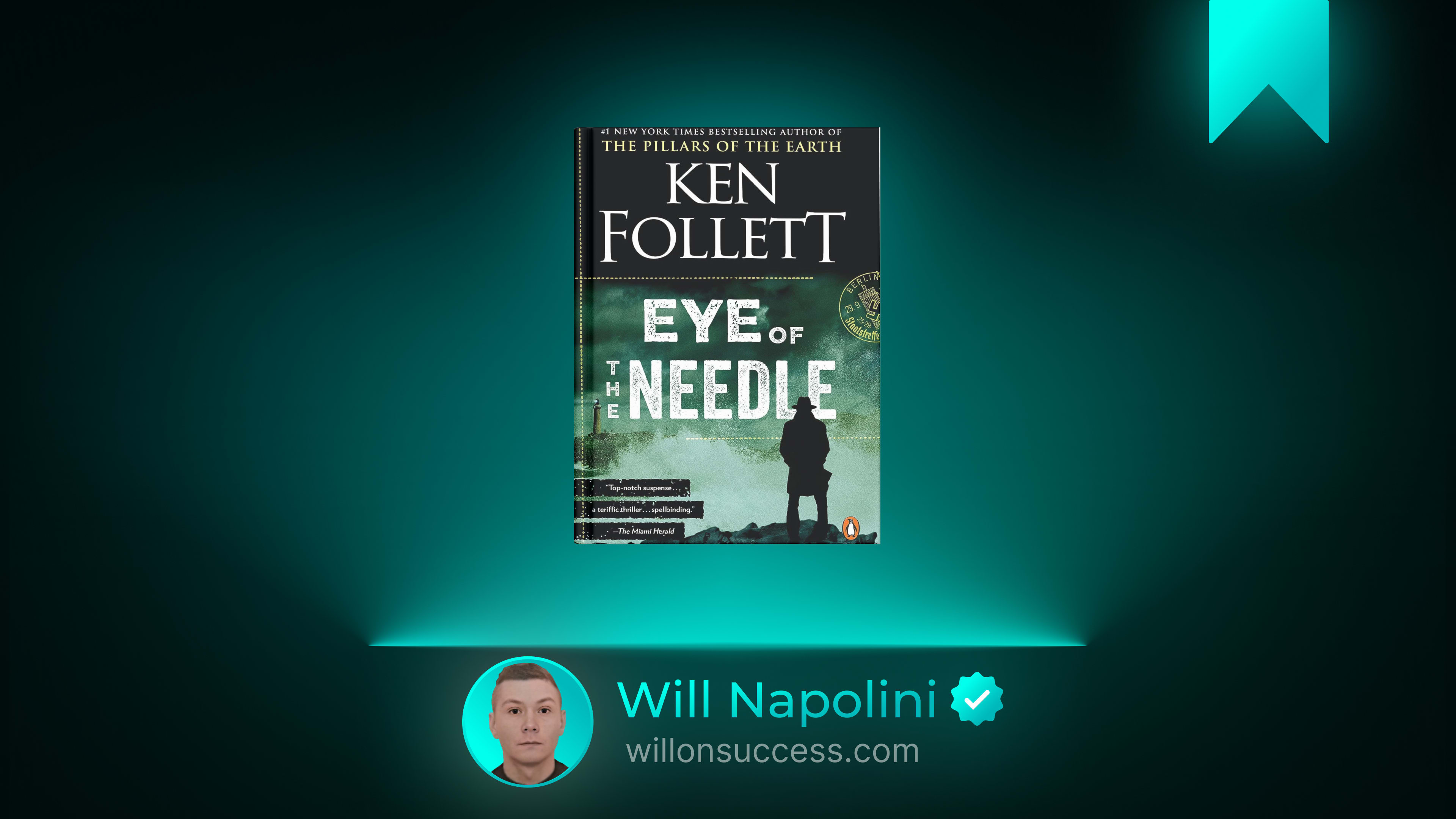
There is a question that most thrillers never bother to ask. They give you a hero, a villain, a ticking clock, and a resolution. You close the book satisfied. But you are not changed.
Ken Follett’s Eye of the Needle, published in 1978, asks the question. And it does so inside the skin of a spy thriller so tightly wound that you will forget you are reading something quietly philosophical until the last fifty pages hit you and you realize you have been thinking about duty, loneliness, and the cost of devotion for three hundred pages without noticing.
I want to talk to you about this book not as a plot summary—though I will give you the shape of the story—but as an exploration of something I think most of us carry without examining it: the tension between the role we have built our lives around and the human needs that role was designed to suppress.
If you have ever felt that the thing you are supposed to be is slowly strangling the thing you actually are, this book will find you.
The Story: A Needle in the Heart of England
The year is 1944. The Allies are preparing to invade Nazi-occupied Europe. The location and timing of that invasion are the most closely guarded secrets of the war. And a German sleeper agent named Henry Faber—codenamed Die Nadel, the Needle, for the stiletto he uses to kill—has spent years embedded in England, patient, invisible, waiting.
Faber is not a cartoon villain. Follett takes great care to make him intelligent, resourceful, disciplined, and in his own way, admirable. He is a man who has subordinated every personal desire to a single mission. He has no friends. No lovers. No life outside the work. He is, in the truest sense, alone by design.
And then he discovers the secret. The Allies have constructed an elaborate deception—a phantom army of inflatable tanks, dummy vehicles, and false radio traffic—designed to convince the Germans that the invasion will come at Pas-de-Calais rather than Normandy. Faber photographs the evidence. Now he must get it back to Germany. Everything depends on it.
What follows is a pursuit northward through England and into Scotland, with British intelligence closing in behind him. And it is on a small, storm-battered island off the Scottish coast—Storm Island—that the novel finds its true center. Because on that island live two people who will change everything: Lucy Rose, lonely and quietly desperate, and her husband David, paralyzed from the waist down after an accident, bitter with his own helplessness.
Faber arrives on the island injured. Lucy nurses him. And something happens that no amount of training prepared him for.
The Big Idea: What Happens When Solitude Meets Warmth
The novel’s deepest question is not “Will the spy escape?” It is this: Can a person who has made himself into a pure instrument of duty survive an encounter with genuine human connection?
Faber has spent years as a tool. A weapon. A mechanism for completing a mission. He has no interior life outside the work because the work demanded all of him. And for a long time, that was sustainable. The solitude was not a wound. It was the architecture.
Then Lucy looks at him. Not as an agent. Not as a threat. Not as a function. As a person. And something in the architecture cracks.
Follett does not play this as sentimentality. He plays it as danger. Because for Faber, feeling is not a gift. It is a structural failure. The moment he begins to care about Lucy, he becomes slower, more hesitant, more human. And in his line of work, being human is how you get caught. Being human is how you die.
I think this is the idea that gives the book its lasting weight. It is not simply a love story inserted into a thriller. It is an argument that the parts of ourselves we suppress in service of a role do not disappear. They wait. And when they finally surface, they do not ask permission. They rearrange everything.
The Island as a Mirror
Follett chose his setting with real intention. Storm Island is small, isolated, battered by weather. There is nowhere to hide on it, and nowhere to run. The characters are trapped together by geography and storm, and that confinement forces every hidden thing to the surface.
David, paralyzed and proud, hides his helplessness behind anger. Lucy hides her loneliness behind duty. Faber hides his humanity behind the mission. And on that rock, in that weather, with the sea cutting them off from the world, none of those disguises hold.
There is something true here that extends well beyond the novel. I have seen it in my own life, and I suspect you have seen it in yours: we can maintain a performance indefinitely when we have space, distraction, and distance. We can keep the mask in place when there is always somewhere else to go, someone else to perform for, another task to absorb us. But remove the exits. Remove the noise. Place a person in a small room with the one other person who sees them clearly, and the mask begins to slip. Not because it was poorly made. Because it was never meant to be worn forever.
The island is that small room. And what happens there is what happens whenever we are finally still enough, and close enough to another person, to be seen.
Duty Is Not the Same as Purpose
One of the tensions Follett builds carefully is the distinction between duty imposed from outside and meaning chosen from within.
Faber’s loyalty to Germany, to his mission, to the work he was trained to do—this is real. He is not a cynic. He believes in what he does. But his belief was handed to him. Structured for him. He did not build it from his own questioning, his own searching, his own experience of what matters. He inherited a purpose and became its instrument.
And that works. Until it doesn’t. Until a woman on an island asks him a simple question about who he is when he is not completing a task, and he discovers he does not have an answer.
I think many of us live closer to Faber than we would like to admit. Not as spies. But as people who have built an identity around a role—parent, provider, professional, caretaker, achiever—and have not paused to ask whether the role was chosen or merely accepted. Whether it still fits. Whether there is a person underneath it who has been waiting, quietly, for acknowledgment.
Follett does not condemn Faber for his duty. He does not mock the structure that made him. But he shows, with great patience and some real tenderness, what it costs a person to be nothing but a function. And he shows that the cost comes due eventually, whether you are ready for it or not.
The Cat-and-Mouse Structure as Moral Pressure
The novel operates on two timelines that converge. Faber is moving north, killing when necessary, trying to reach the U-boat that will take him and the photographs back to Germany. Behind him, British intelligence—led by a determined professor turned spymaster named Percival Godliman—is piecing together his trail, always a step behind, always closing.
This structure does more than create suspense, though the suspense is genuinely excellent. It creates a kind of moral pressure on the reader. You are, whether you want to be or not, rooting for Faber. He is the protagonist. You are inside his mind. You feel his competence, his discipline, his loneliness. And then you remember what he is trying to do: deliver information that will allow the Germans to redirect their defenses and potentially slaughter thousands of Allied soldiers on the beaches of Normandy.
Follett does not let you resolve that tension easily. You care about this man. You also understand what his success would cost. And the novel asks you to hold both of those truths at the same time without flinching.
That is rarer in thriller writing than it should be. Most genre fiction resolves moral ambiguity quickly. Follett lets it breathe. He lets you sit inside the discomfort of caring about someone whose victory you cannot want.
Lucy and the Cost of Being Unseen
I want to say something about Lucy, because I think she is the emotional center of the book even though the plot orbits Faber.
Lucy married David. Then David was paralyzed. And in the aftermath, without either of them quite choosing it, their marriage became a caretaking arrangement. Lucy is not cruel. David is not a monster. But the intimacy between them has calcified into obligation, and Lucy has become invisible in her own life. She tends. She manages. She endures. And no one asks her what she wants.
When Faber arrives, what he gives her is not primarily romance. It is attention. He sees her. He speaks to her as though her thoughts matter. He treats her as a person rather than a function. And for a woman who has been a function for years, that attention is almost unbearable in its sweetness.
Follett handles this with restraint. He does not turn Lucy into a victim or a fool. She is intelligent, practical, strong. But she is also hungry for something she has been denying herself for so long that she has forgotten it is a legitimate need.
And I think that is something many readers will recognize, regardless of the setting. The experience of being useful without being seen. Of being needed without being wanted. Of discovering, in some unexpected encounter, that you had been starving without realizing it.
What the Book Asks of You
Eye of the Needle is a thriller. It moves fast. It is propulsive, well-crafted, and deeply satisfying as a piece of genre storytelling. You can read it purely for the plot and enjoy every page.
But if you let it, it asks something more of you. It asks you to look at the roles you inhabit and wonder whether they are still yours. It asks whether the people closest to you are seeing you, or merely seeing what you do for them. It asks whether you have built a life that has room in it for the person you are when you are not performing a function.
And it asks a harder question, one I will not soften: What are you willing to lose in order to remain who you actually are?
Faber’s answer, in the end, costs him everything. But the novel does not frame his undoing as simple weakness. It frames it as the inevitable return of everything he had tried to amputate from himself. The heart does not stay buried. It surfaces. And when it does, it does not negotiate.
Who Should Read This Book
If you enjoy historical fiction with genuine tension, tight plotting, and characters who feel like people rather than archetypes, this is a strong choice. Follett researched the period carefully, and the details of wartime England—the blackouts, the rationing, the quiet paranoia of a nation expecting invasion—feel lived-in rather than decorative.
If you like thrillers but wish they had more emotional depth, this will satisfy you. The spy plot is genuinely gripping. But the island section, the love story, the psychological unraveling—these are where the book earns its place beyond genre.
If you want something light, easy, and morally simple, this is not that. Follett asks you to sympathize with a killer. He asks you to sit inside ambiguity. He does not hand you a clear hero and a clear villain and let you relax into certainty.
And if you are in a season of life where you are questioning the roles you play, where you feel the weight of an identity that was built around obligation rather than desire, this book will land with particular force.
One Small Step
Here is what I would invite you to do after you finish this book—or even before you start it.
Find ten minutes where you are alone. No phone. No task. No performance for anyone. Sit with a cup of tea or a glass of water or simply your own breathing, and ask yourself one question:
If no one needed me to be anything right now—who would I be?
Do not rush the answer. Do not judge it. If the answer is “I don’t know,” that is also an answer. And perhaps an important one. Because knowing that you have lost track of yourself underneath the roles is the first step toward finding your way back.
You do not need to be on a storm-battered island for that reckoning to arrive. You only need to be still enough to hear it.
Faber’s tragedy was not that he was caught. It was that he spent years building a self that had no room for the person he might have been. And by the time he glimpsed that person—in Lucy’s eyes, in the small kindness of being seen—it was too late to build a life around him.
You are not too late. Whatever role you are wearing, whatever duty you are carrying, whatever island you are stranded on: the person underneath is still there. Still waiting. Still hoping you will turn toward them and say, I see you. You matter. You are more than what you do for other people.
Turn toward them. Even for ten minutes. Even tonight.
The door is not locked. You just have to stop performing long enough to walk through it.