Factfulness by Hans Rosling: Why the World Is Better Than You Think (And How to See It Clearly)
You wake up, reach for your phone, and scan the morning headlines. War. Economic crash. Climate disaster. Political outrage. Within three minutes, your heart rate is up, your shoulders are tense, and you feel a familiar, quiet dread about the state of the world.
I used to start my days exactly this way. I thought I was being responsible. I thought staying informed meant absorbing every alarming headline and carrying the weight of the world’s crises before I even had my coffee.
Then I came across the work of Hans Rosling, a Swedish physician and global health statistician. He asked a simple, seemingly obvious question to audiences around the world: Is the world getting better or worse?
When he gave this multiple-choice question to thousands of people—including Nobel laureates, bankers, and journalists—humans consistently scored worse than random chance. A group of captive chimpanzees, picking answers at random, scored 33 percent. The humans scored 10 to 15 percent.
We were systematically wrong. And not just a little wrong. We were deeply, predictably, and dramatically wrong.
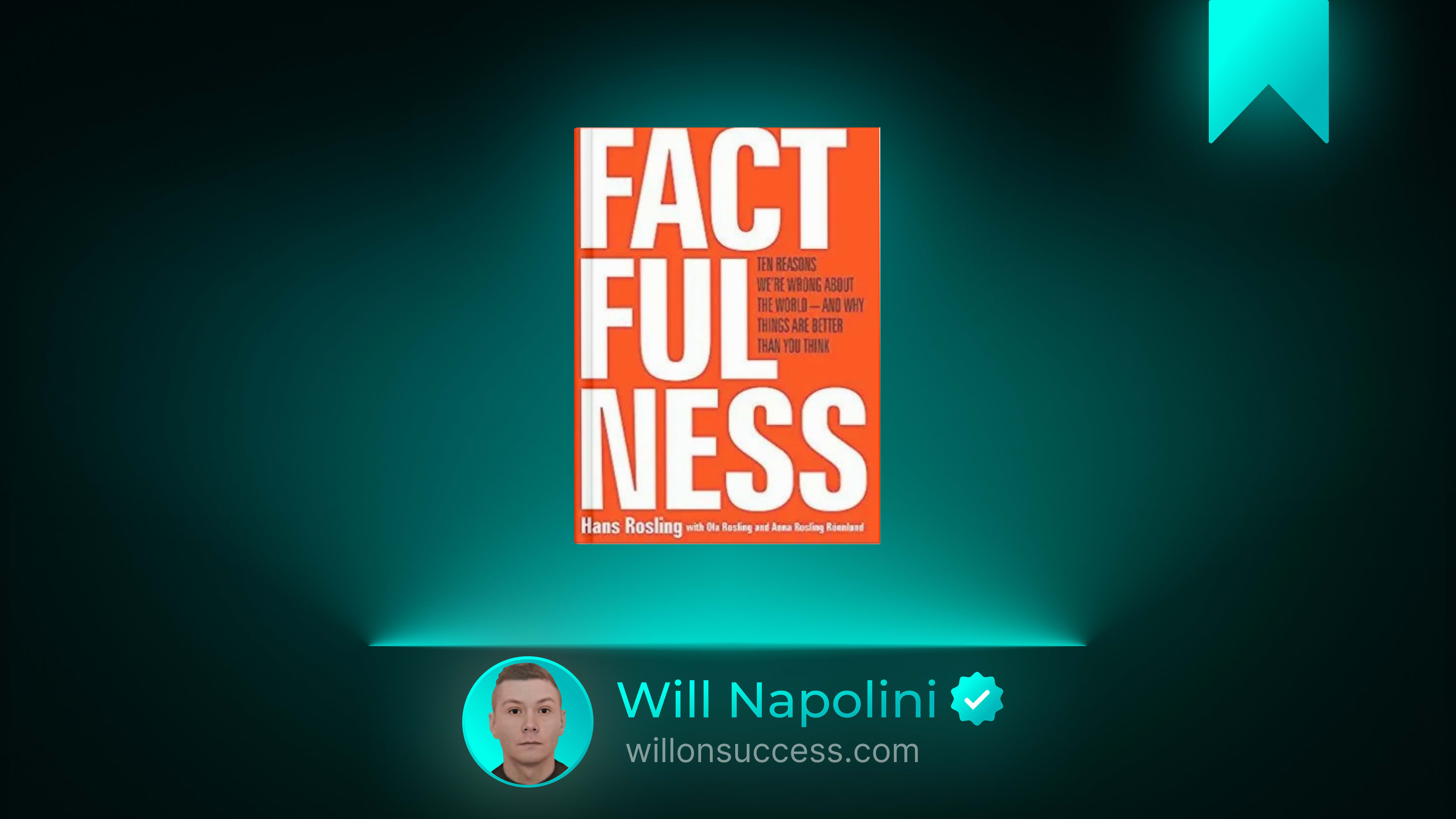
That realization is the foundation of Factfulness: Ten Reasons We’re Wrong About the World—And Why Things Are Better Than You Think. It is not just a book about data. It is a book about human psychology, about how our own minds trick us into despair, and about how we can reclaim our agency by learning to see the world as it actually is.
The Big Idea: The Overdramatic Worldview
Rosling’s central thesis is not that the world is perfect. He was a doctor who worked in some of the poorest regions on earth; he knew exactly how much suffering existed, and he spent his life fighting it.
His argument is that we suffer from an “overdramatic worldview”. Our brains are hardwired by evolution to pay attention to immediate threats, to gossip, to dramatic shifts, and to negative news. As a result, we systematically overestimate how bad the world is on the most important metrics, such as poverty, violence, and disease.
Factfulness, as Rosling defines it, is the habit of only carrying opinions that have strong facts to back them up. It is a stress-reducing, hope-generating practice. When you replace your dramatic instincts with a fact-based worldview, you do not become a naive optimist. You become what Rosling called a “possibilist.” You see the world clearly enough to know what actually needs fixing, and you retain the energy required to actually fix it.
The Story: The Patient in the Incubator
To understand Rosling’s perspective, you have to understand how he viewed data. He did not see numbers as cold abstractions. He saw them as the vital signs of a patient.
Imagine you are sitting beside a premature baby in an incubator. The monitors are beeping. The baby’s heart rate is fluctuating. The situation is undeniably critical. If someone walked in and said, “Everything is fine,” you would rightfully throw them out. The baby is not fine. The baby is struggling.
But if the doctor looked at the charts and said, “Yesterday, the baby’s vitals were failing. Today, they are stabilizing. The situation is still bad, but it is getting better,” that is a completely different reality.
Both things can be true at once. The world can be deeply flawed, and it can be getting better. Rosling’s life’s work was teaching us how to hold both of those truths in our minds simultaneously, rather than letting the bad news completely erase the quiet, steady progress happening in the background.
Navigating the Ten Instincts That Distort Reality
Rosling identified ten dramatic instincts that distort our perception of reality. He did not list them to shame us. He listed them so we could recognize them when they flared up, the way you recognize a physical reflex before it makes you flinch. Let us look at the most disruptive ones and how to tame them.
The Instincts That Divide and Diminish: The Gap and The Negativity
We love a good “us versus them” story. Rosling called this the Gap Instinct. We divide the world into two distinct camps: the rich and the poor, the developed and the developing, the West and the rest.
But this binary is a ghost. It does not exist anymore.
Rosling replaced this outdated view with four income levels. Level 1 is extreme poverty (surviving on less than $2 a day, walking barefoot to fetch water). Level 4 is the wealthiest tier (flying on airplanes, owning a car, having a college degree). The stunning fact is that the vast majority of humanity now lives in the middle—Levels 2 and 3. They have bicycles, or maybe motorcycles. Their children go to school. They are not “us,” but they are no longer the extreme “them” we see in charity commercials. The gap has closed, but our mental models have not updated.
Coupled with the Gap Instinct is the Negativity Instinct. We notice the bad much more than the good. When a bridge collapses, it makes global news. When a million children successfully learn to read this week, it makes no news at all. Slow, quiet improvement is not dramatic, so it is invisible. To fight this, you must actively look for the silent miracles. You must realize that the absence of a news story is often the proof that things are working exactly as they should.
The Instincts That Distort Scale and Danger: Fear and Size
The Fear Instinct makes us confuse what is frightening with what is actually dangerous. We are terrified of sharks, terrorists, and plane crashes, while ignoring the things that actually threaten our lives: heart disease, car accidents, and preventable infections. Our fear system was built for a world of predators and sudden violence. It is not calibrated for the modern world, and it routinely tricks us into spending our energy defending against the wrong threats.
Then there is the Size Instinct. We see a massive, terrifying number in the news—a national debt, a number of casualties, a financial cost—and we panic. But a big number without context means nothing. You must always ask: Compared to what? What is the rate per capita? What was this number ten years ago? Division is your friend. Break the big, scary number down to a rate, and it often shrinks back to a manageable, understandable size.
The Instincts That Blind Us to the Future: The Straight Line and Destiny
We tend to assume that whatever is happening right now will just keep happening in a straight line forever. If a population is growing, we imagine it growing infinitely. If a resource is being depleted, we imagine it hitting zero next Tuesday. Rosling points out that almost nothing in nature or human society moves in a straight line. Graphs curve, they plateau, they dip, and they S-curve. The Straight Line Instinct causes us to panic about the future because we refuse to imagine that systems adapt and change.
Similarly, the Destiny Instinct makes us believe that innate characteristics—of people, of cultures, of nations—are permanent and unchangeable. “That’s just how they are,” or “That country will never modernize.” This instinct is a comfort to the brain because it simplifies the world, but it is a lie. Cultures evolve. Economies shift. People change. Assuming that the future is locked in by the past is not just factually wrong; it is a profound failure of imagination.
The Instincts That Trap Us in Panic: Urgency and Blame
The Urgency Instinct is the voice that says, “Act now or lose everything!” It is the favorite tool of salespeople, activists, and algorithms. It forces you to make snap decisions before your analytical brain can engage. Rosling’s antidote is simple: take a breath. Demand data. Rarely is a global or personal crisis so urgent that you cannot afford a few hours of careful thought.
And when things do go wrong, the Blame Instinct kicks in. We want to find a bad guy. A villain. A corrupt politician, a greedy corporation, a careless driver. But complex problems rarely have simple villains. They have complex systems. When you stop looking for someone to blame, you free up your energy to look for the systemic causes, which is the only place where real, lasting solutions live.
Why This Matters on an Ordinary Tuesday
You might be thinking: This is interesting global trivia, but what does it have to do with my life, my career, my family?
Everything.
Your worldview is the operating system for your decisions. If your operating system is infected with the belief that the world is collapsing, that people are inherently selfish, and that nothing ever gets better, you will make defensive, short-term, fearful choices.
You will hoard resources instead of investing them. You will avoid taking calculated risks in your career because the environment feels too hostile. You will raise your children with anxiety instead of agency.
When you adopt factfulness, you do not just learn about global poverty rates. You learn how to evaluate risk in your own business. You learn to look past the dramatic, emotional pitch of a client and look at the actual data of their proposal. You learn to give yourself grace when you fail, recognizing that progress is a slow, upward trend punctuated by sudden, highly visible setbacks.
A fact-based worldview gives you the courage to be patient. It allows you to commit to long-term goals because you actually believe that incremental progress is real.
Practical Application: How to Consume the World
So, how do you build this habit? You do not need to become a statistician. You just need to change how you consume information and process your daily experiences.
Look for the slow changes. The next time you read a story about a slow, incremental improvement—a drop in local crime, an increase in high school graduation rates, a new water filtration plant—pause and acknowledge it. Train your brain to register quiet progress. Celebrate the unglamorous work of maintenance and improvement.
Beware of dramatic filters. When a news outlet or a social media feed tells you that everything is a disaster, remember that their business model relies on your Fear and Negativity instincts. Do not let an algorithm decide what is dangerous. Step away from the feed and look at the baseline.
Expect bad news. Remember that bad events are much more likely to reach you than good ones. A plane lands safely; nobody tweets about it. A plane crashes; it is on every screen. Recognize that the filter of the media is inherently skewed toward the negative, and adjust your internal calibration accordingly.
Who Should Read This Book
If you are a leader, a manager, an entrepreneur, or an investor, this book is mandatory reading. You cannot make good strategic decisions if your map of the territory is fundamentally wrong. If you think a market is collapsing when it is actually stabilizing, you will make the wrong investments.
If you are someone who feels paralyzed by “doomscrolling,” who feels a low-grade, persistent dread about the future of humanity, Factfulness is a profoundly therapeutic book. It does not ask you to ignore the world’s pain. It asks you to look at the world’s progress so that you have the strength to address the pain.
This book is less useful if you are looking for a deep dive into advanced statistical modeling. Rosling keeps the math simple and visual. He is not trying to make you a data scientist. He is trying to make you a clear thinker. And if you are deeply attached to your cynicism—if you believe that pessimism is the only sign of intelligence—this book will frustrate you. It asks you to let go of the comfort of despair.
One Small Step You Can Take Today
Here is your assignment for today.
The next time you see a headline or a social media post designed to make you angry or terrified—the next time you feel that familiar spike of adrenaline—do not immediately share it, comment on it, or let it ruin your afternoon.
Instead, pause and ask one simple question: What was this number ten years ago?
Is the problem growing? Is it shrinking? Is it stabilizing?
Force yourself to look for the trend, not just the snapshot.
You will be amazed at how often the terrifying monster in the headlines turns out to be a shadow, shrinking in the light of actual data.
You do not need to be a pessimist to be a realist. The world is complicated, it is flawed, and it is full of challenges that require our absolute best effort. But it is also improving.
Progress is not a straight line shooting to the stars. It is a slow, quiet accumulation of small victories, built by ordinary people making better decisions.
When you see the world as it actually is, you stop wasting your energy fighting ghosts. You finally have the strength to build what comes next.