Fahrenheit 451 by Ray Bradbury: A Warning About What We Choose to Surrender
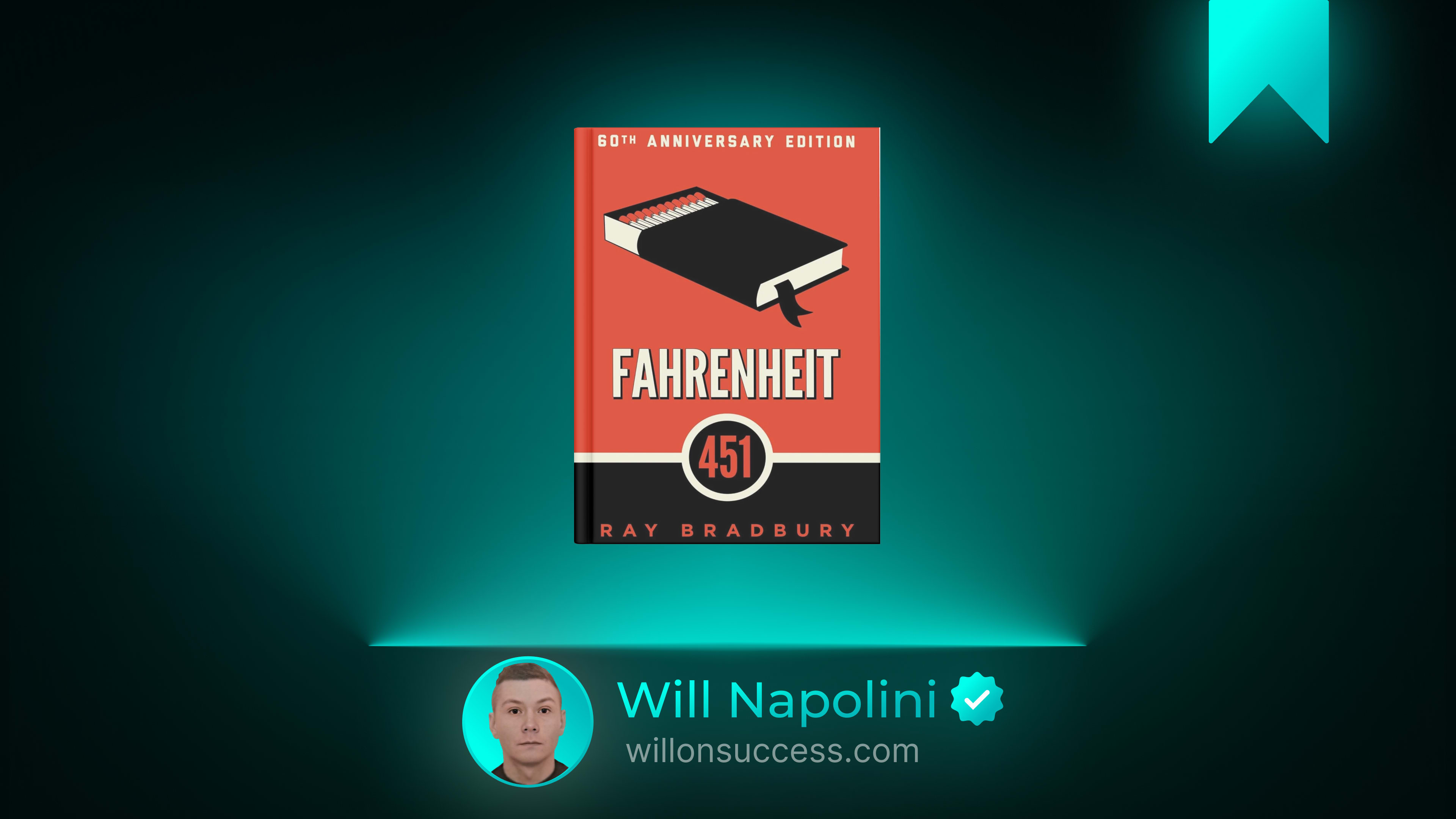
Here is what unsettles me most about Fahrenheit 451. It is not the fire. It is not the Mechanical Hound, or the burning of libraries, or the government agents hunting down readers. Those are dramatic. They are frightening. But they are not the real horror of the novel.
The real horror is how willingly the people gave it all up.
No dictator marched into Ray Bradbury’s fictional world and demanded that the citizens surrender their books, their conversations, their capacity for sustained thought. The citizens did it themselves. They chose the glowing wall over the difficult page. They chose the constant hum of entertainment over the uncomfortable silence of their own minds. They chose comfort. They chose speed. They chose not to feel the weight of a challenging idea pressing against them at eleven o’clock at night when they would rather sleep.
Bradbury published this novel in 1953. He wrote it as a warning about television, about McCarthyism, about the flattening of culture into something inoffensive and disposable. And yet, reading it now, more than seventy years later, I find that it reads less like a warning about some authoritarian future and more like a mirror held up to the ordinary Tuesday evening of a person scrolling through a phone in a darkened living room.
I want to walk through this book with you. Not as a literary analysis. As a conversation about what it means to pay attention in a world that profits from your distraction.
The Big Idea: You Do Not Have to Burn the Books If No One Will Read Them
The novel’s central insight is not that censorship destroys freedom. That is true, but it is the surface. The deeper idea—the one that has stayed with me through multiple readings—is this: a society does not need to be forced into ignorance. It will volunteer, eagerly and gratefully, if ignorance is packaged as entertainment.
Bradbury understood that the most effective way to control thought is not to punish thinking. It is to make thinking feel unnecessary. Uncomfortable. Slow. Boring. Why sit with a novel that challenges your assumptions for six hours when you can be stimulated, soothed, and distracted in six seconds?
The firemen in this world do not put out fires. They start them. Their job is to burn books, because books have been deemed dangerous—not because they contain forbidden information, but because they contain difficulty. They contain ideas that make you sit still, wrestle with ambiguity, and feel things you did not ask to feel. And in a culture that has decided comfort is the highest good, difficulty is a threat.
The Story: A Man Who Wakes Up
Guy Montag is a fireman. He has been one for ten years. He burns books for a living, and he enjoys it. The novel opens with him describing the pleasure of watching paper blacken and curl, the satisfaction of the flamethrower in his hands. He is not a villain. He is not cruel. He is a man who has never questioned the shape of his life because questioning was never required of him.
Then he meets Clarisse McClellan.
Clarisse is seventeen. She is his neighbor. She walks slowly. She watches the moon. She notices the dew on the grass. She asks him questions that no one in his world asks anymore. And the question that cracks him open is devastatingly simple: Are you happy?
Not “Are you successful?” Not “Are you comfortable?” Not “Are you entertained?” Are you happy?
Montag cannot answer. And the inability to answer becomes the engine of everything that follows.
At home, his wife Mildred lives inside the parlor walls—three walls of her living room are floor-to-celevision screens running interactive programs she calls her “family.” She wears seashell radios in her ears, feeding her a constant stream of sound so she never has to sit in silence. She has forgotten the words to meaningful conversations. She overdoses on sleeping pills and is revived by technicians who treat her like a broken appliance, pumping her stomach and replacing her blood with mechanical efficiency.
She does not remember the overdose. She does not want to remember it. Remembering would require sitting with something painful, and the entire architecture of her world is designed to prevent that.
Montag’s awakening is slow, painful, and costly. He begins hiding books. He seeks out Faber, a retired English professor who lives in fear. He confronts his fire chief, Captain Beatty, a man who has read extensively and quotes literature fluently—while arguing, with terrifying eloquence, that literature must be destroyed because it offends someone, challenges someone, makes someone uncomfortable.
The novel ends in fire and ash. The city is destroyed. But a small group of people—wanderers, outcasts, memorizers—survive. They have each committed a book to memory. They carry the words in their minds, walking from town to town, waiting for the day when someone will want to listen again.
The Danger of a Life Without Friction
What Bradbury saw clearly, and what I think applies directly to how we live now, is that the enemy of depth is not oppression. It is convenience.
Mildred is not oppressed. She is not imprisoned. She has everything she says she wants. She has stimulation. She has noise. She has a social world that never asks anything difficult of her. And she is, by every external measure, fine.
She is also hollow.
I have seen this pattern play out in smaller, quieter ways. The person who fills every silent moment with a podcast or a video, not because they are learning, but because silence feels unbearable. The person who has opinions about everything but has never sat with a single book long enough to be changed by it. The person who confuses being informed—having scrolled past enough headlines to have a reaction—with being thoughtful.
Bradbury is not saying entertainment is evil. He is saying that when entertainment becomes the only thing—when it replaces conversation, replaces reflection, replaces the slow and difficult work of building a mind—something essential is lost. Not by force. By choice. By a thousand small choices to reach for the easy thing instead of the meaningful thing.
The cost is not dramatic. The cost is that you stop knowing what you actually think. You stop knowing what you actually feel. You become a vessel for whatever the loudest, most stimulating input poured into you most recently.
Clarisse and the Courage of Attention
Clarisse McClellan appears only briefly in the novel, but she is its moral center. She is not a rebel in any political sense. She does not organize a resistance. She does not give speeches.
She pays attention.
She notices the way the moonlight looks. She asks people what they think about things. She walks instead of driving. She sits on her porch and talks to her family instead of watching the parlor walls. In the context of her world, these acts are radical. Not because they are illegal, but because they are slow. And slowness, in a world built on speed and stimulation, is a form of dissent.
I think about this often. The most subversive thing you can do in a culture of constant distraction is to give something your full, unhurried attention. To read a book without checking your phone. To sit across from another person and ask them a real question, then actually wait for the answer. To walk outside without earbuds and notice the quality of the light.
These are small acts. They will not make the news. They will not build a following. But they are how you remain a person with an interior life in a world that would prefer you to be a surface.
Beatty’s Warning: Knowledge Without Conviction Is Useless
Captain Beatty is one of the most disturbing characters in literature because he is not stupid. He is not ignorant. He has read the books he burns. He quotes them freely. He understands their power. And he has decided, consciously and articulately, that their power is dangerous and must be contained.
He represents something I have encountered in different forms throughout life: the person who has accumulated information but never allowed it to change them. The person who can argue any side of any question but holds no genuine conviction. The person who knows the arguments but has never been moved by them.
Beatty is a warning that reading, learning, and intellectual activity are not automatically virtuous. You can read a hundred books and use them all to build a more sophisticated cage around yourself. Knowledge without the willingness to be transformed by it is just decoration.
The question is not whether you consume ideas. The question is whether you let them cost you something. Whether you let them change your behavior, your priorities, your relationships, your daily choices.
Why This Novel Matters Beyond the Page
You might read Fahrenheit 451 as a political allegory about censorship, and it is that. But I think its deeper relevance is personal. It asks each of us a question we would rather not answer:
What have you voluntarily surrendered because thinking about it was uncomfortable?
What ideas have you stopped engaging with because they would require you to change your mind? What conversations have you avoided because they would be messy, uncertain, unresolved? What books, what experiences, what relationships have you set aside because they demanded more patience than you wanted to give?
And what have you filled that space with? What comfortable, frictionless, undemanding stimulation occupies the hours where thought used to live?
I do not ask this to judge you. I ask because I have felt it in myself. The pull toward the easy thing. The relief of not having to think too hard. The seductive comfort of letting someone else’s noise fill the space where my own questions should be.
Bradbury’s world is not a world where people were forced to stop thinking. It is a world where people were grateful to stop thinking. And that gratitude is the most frightening part.
Practical Application: Reclaiming Your Attention
You do not need to memorize a book and wander the countryside to honor what this novel teaches. But you do need to make some small, deliberate choices about how you spend your attention.
Sit with one difficult thing this week. Choose a book, an essay, a long-form article that challenges you. Not something that confirms what you already believe. Something that makes you uncomfortable. Read it slowly. Do not skim. Let it press against you.
Create one pocket of silence each day. Ten minutes. No phone. No audio. No input. Just you and your own thoughts. It will feel strange at first. It may feel unbearable. That discomfort is not a sign that something is wrong. It is a sign that you are remembering how to be alone with yourself.
Ask one real question of someone you care about. Not “How was your day?” but something that requires an actual answer. “What are you thinking about lately?” “What is something you changed your mind about this year?” Then listen. Do not plan your response. Just listen.
Notice what you reach for when you are bored. The reflex. The automatic hand-to-pocket movement. You do not have to judge it. Just notice it. And once in a while, choose not to. Let the boredom exist. See what grows in the space it leaves behind.
Who Should Read This Book
If you feel a vague unease about how much of your inner life is occupied by other people’s content—if you sense that your attention has become something that is harvested rather than something you direct—this novel will feel like someone turned on a light in a room you had forgotten existed.
It is especially powerful for anyone working in education, media, technology, or leadership, because it forces you to confront what you are building. Are you building something that deepens people’s capacity for thought? Or are you building another parlor wall?
The prose is lyrical, sometimes dense, occasionally overwrought. Bradbury writes with a poet’s love of language, and there are passages that are more about rhythm and image than plot. If you prefer tight, propulsive storytelling, the middle section may feel slow. But the slowness is part of the point. The book asks you to slow down. It asks you to sit with its images the way it asks you to sit with any difficult idea: patiently, attentively, without rushing to the next thing.
It is not a long book. You can read it in a weekend. But I would encourage you not to. Give it a week. Give it two. Let it breathe between sessions. Let it work on you the way a conversation works on you, slowly, in the hours after it ends.
One Small Step You Can Take Today
Tonight, before you go to sleep, do one thing.
Turn off every screen. The television. The phone. The tablet. The laptop. Turn them off and set them in another room or face-down in a drawer.
Then sit. For five minutes. In the quiet. In the dark, if you like. With no input. No voice in your ear. No image in front of your eyes. Just the sound of your own breathing and whatever thoughts rise up when you stop drowning them out.
You do not have to meditate. You do not have to journal. You do not have to solve anything. You just have to be present in your own mind without an intermediary.
It will feel small. It will feel almost pointless. And then, tomorrow, you will do it again. And the day after. And slowly, like Clarisse noticing the moon, you will begin to remember that you are a person with an interior life. That you have thoughts that belong to you. That you can sit with a question and not need an immediate answer.
Bradbury’s world did not end with a bang. It ended with a long, comfortable sigh. People chose the easy thing, over and over, until the hard thing became impossible.
You do not have to choose the easy thing tonight. You can choose the quiet. You can choose the slow, difficult, beautiful act of paying attention.
The fire is not coming for your books. But your attention is being asked for, every hour of every day, by a thousand small things that want nothing from you except your presence.
You get to decide what deserves it. And that decision, made quietly, in the small hours, with no audience and no applause, is where the life you actually want begins.