Fear of Flying by Erica Jong: Why We Run From the Very Freedom We Crave
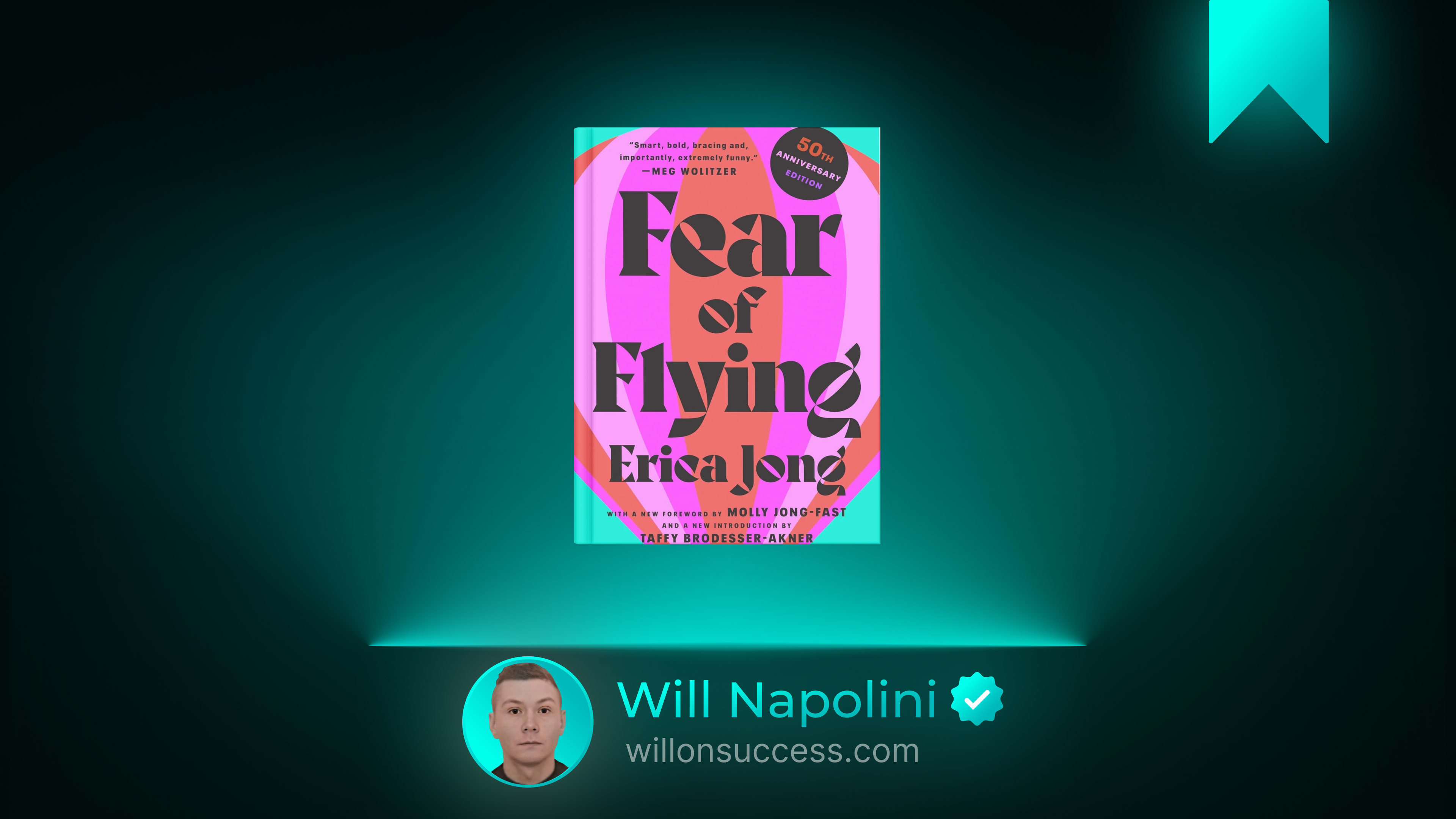
I want to tell you about a feeling you might know well, even if you have never quite found the words for it.
You are sitting in your life. On paper, it is a good life. You have the relationship, the career, the apartment, the routine. You are doing the things you are supposed to do. But underneath the surface, there is a low-grade hum of panic. A quiet, persistent sense that you are waiting. Waiting for someone to arrive and give you permission to actually start living. Waiting for a sign. Waiting for a rescue.
If that resonates with you, I want to introduce you to a book that changed the way I think about the excuses we make for staying stuck.
Published in 1973, Erica Jong’s Fear of Flying shocked the world. It was controversial, explicit, and became a rallying cry for second-wave feminism. But if you look past the cultural shockwaves and the era-specific language, what you find is not just a novel about female sexuality. You find one of the most honest, unsparing maps of human psychology ever written.
You find a mirror reflecting our deepest terror: the fear of our own freedom.
The Big Idea: Freedom Is Terrifying, So We Build Cages
The title of the book is a literal and psychological metaphor. The protagonist, a 29-year-old writer named Isadora Wing, is terrified of airplanes. She sits on a flight to Vienna, surrounded by 117 psychoanalysts, gripped by the irrational fear that the plane will crash.
But as the story unfolds, you realize her fear of flying is not really about gravity or metal tubes. It is about the fear of leaving the ground. It is the fear of cutting the tethers to what is safe, predictable, and known. It is the fear of taking total, unmitigated responsibility for her own life.
Most of us say we want freedom. We say we want to be our own boss, to leave the stifling relationship, to write the book, to move to the new city. But when the moment of departure actually arrives, we panic. Because freedom means there is no one left to blame. If you take the controls of your own life and you crash, it is on you.
Jong’s central insight is that we routinely sabotage our own liberation because the safety of a familiar cage feels better than the terrifying expanse of an open sky.
The Story: The Search for the Savior
To understand this, we have to look at Isadora’s journey.
She is married to Bennett, a psychiatrist who is safe, predictable, and entirely emotionally unavailable. She feels suffocated. She feels like she is disappearing into the wallpaper of her own marriage. So, when she meets Adrian—a reckless, brilliant, exciting psychoanalyst—she believes she has found her escape hatch.
She runs away with him. She leaves her husband, her routine, and her safety, convinced that Adrian is the key to her liberation. She believes that by throwing herself into this wild, passionate affair, she will finally become the free, authentic woman she wants to be.
But here is the twist that makes this book a masterpiece of personal development disguised as fiction: the savior is just another cage.
Adrian is not a liberator. He is manipulative, selfish, and ultimately abandons her in a foreign country. Isadora realizes, with devastating clarity, that trading one dependency for another is not freedom. She did not fly. She just changed the person holding her leash.
The “Zipless” Fantasy and the Trap of Frictionless Living
There is a concept in this book that entered the cultural lexicon and stayed there: the “zipless” encounter.
Isadora fantasizes about a purely physical, emotionally unentangled, guilt-free experience with a stranger. She describes it as the purest thing there is, rarer than a unicorn. It is an encounter with no strings attached, no messy morning-after conversations, no vulnerability, and no consequences.
Why does she want this? Because she is exhausted by the friction of real human connection. She is tired of the heavy, complicated demands of her marriage, and she craves an experience that requires absolutely nothing of her soul.
I want to challenge you to look at where the “zipless” fantasy shows up in your own life. We might not use that exact term today, but we chase the exact same illusion.
We want the rewards of a deep career without the friction of office politics and difficult feedback. We want the profound intimacy of a long-term relationship without the messy, unglamorous conflict of merging two lives. We want the physique of an athlete without the friction of early mornings and sore muscles. We want the “zipless” version of success, love, and health.
We swipe through dating apps looking for a flawless match who will require no emotional labor. We jump from job to job the moment the honeymoon phase ends and the actual work begins.
But a life without friction is a life without depth. The things that actually matter—building a business, raising a child, mastering a craft, sustaining a marriage—are inherently messy. They are full of strings. They are heavy. And running from that weight does not make you free; it just makes you hollow.
The Illusion of the Savior
Here is what I would tell you if we were sitting across the table from each other, and you were telling me about the partner, the mentor, or the dream job that is going to finally “fix” your life: No one is coming to save you.
This is the hardest lesson Isadora has to learn. She projects all her unfulfilled desires onto Bennett, and when he fails to make her happy, she projects them onto Adrian. She treats the men in her life not as complex human beings, but as instruments for her own salvation.
We do this all the time. We treat a new city like a savior. “If I just move to Austin, I’ll finally be happy.” We treat a new romantic partner like a savior. “If I just meet the right person, I won’t feel this empty anymore.” We treat a new productivity system like a savior.
But external circumstances cannot solve internal voids. When you use another person or a new environment to escape yourself, you eventually realize that you brought yourself with you. The boredom, the anxiety, the feeling of being stuck—it all unpacks its bags right alongside you.
You cannot outsource your own becoming. The rescue you are waiting for has to come from the person looking back at you in the mirror.
Owning the Blank Page
Throughout the novel, Isadora struggles with her identity as a writer. She has the talent, but she lacks the courage. She hides behind the expectations of her family, her husband, and society. She is terrified of what people will think if she actually tells the truth about what she feels, what she wants, and who she is.
This is the fear of the blank page.
It is the terror of looking at the empty space of your own potential and realizing that you are the one who has to fill it. It is so much easier to let other people write your story. It is easier to let your parents dictate your career path. It is easier to let your partner dictate your weekend plans. It is easier to let the algorithm dictate your opinions.
But growth requires the courage to be seen. It requires you to claim your desires without shame. Isadora’s ultimate triumph in the book is not that she finds the perfect man. It is that she finds her own voice. She decides that her mind, her body, and her art belong to her, regardless of whether the world approves.
What part of your life are you currently leaving blank because you are afraid of what people might write in the margins?
Why This Matters on an Ordinary Tuesday
You might be wondering how a controversial novel from the 1970s applies to your Tuesday morning.
It applies because the human heart has not changed in fifty years. We are still terrified of being truly known. We are still looking for shortcuts. We are still waiting for permission.
When you understand the lessons of Fear of Flying, you stop romanticizing your own dissatisfaction. You stop viewing your boredom or your restlessness as proof that you need a new partner or a new job, and you start viewing it as proof that you need to take more responsibility for your own inner life.
You stop looking for the “zipless” escape when your relationship gets hard, and you choose to stay in the room and do the work. You stop waiting for a mentor to give you a roadmap, and you start drawing your own. You realize that the anxiety you feel when you face a big decision is not a stop sign. It is the feeling of the engines revving. It is the feeling of preparing to fly.
Practical Application: How to Claim Your Own Life
So, how do you move from intellectual understanding to actual behavior? How do you stop waiting for the rescue?
Audit your “saviors.” Take out a piece of paper and write down the things you are secretly waiting for to “fix” your life. Is it a specific amount of money in the bank? A promotion? A partner? A diagnosis? Look at that list. Now, ask yourself: If none of those things ever happen, what is one small way I can give myself the feeling I am looking for today? If you are waiting for a partner to make you feel valued, how can you value yourself this afternoon?
Embrace the friction. Identify one area of your life where you are avoiding a difficult conversation or a hard task because you want the frictionless version. Maybe you need to set a boundary with a friend. Maybe you need to tell your boss you are overwhelmed. Do not look for the perfect, painless way to do it. It does not exist. Accept the friction. Have the messy conversation. Send the imperfect email.
Claim your blank page. Dedicate twenty minutes this week to doing something purely for yourself, with zero intention of monetizing it, posting it, or sharing it. Write in a journal. Paint badly. Walk in the woods without your phone. Reclaim the idea that your time and your mind belong to you, not to the economy of productivity.
Who Should Read This Book
This book will speak profoundly to you if you are feeling trapped in a “safe” but unfulfilling life. If you are someone who jumps from one relationship, job, or city to the next, hoping the next one will finally be the one that “fixes” you, Isadora’s journey will serve as a powerful, compassionate mirror.
It is especially useful for anyone struggling with people-pleasing, perfectionism, or the fear of being truly seen.
That said, you should know what you are getting into. This is a novel, not a structured self-help manual. It is deeply rooted in the feminist movement of the 1970s, and the language, cultural references, and explicit sexual content are very much of their time. If you are easily distracted by era-specific markers, or if you prefer your personal development delivered in neat, bulleted frameworks, this might not be the book for you.
But if you are willing to look past the packaging, the psychological gold underneath is timeless. It asks the hardest question of all: What will you do when you realize no one is coming to save you?
One Small Step You Can Take Today
Here is your assignment for today.
I want you to identify one small decision you have been postponing because you are waiting for someone else to make it for you, or waiting for the “perfect” moment to act.
Maybe it is canceling a commitment you do not have the energy for. Maybe it is signing up for a class you think you are too old to take. Maybe it is simply turning off your phone for two hours to sit in silence.
Do it today. Do not ask for permission. Do not apologize for it. Do not explain yourself.
Just do it.
At the end of the novel, Isadora finds herself alone in a hotel room in Paris. She has no husband, no lover, and no clear plan for what happens next. But she is not despairing. She runs a bath, washes her own hair, and realizes that she is entirely capable of taking care of herself.
She finally understands that the only person who can write her story is her.
You are standing on the edge of your own runway. The engines are loud. The ground is safe, but it is not where you belong.
Stop waiting for the co-pilot. Take the controls. And fly.