How to Rewire Your Mind: A Mentor's Guide to 'Feeling Good' by David D. Burns
There is a dangerous assumption hiding inside the way most of us think about our own emotional pain. We believe that our feelings are facts. When you wake up heavy, exhausted, and convinced that you are failing at life, it feels like an objective truth. You tell yourself, I feel worthless, therefore I must be worthless. You wait for the heavy cloud to pass before you take action, assuming that you must feel better before you can do better.
But what if your feelings are not the cause of your reality, but merely the echo of your thoughts?
The Big Idea
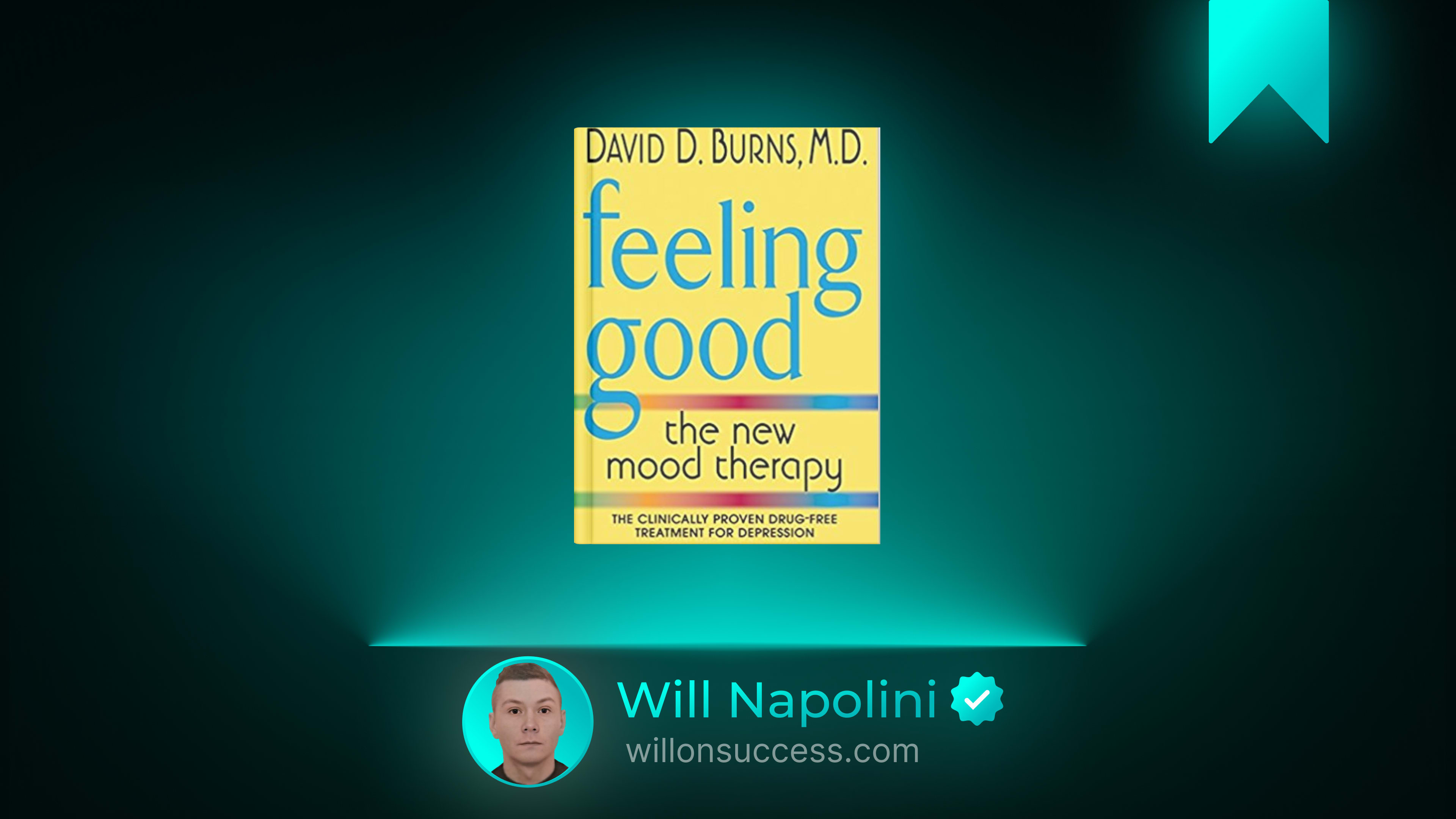
This is the profound, life-altering premise at the heart of Dr. David D. Burns’ classic book, Feeling Good: The New Mood Therapy. As a psychiatrist and one of the pioneers of Cognitive Behavioral Therapy (CBT), Burns built his work on a single, revolutionary principle: you feel the way you think.
Before I understood this, I spent years trying to fix my circumstances to fix my mood. I thought that if I just achieved more, earned more, or organized my life perfectly, the anxiety and heaviness would evaporate. What I discovered was that I was trying to mop up the floor while the faucet was still running.
Burns teaches us that negative feelings—like depression, anxiety, and deep frustration—are not created by the world around us. They are created by the way we interpret the world. When your thinking is clear and realistic, your emotions naturally stabilize. But when your thinking is twisted, your emotions will spiral. The goal is not to force yourself to be artificially happy. The goal is to become a clear thinker.
The Story of the Automatic Thought
To understand how this works, we have to look at the mechanism of an “automatic thought.” Imagine you send an important email to a colleague and they don’t reply for two days. Instantly, a thought flashes through your mind: They think my idea is stupid. I’m going to be passed over for the promotion.
Before you even realize what has happened, your chest tightens. Your energy drops. You feel a wave of shame and anxiety.
Burns points out that it was not the unanswered email that caused your anxiety. It was the story you told yourself about the email. Your mind is a brilliant storyteller, but it is not always a reliable historian. In moments of stress, the brain takes shortcuts. It relies on old, worn-out mental pathways that distort reality to protect you from perceived threats. Burns calls these shortcuts “cognitive distortions.” They are like looking at the world through a pair of scratched, warped sunglasses. The world looks dark and bent, but the problem isn’t the landscape. The problem is the lenses.
The Major Principles
The Lenses That Distort Your Reality
Burns identified several specific patterns of warped thinking that fuel our emotional suffering. When you learn to spot them, they lose their power over you. Here are three of the most common traps we fall into:
All-or-Nothing Thinking This is the foundation of perfectionism. You view your life in extreme, black-and-white categories. If you eat one piece of cake while trying to eat healthier, you tell yourself you have completely ruined your progress, so you might as well eat the whole thing. If a project at work is not a resounding success, you label it a total failure. Life rarely exists in the extremes. It lives in the gray. When you catch yourself using words like always, never, or ruined, you are likely looking through an all-or-nothing lens.
Emotional Reasoning This occurs when you take your emotions as absolute proof of the truth. I feel overwhelmed, therefore my problems must be unsolvable. I feel guilty, therefore I must have done something wrong. But feelings are just physiological responses to your thoughts. They are not evidence. You can feel terrified while sitting safely in your living room. You can feel like a failure while objectively succeeding. Do not let your temporary emotional weather dictate your long-term self-worth.
Personalization This is the tendency to blame yourself for events that are not entirely within your control. If a friend seems quiet at dinner, you assume you must have offended them. If a team project fails, you carry the weight of the entire failure on your own shoulders. Personalization strips you of your boundaries and forces you to take responsibility for the moods and actions of everyone around you. It is an exhausting way to live.
The Tyranny of “Should”
We use “shoulds” to try and motivate ourselves, but they usually just breed guilt and resentment. I should be further along in my career. I shouldn’t be so tired. When you direct “shoulds” at yourself, you create a standard that often ignores your actual humanity, your current capacity, and your context. When you direct them at others, you create frustration and entitlement.
Replace “should” with “it would be nice if” or “I would prefer to.” Notice how the tension in your shoulders immediately drops. You move from a place of self-punishment to a place of preference and possibility.
Action Precedes Motivation
One of the most paralyzing symptoms of a low mood is the loss of motivation. You sit on the couch, knowing you need to go for a walk, clean the kitchen, or work on your business, but you simply cannot make your body move. You tell yourself, I’ll do it when I feel more motivated.
Here is what I would tell you if we were sitting across the table from one another: you have the sequence backward.
Burns emphasizes that action can, and often must, precede motivation. We assume that inspiration leads to action, which then leads to a good
title: “How to Rewire Your Mind: A Mentor’s Guide to ‘Feeling Good’ by David D. Burns” description: >- Discover the core principles of Cognitive Behavioral Therapy from David Burns’ Feeling Good. Learn how to identify the distorted thoughts holding you back and take practical steps to reclaim your mood and your life. date: 2026-08-15 00:00:00 +0800 categories: [book-summaries, personal-development] tags: [ cognitive-behavioral-therapy, mental-health, david-burns, overcoming-depression, mindset ] image: “IMAGE_URL” alt: “A person looking out a window at a clearing sky, symbolizing mental clarity and overcoming distorted thoughts” pin: false fallback: —
There is a dangerous assumption hiding inside the way most of us think about our own emotional pain. We believe that our feelings are facts. When you wake up heavy, exhausted, and convinced that you are failing at life, it feels like an objective truth. You tell yourself, I feel worthless, therefore I must be worthless. You wait for the heavy cloud to pass before you take action, assuming that you must feel better before you can do better.
But what if your feelings are not the cause of your reality, but merely the echo of your thoughts?
The Big Idea
This is the profound, life-altering premise at the heart of Dr. David D. Burns’ classic book, Feeling Good: The New Mood Therapy. As a psychiatrist and one of the pioneers of Cognitive Behavioral Therapy (CBT), Burns built his work on a single, revolutionary principle: you feel the way you think.
Before I understood this, I spent years trying to fix my circumstances to fix my mood. I thought that if I just achieved more, earned more, or organized my life perfectly, the anxiety and heaviness would evaporate. What I discovered was that I was trying to mop up the floor while the faucet was still running.
Burns teaches us that negative feelings—like depression, anxiety, and deep frustration—are not created by the world around us. They are created by the way we interpret the world. When your thinking is clear and realistic, your emotions naturally stabilize. But when your thinking is twisted, your emotions will spiral. The goal is not to force yourself to be artificially happy. The goal is to become a clear thinker.
The Story of the Automatic Thought
To understand how this works, we have to look at the mechanism of an “automatic thought.” Imagine you send an important email to a colleague and they don’t reply for two days. Instantly, a thought flashes through your mind: They think my idea is stupid. I’m going to be passed over for the promotion.
Before you even realize what has happened, your chest tightens. Your energy drops. You feel a wave of shame and anxiety.
Burns points out that it was not the unanswered email that caused your anxiety. It was the story you told yourself about the email. Your mind is a brilliant storyteller, but it is not always a reliable historian. In moments of stress, the brain takes shortcuts. It relies on old, worn-out mental pathways that distort reality to protect you from perceived threats. Burns calls these shortcuts “cognitive distortions.” They are like looking at the world through a pair of scratched, warped sunglasses. The world looks dark and bent, but the problem isn’t the landscape. The problem is the lenses.
The Major Principles
The Lenses That Distort Your Reality
Burns identified several specific patterns of warped thinking that fuel our emotional suffering. When you learn to spot them, they lose their power over you. Here are three of the most common traps we fall into:
All-or-Nothing Thinking This is the foundation of perfectionism. You view your life in extreme, black-and-white categories. If you eat one piece of cake while trying to eat healthier, you tell yourself you have completely ruined your progress, so you might as well eat the whole thing. If a project at work is not a resounding success, you label it a total failure. Life rarely exists in the extremes. It lives in the gray. When you catch yourself using words like always, never, or ruined, you are likely looking through an all-or-nothing lens.
Emotional Reasoning This occurs when you take your emotions as absolute proof of the truth. I feel overwhelmed, therefore my problems must be unsolvable. I feel guilty, therefore I must have done something wrong. But feelings are just physiological responses to your thoughts. They are not evidence. You can feel terrified while sitting safely in your living room. You can feel like a failure while objectively succeeding. Do not let your temporary emotional weather dictate your long-term self-worth.
Personalization This is the tendency to blame yourself for events that are not entirely within your control. If a friend seems quiet at dinner, you assume you must have offended them. If a team project fails, you carry the weight of the entire failure on your own shoulders. Personalization strips you of your boundaries and forces you to take responsibility for the moods and actions of everyone around you. It is an exhausting way to live.
The Tyranny of “Should”
We use “shoulds” to try and motivate ourselves, but they usually just breed guilt and resentment. I should be further along in my career. I shouldn’t be so tired. When you direct “shoulds” at yourself, you create a standard that often ignores your actual humanity, your current capacity, and your context. When you direct them at others, you create frustration and entitlement.
Replace “should” with “it would be nice if” or “I would prefer to.” Notice how the tension in your shoulders immediately drops. You move from a place of self-punishment to a place of preference and possibility.
Action Precedes Motivation
One of the most paralyzing symptoms of a low mood is the loss of motivation. You sit on the couch, knowing you need to go for a walk, clean the kitchen, or work on your business, but you simply cannot make your body move. You tell yourself, I’ll do it when I feel more motivated.
Here is what I would tell you if we were sitting across the table from one another: you have the sequence backward.
Burns emphasizes that action can, and often must, precede motivation. We assume that inspiration leads to action, which then leads to a good result. The actual loop is Action → Result → Motivation. When you schedule a positive activity and force yourself to do it—even when every fiber of your being wants to stay in bed—you generate a small win. That small win creates a spark of momentum. Motivation is not the spark that starts the engine; it is the warmth generated once the engine is already running.
You start small. You stay consistent. You let time do its work.
Why It Matters
Why does this matter on an ordinary Tuesday? Because the way you talk to yourself in private eventually becomes the architecture of your life.
If you constantly filter out your successes and magnify your flaws, you will eventually stop taking risks. You will stay in the job that drains you because your distorted mind tells you that you aren’t qualified for anything else. You will pull away from relationships because you are convinced that people are secretly judging you.
But when you apply these principles, you reclaim your agency. You realize that you do not need to wait for a perfect day to feel at peace. You begin to separate your identity from your temporary moods. You stop treating your mind like an absolute dictator and start treating it like a well-meaning but occasionally confused advisor.
When you lead a team, raise a family, or build a business, your unexamined distortions bleed into the people around you. If you operate from a place of catastrophic thinking, you will create a culture of anxiety. If you operate from a place of realistic, grounded thinking, you will create an environment where resilience can grow. Character before circumstances. The internal work always precedes the external result.
Practical Application
You cannot think your way out of a thinking problem without a system. Burns popularized a profoundly effective tool called the Daily Mood Log. It takes the abstract chaos of your mind and forces it onto paper, where it can be examined and dismantled.
The next time you feel a sudden drop in your mood, follow this sequence:
- Describe the Upsetting Event: Write down the trigger in plain, objective terms. (My manager didn’t reply to my proposal.)
- Record Your Automatic Thoughts: What did you tell yourself? (She hates it. I’m going to be fired.) Rate how much you believe this thought from 0 to 100.
- Name the Emotion: Are you feeling anxious, ashamed, angry, or hopeless? Rate the intensity from 0 to 100.
- Identify the Distortion: Look at Burns’ list. Are you engaging in All-or-Nothing thinking? Are you Jumping to Conclusions? Are you Personalizing?
- Write the Rational Response: Draft a counter-thought that is 100% true, objective, and compassionate. (She is likely just busy. I have a strong track record, and one unanswered email does not determine my career.)
- Re-rate: Check the intensity of your original thought and emotion again. It will rarely be zero, but it will almost always be lower.
By putting the thought on paper, you move it out of the emotional center of your brain and into the prefrontal cortex—the logical, reasoning part of your mind. You stop being the victim of your thoughts and become the observer of them.
Who Should Read This Book
Feeling Good is an essential read for anyone who struggles with chronic self-criticism, perfectionism, anxiety, or mild-to-moderate depression. It is especially powerful for those who feel stuck in repetitive loops of worry and guilt, or those who find themselves constantly paralyzed by the fear of making the wrong choice.
However, I want to be honest with you. If you are in the depths of a severe, acute mental health crisis, a book alone is not enough. In those moments, please seek the guidance of a licensed professional who can support you. But as a daily companion, a preventative toolkit, and a masterclass in understanding your own psychology, this book remains one of the most practical guides ever written. It does not offer empty platitudes. It offers a workshop for your mind.
It is less useful for those looking for a quick philosophical read or a spiritual bypass. This book requires work. It requires you to sit down with a pen, confront your ugliest thoughts, and systematically dismantle them.
One Small Step
I want you to take action today. Not tomorrow. Not when you “feel ready.” Today.
Sometime in the next few hours, you will have a negative thought about yourself, your work, or your future. When it happens, do not fight it, and do not blindly believe it. Instead, pull out your phone’s notes app or a scrap of paper.
Write the thought down exactly as it sounds in your head. Then, underneath it, write this single question: If my best friend came to me and said this exact thought about themselves, what would I tell them?
Write down the answer. Give yourself the same grace, logic, and compassion you so freely give to others.
You do not have to believe everything you think. You only have to be willing to question it. And in that small space of questioning, your entire life begins to change.