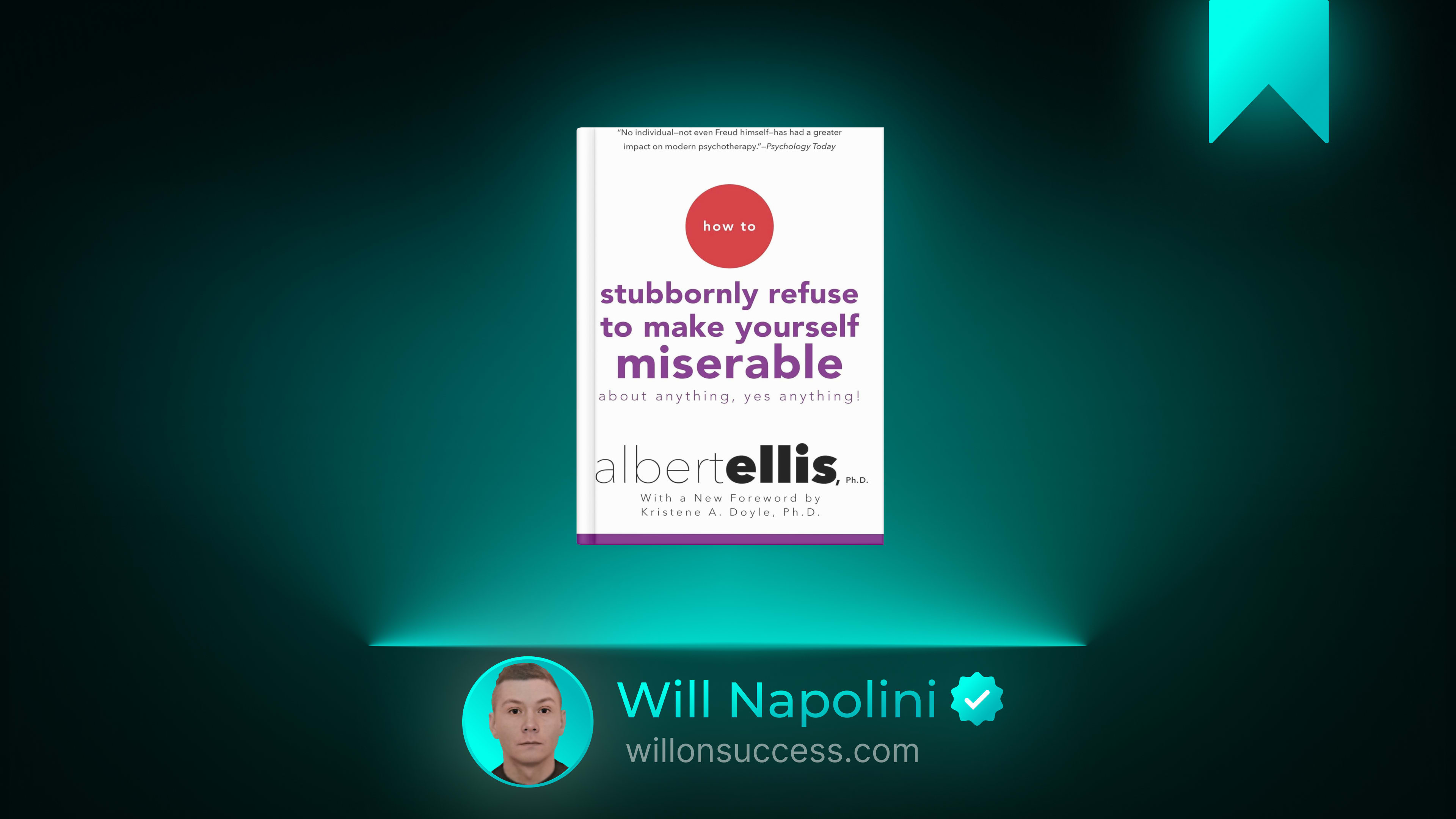
How to Stubbornly Refuse to Make Yourself Miserable: Taking Back Your Emotional Destiny
Have you ever watched something go wrong in your life—a missed promotion, a harsh word from a friend, a sudden financial setback—and felt your stomach drop as a wave of misery washed over you? In that moment, it feels entirely obvious why you are upset. The bad thing happened, so you feel bad. It seems like simple cause and effect.
But what if I told you that the event itself is not actually making you miserable? What if the source of your pain is not out there in the world, but hiding inside your own head?
If I could sit across the table from you right now, watching you carry the heavy, exhausting burden of your own expectations, here is the first thing I would tell you: You are not a victim of your circumstances. You are the architect of your own distress, which means you also hold the blueprint for your own freedom.
The Big Idea: The Architecture of Your Emotions
In his brilliantly blunt and profoundly liberating book, How to Stubbornly Refuse to Make Yourself Miserable About Anything—Yes, Anything!, the legendary psychologist Albert Ellis challenges one of our most deeply held assumptions. We believe that our circumstances dictate our emotional state. We think that if the world would just behave, if people would just treat us fairly, and if things would just go our way, we would finally be at peace.
Ellis, the founder of Rational Emotive Behavior Therapy (REBT), shatters this illusion. His central thesis is both radical and deeply empowering: You are not disturbed by things, but by the views you take of them.
Misery is not an inevitable reaction to adversity. It is a habit. It is a self-inflicted condition born from the rigid, irrational demands we place on ourselves, on others, and on the universe. And because it is a habit, it can be stubbornly, deliberately broken.
The Tale of Two Storms: The ABC Model
To understand how to stop making yourself miserable, you have to understand the hidden mechanics of your emotional life. Ellis introduces a brilliantly simple framework known as the ABC model.
Imagine a sudden, heavy rainstorm ruins your meticulously planned outdoor event.
- A is the Activating Event. (The rainstorm.)
- C is the Consequence. (Your emotional reaction: crushing despair, rage, or deep depression.)
Most of us believe that A directly causes C. The rain ruined the day, therefore I am miserable. But Ellis points out that this is a dangerous illusion. Between A and C sits a hidden, crucial step: B, your Beliefs.
It is not the rain that makes you miserable. It is the belief you hold about the rain. If your belief is, “This is highly disappointing and frustrating, but we will adapt and still find a way to connect,” your emotional consequence will be healthy sorrow and frustration. But if your belief is, “This absolutely MUST not happen! This is terrible! My life is ruined!” your consequence will be toxic despair.
Ellis spent his life proving that human beings are not merely emotional victims reacting to the world. We are active meaning-makers. You do not react to reality; you react to your interpretation of reality.
The Core Principles of Emotional Freedom
How do we dismantle the beliefs that are keeping us trapped in a cycle of anxiety and anger? Here are the core principles Ellis offers to help you reclaim your peace of mind.
1. Conquer the Tyranny of “Shoulds” and “Musts”
If you listen closely to your own internal monologue when things go wrong, you will almost always hear the same three words: Must, Should, and Ought.
- “I must be perfect, or I am a failure.”
- “People should treat me fairly, or they are terrible human beings.”
- “The world ought to be easy, or I can’t stand it.”
Ellis famously coined the term “musturbation” to describe this self-defeating habit of turning our reasonable preferences into absolute, rigid demands. When you prefer to succeed, you are motivated. When you must succeed, you are terrified. When you prefer to be liked, you are pleasant. When you must be liked, you become a people-pleasing prisoner. The moment you elevate a desire into a demand, you hand over your emotional stability to a universe that does not care about your demands.
2. The Art of Ruthless Disputation
You cannot simply “think positive” your way out of misery. Positive thinking often just puts a cheerful bandage over a deep wound. Ellis advocates for something much more rigorous: Disputation.
When you feel a surge of anxiety or anger, you must become a detective of your own mind. You must take your irrational belief to the witness stand and cross-examine it.
- Where is the evidence that I MUST not make a mistake?
- Is it truly awful and catastrophic, or is it just highly inconvenient?
- Where is it written in the universe that people should always act the way I want them to?
By logically and forcefully challenging your own “shoulds,” you strip them of their power. You replace the rigid dogma of your anxiety with the flexible reality of your preferences.
3. Embrace Unconditional Self-Acceptance (USA)
Perhaps the most profound gift of this book is Ellis’s concept of Unconditional Self-Acceptance, or USA. Most of us operate on Conditional Self-Esteem. We tell ourselves, “I am a good person if I succeed at work. I am worthy if my partner loves me. I am valuable if I look a certain way.”
This is a psychological trap. If your worth is conditional, then every failure is an existential threat. Every rejection is a death sentence.
Ellis argues that human beings are far too complex, contradictory, and ever-changing to be given a single global rating. You are not a “good” person or a “bad” person. You are a fallible human being who sometimes does good things and sometimes does foolish things. Unconditional Self-Acceptance means you stubbornly refuse to globally rate your own soul, regardless of your external performance. You can deeply regret a bad action without ever condemning yourself as a bad person.
Conditional self-esteem builds a house on sand; unconditional self-acceptance builds a fortress on bedrock.
Why This Matters on an Ordinary Tuesday
Why does this matter when you are sitting in traffic, or dealing with a difficult boss, or scrolling through social media and feeling inadequate?
Because life guarantees adversity. You will be rejected. You will lose money. You will get sick. People will be unfair. If your happiness depends on the world behaving perfectly, you will be miserable for most of your life.
But when you internalize the ABC model, you realize that while you cannot control the traffic, you can absolutely control whether you drive yourself into a rage about it. You cannot control the economy, but you can refuse to tell yourself that a financial setback makes you a worthless human being. You shift your energy away from trying to manipulate an uncontrollable world, and you pour it into mastering your own internal landscape. You become emotionally resilient, not because nothing bad ever happens to you, but because you have stopped demanding that the universe cater to your preferences.
Practical Application: Breaking the Cycle
Understanding these principles is beautiful, but reading without action is just intellectual entertainment. If you want to stop making yourself miserable, you must build a daily practice of cognitive self-defense.
- Catch the “Must”: For the next 48 hours, pay close attention to your inner voice when you feel frustrated. The moment you feel a spike of intense anger or anxiety, stop and ask yourself: What “must” or “should” am I currently demanding of the world?
- The Dispute Journal: Keep a small notebook. When you catch an irrational belief, write it down. Next to it, write a rational, flexible alternative. Change “My boss shouldn’t have criticized me, it’s terrible!” to “I strongly prefer that my boss be gentle, but there is no universal law that says he must be. It’s uncomfortable, but I can stand it and learn from it.”
- Practice the “Stood-It” Technique: When you face a genuine hardship, remind yourself of your track record. Tell yourself out loud: “This is difficult, this is frustrating, but I have survived 100% of my bad days so far, and I can stand this too.”
Who Should Read This Book
How to Stubbornly Refuse to Make Yourself Miserable is essential reading for the chronic over-thinker, the perfectionist, and anyone who feels held hostage by their own anxiety or anger. It is a masterpiece for those who are tired of “venting” their feelings and are ready to actually dismantle them.
However, if you are looking for gentle validation of your grievances, or a book that tells you how the world should change to accommodate you, this book will likely annoy you. Albert Ellis is warm, but he is entirely unsentimental. He will not coddle your victimhood. He will hand you a mirror, hand you a hammer, and tell you to get to work demolishing your own irrational demands. It requires honesty, effort, and a willingness to take radical responsibility for your own emotional life.
One Small Step to Take Today
You do not need to wait for a crisis to begin taking back your emotional destiny. You can start the very next time something minor goes wrong today.
Here is your one small step: Today, when a minor inconvenience occurs—someone cuts you off in traffic, your coffee spills, or a meeting runs late—catch your immediate thought. Notice if you think, “This shouldn’t be happening!”
Take a deep breath, and deliberately choose to say out loud: “I strongly prefer this wasn’t happening, but there is no law of the universe that says it can’t. It is an annoyance, not a catastrophe. I can stand it.”
Feel the subtle shift in your nervous system. Feel the anger deflate into mere frustration.
You have the power to stop demanding that the world be perfect, and start refusing to make yourself miserable when it isn’t. The storm will eventually come, but you are the one who decides whether you get wet or whether you build a shelter.