How to Promote Yourself: The Art of Becoming the Person Who Can
Have you ever sat at your desk, or stood in your workshop, or looked at your business ledger, and felt a quiet, aching frustration? You are doing the work. You are showing up. You are sacrificing your evenings and your weekends. Yet, you watch people who seem to do less, or do it with less effort, rise past you.
If I could sit across the table from you right now, looking at the exhaustion in your eyes, here is the first thing I would tell you: The world does not reward mere effort. The world rewards capacity.
We have been taught a dangerous lie about advancement. We believe that promotion is a prize handed down by superiors, a reward for keeping our heads down and doing exactly what we are told. We think that if we just grind hard enough, someone will eventually notice and tap us on the shoulder.
But the most successful people I have ever studied—the ones who seem to effortlessly attract opportunity, respect, and wealth—do not wait to be tapped on the shoulder. They do not rely on office politics, manipulation, or aggressive self-promotion. Instead, they understand a profound, almost invisible law of human nature.
The Big Idea: The Successful Life is the Advancing Life
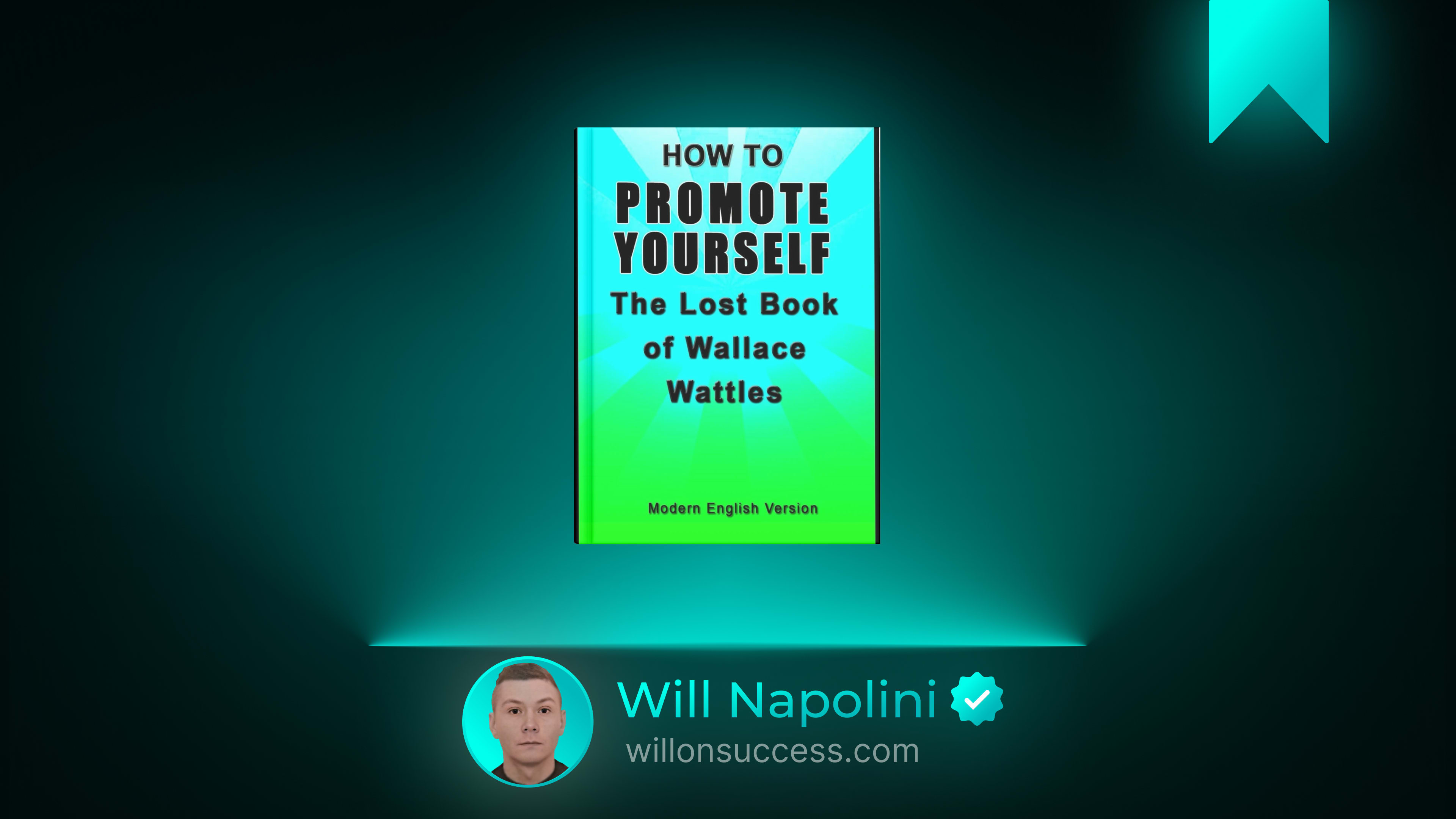
In his lesser-known but profoundly practical book How to Promote Yourself (originally published in 1909 under the title Making the Man Who Can), Wallace D. Wattles strips away the modern obsession with “hacks” and “networking tricks.” Wattles, a pioneer of the personal development movement, offers a radically different perspective on career and life advancement.
His central thesis is this: True promotion is never given; it is recognized. And it is only recognized when you have already become the person capable of holding the new position.
Wattles argues that the universe is governed by a law of increase. Life is not meant to be stagnant. “The successful life is the advancing life,” he writes. If you are not advancing, you are not just standing still; you are actively decaying. To promote yourself, you do not need to shout louder than everyone else. You need to become a source of life, growth, and capability—a person Wattles calls “the man (or woman) who can.”
You cannot be given a larger life until you have built the internal architecture to sustain it.
The Story of Two Builders: The Laborer vs. The Architect
To understand how this works in reality, imagine two builders working on the same construction site.
The first builder views himself strictly as a laborer. He trades his hours for dollars. He lays his bricks, wipes his brow, and clocks out the very second his shift is over. If it rains, he complains. If the foreman asks for a little extra, he resents it. His internal dialogue is one of scarcity and transaction. He is waiting to be paid, waiting to be recognized, waiting to be promoted.
The second builder also lays bricks, but he views himself as an architect in training. He studies how the mortar sets. He notices how the weight of the wall affects the foundation. He speaks to the master mason not to complain, but to understand. When he lays a brick, he is not just completing a task; he is constructing a cathedral.
Wattles would tell you that the first builder is trapped in what he calls the wrong “business attitude.” He is reacting to his environment. The second builder possesses the mind of the advancing life. He is not just doing the work; he is becoming the person who masters the work.
Before the first builder ever gets a promotion, the second builder has already promoted himself in his own mind. And the fascinating thing about human nature is that the world eventually catches up to the reality you have already built internally.
The Core Principles of Advancement
How do you transition from the laborer to the architect? How do you become the person who naturally draws opportunity, clients, and leadership roles toward them? Here are the core principles Wattles outlines.
1. Cultivate the “Business Attitude”
Wattles begins by establishing a foundational law: like causes, under like conditions, produce like effects. This is as true in human psychology as it is in physics. If you walk into a room with a mindset of scarcity, resentment, and exhaustion, you will repel opportunity.
The “business attitude” is not about wearing a suit or speaking in corporate jargon. It is a state of mind characterized by faith, purpose, and creative energy. It is the absolute conviction that you are here to grow, to serve, and to increase. When you hold the attitude of an advancing soul, your actions naturally align with success. You stop asking, “What is the bare minimum I can do to not get fired?” and start asking, “How can I master this domain?”
A mindset of scarcity builds a prison; a mindset of increase builds an empire.
2. Become a Source of “Increase”
This is perhaps the most powerful and overlooked concept in all of Wattles’ teachings. Why do people promote others? Why do clients refer certain businesses? Why do we gravitate toward certain leaders?
Because human beings are biologically and spiritually wired to seek “increase.” We want to be around people who make us feel more alive, more capable, and more successful.
When you interact with most people, you leave them feeling slightly drained. They complain about the economy, they gossip about coworkers, they project their anxieties onto you. They are “Diminishers” of life. But when you learn to promote yourself, you become a transmitter of increase. You speak to people about their potential. You bring solutions instead of just highlighting problems. You make the people around you feel that by working with you, their own lives and businesses will expand.
When you become a source of increase, you do not have to chase opportunities. Opportunities will chase you, because being around you feels like stepping into the sunlight.
3. Thoughts That Build (Becoming Before Doing)
Wattles insists that “Thought is the only power that can make you what you want to be.” You cannot act your way into a new way of thinking; you must think your way into a new way of acting.
If you want to be a leader, you cannot wait until someone gives you the title of “Manager” before you start acting like one. You must mentally inhabit the role of the leader right now, in your current, seemingly mundane circumstances. How would a great leader handle this angry client? How would a master craftsman treat this difficult material?
You must hold the clear, mental image of the person you intend to become, and then let that image dictate your daily actions. You are not pretending; you are rehearsing. You are building the neurological and spiritual pathways of the person you are meant to be.
You do not attract what you want; you attract what you are.
4. The Power of the Efficient Act
Does this mean you just sit around visualizing success? Absolutely not. Wattles is deeply practical. He emphasizes that you must act, and you must act efficiently. But there is a profound difference between being “busy” and being “efficient.”
A busy person does ten things poorly, driven by anxiety and the fear of falling behind. An efficient person does one thing perfectly, driven by purpose and the faith of the advancing life.
To promote yourself, you must put your whole soul into the act you are performing right now. Do not worry about the ten things you have to do tomorrow. Give your complete, undivided, creative attention to the single task in front of you. When every small act is done with the power and presence of a master, the cumulative effect is undeniable. People notice the person who handles a small task with the grace and precision of someone handling a massive enterprise.
Why This Matters on an Ordinary Tuesday
Why does a book written in 1909 matter to you today? Because the technology of our work has changed, but the psychology of human advancement has not changed at all.
If you are an entrepreneur, you might be struggling to get clients. You are tweaking your website, changing your prices, and running ads. But Wattles would ask: Are you transmitting increase? When a prospect gets on a call with you, do they leave feeling expanded and hopeful, or do they feel pressured and drained?
If you are an employee feeling stuck on the corporate ladder, you might be complaining that management doesn’t see your hard work. But are you doing your work with the attitude of a laborer, or the attitude of an owner?
The tragedy of modern life is that millions of brilliant people are working incredibly hard, but they are working in the wrong mental state. They are trying to extract success from a hostile world, rather than generating success from within and radiating it outward.
When you apply these principles, the anxiety of “climbing the ladder” disappears. You stop competing with your peers, because you realize that your only competition is the smaller version of yourself you left behind yesterday.
Practical Application: Engineering Your Advancement
Understanding these principles is a beautiful start, but understanding without action is just entertainment. If you want to truly promote yourself, you must build a system that turns these ideas into daily behaviors.
- Audit Your Transmission: For the next three days, pay close attention to how people react when they finish talking to you. Do they stand a little taller? Do they seem more energized? Or do they look exhausted? Make it your primary daily goal to leave every single person you interact with feeling a greater sense of their own capability.
- The “Architect” Question: Before you begin your most tedious, repetitive task today, pause and ask yourself: “How would the absolute master of this craft perform this exact action?” Then, do it that way. Bring artistry to the mundane.
- Define Your Increase: Write down exactly what “increase” means for the people you serve. If you are a designer, you don’t just sell logos; you sell the confidence of a new brand identity. If you are an accountant, you don’t just do taxes; you sell the peace of mind that allows a business owner to sleep at night. Connect your daily grind to the expansion of someone else’s life.
Who Should Read This Book
How to Promote Yourself is a vital read for the ambitious soul who is tired of superficial “hustle culture.” It is for the employee who feels invisible, the entrepreneur who feels stuck, and the creative who knows they have more to give but cannot find the outlet. It is deeply valuable for anyone who wants to advance in life without losing their integrity or resorting to manipulative tactics.
However, if you are looking for a step-by-step tactical manual on how to optimize your LinkedIn profile, how to negotiate a salary, or how to play corporate politics, this book will frustrate you. Wattles is not interested in the superficial mechanics of the modern workplace. He is interested in the eternal laws of human development. He demands that you change your character, your faith, and your fundamental orientation toward life. And for many, that internal work is far more daunting than simply updating a resume.
One Small Step to Take Today
You do not need to wait for a performance review, a new year, or a Monday morning to begin promoting yourself. The law of increase is available to you right now, in this very moment.
Here is your one small step for today: Identify one person in your life—a colleague, a client, a family member, or a stranger in the service industry—who looks tired, overlooked, or diminished.
Go out of your way to speak to them in a way that transmits “increase.” Acknowledge a specific strength you see in them. Ask them a question that allows them to talk about a recent victory. Look them in the eye and treat them as if they are the most important person in the room.
Watch how their posture changes. Watch how the energy in the room shifts. In that single moment, you have stopped being a laborer waiting for a reward, and you have become an architect of human potential.
The world does not promote the person who demands more; it promotes the person who already has more to give.