Stop Fighting Your Pain: A Mentor's Guide to 'Feeling Great' by David D. Burns
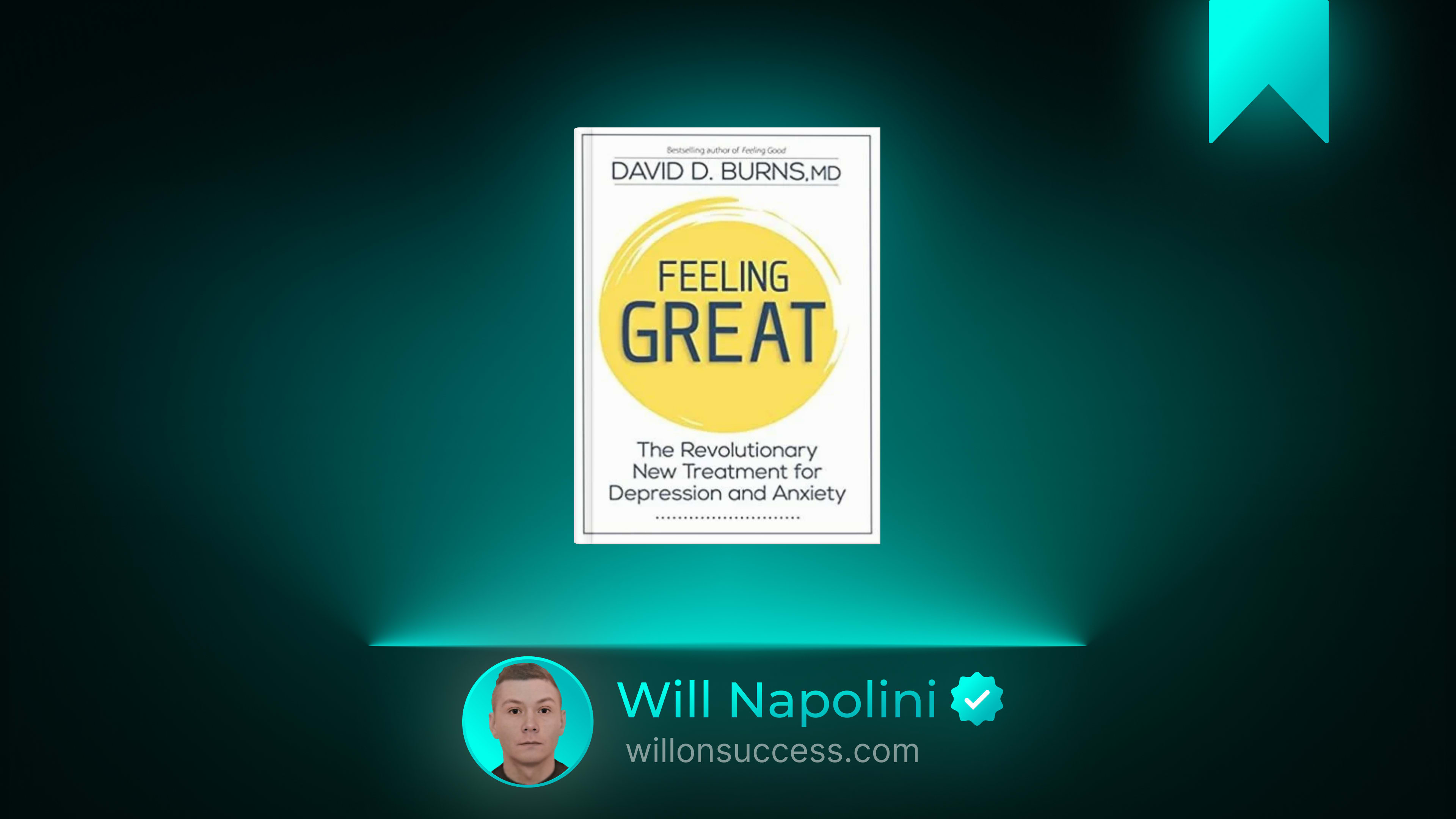
Have you ever noticed that the harder you try to force yourself to feel better, the worse you actually feel?
You read the books, you recite the affirmations, you fight your negative thoughts with logic, yet the heavy cloud of anxiety, guilt, or sadness remains stubbornly parked over your life. You start to wonder if you are simply broken. If you just had more discipline, or a better morning routine, or a sharper mindset, you could finally fix yourself.
If I could sit across the table from you right now, I would tell you to put down the weapons. You are not failing at healing. You are just fighting the wrong war.
The Big Idea
Decades ago, Dr. David D. Burns changed the landscape of psychology with his classic book, Feeling Good. He taught millions of people how to identify and correct distorted thinking. It was a revolution. But years of clinical practice revealed a missing piece of the puzzle. Why do some people know exactly how to challenge their negative thoughts, yet remain emotionally stuck? Why do we so often resist our own healing?
In his groundbreaking follow-up, Feeling Great, Burns reveals a profound, counterintuitive truth: your negative moods do not result from what is wrong with you, but from what is right with you.
Your suffering is not a defect in your machinery. It is an expression of your deepest core values. When you treat your anxiety or depression as an enemy to be eradicated, your subconscious mind digs its heels in. But when you learn to listen to the hidden wisdom inside your pain, the internal resistance melts away, and true transformation becomes possible.
The Story of the Inner Resistance
To understand how this works, we have to look at the architecture of resistance. Burns developed a comprehensive framework called TEAM-CBT, which stands for Testing, Empathy, Assessment of Resistance, and Methods. The true breakthrough of Feeling Great lies in the “A”—the Assessment of Resistance, which he also calls Paradoxical Agenda Setting.
Imagine you are deeply anxious about an upcoming presentation at work. Your instinct is to crush the anxiety. You tell yourself, “I shouldn’t be nervous. I need to calm down. This anxiety is ruining my performance.” You try to logic it away. You try to breathe it away. But the harder you push the anxiety away, the more it pushes back.
Burns realized that we become the voice of resistance when we try to forcefully “fix” ourselves. By declaring war on your anxiety, a part of your brain feels attacked. It feels misunderstood. So, it holds onto the symptom even tighter.
Paradoxical Agenda Setting flips the script entirely. Instead of acting like a mechanic trying to repair a broken part, you act like a curious host welcoming a misunderstood guest. You stop asking, “How do I get rid of this?” and start asking, “Why are you here? What are the hidden benefits of this anxiety? How does it reflect my beautiful, core humanity?”
When the subconscious mind realizes you are no longer trying to destroy it, the resistance dissolves. The door to rapid, lasting healing finally opens.
The Major Principles
Your Symptoms Are Actually Your Strengths
We are conditioned to view depression, anxiety, and guilt as illnesses or cognitive errors that need to be deleted. But Burns asks us to look closer.
If you feel profound guilt after making a mistake at work, it is not because you are a bad person. It is because you have a strong moral compass and deeply care about acting with integrity. If you feel anxious about the future, it is because you are conscientious and fiercely protective of the people you love. If you feel depressed about the state of the world, it is because you have a profound capacity for empathy and a deep desire for justice.
When you reframe your “flaw” as a reflection of your highest values, the inner war ends. You stop treating yourself like an enemy and start treating yourself like an ally. Your habits are votes for the person you are becoming, and sometimes, even your pain is a vote for your own goodness.
The Trap of the “Fix-It” Mentality
Most personal development is built on the premise that you are a problem to be solved. You track your habits, you optimize your routines, and you judge yourself when you fall short. But human beings are not algorithms.
When you aggressively try to change, a part of you naturally resists. This therapeutic resistance is why diets fail, why New Year’s resolutions evaporate by February, and why we stay stuck in toxic patterns despite hating them. By leaning into the symptom and asking, “What good does this sadness do for me?”, you validate your own experience. Once the feeling feels heard and respected, it no longer needs to scream at you to get your attention. It naturally begins to dissipate.
What you repeat in private eventually becomes visible in your life. If you repeat self-compassion in private, resilience becomes visible in your life.
The “Great Deaths” of the Ego
To truly heal, Burns suggests we often have to go through what he calls the “Great Deaths.” These are the quiet, necessary mournings of our unrealistic, ego-driven demands.
We carry around heavy, invisible contracts with the world. I must be universally loved by everyone. I must be perfectly successful to be worthy. I must never make a mistake. These demands keep us on an exhausting treadmill.
Letting these go is not a defeat; it is a profound liberation. It requires grieving the fantasy of perfection. It requires the death of the “Achievement Addiction” that tells you your worth is tied to your productivity. It requires the death of the “Love Addiction” that tells you you are nothing if someone rejects you. Letting these illusions die allows you to step out of the exhausting performance of being flawless and into the quiet dignity of being wonderfully, imperfectly human.
Action Through Empathy, Not Force
Just as in his earlier work, Burns maintains that action is the engine of change. But in Feeling Great, action is not a blunt instrument used to beat your feelings into submission. Action is taken after the resistance has been honored.
You do not force yourself to go to the social gathering to prove your anxiety wrong; you go to the gathering because you have made peace with the part of you that wants to stay home, and you choose to move forward anyway. You negotiate with your fear rather than trying to conquer it. You start small. You stay consistent. You let time do its work.
Why It Matters
Why does this matter on an ordinary Tuesday when you are overwhelmed by an inbox full of demands and a house full of chaos? Because it changes the texture of your daily life.
When you stop fighting your emotions, they lose their paralyzing grip. You move from a state of chronic self-correction to a state of self-compassion. And paradoxically, self-compassion is the fastest route to actual behavioral change. Shame drains your energy; acceptance frees it up for action.
If you are a leader, a parent, or a partner, this shift is magnetic. When you operate from a place of inner peace rather than inner warfare, you give the people around you permission to drop their armor. You stop demanding that your children, your spouse, or your employees “fix” their moods, and you start holding space for their humanity. Character before circumstances. The internal truce you sign with yourself will dictate the external peace you experience in your relationships.
Practical Application
You cannot merely philosophize your way out of a lifetime of inner conflict. You need a practice. The next time a heavy emotion—like anxiety, guilt, or frustration—washes over you, do not reach for a distraction, and do not try to logic it away. Instead, use the Benefits List.
Take out a piece of paper and ask yourself three questions:
- What are three ways this negative feeling is actually trying to help me? (e.g., “My anxiety is trying to make sure I am prepared for this difficult conversation.”)
- What does this feeling show about my core values? (e.g., “It shows that I deeply value honesty and do not want to hurt my friend’s feelings.”)
- If I had a magic button that would instantly turn off this anxiety, but doing so would also turn off my dedication to honesty and care, would I push it?
Almost always, the answer is no. You realize you do not want to get rid of the value; you just want to turn down the volume of the pain. So, you negotiate with the feeling. You say, “Thank you for protecting me. I see your value. But I have it from here.” By honoring the messenger, the message no longer needs to be shouted.
Who Should Read This Book
Feeling Great is an essential read for the chronic overthinker, the exhausted perfectionist, and the high-achiever who feels empty despite their success. It is profoundly useful for anyone who has tried traditional cognitive behavioral techniques, habit trackers, or positive thinking, but still feels emotionally stuck or secretly resistant to change.
It is less useful for readers looking for a shallow, quick-fix motivational book. Burns does not offer empty platitudes or spiritual bypasses. He offers a rigorous, sometimes uncomfortable, deeply honest framework for dismantling the ego’s defenses. It requires the courage to look at your pain not as a monster to be slain, but as a misunderstood friend to be heard.
One Small Step
I want you to take action today. Right now.
Think of one negative emotion or “flaw” you have been harshly judging yourself for lately. Maybe it is your procrastination, your quick temper, or your tendency to worry.
Write it down. Then, write down one single sentence that answers this question: How is this “flaw” actually a distorted expression of one of my greatest strengths?
Give yourself permission to feel it today without trying to fix it, cure it, or banish it. Just let it sit in the passenger seat.
You do not need to go to war with yourself to become whole. You only need to be willing to lay down your arms. And in that quiet surrender, your true healing begins.