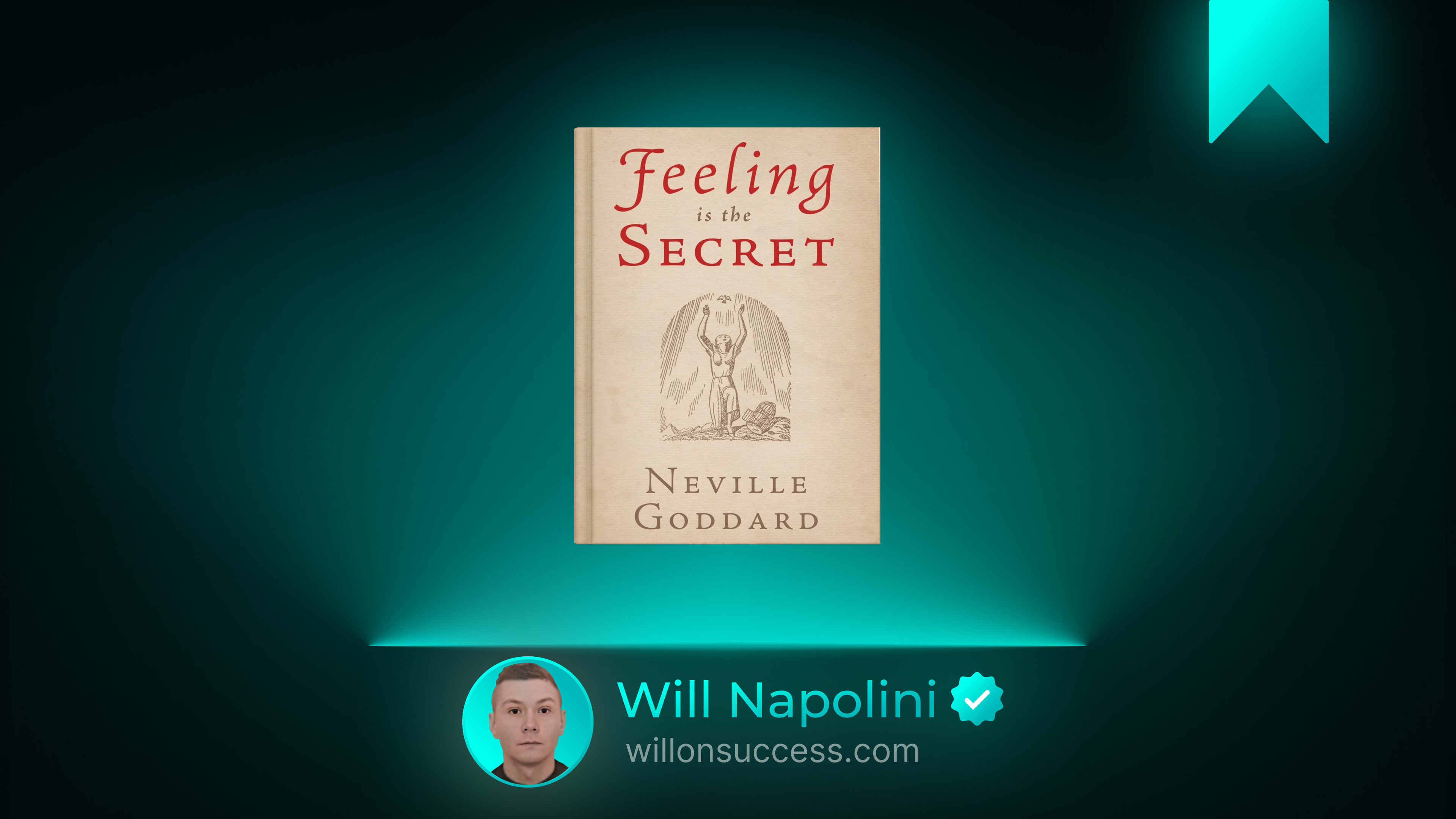
Feeling Is the Secret by Neville Goddard: Why What You Feel Shapes More Than What You Think
There is a question I have asked myself more times than I can count, and I suspect you have asked it too:
Why do I know what to do, feel genuinely committed to doing it, and still watch nothing change?
You read the book. You set the goal. You repeat the affirmation. You build the vision board. And then Tuesday arrives, and you are exactly where you were last Tuesday. The distance between your intention and your reality feels almost mocking.
Neville Goddard wrote a very short book in 1944 that addresses precisely this gap. It is called Feeling is the Secret, and its argument is disarmingly simple: the subconscious mind—the deep, automatic layer that actually governs your behavior, your emotional reactions, and the way you move through the world—does not respond to your thoughts. It responds to your feelings. Not your wishes. Not your plans. Not your intellectual agreement with a nice-sounding idea. The feeling. The lived, embodied sense that something is real.
If you have ever wondered why positive thinking feels hollow, why affirmations bounce off you, why you can “know” you deserve better and still sabotage every opportunity that arrives—this little book may explain why. And more importantly, it may show you what to do differently.
The Big Idea: Your Subconscious Does Not Argue. It Accepts What Feels Real.
Goddard’s central claim runs like this: there are two minds operating in you at all times. The conscious mind—rational, analytical, choosing—and the subconscious mind, which he describes as the creative, impressionable medium that takes whatever you impress upon it and works to make it real in your experience.
The conscious mind selects. The subconscious mind builds.
And here is the part most people miss: the subconscious does not evaluate. It does not fact-check. It does not say, “Well, actually, you have no evidence for this, so I will wait.” It simply accepts whatever is impressed upon it with feeling and begins constructing a life that matches.
This means that if your dominant feeling—your settled, habitual emotional state—is one of lack, unworthiness, or quiet dread, the subconscious is receiving that signal clearly. Loudly. Every single day. And it is building accordingly.
You can override this with a conscious affirmation for ten minutes in the morning. But if the remaining twenty-three hours are saturated with the feeling of “this isn’t really going to happen for me,” the subconscious has its answer. And it will work with the feeling, not the words.
Goddard’s phrase for the solution is specific: you must enter the feeling of the wish fulfilled. Not the hope of it. Not the desire for it. The feeling you would have if it were already done, already yours, already true.
The Mechanism: Why Feeling Is the Language That Gets Through
Think of it this way. Imagine you are learning to play a musical instrument. You can read every book on piano technique. You can watch hundreds of hours of performances. You can intellectually understand the theory of scales, chord progressions, and dynamics. But until your fingers feel the keys—until the motion becomes embodied, physical, second nature—you cannot play.
The conscious mind is the sheet music. The feeling is the performance.
Goddard draws heavily on a metaphor he finds in biblical language, interpreting it psychologically rather than theologically. He describes the conscious mind as a “father” that plants a seed of intention, and the subconscious as a “mother” that receives, nurtures, and gives birth to that seed in the physical world. The seed only takes root if it is planted in fertile soil—and the soil, in this analogy, is the emotional state in which you impress the idea.
A thought planted in anxiety grows anxiety. A thought planted in genuine, quiet conviction grows something else entirely.
This is not magic. You do not need to believe in anything supernatural to see the practical truth here. Psychology confirms what Goddard intuited: your emotional state filters your perception, shapes your decisions, alters your body language, and determines which opportunities you notice and which you walk past without seeing. A person who feels confident in a negotiation behaves differently than one who merely thinks they should be confident. The feeling changes the posture, the tone, the willingness to hold a boundary. And the world responds to the posture.
The State Akin to Sleep: When the Door Is Open
One of the most practical ideas in the book concerns timing. Goddard emphasizes that the subconscious is most impressionable in a particular state: the drowsy, half-awake condition just before sleep. He calls it “the state akin to sleep.”
In that window, the conscious mind’s grip loosens. The inner critic quiets. The analytical voice that says “this is unrealistic” grows faint. And in that softened state, whatever you feel—whatever scene you inhabit emotionally—sinks deeply into the subconscious like a seed into turned soil.
Goddard’s instruction is straightforward: as you drift toward sleep each night, construct a short scene—a fragment, a moment—that implies your desire is already fulfilled. Not a long, elaborate movie. A handshake. A voice saying “congratulations.” The feeling of sitting in a chair in an office that is yours. The weight of a key in your hand. Then feel it. Let the emotion of it wash over you. Let it feel natural. And fall asleep inside that feeling.
He insists this is not idle fantasy. It is deliberate impression. You are choosing, in the most receptive state available to you, what the subconscious will work with through the night.
I find this idea remarkably useful even stripped of any metaphysical framing. What you rehearse emotionally before sleep shapes your sleep quality, your morning mood, your first thoughts upon waking, and the emotional baseline you carry into the day. If the last feeling you practice each night is one of quiet satisfaction rather than anxious review, something shifts. Slowly. But it shifts.
Persistence Until It Feels Natural
Here is where most people abandon the practice, and I want to be honest with you about why.
You try it for three nights. Maybe a week. You construct the little scene. You try to feel it. And it feels false. Forced. Like pretending. The feeling does not arrive. The conviction does not settle in. And the analytical mind whispers, “This is ridiculous. Nothing is happening.”
Goddard anticipates this. His answer is one word: persistence.
You do not need to feel it perfectly on the first attempt. You need to return to the feeling repeatedly until it loses its strangeness. Until the imagined state begins to feel familiar. Until “this is my life” replaces “this is something I am pretending.”
He compares it to the way any new skill becomes natural. The first time you drive a car, every motion is conscious and exhausting. After a year, you drive without thinking. The feeling of driving becomes your default. In the same way, a new emotional state feels artificial at first because your subconscious is accustomed to the old one. Persistence rewires the default.
A small decision becomes a direction. A direction repeated long enough becomes a life. And the feeling you practice nightly is that small decision, made in the quiet, where no one is watching.
What This Looks Like on an Ordinary Tuesday
Let me bring this down from the conceptual and into the concrete, because I think this is where the book either becomes useful or remains a curiosity.
Suppose you want to feel more confident in your work. Perhaps you have been passed over for a promotion, or you are building something new and the fear of being “found out” follows you around like a shadow.
The old approach: you tell yourself, “I am confident. I am capable.” You say it in the mirror. You write it in a journal. And underneath the words, the feeling is still I am not sure I belong here.
The approach Goddard suggests: at night, as you settle into bed and the day’s noise fades, you do not recite words. You construct a small moment. Maybe it is the feeling of shaking your manager’s hand after a meeting where you spoke clearly and they listened. Maybe it is the sensation of closing your laptop at the end of a day where the work felt solid, unhurried, yours. You do not need the whole story. You need one moment that carries the emotional texture of what you want.
Then you inhabit it. Not as a fantasy you are watching from outside. As a memory you are reliving. The warmth in your chest. The steadiness in your hands. The quiet “yes” in your gut. You hold it until drowsiness takes you.
And in the morning, you do not check to see if the world changed overnight. You simply notice whether the feeling lingers a little. Whether the old anxiety has one less degree of grip. Whether you walk into the room with your shoulders back without having to remind yourself.
That is the mechanism. Slow. Quiet. Cumulative. Like roots pressing through soil in the dark.
The Honest Difficulty: You Must Feel Before the Evidence Arrives
I will not pretend this is easy. The hardest part of Goddard’s teaching is also the simplest: you are asked to feel the reality of something before the external world confirms it.
This runs against every instinct. We are trained to feel our feelings after the evidence. After the paycheck arrives. After the compliment is given. After the relationship is secure. After the result is visible.
Goddard reverses the sequence. Feel first. Build the inner conviction first. Let the outer world rearrange around the new internal state.
And I want to acknowledge something honestly: for people in genuine crisis—financial desperation, grief, trauma, systemic oppression—the instruction to “feel the wish fulfilled” can land as tone-deaf. If you are in survival mode, the first task is not visualization. The first task is safety, support, and practical action. Goddard’s framework is most useful not as a crisis intervention but as a daily practice of orientation—a way to stop letting fear and lack be the only signals you send to your own deepest mind.
If you are in a hard season, give yourself grace. Start smaller. Perhaps the feeling you practice is not “I have everything I want.” Perhaps it is simply “I am okay in this moment. I am not in danger right now. I can rest.” That, too, is a seed.
Who Should Read This Book
Feeling is the Secret is very short—you can read it in an afternoon. It will appeal most to:
- Anyone who has tried affirmations, goal-setting, or “positive thinking” and felt that something was missing.
- Readers drawn to the intersection of psychology, imagination, and inner work.
- People who want a simple, repeatable nightly practice rather than a complex system.
- Those interested in Goddard’s broader body of work (this is one of his most accessible entry points).
It may frustrate:
- Readers who want empirical, peer-reviewed evidence for every claim. Goddard writes from a metaphysical and interpretive tradition. He is not conducting experiments. He is making a philosophical and practical argument.
- People in acute crisis who need structural support before internal reframing.
- Anyone who finds spiritual or biblical metaphor off-putting, though I would encourage you to read past the language to the psychological mechanism underneath.
The book is not perfect. It is repetitive in places. It can feel overly certain about a process that is genuinely mysterious. But its core insight—that the emotional state you inhabit matters more than the thoughts you think—has practical power that does not depend on whether you accept the full metaphysical framework.
One Small Step: Tonight, Before Sleep
Here is what I would ask you to do. Not tomorrow. Tonight.
Choose one small, specific moment that would imply a shift you want in your life. Not the grand finale. Not the ten-year vision. One moment. A conversation. A feeling in your body. A room you are sitting in. A sentence someone says to you.
When you lie down tonight, close your eyes, slow your breathing, and step into that moment. Do not watch it like a film. Be inside it. Feel the texture of it. The temperature. The emotion. Let it be simple. Let it be short—thirty seconds is enough.
Then let sleep take you while the feeling is still warm.
Do not judge whether it “worked.” Do not evaluate in the morning. Just return to it tomorrow night. And the night after. Give it a week before you decide anything.
You are not performing a trick on the universe. You are choosing, deliberately, what emotional signal you send into the deepest part of yourself before the conscious mind goes offline. You are deciding what the roots will drink overnight.
And roots, as any gardener knows, do their most important work in the dark, where no one is watching.
What you feel in private eventually becomes visible in your life. Tonight, choose the feeling carefully. Then rest. The seed knows what to do.