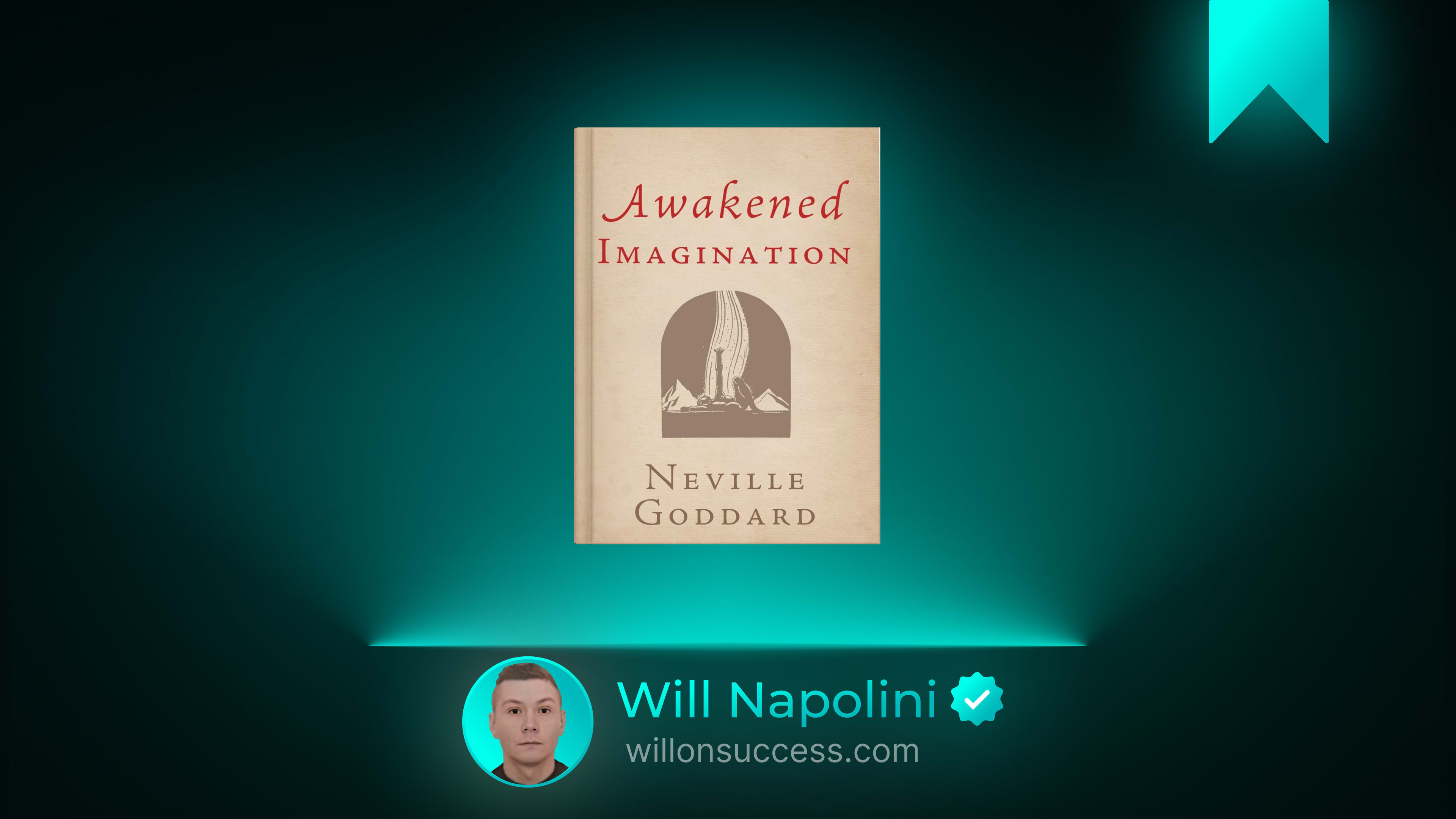
Awakened Imagination by Neville Goddard: How to Master the Hidden Architecture of Your Life
Imagine you are standing in front of a mirror. You are frowning, your shoulders are slumped, and you are deeply dissatisfied with the person looking back at you. So, you reach out and try to force the reflection to smile. You push on the glass. You manipulate the frame. You scrub the surface, hoping that if you just work hard enough on the outside, the image will finally change.
It sounds absurd when stated that way. Yet, this is exactly how most of us try to change our lives.
We try to force our circumstances to shift. We try to manipulate the people around us. We hustle, we grind, and we exhaust ourselves trying to scrub the surface of our external reality, completely ignoring the person standing in front of the glass.
If I could sit across the table from you today, I would ask you to stop scrubbing the mirror. I would ask you to look at the face casting the reflection.
Neville Goddard wrote Awakened Imagination to deliver a single, radical, and deeply challenging premise: your imagination is not a place to escape when reality becomes too difficult. It is the actual, hidden workshop where reality is forged. The physical world you interact with every day is not the cause of your life; it is merely the shadow cast by your internal state.
This is not a book about passive wishing or empty positive thinking. It is a masterclass in psychological and spiritual architecture. It asks you to take absolute, uncompromising responsibility for the inner world you inhabit, because that inner world is the only one you actually have the power to change. And when you change it, the outer world has no choice but to follow.
The Central Idea: The World Is a Mirror, Not a Master
To understand Neville’s work, you have to accept a profound inversion of how we are taught to view the world. We are conditioned to believe that our internal state is a reaction to our external circumstances. We think: When I get the promotion, I will feel secure. When I find the right partner, I will feel loved. When I have enough money, I will feel at peace.
Neville argues that this sequence is backward. The external world does not create your internal state; your internal state creates your external world.
He teaches that imagination is the true creative power of the universe operating within the individual. Whatever you assume to be true on the inside, and whatever you feel to be real in your imagination, will eventually harden into fact on the outside.
This is where most people stumble. They hear the word “imagination” and they think of daydreams, fantasies, or childhood make-believe. But Neville is talking about something far more rigorous. He is talking about assumption. He is talking about the deep, unshakable convictions you hold about who you are, what you deserve, and how the world operates.
Your life right now is a perfect, unarguable reflection of your deepest assumptions. If you assume the world is hostile, you will unconsciously act in ways that provoke hostility, and the world will obligingly reflect that back to you. If you assume you are capable and resourceful, you will spot opportunities others miss, and the world will reflect your capability.
You cannot change the reflection by scrubbing the glass. You must change the face looking into it.
The Story of the Stage: From Actor to Architect
To understand how Neville arrived at this framework, it helps to look at his early life. Before he became one of the most influential metaphysical teachers of the twentieth century, Neville was a theatrical director and a dancer. He spent his formative years in the world of the stage.
In the theater, an actor does not simply “think” about being a king. If an actor walks onto the stage merely thinking about royalty, the audience will not believe them. The actor must assume the state of the king. They must adopt the posture, the internal rhythm, the quiet authority, and the sensory experience of the character. They must live in the imagination of the character until the performance becomes indistinguishable from reality.
Neville took this principle of theatrical embodiment and applied it to the human mind. He realized that we are all, constantly, acting on the stage of our own lives. The problem is that most of us are unconsciously playing the victim, the underdog, or the anxious worrier. We have rehearsed those roles so many times that we have forgotten we are the ones who wrote the script.
Neville’s great contribution was teaching people how to step off the stage of their old conditioning, walk into the director’s chair, and consciously cast themselves in a new role. He taught that an “imaginal act”—a vivid, sensory-rich mental rehearsal of a desired state—is the exact mechanism by which we rewrite the script of our lives.
The Vast Difference Between Daydreaming and an Imaginal Act
One of the most critical distinctions in this book is the difference between a passive daydream and an active imaginal act. This distinction is where most people fail when they try to use their minds to change their lives.
When you daydream, you are watching a movie of yourself. You are seeing yourself from the outside, as a third party. You might picture yourself shaking hands with a new boss, or walking onto a stage, or driving a new car. But you are watching it happen to you. It feels distant, hazy, and separate from your current reality. A daydream is a visitor; it comes and goes without leaving a mark.
An imaginal act is entirely different. In an imaginal act, you are not watching the movie; you are in the movie. You are looking out from behind your own eyes. You do not see yourself shaking the hand; you feel the texture of the other person’s skin against your palm. You hear the specific tone of their voice. You feel the physical sensation of relief or joy in your own chest.
Neville insists that the subconscious mind—which is the engine that shapes our behavior and perception—cannot tell the difference between a vividly imagined sensory experience and a physical one. But it only accepts the experience if it is felt from the first-person perspective.
You must move from observing the desire to occupying the state of the wish fulfilled.
Think of it like a house. A daydream is standing on the sidewalk, looking at a photograph of a house you want to buy. An imaginal act is walking through the front door, feeling the weight of the brass doorknob, and smelling the coffee brewing in the kitchen. One is a picture; the other is a residence. You must take up residence in your new state of mind.
The Bridge of Incidents: Letting Go of the “How”
When you first attempt to shift your internal assumptions, your logical mind will immediately rebel. It will ask the most paralyzing question in the human vocabulary: How?
How will I get the money to start this business? How will that person suddenly change their mind about me? How will my health improve when the doctors have said what they said?
Neville’s advice here is both challenging and deeply liberating: the “how” is none of your business.
He introduces the concept of the “bridge of incidents.” When you successfully assume the feeling of your goal already being accomplished, a series of events will naturally unfold to lead you to that reality. These events might look like coincidences, sudden impulses, unexpected meetings, or even temporary setbacks that ultimately redirect you.
Your only job is to define the end. Your only job is to embody the feeling of the completed goal. The moment you start worrying about the “how,” you step out of the state of the wish fulfilled and back into the state of lack. You are essentially telling the universe, “I am imagining this, but I don’t actually believe it’s possible, so I need to figure out the mechanics myself.”
This requires a profound surrender of control. It asks you to trust that the same intelligence that beats your heart and grows the forests knows how to arrange the circumstances of your life.
You define the destination. You feel the reality of having arrived. And then, you let the world do the heavy lifting of building the bridge.
The Pearl of Great Price: The Discipline of Mental Focus
Neville frequently uses biblical allegories to explain psychological truths, and one of his most powerful is the parable of the Pearl of Great Price. The story describes a merchant who finds a pearl so valuable that he sells everything he owns just to buy it.
In the context of awakened imagination, the “pearl” is your singular, focused imaginal act. The “selling of everything” is the willingness to let go of your current mental clutter, your doubts, your past grievances, and your obsessive need to micromanage reality.
We live in an age of fractured attention. We want a new career, but we spend three hours a day consuming content that makes us feel inadequate. We want a peaceful relationship, but we mentally rehearse arguments with our partner while driving to work. We are scattering our imaginative power across a dozen conflicting desires, and so we manifest a life of confusion and stagnation.
To awaken your imagination, you must practice the discipline of mental focus. You must choose one state, one assumption, one “pearl,” and give it your undivided inner loyalty. When the old doubts creep in—and they will—you do not fight them. You simply return your attention to the feeling of the wish fulfilled. You gently but firmly redirect your mind back to the pearl.
What you repeat in private eventually becomes visible in your life. But it only becomes visible if what you are repeating is clear, focused, and deeply felt.
Why This Matters on an Ordinary Tuesday
It is easy to read about the creative power of imagination and think it applies only to grand, life-altering ambitions. But the true test of this philosophy happens on an ordinary, unremarkable Tuesday.
It matters when you wake up and the bank account is lower than you want it to be. The unawakened mind reacts with panic, scarcity, and fear. It assumes the state of lack, which guarantees that every decision made that day will be driven by anxiety and poor judgment.
The awakened mind pauses. It recognizes that reacting to the shadow will only create more shadows. So, before getting out of bed, it takes three minutes to assume the feeling of financial stability. It feels the quiet confidence of having enough. It steps into the day not as a victim of a bank balance, but as a person of resourcefulness and calm. And from that state of calm, it makes better decisions, has clearer conversations, and spots opportunities that the panicked mind would have entirely missed.
It matters when someone cuts you off in traffic or speaks to you disrespectfully. The unawakened mind assumes the state of the victim or the aggressor, escalating the conflict. The awakened mind realizes that the other person is simply reflecting a state of consciousness, and refuses to internalize it. It maintains its own internal standard of peace.
You are not using imagination to escape reality. You are using imagination to master your response to reality. And in mastering your response, you eventually master the circumstances themselves.
A Practical Application: The Threshold Practice
Neville’s most famous technique for impressing the subconscious mind is what he called the “State Akin To Sleep” (SATS). He observed that the moments just before you drift off to sleep are the most critical of the day. In this threshold state, the critical, analytical filter of the conscious mind is lowered, and the subconscious is wide open to suggestion. Whatever you feel deeply in those final moments will be incubated and magnified throughout the night and into the next day.
Here is how you can apply this tonight, in a grounded, practical way:
1. Construct a Single Scene Create a short, five-to-ten-second mental event that implies your desire is already fulfilled. Do not imagine the process of getting there; imagine the aftermath. If you want a new home, do not imagine signing the papers. Imagine turning the key in the front door and feeling the solid wood. If you want a promotion, imagine a colleague shaking your hand and saying, “Congratulations on the new role.”
2. Engage the Senses Make it sensory and vivid. What does the doorknob feel like? What is the exact tone of your colleague’s voice? How does your chest feel in that moment of success?
3. Loop It Until It Feels Real As you lie in bed, relaxed and drowsy, replay this short scene in your mind. Do not watch it from the outside; live it from the inside. Loop it over and over. If your mind wanders, gently bring it back to the scene.
4. Fall Asleep in the Feeling The goal is to let this feeling of reality, satisfaction, or relief be the very last thing you experience before you lose consciousness. You are handing a completed blueprint to your subconscious mind, trusting it to organize the “bridge of incidents” while you rest.
Do this not as a frantic attempt to force the universe to obey you, but as a quiet, dignified act of claiming your own identity.
Who Should Read This Book
Awakened Imagination is a profound, paradigm-shifting book, but it requires a specific type of reader.
If you are someone who feels trapped in repetitive cycles—if you keep finding yourself in the same types of toxic relationships, the same financial bottlenecks, or the same professional dead-ends despite changing your external circumstances—this book will show you the hidden internal script you are unconsciously following. It is invaluable for anyone willing to take radical, uncompromising responsibility for their own inner life.
However, if you are looking for a purely materialistic, step-by-step business manual, or if you require strictly clinical, peer-reviewed psychological frameworks to validate a concept, Neville’s metaphysical language and biblical allegories may frustrate you. He writes as a mystic and a philosopher, not a scientist. You have to be willing to look past the esoteric delivery to extract the deeply practical psychological mechanics underneath.
But if you are willing to do the inner work, if you are tired of scrubbing the mirror and are finally ready to change the face looking into it, this book will hand you the tools to rebuild your life from the foundation up.
One Small Step, Right Now
You do not need to wait for a crisis or a moment of deep inspiration to begin. You can begin tonight, in the quiet dark of your own room.
Choose one small assumption you want to make about yourself. Not a massive, overwhelming goal, but a quiet shift in identity. Perhaps you want to assume the state of being a person who is deeply respected. Perhaps you want to assume the state of being calm under pressure.
Construct a tiny, three-second scene that proves that assumption is true. A nod of deep respect from a mentor. The feeling of your own steady breathing in a chaotic room.
Tonight, as you feel sleep approaching, do not review your worries. Do not plan tomorrow’s to-do list. Take that single, three-second scene, step inside it, and feel its reality. Loop it gently until you fall asleep.
The world does not give you what you want; it gives you who you are. Your imagination is the only place where you can decide who that is.
The blueprint is drawn. The foundation is poured. Now, let the world catch up to who you have decided to be.