The Architecture of the Unseen: How to Step Out of This World and Rewrite Your Future
Have you ever looked at the circumstances of your life—the balance in your bank account, the state of your relationships, the walls of your home—and felt a deep, exhausting sense of finality? You look at the hard evidence in front of you and conclude, “This is just the way things are.” You believe that your current reality is a solid, immovable object, and that to change it, you must engage in years of grueling, physical friction.
But what if the physical world you are staring at is not the cause of your life, but merely the echo of your past thoughts?
If I could sit across the table from you right now, I would ask you to consider a radical possibility: You are living in a shadow. The hard, undeniable facts of your three-dimensional world are just the delayed harvest of seeds you planted in your imagination months or years ago. And if you want to change the harvest, you do not fight the shadows on the wall. You turn around, step into the light, and change the object casting the shadow.
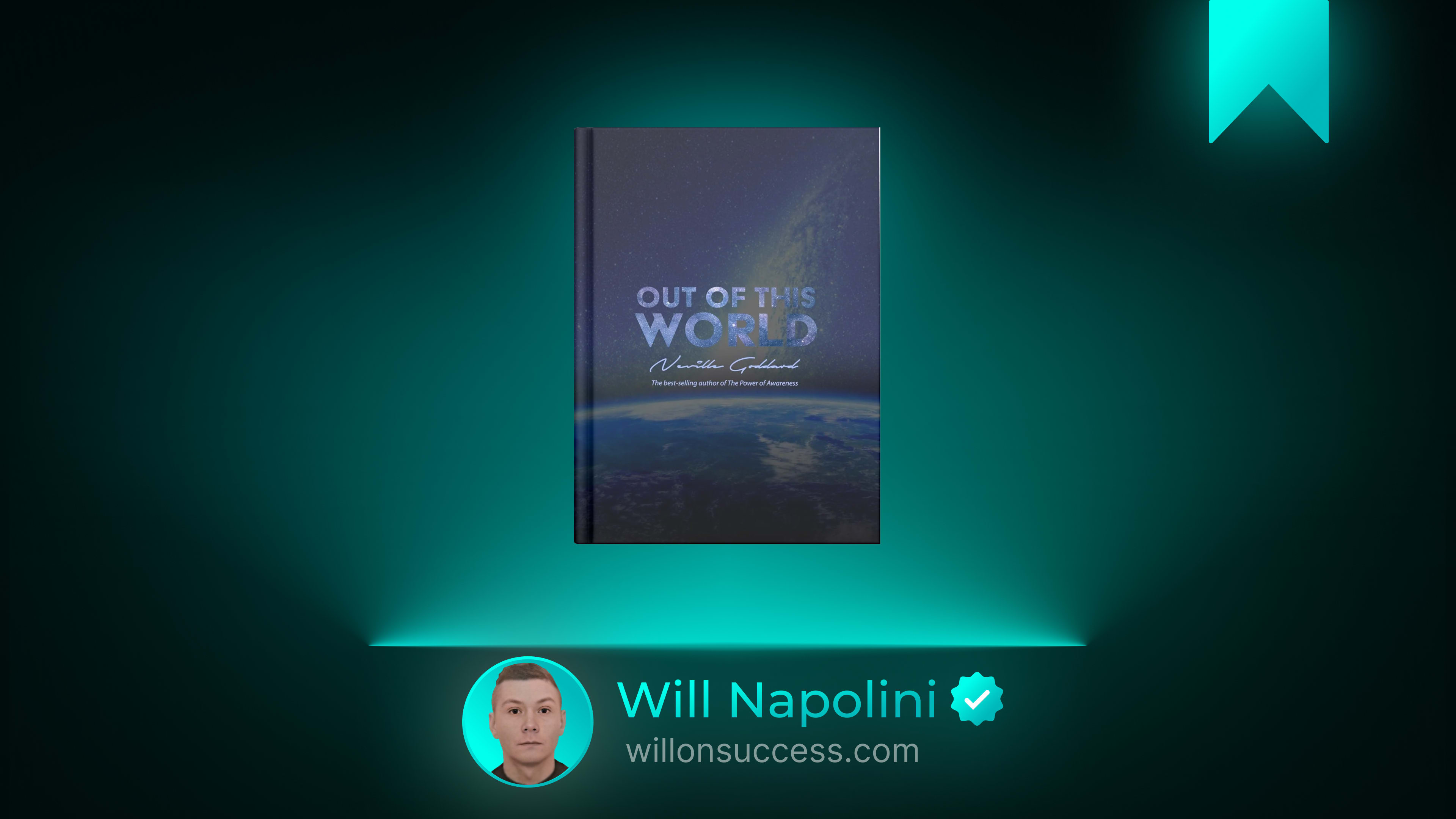
In his 1949 masterwork, Out of This World: Thinking Fourth-Dimensionally, the mystic and philosopher Neville Goddard dismantles the materialist view of reality. He proposes a thesis that is as challenging as it is liberating: Human imagination is not merely a daydreaming faculty; it is the actual fourth dimension of space.
The central idea of the book is that all possible states of existence already exist right now, in an infinite series of parallel realities. You do not create your future from nothing; you select it. By mastering the art of “thinking fourth-dimensionally”—by assuming the feeling of your wish already fulfilled—you move your consciousness across timelines and cause your assumptions to harden into physical facts.
The Architecture of the Fourth Dimension
To understand this, we have to look at how Goddard frames the dimensions. We live in a three-dimensional world—the world of time, space, and physical limits. In this world, events happen sequentially. First you plant the seed, then you wait, then the flower blooms.
But Goddard argues that if we observe events occurring that were not physically present when they were conceived, they must logically have existed “out of this world”—in the unseen, fourth-dimensional realm of imagination.
Think of a film reel. The entire movie—the beginning, the middle, and the end—exists simultaneously on the strip of celluloid. The projector’s light simply moves through it frame by frame, creating the illusion of sequential time. Your three-dimensional life is the projector’s light. Your imagination is the film reel. Every possible version of your life already exists on the reel. When you change your internal state, you simply shift the projector to a different frame.
Goddard draws heavily on the philosophy of William Blake, asserting that man is, fundamentally, imagination. In the three-dimensional world, you are bound by logic. But in the fourth dimension, space and time do not exist as barriers. The fourth dimension is an infinite library of “states.” There is a state of being wealthy, a state of being deeply loved, a state of being profoundly healthy. These states are not things you must build from scratch; they are rooms in a mansion that already exist. The only question is: which room are you currently occupying? Most of us unconsciously wander into the rooms of lack, anxiety, and resentment, and then wonder why the furniture looks exactly the same every day.
Assumptions Harden Into Fact
This is perhaps the most sobering and empowering law in the book: Assumptions harden into fact.
An assumption is not a casual wish. It is a deeply held, often unexamined premise about yourself and the world. If you operate from the silent, internal assumption that “people always take advantage of me,” your brain will filter reality to prove that assumption true, and your subtle behaviors will invite that exact treatment. Over time, the assumption calcifies into your undeniable, three-dimensional reality.
Goddard teaches that you must become ruthlessly aware of your current assumptions. You cannot change your outer world until you change the inner premise you are standing on. If you want a different reality, you must dare to assume the feeling of the new state, even while your physical senses deny it. You must walk in the feeling of the wish fulfilled until that new assumption hardens into the new fact of your life.
Thinking From the End
Most people think of their goal. They look at it from a distance, across the chasm of their current lack. They say, “I want to be debt-free,” which internally translates to, “I am currently in debt.” Thinking of the end keeps you separated from it.
Goddard insists you must think from the end. You must mentally step into the reality where the desire is already accomplished, and look back at the world from that vantage point. What does the world look like when you are already secure? How does your body feel? How do you speak to your partner when the argument is already resolved?
By occupying the psychological state of the fulfilled desire, you collapse the time between the seed and the harvest. You trick the projector into skipping the frames of struggle and landing directly on the resolution.
Why This Matters on an Ordinary Tuesday
Why should you care about fourth-dimensional thinking on an ordinary Tuesday when the bills are due and the inbox is full?
Because living entirely in the three-dimensional world is a recipe for chronic reactivity. When you believe that the physical world is the ultimate authority, you become a victim of circumstance. Good news makes you happy; bad news makes you despair. You are constantly reacting to the shadows on the wall.
But when you internalize Goddard’s teachings, you reclaim your agency. You realize that your internal state is the only true cause in the universe. You stop trying to force people to change, stop trying to manipulate the economy, and stop begging the world to give you a break. Instead, you quietly, deliberately change your internal assumption. You become the architect of your reality rather than its janitor.
This does not mean you stop taking physical action. It means your actions are no longer driven by panic, lack, or desperation. You act from a place of calm certainty. You apply for the job not to escape poverty, but as a natural expression of the career you have already secured in your mind.
How to Reclaim Your Agency Today
Understanding that imagination creates reality is profound, but without a mechanism, it remains mere philosophy. If you want to step out of this world and into the driver’s seat of your life, you must begin applying these principles immediately.
1. The State Akin to Sleep (SATS) Goddard’s most famous technique involves catching the mind in the drowsy state just before sleep. In this state, the conscious, rational mind (the gatekeeper of the 3D world) steps aside, and the subconscious is wide open. Tonight, as you are drifting off, construct a single, short scene that implies your desire is already fulfilled. If you want a promotion, imagine a friend shaking your hand and saying, “Congratulations on the new role.” Loop this five-second scene in your mind over and over until it takes on the tones of reality, until you feel the physical sensation of their hand in yours. Fall asleep in that assumption.
2. The Inner Conversation Audit Your inner monologue is the chisel that carves your fourth-dimensional reality. For one day, listen to the conversations you have with yourself in your head. Are you arguing with your boss? Are you defending yourself against an imaginary critic? Are you complaining about your bank account? Every time you catch yourself in a 3D conversation of lack, stop. Rewrite the inner dialogue to match the 4D reality you desire. Change the inner conversation, and the outer world must eventually rearrange itself to match it.
3. The “I Remember When” Technique When a physical problem arises—a sudden bill, a health scare, a conflict—do not deny it. But immediately reframe it using the “I remember when” technique. Tell yourself, “I remember when I used to worry about money, but now I am completely secure.” This simple linguistic trick instantly moves your consciousness out of the state of the problem and places it in the state of the solution. It forces you to think from the end.
Who Should Read This Book
Out of This World is essential reading for the seeker who is tired of purely intellectual self-help and is ready to take radical responsibility for their reality. It is for the person who suspects that the universe is far more malleable and responsive than they have been taught. It is a lifeline for anyone feeling trapped by their current circumstances, offering a profound, internal exit strategy.
However, if you are deeply attached to a strictly materialist, Newtonian view of the universe, or if you are looking for a grounded, step-by-step business strategy, this book will deeply frustrate you. Goddard speaks with the absolute conviction of a mystic. He does not coddle the ego or offer compromises. He demands that you take your imagination seriously as the primary creative force of the cosmos.
Your First Step Toward Freedom
You do not need to master the cosmos today. You do not need to completely overwrite a lifetime of negative assumptions in a single afternoon. You only need to prove to yourself that you have the power to shift the projector.
Here is what I want you to do today. Choose one minor, specific desire. It could be receiving a specific email, finding a parking spot, or getting a small, unexpected compliment. Spend two minutes right now closing your eyes and constructing a brief scene that implies it has already happened. Feel the reality of it. Feel the relief.
Then, open your eyes, drop it, and go about your day.
Do not look for it. Do not strain for it. Let it come to you.
When it arrives, you will feel a quiet thrill. That thrill is the realization that you are not a victim of the world you see. You are the author of it. Step out of the shadows, take your place in the unseen, and watch as the world rearranges itself to match the quiet certainty of your mind.