The Rules of the Game: How to Stop Fighting Your Life and Start Winning It
Most advice on achieving your goals treats life like a war. We are told to fight for our dreams, battle our circumstances, and crush our obstacles. We view our daily struggles as a series of conflicts where we must constantly defend our position. But what if this combative approach is exactly why you are so exhausted and getting nowhere?
Life is not a battle. It is a game. And like any game, it has specific, unbreakable rules. If you do not know the rules, you will lose, no matter how hard you fight. If you master them, you cannot help but win.
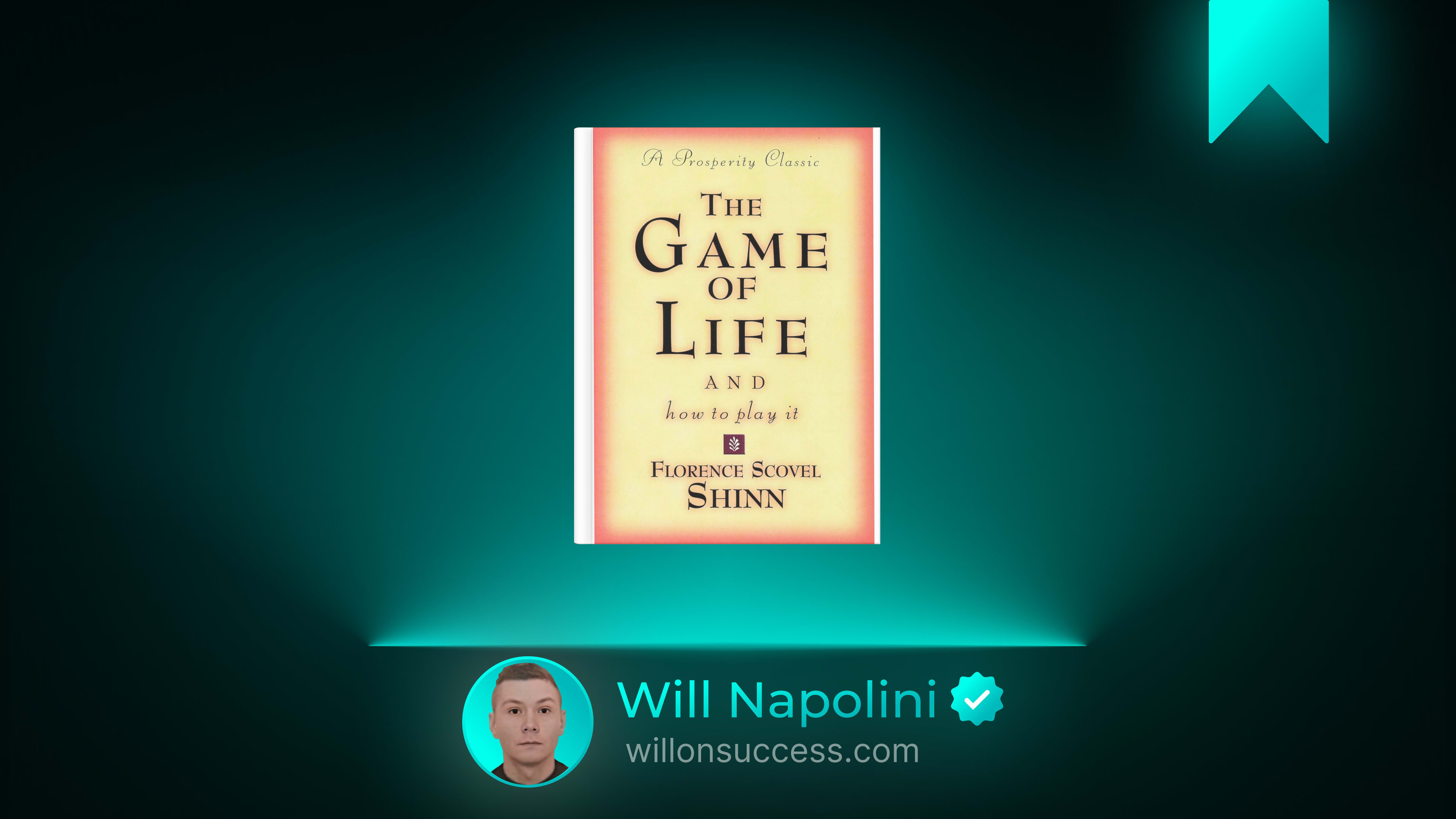
This is the foundational premise of The Game of Life and How to Play It by Florence Scovel Shinn. First published in 1925, this slim volume became a cornerstone of the New Thought movement and has remained in print for a century. Shinn was not an academic theorizing from a university; she was a practical Bible teacher and metaphysical pioneer in New York who worked directly with people facing severe financial, health, and relational crises.
She observed a simple, profound pattern: the people who thrived were not necessarily the ones who worked the hardest or fought the most fiercely. They were the ones who understood the invisible mechanics of their own minds.
Here is what her work can teach you about stopping the war you are fighting, and starting to play the game you were meant to win.
The Big Idea: You Are Broadcasting, Not Just Reacting
The central thesis of Shinn’s work is that life is a creative process, not a contest of endurance. We are constantly broadcasting a signal through our words, thoughts, and expectations, and our external reality is simply reflecting that signal back to us.
Most of us walk through life reacting to circumstances. We see a problem, we feel fear, we speak about the problem, and then we wonder why the problem multiplies. Shinn flips this dynamic entirely. She teaches that your external world is merely a mirror of your internal state.
If you want to change the reflection in the mirror, you do not scrub the glass. You change the face making the expression. You change the words you speak, the expectations you hold, and the emotional energy you project. When you align your internal broadcast with the outcome you desire, the “game” shifts in your favor.
The Story or Concept: The Divine Design and the Power of the Word
To understand how to play the game, Shinn introduces two foundational concepts.
The first is the “Divine Design.” Shinn teaches that every person has a unique, perfect blueprint for their life. She often used geometric shapes—the square (representing solid foundation and completeness), the circle, the triangle, and the oblong—to illustrate that your ideal life is not a generic template. It is a highly specific design tailored to your unique character and purpose. Your job is not to force a life upon yourself, but to uncover and step into the design that already belongs to you.
The second concept is the creative power of the spoken word. Shinn frequently referenced the ancient proverb that “death and life are in the power of the tongue.” She did not mean this merely as a poetic metaphor for kindness. She meant it as a literal, mechanical law of the universe. Your subconscious mind does not argue with you; it simply executes your commands. When you speak, you are giving orders to the invisible forces that shape your reality.
The game of life, therefore, is the practice of aligning your words and your mental imagery with your Divine Design, while completely withdrawing your energy from the things you do not want.
The Major Principles
Your Words Are Not Descriptions; They Are Directives
We tend to think of our speech as a way to describe our current reality. When you say, “I am so overwhelmed,” or “I can never get ahead,” you believe you are simply stating a fact.
Shinn argues that this is a fatal misunderstanding of how the game is played. Your words are not descriptions; they are directives. You are not reporting on your life; you are programming it.
When you repeatedly use the vocabulary of lack, delay, or defeat, you are giving your subconscious mind a clear set of instructions to manifest more of the same. You cannot build a life of abundance using the vocabulary of lack.
I have seen this happen countless times. People will ask for help achieving a goal, but every sentence they speak reinforces their failure. They say, “I’m just so bad with money,” or “I always mess up my relationships.” They are playing the game, but they are actively playing to lose. The mechanism is simple: the universe is entirely neutral. It will give you exactly what you ask for, which is why you must be incredibly careful about what you say.
Resistance Is the Tax You Pay on a Problem You No Longer Need to Solve
This is perhaps Shinn’s most counter-intuitive and powerful teaching: the Law of Non-Resistance.
When we encounter a problem—a difficult boss, a financial shortfall, a health issue—our instinct is to fight it. We obsess over it. We complain about it. We analyze it from every angle. We give it all of our emotional energy.
Shinn teaches that whatever you resist, persists. By fighting a problem, you are focusing all your creative power on it. You are keeping it alive. It is like struggling in quicksand; the more you thrash and fight, the faster you sink.
To win the game, you must learn to withdraw the emotional charge from the problem. This does not mean you become passive or ignore practical steps. It means you stop feeding the problem your fear and your anger. You look at the obstacle calmly, you take the logical steps required, but you internally refuse to give it power over your peace of mind.
Resistance is the tax you pay on a problem you no longer need to solve. When you stop paying the tax, the problem loses its grip on you. You overcome evil not by fighting it directly, but by withdrawing your belief in it and focusing entirely on the good you intend to build.
Expectation Is the Magnet of Reality
There is a distinct difference between what you want and what you expect. You might want to be financially secure, but if you deeply expect to struggle, you will struggle.
Shinn outlines the Law of Expectation: we attract what we expect. If you expect betrayal, you will find it. If you expect delay, you will experience it. But if you expect a “divine order” and a smooth path, you will find that the obstacles mysteriously clear.
This is where character before circumstances becomes vital. It is easy to have positive expectations when everything is going well. The true test of your mastery of the game is maintaining an expectation of victory when the current circumstances suggest defeat.
Your expectation acts as a magnet. It pulls the people, resources, and opportunities that match its frequency. If you want to change your life, you must first change what you consider to be normal. You must elevate your expectation until it matches the reality of your Divine Design.
Intuition Is the Compass of the Game
How do you actually navigate toward your Divine Design? Shinn points to the “sixth sense”—intuition.
She describes intuition as the inner guidance system that knows the rules of the game better than your logical mind does. It shows up as a hunch, a sudden idea, a fleeting thought to take a different route home, or an urge to call a specific person.
Many of us ignore these nudges because they do not make logical sense. We rely entirely on our intellect. But Shinn insists that intuition is the direct line to the solution. When you follow a hunch, you are taking a shortcut through the game.
This requires action before intention. A hunch is useless if you do not act on it. When you feel that inner pull, you must move. By taking action on intuition, you signal to the universe that you are playing by the higher rules of the game, and the path will continue to open before you.
Why It Matters: Your Ordinary Tuesday
You might be wondering how a metaphysical book from 1925 applies to your ordinary Tuesday.
Consider your morning. You wake up, check your bank account, and think, “I’m never going to catch up.” You get in the car, hit traffic, and say, “Why does this always happen to me?” You arrive at work, see a massive inbox, and sigh, “I’m so behind.”
By noon, you have spoken three powerful directives into the universe. You have commanded more lack, more frustration, and more overwhelm. And you wonder why your afternoon feels so heavy.
This book matters because it hands you the remote control to your own experience. It shifts you from a state of helpless reaction to empowered creation.
When you apply Shinn’s principles, your ordinary Tuesday changes. You wake up, see the bank account, and consciously choose to say, “I am open to new avenues of income.” You hit traffic, and instead of gripping the steering wheel in anger, you listen to an audiobook, withdrawing your resistance from the delay. You see the inbox, and instead of panicking, you tackle the first task with calm focus.
You stop being a victim of your circumstances and become the architect of your responses. You realize that the game is not happening to you; it is happening through you.
Practical Application: Turning Insight into Behavior
Understanding these laws is only the beginning. The game is won in the application. Here are three specific practices to integrate into your life this week.
1. Conduct a 24-Hour Vocabulary Audit For one full day, monitor every word that comes out of your mouth regarding your life, your work, and your relationships.
- Catch yourself when you say, “I can’t,” “I always,” “I never,” or “It’s impossible.”
- Immediately rephrase the statement. Change “I can’t afford this” to “I am currently directing my resources elsewhere, and new opportunities are coming.” Change “I’m so tired” to “I am resting and renewing my strength.” Do not judge yourself when you slip up. Just notice it, correct it, and move on. You are retraining a lifetime of verbal habits.
2. Practice the Quicksand Protocol Identify one persistent problem in your life that you have been fighting, worrying about, or complaining about.
- For the next 48 hours, you are not allowed to talk about this problem, complain about it, or visualize it getting worse.
- When the thought arises, acknowledge it calmly, but refuse to give it emotional energy. Say internally, “I withdraw my energy from this, and I focus on the solution.”
- Take the practical steps required to address the issue, but do so with a detached, calm demeanor. Stop throwing gasoline on the fire. Watch how quickly the problem loses its intensity when you stop feeding it.
3. Follow One Illogical Hunch This week, pay close attention to your intuition. When you get a sudden, unexplainable urge to do something—take a different route, read a specific article, reach out to an old acquaintance, or start a new project—act on it immediately.
- Do not wait for it to make logical sense.
- Do not wait for permission.
- Follow the hunch. You are practicing the muscle of listening to your inner compass. The more you follow it, the clearer the signals will become.
Who Should Read This Book
The Game of Life and How to Play It is a unique text, and it is important to know what you are getting into.
You will benefit most from this book if:
- You feel stuck in repetitive loops of failure, financial lack, or relational conflict and suspect your own mindset is the common denominator.
- You are interested in the intersection of spirituality, metaphysics, and practical psychology.
- You need permission to stop fighting your life so hard, and want to learn how to align with a deeper current of ease and intuition.
You may find it less useful if:
- You are a strict materialist who rejects the premise that thoughts, words, and expectations can influence physical reality.
- You are looking for a step-by-step tactical business strategy or a highly structured productivity system. This is a book about the internal mechanics of the mind, not external tactics.
- You are easily put off by early 20th-century metaphysical Christian language. Shinn uses biblical references extensively to illustrate her points. Even if you are not religious, you can extract the psychological principles, but the framing is undeniably spiritual.
Despite its age and specific terminology, the underlying mechanics of human behavior it describes are as accurate today as they were a century ago. It is a book that rewards an open mind and a willingness to take radical responsibility for your own experience.
One Small Step
We often wait until we feel completely confident before we change the way we speak or think. But in the game of life, the action often precedes the feeling.
Here is what I want you to do right now.
Think of the one area of your life where you have been speaking the most defeat. Is it your finances? Your health? Your career?
Take out your phone or a piece of paper. Write down one single, positive, present-tense statement about that area. Not a wish. Not a hope. A statement of fact as you want it to be. For example: “I am easily managing my finances,” or “My career is advancing in perfect order.”
Read that statement out loud, with absolute conviction, three times.
You have just made your first move on the board. You have changed your broadcast. The universe has received the new directive.
The board is set, the pieces are in your hands, and the rules have not changed in a century. The only question that remains is whether you will keep fighting the game, or finally learn how to play.