Why You Keep Blocking What You Want—And How Tapping Can Quietly Remove the Resistance
Have you ever set a goal, genuinely wanted it, worked toward it in every way you knew how, and still watched it slip through your fingers? Not because you lacked talent. Not because the opportunity was missing. But because somewhere beneath your conscious effort, a quieter voice was whispering, “You don’t really deserve this” or “This isn’t how your life goes” or “Who are you to want something that big?”
If that question stings a little, stay with me. Because that sting is exactly where this book begins.
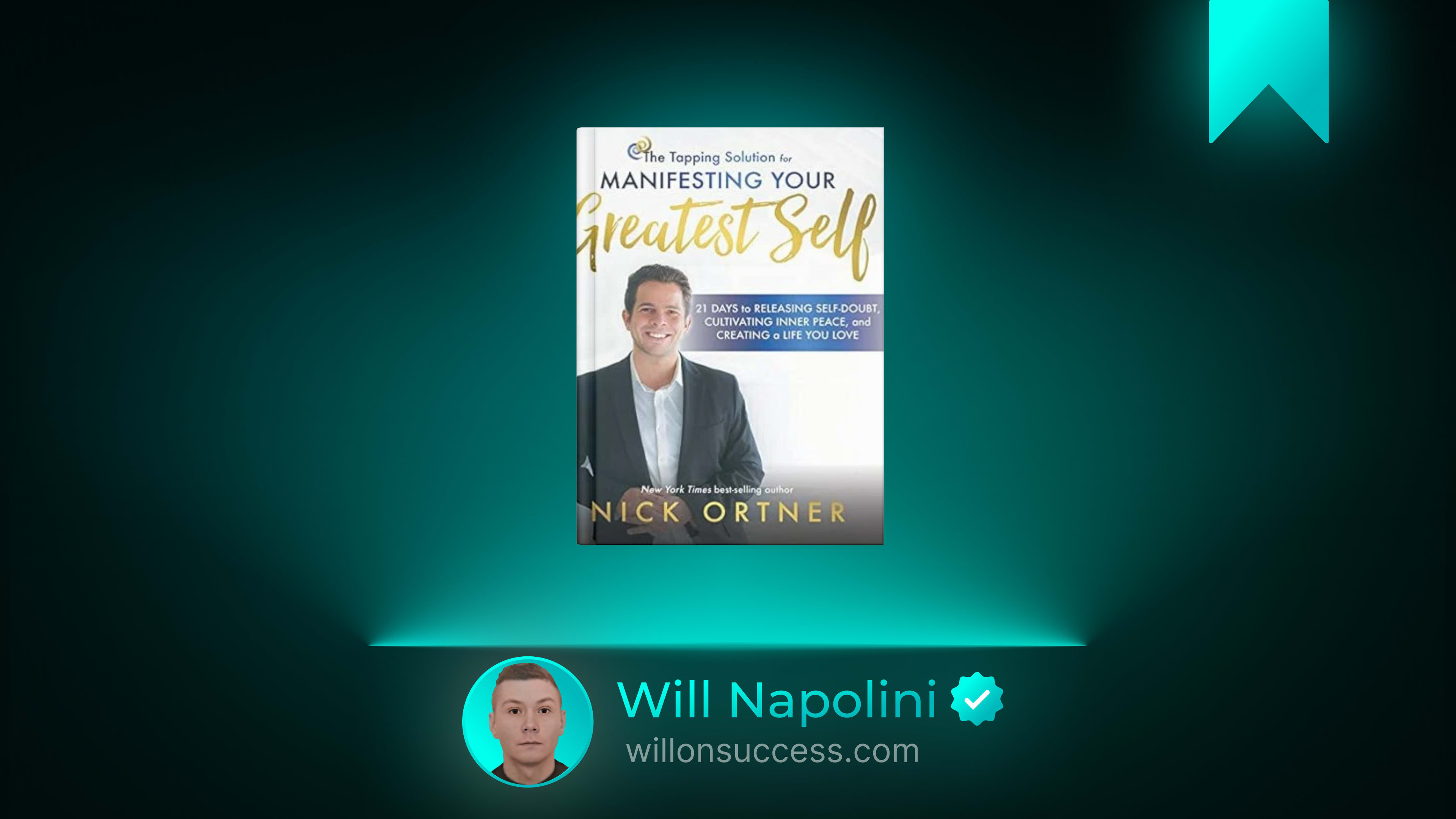
I have watched people pour years of discipline into careers, relationships, and creative projects, only to sabotage themselves at the finish line. They quit right before the breakthrough. They pick a fight when things are finally peaceful. They overspend right after a financial windfall. And they cannot explain why. They call it bad luck. They call it timing. But what I have come to believe, and what Nick Ortner argues throughout The Tapping Solution for Manifesting Your Greatest Self, is that the real obstacle is not outside them. It is a set of old, invisible beliefs running the show from beneath the surface.
This book is about finding those beliefs, loosening their grip, and making room for a different story. And it offers a specific, physical technique for doing that. Let me walk you through it.
The Central Idea: You Cannot Build on a Cracked Foundation
Ortner’s thesis is straightforward once you see it clearly. Most of us carry a collection of beliefs about ourselves, about money, about love, about what we are allowed to have, that were installed long before we were old enough to question them. A child who hears “People like us don’t get ahead” absorbs that sentence like soil absorbs rain. Twenty years later, that child is an adult who works sixty-hour weeks but cannot seem to hold onto a promotion, a savings account, or a sense of peace.
The conscious mind says, “I want more.” The subconscious mind says, “More is not safe. More is not for you. More will make you a target.” And the subconscious, because it runs so much of your daily behavior, wins that argument quietly, every single day.
Ortner’s argument is not that you should simply think positive thoughts and the universe will hand you what you want. He is more grounded than that. His point is practical: as long as your inner emotional landscape is organized around old fears and old stories, your outer actions will keep circling back to the same results. You can build the most beautiful house you like, but if the foundation is cracked, the walls will keep splitting.
Tapping, in his framework, is the repair work on the foundation.
What Tapping Actually Is (And What It Is Not)
Before we go further, let me clear the fog around the technique, because I think many people dismiss it without understanding it, and others embrace it with expectations it cannot meet.
Emotional Freedom Techniques, or EFT, involve gently tapping with your fingertips on a sequence of specific points on the body—points that correspond, in traditional Chinese medicine, to meridian endpoints—while simultaneously focusing your attention on a particular fear, memory, or limiting belief. The typical sequence moves from the side of the hand (the karate-chop point) to the inner eyebrow, the side of the eye, under the eye, under the nose, the chin, the collarbone, the underarm, and the top of the head.
You speak the problem aloud while you tap. You name it. “Even though I feel like I’ll never be enough, I deeply and completely accept myself.” You repeat. You breathe. You tap through the sequence again, often shifting the language to acknowledge the emotion, then gradually to introduce a more balanced or hopeful perspective.
What it is not: it is not magic. It is not a substitute for medical treatment, therapy for serious trauma, or sustained practical effort toward a goal. Ortner himself frames it as one tool among many. What it appears to do, based on the growing body of research around EFT and on the thousands of anecdotal accounts Ortner has gathered through his foundation and documentaries, is reduce the emotional intensity attached to a specific thought or memory. The belief may still be there. But its charge, its ability to hijack your nervous system and drive your behavior without your permission, diminishes.
Think of it this way. A limiting belief is like a splinter under your skin. You can put a bandage over it and keep working. You can tell yourself it does not hurt. But every time you press on that spot, you flinch, and the flinch changes how you move, what you reach for, what you avoid. Tapping is the careful, gentle process of working the splinter out.
The Beliefs You Inherited Were Never Yours to Keep
One of the ideas in this book that I find most useful, and most uncomfortable, is the emphasis on origin. Ortner encourages readers to trace their current blocks back to their source. The belief that money is dangerous. The conviction that you must earn love through exhaustion. The quiet assumption that if something good happens, something bad will follow to balance it out.
These beliefs did not arrive fully formed. They were handed to you. A parent’s anxiety about bills. A teacher’s offhand comment in third grade. A family culture that treated ambition with suspicion. A heartbreak that calcified into a rule: “Don’t get close to people. They leave.”
You did not choose these stories. But you have been living inside them as though they were architecture, load-bearing walls you could not remove without the whole structure collapsing.
Here is what I would tell you if we were sitting across from each other right now: you are allowed to renovate. You are allowed to look at a belief you have carried for twenty years and ask, honestly, “Is this still true? Is this still mine?” And if the answer is no, you are allowed to set it down. Tapping, in Ortner’s framework, is the physical practice that helps you actually set it down rather than just intellectually agreeing it should go.
Resistance Lives in the Body, Not Just the Mind
This is where the book distinguishes itself from a hundred other self-help books that tell you to reframe your thoughts and move on. Ortner insists that emotional blocks are not purely cognitive. They live in the body. In the tightness across your shoulders when you think about asking for a raise. In the knot in your stomach when someone compliments your work. In the way your breathing changes when you imagine yourself succeeding in the way you secretly want to succeed.
You cannot always argue a feeling away. You can write a hundred affirmations on a mirror and still feel a quiet dread underneath them. The body keeps its own ledger.
Tapping engages the body directly. By stimulating specific points while holding the difficult thought in your awareness, you are, in a sense, giving your nervous system permission to process the emotion without being overwhelmed by it. You are saying to your body, “I see this fear. I am not going to run from it. But I am also not going to let it run me.”
I have seen this principle play out in small, ordinary ways. Someone who has been frozen for months on a creative project, not because they lack ideas but because finishing it means exposing themselves to judgment. They tap on the fear of being seen, the fear of being laughed at, the memory of one cruel comment from years ago. And the next morning, they sit down and write three pages. Not because the fear vanished. Because its volume turned down enough that they could hear their own desire again.
What You Focus On Expands—but Only After You Clear the Static
Ortner spends meaningful time discussing the role of attention and intention, the idea that what you consistently direct your focus toward tends to grow in your experience. This is not a mystical claim. It is observable. If you wake up scanning for evidence that the world is unfair and that you are falling behind, you will find that evidence everywhere, because your brain is now filtering reality through that lens. If you shift your attention, even slightly, toward what is working, what is possible, what is within your control, the filter changes. And your behavior changes with it.
But here is the nuance that I appreciate about this book: Ortner does not say you can simply flip the switch. He acknowledges that trying to focus on abundance while your subconscious is screaming “scarcity is coming” creates a kind of internal static. The positive intention and the old fear are broadcasting on the same channel, and the fear usually has a stronger signal because it is older, more rehearsed, more emotionally charged.
Tapping is the process of turning down the fear signal so the intention signal can finally come through clearly. You are not adding something new. You are removing interference.
A radio buried under static is not broken. It just needs the frequency cleared.
The Specific Areas Where Blocks Hide
Ortner structures much of the book around the domains where people most commonly experience self-sabotage: money, relationships, health, career and purpose, and self-worth. In each area, he offers specific tapping scripts and guided exercises.
On money, for instance, he explores how many people carry contradictory messages. They want financial security, but they also absorbed the idea that wanting money makes you greedy, or that having money will isolate you, or that they will inevitably lose whatever they gain. The tapping work in these sections is designed to surface those contradictions and reduce their emotional power.
On relationships, the pattern is often about worthiness. The belief that you must perform, shrink, or over-give to keep someone from leaving. The tapping sequence targets the specific memory or fear underneath that pattern.
On health and self-worth, the work often circles back to a single, stubborn sentence: “I am not enough as I am.”
I want to be honest with you. Reading these scripts will not rewire a lifetime of conditioning in one sitting. What the book offers is a repeatable practice. You tap on the belief today. The charge lessens a little. You tap on it again next week when it resurfaces in a different form. The charge lessens a little more. Over weeks and months, the old story loses its authority. Not because you fought it. Because you stopped feeding it the energy of avoidance.
Consistency Quietly Outperforms Intensity
If there is a principle woven through this book that I keep returning to, it is this: small, repeated practice changes more than dramatic one-time effort. You do not need to tap for two hours. You need five or ten minutes, done regularly, aimed honestly at whatever is actually bothering you.
This mirrors something I have learned about every meaningful change I have ever made. The turning point is almost never a grand decision. It is the quiet Tuesday morning when you do the small thing again, even though it feels insignificant. The block did not dissolve because of one powerful session. It dissolved because you showed up for yourself, gently, repeatedly, and refused to let the old story have the final word.
You start with one belief. You tap. You breathe. You name it. You do it again tomorrow. And slowly, the architecture of your inner life begins to shift.
Who Will Benefit Most From This Book
If you have ever felt stuck in a pattern you can see clearly but cannot seem to break, this book speaks to that experience. If you have done the intellectual work—read the books, attended the workshops, understood your patterns—and still feel an invisible wall between your understanding and your actual life, the somatic, body-based approach of tapping may offer the missing piece.
It will be most useful for readers who are open to a technique that blends mindfulness, somatic awareness, and cognitive reframing, and who are willing to sit with uncomfortable emotions for a few minutes at a time.
It may be less useful if you are looking for a rigid, step-by-step business plan or a clinical psychology text. Ortner writes accessibly and warmly, but the book is a guided practice, not a research monograph. And if you are dealing with deep trauma, PTSD, or a clinical condition, tapping can be a complement to professional support, but it should not replace it. Ortner acknowledges this, and I want to reinforce it clearly.
One Small Step You Can Take Before You Close This Page
You do not need to commit to a thirty-day program right now. You do not need to overhaul your entire belief system by dinner.
Here is what I would invite you to do today. Just one thing.
Find a quiet moment. Sit comfortably. Take three slow breaths. Then ask yourself one question: “What is one thing I want but quietly believe I cannot have?”
Do not judge the answer. Do not argue with it. Just let it surface. Maybe it is a promotion. Maybe it is a peaceful relationship. Maybe it is the simple belief that you are allowed to rest.
Now, using your fingertips, tap gently through the sequence: the side of your hand, the inner edge of your eyebrow, the side of your eye, under your eye, under your nose, the chin, the collarbone, the underarm, the top of your head. As you tap, say the belief out loud. “Even though I believe I can’t have this, I accept that this is how I feel right now.” Go through the sequence two or three times. Breathe. Notice what shifts, even slightly.
That is it. You do not need to solve everything tonight. You just need to open one small window and let a little air in.
The beliefs that have been running your life were installed by accident, by circumstance, by other people’s fears dressed up as advice. They were never a life sentence. They were a habit. And habits, no matter how old, can be gently, patiently, stubbornly revised.
You do not have to become someone new. You just have to clear enough of the old noise to hear who you have been underneath it all along. And that version of you has been waiting, quietly, for you to stop arguing with the static and finally tune in.