The Tale of Peter Rabbit: The Smallest Book That Taught Me the Most About Disobedience, Consequence, and Coming Home
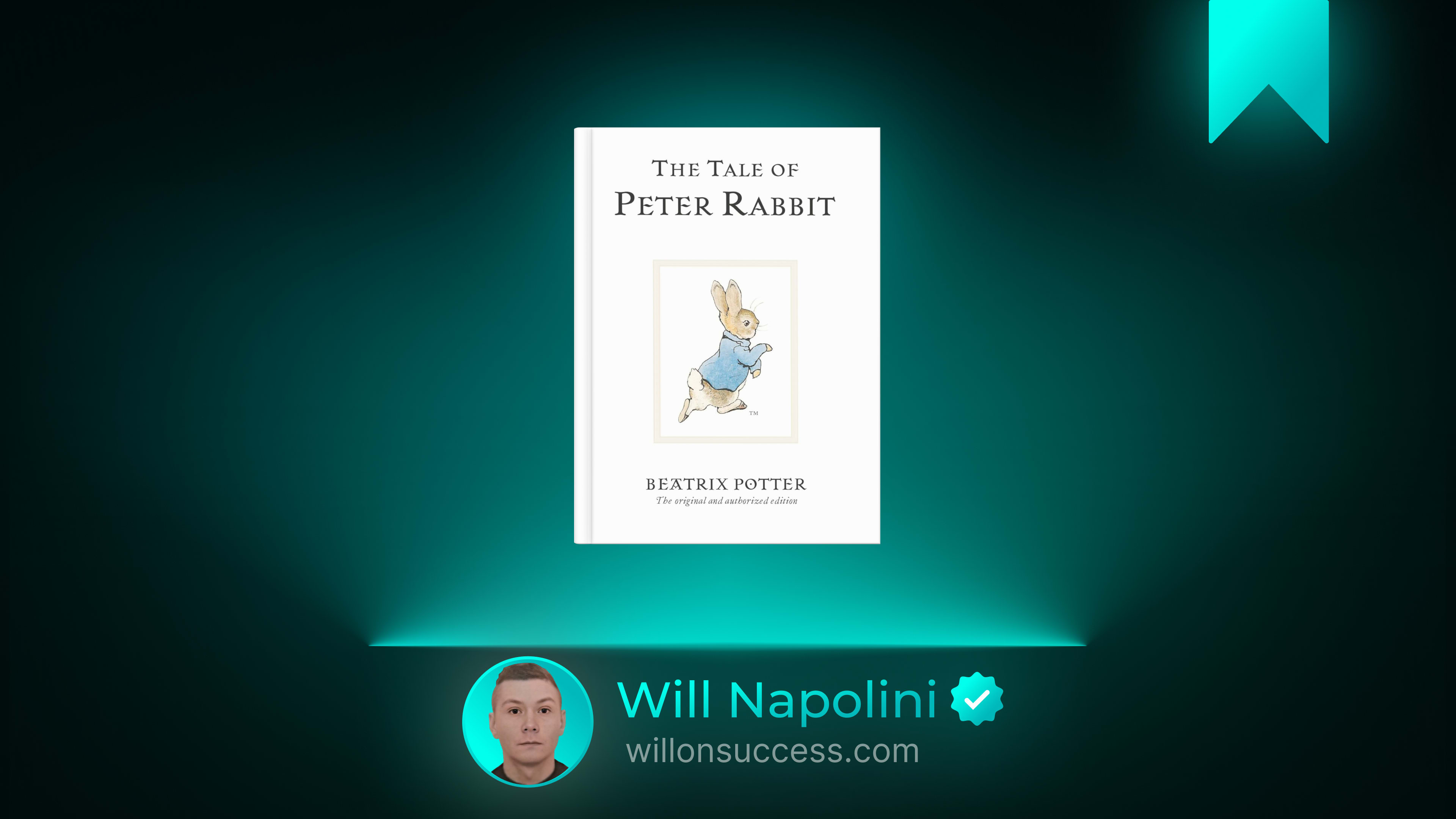
I want to talk to you about a book that is sixty pages long, illustrated with watercolors of vegetables, and originally written for a sick child in a letter. I want to talk about it because I believe it contains a more honest account of how a person grows up than most three-hundred-page memoirs manage.
The book is The Tale of Peter Rabbit, written and illustrated by Beatrix Potter, first published in 1902. And if your first instinct is to smile and think, that is a children’s book, what could it possibly teach me, I would gently ask you to stay with me for a few minutes. Because the reason a story survives for over a century, the reason it is read aloud to millions of children in dozens of languages, is not nostalgia. It is that the story is true in a way that does not require footnotes or academic framing.
Peter Rabbit is not a fable with a neat moral printed at the bottom. It is something more complicated and more kind than that. It is a story about a small creature who goes where he should not go, loses more than he intended to lose, and is still, at the end of the day, given a cup of chamomile tea and put to bed.
That ending matters. I will explain why.
The Story, in Case It Has Been a While
Mrs. Rabbit tells her four children, Flopsy, Mopsy, Cotton-tail, and Peter, that they may play in the lane. But they must not go into Mr. McGregor’s garden. Their father had an accident there. He was put in a pie by Mrs. McGregor.
This is not a gentle warning. This is a mother telling her children that the place they are curious about is the place where their father died.
Three of the children obey. They go to the lane. They gather blackberries. They are safe, and they are unremarkable, and the story does not follow them further.
Peter does not obey. He squeezes under the gate.
And at first, it is wonderful. He eats lettuces. He eats French beans. He eats radishes. He eats so much that he begins to feel unwell, and he goes looking for parsley to settle his stomach. And it is there, among the cabbages, that Mr. McGregor spots him.
What follows is pure, breathless terror. Mr. McGregor chases Peter with a rake. Peter loses his shoes among the cabbages and the potatoes. He loses his blue jacket on a gooseberry net. He hides in a watering can, sneezes, is discovered again. He runs. He doubles back. He squeezes under the gate with Mr. McGregor close behind.
He makes it home. He is exhausted. His mother puts him to bed with chamomile tea. His sisters, who went to the lane and gathered their blackberries, get bread and milk and a proper supper.
Peter goes to sleep.
That is the whole book. And it is enough.
The Garden Behind the Gate Is Always There
Here is what I have come to believe about this story, after thinking about it far longer than any reasonable adult should think about a tale involving a rabbit and a rake.
Every life has a Mr. McGregor’s garden. A place you have been told not to go. A pursuit, a conversation, a risk, a door that someone who loves you has looked at and said, not there. That place is dangerous. That place took something from us, and I do not want it taking something from you.
And often, that warning is legitimate. Mrs. Rabbit is not being arbitrary. Peter’s father is genuinely gone. The danger is real. The warning is rooted in actual loss.
And yet Peter goes anyway.
Not because he is wicked. Not because he does not love his mother or does not believe her. He goes because he is curious, and because curiosity in a young creature is not a flaw to be corrected. It is the engine by which the creature learns what the world actually is, as opposed to what he has been told it is.
I think this is the first honest thing Potter gives us. She does not pretend Peter was right to go. She does not pretend the garden was safe. But she also does not pretend that a life spent entirely in the lane, gathering blackberries, is the whole of what a life can be.
You will face this choice in forms Peter could never have imagined. A career change that your family worries about. A creative project that seems impractical. A truth you need to speak that might cost you comfort. A version of yourself you have been told to leave behind.
I am not telling you to always go into the garden. Sometimes the warning is correct, and the gate should stay shut, and the lane with its blackberries is exactly where you need to be. But I am telling you to notice which gardens you have been circling for years, pressing your nose against the gate, telling yourself you are being responsible when what you are actually doing is afraid.
The Cost of Appetite Without Restraint
There is a small detail in the middle of the story that I think is quietly devastating. Peter does not simply enter the garden. He gorges. Lettuces, beans, radishes, one after another, until he feels sick. He does not take what he needs. He takes and takes until the taking itself becomes the problem.
Potter does not moralize about this. She simply shows it. Peter eats until he is unwell, and that excess is part of what slows him down, part of what makes the escape harder than it needs to be. A rabbit who had eaten one radish and moved on might never have been caught among the cabbages.
I see this pattern everywhere in adult life, and I include myself in it. We do not merely enter the garden. We overstay. We overcommit. We say yes to one too many things. We pursue the goal long past the point where it nourishes us and into the territory where it is making us sick. We keep eating radishes when what we actually need is to stop, breathe, and find our way back to open ground.
The garden is not the problem. The inability to leave the garden is.
There is a discipline in enjoyment that Potter understands intuitively. You can go where you are drawn. You can taste what is there. But you must retain enough of yourself to run when Mr. McGregor appears with his rake. And if you have stuffed yourself so full that you can barely move, the rake finds you.
Coming Home: The Chamomile Tea at the End
This is the part of the story that undoes me, every time.
Peter comes home terrified, shoeless, jacketless, exhausted. He has lost things. He has been hunted. He has barely escaped with his life. And his mother does not stand over him with a lecture. She does not say, I told you so. She does not withhold supper or make him earn his rest.
She puts him to bed. She gives him chamomile tea.
That is all.
And his sisters get their bread and milk. The world continues. The evening settles. Peter sleeps.
If I could sit across the table from you and tell you one thing I have learned in the years since I first understood what this small scene means, it would be this: there must be a place you are allowed to return to after you have lost your jacket in the garden. There must be a version of home, whether it is a person, a practice, a place, or simply your own willingness to be gentle with yourself, where you are not required to justify your fear before you are allowed to rest.
This does not mean there are no consequences. Peter is exhausted. He lost his shoes. He lost his coat. He will not forget what it felt like to hear the rake scraping the earth behind him. The experience has cost him something, and that cost is real, and Potter does not wave it away.
But the cost is not the whole story. The whole story includes the tea. The whole story includes the bed. The whole story includes the fact that the mother’s love is not conditional on the child’s obedience.
You will go into gardens. You will lose things there. You will come home smaller than you left, and tired, and maybe a little ashamed. And the most important thing you can build in your life, the most important thing you can offer another person, is a door that opens anyway. A cup of something warm. A place to sleep without explanation.
Beatrix Potter’s Own Garden
I cannot talk about this book without talking about the woman who made it, because her life embodies the same tension Peter’s story encodes.
Beatrix Potter was a keen naturalist and a gifted illustrator in late Victorian England, a world that had very firm ideas about what women could and could not do. She studied fungi and attempted to present scientific work. She was turned away. She wrote and illustrated a story about a rabbit and sent it to publishers. She was turned away.
So she published it herself. In 1901, she arranged for a small private print run of The Tale of Peter Rabbit, paying for it out of her own resources. Only after that did Frederick Warne and Company agree to publish it properly in 1902.
She entered the garden. She was told, repeatedly, by institutions and conventions and people who believed they were being reasonable, that the garden was not for her. And she went under the gate anyway.
She went on to write and illustrate over twenty additional books, to become a successful sheep farmer, and to conserve thousands of acres of land in the Lake District that remain protected to this day. The woman who drew a small rabbit losing his shoes among the cabbages became one of the most quietly determined forces in English literary and environmental history.
I do not think that is a coincidence. I think she understood, in her body, what Peter’s story dramatizes: that the creatures who are told to stay in the lane sometimes have the most important gardens to tend.
What This Looks Like in Your Life This Week
You are not a rabbit, and you are probably not going to lose a shoe in a vegetable patch. But the architecture of Peter’s small story maps onto choices you face regularly.
It looks like noticing where you have been gorging instead of tasting. The project you keep adding to long past the point of enjoyment. The commitment you keep saying yes to because stopping feels like failure. The habit that started as nourishment and has become a kind of sick fullness. One radish is fine. Twelve will make you too slow to run.
It looks like asking yourself whether the warnings you have internalized are still true, or whether they belong to a version of the world that no longer exists. Mrs. Rabbit’s warning was valid. But Peter’s father’s accident was not the only possible outcome of entering that garden. Sometimes the warning describes a risk that is real but survivable, and survivable risks are the ones that grow you.
It looks like building your own chamomile tea. A practice, a person, a place, a small ritual that says to you, at the end of a day when you have lost something and been frightened: you are allowed to rest now. You do not have to explain. You do not have to justify. You are allowed to be tired and small and still loved.
And it looks like forgiving yourself for the blue jacket. You will lose things in the gardens you enter. Time. Money. A relationship. A version of yourself you thought you would always be. The loss is real. You are allowed to grieve it. But the jacket is not you. You came home without it, and you are still here, and that is enough.
Who Should Read This Book
This is, literally, a book for children. It is best read aloud to a small person sitting on your lap, pointing at the watercolors of Mr. McGregor’s hoe and Peter’s lost shoe.
But I would also hand it to any adult who has forgotten that the most important truths do not require a large container. If you have been in a season of overthinking, of accumulating strategies and systems and frameworks, of reading thick books about optimization while your actual life remains unchanged, Peter Rabbit will do something those books cannot. It will remind you that a story can be sixty pages long and still hold the whole shape of a human experience: the pull of the forbidden, the cost of excess, the terror of pursuit, and the quiet grace of being welcomed home.
It is not a book that will teach you a productivity system. It will not restructure your morning routine. But it will remind you that you are a small creature in a large garden, and that being small is not the same as being powerless, and that the gate you are afraid to go under might be the one that leads to the life you actually want.
One Small Step
Tonight, before you sleep, I would invite you to do one small thing.
Think of one garden. One pursuit, one conversation, one creative impulse, one honest admission that you have been circling but not entering because someone, at some point, told you it was not for you. It might be a conversation you need to have. A project you need to start. A truth you need to say aloud to one person. A place you need to go, literally or figuratively, that you have been avoiding because the warning feels safer than the risk.
You do not have to squeeze under the gate tonight. You do not have to commit to the whole garden.
Just name it. Say it to yourself, or write it on a scrap of paper and put it on your bedside table. This is the garden I have been standing outside.
And then give yourself the chamomile tea. Give yourself the rest. Give yourself permission to be the small creature who is afraid and curious at the same time, and to know that both of those things can be true without either one being the final word.
Peter went in. Peter ran. Peter lost his shoes. Peter came home.
And the next morning, the sun came up, and the lane was still there, and the gate was still there, and the garden was still there, waiting.
It is still waiting for you, too. And you do not have to go in all at once. You only have to press your nose to the wood, feel the grain of it under your small hands, and decide that the story you are living is one you are choosing, not one that is simply happening to you.
The gate is lower than you think. You can fit under it. You have always been able to fit under it.